

Every morning, eco-conscious coffee lovers face a choice that goes beyond taste. The journey from farm to cup has a real impact on communities and the planet. If you value meaningful connections and sustainability, understanding direct trade coffee gives you the insight needed to support farmers and their families. Learn how direct trade strengthens transparency, raises quality, and rewards ethical sourcing. This introduction helps you spot the difference and make better decisions for both people and nature.
Table of Contents
- Direct Trade Coffee: Core Definition Explained
- How Direct Trade Differs From Fair Trade
- Transparency, Quality, and Relationship Building
- Environmental Impact and Community Benefits
- Risks, Limitations, and Common Misconceptions
Key Takeaways
| Point | Details |
|---|---|
| Direct Trade Principles | Direct trade coffee fosters personal relationships, fair pricing, and high-quality beans by connecting farmers directly with roasters. |
| Economic Impact | Farmers often earn 50-100% more than commodity market rates, promoting economic stability and community support. |
| Comparison with Fair Trade | Unlike fair trade, direct trade focuses on negotiated prices and strong relationships, enhancing quality and farmer autonomy. |
| Environmental and Social Benefits | Direct trade encourages sustainable practices and community development, benefiting both the environment and local economies. |
Direct Trade Coffee: Core Definition Explained
Direct trade coffee represents a revolutionary approach to sourcing coffee that transforms traditional supply chain dynamics. Unlike conventional trading models, direct trade creates a transparent, ethical pathway connecting coffee farmers directly with roasters, eliminating unnecessary intermediaries and creating more equitable economic relationships.
At its core, direct trade coffee is characterized by three fundamental principles:
- Personal relationships between coffee roasters and farmers
- Transparent pricing that ensures fair compensation
- High-quality, sustainably produced coffee beans
This model prioritizes direct connections between producers and buyers, enabling more nuanced communication and collaboration. By bypassing traditional exporters and importers, direct trade allows roasters to understand the precise conditions under which coffee is grown, processed, and harvested.
The economic impact of direct trade goes beyond simple transactions. Farmers receive higher prices for their crops, often 50-100% more than standard commodity market rates, which provides economic stability and incentivizes quality production. These premium prices directly support local agricultural communities, encouraging sustainable farming practices and preserving generational agricultural knowledge.
Pro Tip: Research the specific direct trade practices of your favorite coffee brands to understand their commitment to farmer relationships and sustainable sourcing.
How Direct Trade Differs From Fair Trade
While both direct trade and fair trade aim to support coffee farmers, they represent distinctly different approaches to ethical sourcing. Direct trade fundamentally reimagines coffee purchasing by creating personalized, transparent relationships between roasters and farmers, contrasting sharply with fair trade’s more structured certification model.
Key differences between direct trade and fair trade include:
- Pricing Structure
- Direct Trade: Negotiated prices based on quality and mutual agreement
- Fair Trade: Predetermined minimum price guarantees
- Intermediary Involvement
- Direct Trade: Minimal to no third-party intermediaries
- Fair Trade: Requires certification through formal organizations
- Quality Emphasis
- Direct Trade: Prioritizes exceptional coffee quality
- Fair Trade: Focuses primarily on social and economic standards
The economic implications of these differences are significant. Direct trade often allows farmers to earn substantially more than fair trade minimums, with prices directly tied to the specific quality and characteristics of their coffee. This approach incentivizes farmers to invest in improving cultivation techniques, processing methods, and overall crop quality.
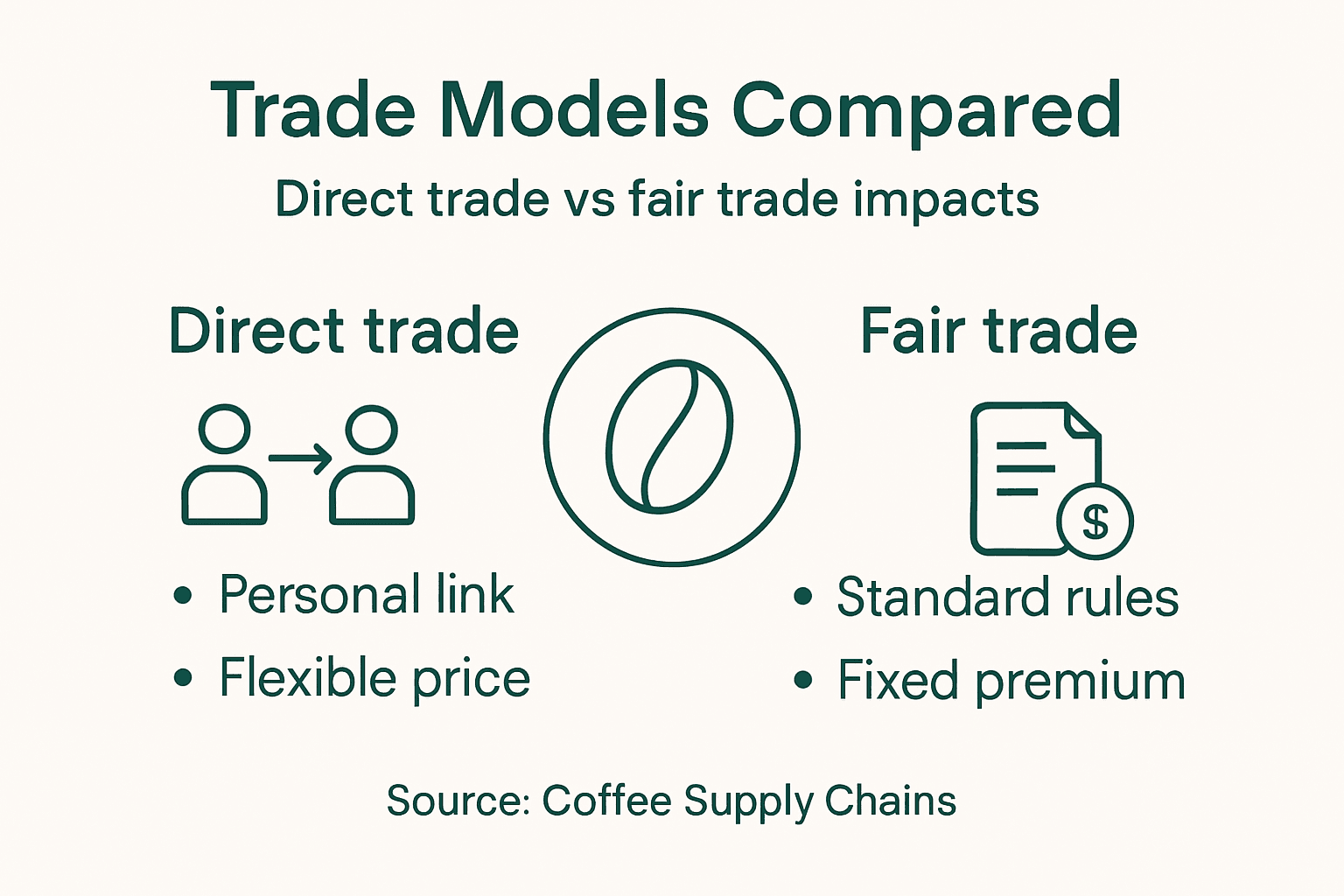
Fair trade certification provides a standardized framework that ensures basic social and economic protections for farmers, including minimum wage guarantees and community development funds. In contrast, direct trade represents a more dynamic, relationship-driven model that empowers individual farmers through direct communication and quality-based compensation.
Here’s how direct trade and fair trade coffee models influence different aspects of the supply chain:
| Aspect | Direct Trade Impact | Fair Trade Impact |
|---|---|---|
| Relationship Depth | Personal and ongoing | Distant and formalized |
| Traceability | High, farm-to-roaster | Certified but less granular |
| Price Variability | Quality-driven, negotiable | Fixed minimums |
| Incentive for Innovation | Strong encouragement | Limited by certification |
| Farmer Autonomy | High decision-making power | Organization-driven process |
Pro Tip: Compare the pricing and sourcing practices of different coffee brands to understand their commitment to farmer support and sustainable trade practices.
Transparency, Quality, and Relationship Building
Direct trade coffee fundamentally transforms traditional sourcing by prioritizing transparent communication networks between roasters and coffee producers. This approach goes far beyond simple transactional relationships, creating a collaborative ecosystem that values mutual understanding and continuous improvement.
Key elements of transparency and relationship building in direct trade include:
- Regular Farm Visits
- Direct interaction with coffee producers
- On-site quality assessment
- Understanding local growing conditions
- Open Communication Channels
- Frequent dialogue about cultivation techniques
- Sharing agricultural insights and challenges
- Collaborative problem-solving
- Quality Improvement Strategies
- Technical agricultural support
- Investment in processing infrastructure
- Shared knowledge about crop optimization
Transparency in direct trade means more than just financial openness. It encompasses a holistic approach to understanding coffee production, where roasters gain deep insights into the intricate processes that transform a coffee cherry into a premium beverage. By eliminating intermediaries, direct trade creates an environment of trust and mutual respect.
Direct trade represents a radical reimagining of the coffee supply chain, where relationships matter more than contracts.
The collaborative nature of direct trade enables roasters to provide targeted support, from agronomy expertise to infrastructure investments. This model creates a symbiotic relationship where both producers and buyers benefit from shared knowledge and commitment to exceptional coffee quality.

Pro Tip: Request transparency reports or farm origin details from your coffee roaster to understand the depth of their direct trade relationships.
Environmental Impact and Community Benefits
Direct trade coffee represents a powerful mechanism for sustainable harvesting and community development, transforming traditional agricultural practices through holistic environmental and social approaches. By prioritizing direct relationships with coffee farmers, this model creates a comprehensive strategy that addresses ecological preservation and economic empowerment simultaneously.
Key environmental and community benefits of direct trade include:
- Ecological Preservation
- Promotion of shade-grown coffee techniques
- Reduction of deforestation
- Protection of local biodiversity
- Economic Empowerment
- Fair compensation for farmers
- Investment in local agricultural infrastructure
- Skill development and training programs
- Social Impact
- Supporting multigenerational farming communities
- Improving local education opportunities
- Enhancing community healthcare access
The environmental impact extends beyond simple conservation efforts. Direct trade encourages farmers to implement sustainable agricultural practices that protect natural ecosystems while maintaining high-quality coffee production. This approach creates a symbiotic relationship between environmental stewardship and economic sustainability.
Sustainable coffee production is not just about protecting the planet, but about creating resilient communities that can thrive alongside their natural environment.
By providing farmers with fair prices and long-term support, direct trade models enable communities to invest in ecological preservation, advanced farming techniques, and local infrastructure. This approach transforms coffee production from a purely extractive industry into a collaborative, regenerative system that benefits both producers and consumers.
Pro Tip: Look for coffee brands that provide detailed information about their direct trade relationships and environmental impact initiatives.
Risks, Limitations, and Common Misconceptions
Despite its promising approach, direct trade coffee is not a perfect solution. Direct trade faces significant scalability and structural challenges that potential consumers and coffee enthusiasts should understand carefully.
Common misconceptions about direct trade include:
- Market Access
- Not all farmers can participate equally
- Smaller producers may be unintentionally excluded
- High entry barriers for resource-limited farmers
- Certification Challenges
- No universal definition or standard
- Varied interpretations across different regions
- Lack of consistent implementation guidelines
- Operational Complexities
- Significant time investment required
- High transparency demands
- Complex communication requirements
The absence of a standardized framework means that direct trade can look dramatically different depending on the specific roaster, region, and individual farmer relationships. Some roasters might claim direct trade status while still maintaining significant intermediary involvement, creating potential confusion for conscientious consumers.
Not all direct trade practices are created equal - context and specific implementation matter tremendously.
Additionally, the model requires substantial commitment from both buyers and producers. Smaller coffee farms might lack the infrastructure, language skills, or technological resources to effectively engage in direct trade relationships, potentially creating new forms of market exclusion.
The following table summarizes the core benefits and challenges of the direct trade coffee approach:
| Category | Key Benefit | Main Challenge |
|---|---|---|
| Economic | Improved income for farmers | Not all can access opportunities |
| Social | Builds trust and knowledge sharing | Significant time investment |
| Environmental | Encourages sustainable practices | No universal enforceable standard |
| Quality | Rewards best cultivation methods | Requires ongoing collaboration |
Pro Tip: Always request specific details about a coffee brand’s direct trade practices to understand the true nature of their sourcing commitments.
Experience the True Value of Direct Trade Coffee with EcoVibe Roast
Understanding the importance of direct trade coffee means recognizing the challenges farmers face with fair compensation and lack of transparency. If you care about ethical sourcing, personal farmer relationships, and high-quality beans, you deserve products that reflect those values. At EcoVibe Roast, we prioritize transparency, sustainability, and community empowerment just like direct trade ideals call for.

Explore our carefully curated selection in the Best Sellers – EcoVibe Roast category to find coffee and tea products that support fair income for producers and promote eco-friendly farming. Every purchase helps foster sustainable livelihoods and protects our planet, with initiatives like mangrove planting and ocean-bound plastic removal. Discover how your daily cup can make a meaningful impact by visiting Coffee and Tea example products – EcoVibe Roast or start your journey now at EcoVibe Roast. Take action today and enjoy beverages that honor both quality and conscience.
Frequently Asked Questions
What is direct trade coffee?
Direct trade coffee is a sourcing model where coffee farmers sell their beans directly to roasters, creating transparent and ethical economic relationships without intermediaries.
How does direct trade coffee differ from fair trade coffee?
Direct trade focuses on personalized relationships and negotiable prices based on coffee quality, while fair trade emphasizes standardized pricing and certification through formal organizations.
What are the benefits of direct trade coffee for farmers?
Farmers can earn higher prices—often 50-100% more than standard market rates, leading to economic stability and incentivizing them to improve quality and sustainability practices.
What role does transparency play in the direct trade coffee model?
Transparency in direct trade enables detailed communication between roasters and farmers, fostering collaboration, quality assurance, and a mutual understanding of cultivation and processing practices.
Recommended
- 7 Types of Coffee Certifications for Conscious Consumers – EcoVibe Roast
- Role of Social Impact in Coffee – Why It Matters – EcoVibe Roast
- Single-Origin Coffee: Traceability, Taste, and Impact – EcoVibe Roast
- Why Buy Organic Coffee Beans: Health, Taste, and Impact – EcoVibe Roast
- Best Refurbished Espresso Machines – Expert Comparison 2025 - Coffee Sensor


