

Waking up with a cup of coffee might seem like a small pleasure, but each brew connects you directly to tropical forests in countries such as Brazil, Colombia, and Vietnam. Modern coffee farming links your daily ritual to issues like forest loss, biodiversity decline, and climate change, especially as traditional shade-grown methods give way to sun-grown monocultures. Expanding coffee cultivation directly drives deforestation and biodiversity loss in key producing regions, making it more important than ever to understand the real impact behind your favorite beans.
Table of Contents
- Coffee And Deforestation: Basic Connections
- How Coffee Farming Contributes To Forest Loss
- Environmental Impact Beyond Tree Removal
- Sustainable Coffee: Certifications And Practices
- How Consumers Reduce Coffee’s Forest Impact
Key Takeaways
| Point | Details |
|---|---|
| Consumer Choices Matter | Selecting sustainably produced coffee influences farming practices and helps reduce deforestation. |
| Farming Methods Impact Ecosystems | Shade-grown coffee supports biodiversity and preserves forest structures, while sun-grown monocultures contribute to deforestation. |
| Understanding Certifications is Crucial | Not all sustainability certifications are equal; consumers should research to make informed decisions that truly support sustainable practices. |
| Collective Consumer Action Amplifies Change | Joining together to demand transparency and sustainability can drive significant shifts in the coffee industry’s supply chain practices. |
Coffee and Deforestation: Basic Connections
Every cup of coffee you brew connects you to something most people never think about: a complex web of land use decisions happening halfway across the world. When you drink coffee, you’re not just enjoying an aromatic beverage—you’re directly participating in how millions of acres of tropical forest are managed, cleared, or preserved. The link between your morning cup and global deforestation isn’t metaphorical. It’s measurably real, and understanding this connection is the first step toward making choices that matter.
Coffee farming sits at the intersection of three major forces: global demand, agricultural efficiency, and biodiversity. Here’s what actually happens on the ground: coffee grows best in tropical regions between the equator and the Tropic of Cancer, which means production concentrates in precisely the areas that harbor some of Earth’s most biodiverse forests. When farmers transition from traditional methods to industrial-scale operations, the ecological cost accelerates. The shift from shade-grown coffee cultivation to sun-grown monocultures represents one of the most significant drivers of forest loss in coffee-producing regions. Sun-grown coffee requires full sunlight, which means clearing the forest canopy entirely. This isn’t just removing trees—it’s dismantling entire ecosystems that developed over centuries.
The numbers paint a sobering picture. Coffee production directly drives deforestation and forest degradation across tropical countries, making it a meaningful contributor to global climate change. In countries like Brazil, Colombia, and Vietnam, large-scale coffee expansion has replaced native forests with monoculture farms. When forests vanish, so do the plants and animals that depend on them. The soil degrades. Carbon stored in trees releases into the atmosphere. And the coffee industry—particularly as demand from eco-conscious consumers like you grows—has become entangled with some of the world’s most urgent environmental problems.
What makes this especially complicated is that the connection between coffee and deforestation isn’t always obvious or intentional. Many farmers, especially smallholders producing the majority of the world’s coffee, operate under economic pressure that leaves them few alternatives. They clear forest because they need income today, not because they want to destroy ecosystems. Meanwhile, regulations like the European Union’s deforestation regulation are beginning to reshape supply chains, pushing the industry toward accountability. But here’s the reality: your coffee choices matter more now than they ever have, because consumer demand for sustainably produced coffee is one of the few market forces powerful enough to change how land is used in coffee-producing regions.
Pro tip: When shopping for coffee, look for beans labeled shade-grown or grown under native tree canopy—these farming methods preserve forest structure and actively fight deforestation by making forests economically valuable enough to keep standing.
How Coffee Farming Contributes to Forest Loss
The mechanics of how coffee farming destroys forests isn’t complicated, but it’s relentless. When you clear land for coffee cultivation, you’re not just removing trees—you’re erasing the entire ecological structure that held that forest together. Biodiverse tropical regions that took centuries to develop get converted into coffee plantations in a matter of months. What was once a complex ecosystem with hundreds of plant and animal species becomes a monoculture where coffee dominates every square meter. The scale of this transformation is staggering. Expanding coffee cultivation directly drives forest loss and biodiversity collapse across tropical regions, particularly in countries like Brazil, Colombia, Vietnam, and Ethiopia where coffee production has become economically central to entire regions.
The problem accelerates when farmers shift toward intensified growing practices. Traditional coffee farming, especially shade-grown methods, actually coexist with forest ecosystems. But the pressure to maximize yields pushes growers toward full-sun plantations, which require completely clear land. Once you’ve cleared the forest, you’ve introduced monoculture farming on exposed soil. This creates a cascade of problems: soil erosion accelerates, water retention plummets, nutrient cycling breaks down, and the land becomes increasingly dependent on chemical inputs to maintain productivity. Then comes the climate feedback loop that most people never connect to their morning coffee. In Brazil alone, over 1,200 square miles of forest were cleared for coffee cultivation, which disrupted regional rainfall patterns and triggered droughts. These droughts then threaten coffee production itself—creating a self-defeating cycle where the farming practices that expand coffee production undermine the climate stability coffee needs to grow successfully.
What makes this dynamic especially difficult is that individual farmers often don’t see themselves as drivers of deforestation. A smallholder farmer clearing a section of forest to grow coffee is making an economically rational decision based on immediate survival needs. They need income now to feed their family. Large-scale commercial operations face different pressures but similar incentives: maximize production, reduce costs, increase margins. The system itself creates the conditions for deforestation because forest preservation generates no immediate revenue for farmers. A standing forest doesn’t put food on the table. A coffee plantation does. This is why consumer demand for sustainably produced coffee matters so profoundly. When buyers like you actively choose sustainable coffee farming methods, you create market value for practices that keep forests standing. You transform the economic equation that drives farmer decision-making.
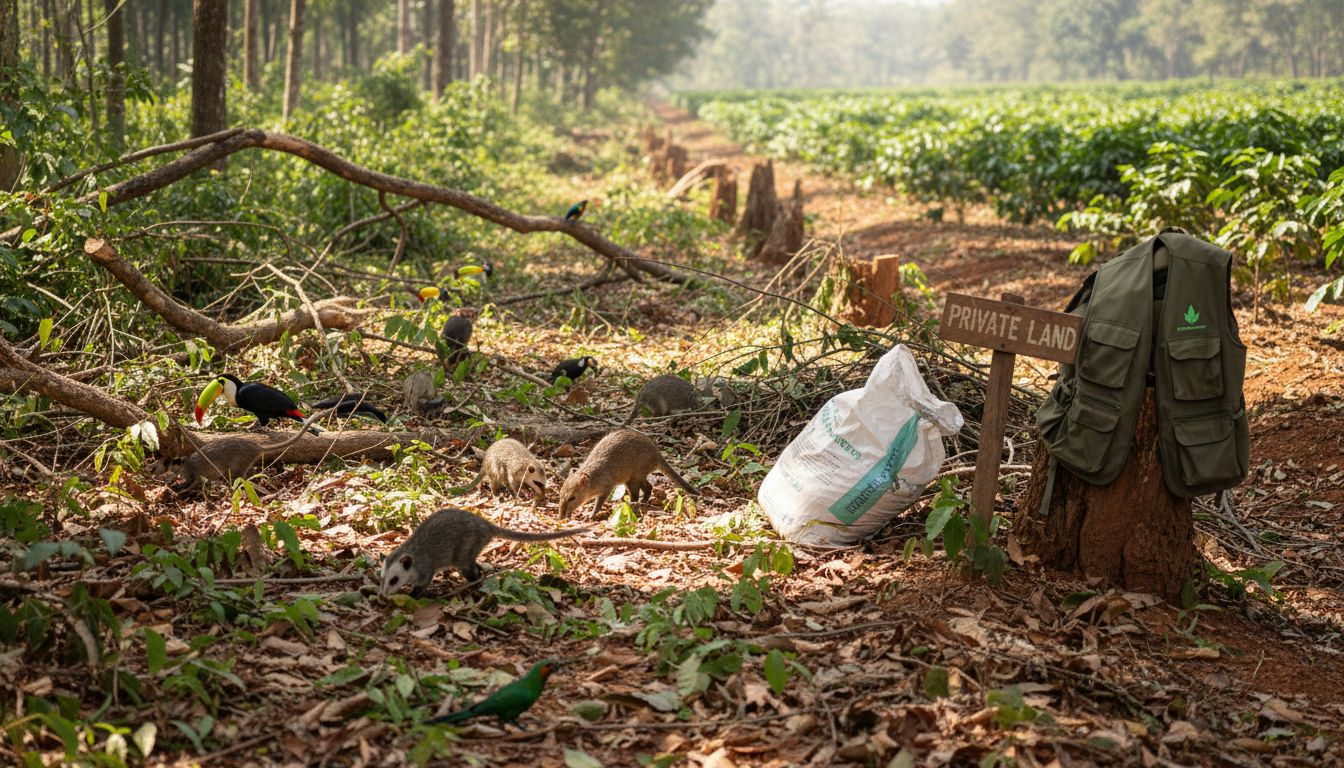
The biodiversity toll extends far beyond the visible loss of trees. Tropical forests harbor roughly half of Earth’s terrestrial species, many found nowhere else on the planet. When coffee plantations replace these forests, endemic species vanish. Soil microorganisms that took millennia to establish disappear overnight. Migratory bird populations collapse because their wintering grounds vanish. Indigenous communities that depend on forest resources lose access to food sources, medicines, and cultural practices. The carbon stored in forest biomass releases into the atmosphere, accelerating climate change. And here’s the cruel irony: the deforestation driven by coffee production creates conditions that make future coffee production increasingly unstable. Rising temperatures, shifting rainfall patterns, and pest explosions threaten the very crop that motivated the forest clearing.
Pro tip: Ask your coffee roaster about their sourcing practices and whether they work directly with farmers using shade-grown or regenerative methods—this conversation signals market demand for sustainable practices and helps steer the industry toward methods that preserve forests instead of destroying them.
Here’s a concise comparison of coffee farming methods and their impact on forests and ecosystems:
| Farming Method | Forest Impact | Biodiversity Effect | Soil Health Outcome |
|---|---|---|---|
| Shade-Grown | Preserves forest | Supports diverse species | Maintains nutrient cycling |
| Sun-Grown Monoculture | Destroys forest | Reduces biodiversity | Promotes soil erosion |
| Agroforestry | Restores forest cover | Enhances ecosystem complexity | Improves long-term fertility |
| Conventional | Spurs deforestation | Displaces native wildlife | Relies on chemical inputs |
Environmental Impact Beyond Tree Removal
When people talk about coffee and deforestation, they typically focus on one thing: trees falling. But that’s where the environmental damage actually begins, not where it ends. The real complexity emerges when you look at what happens to the land, water, and air after the forest disappears. Coffee production generates environmental harm across multiple dimensions that most consumers never connect to their daily cup. The processing itself creates massive waste streams. The farming practices deplete soil and contaminate water. The monocultures attract pests that demand chemical solutions. And all of this compounds over time, creating ecological damage that extends far beyond the initial act of clearing forest.
Let’s start with water, since it’s one of the most critical yet invisible impacts. Coffee is genuinely thirsty. Growing coffee beans requires enormous amounts of water for irrigation, and processing those beans demands even more. Water usage, soil degradation, and pollution from coffee production create cascading problems in already water-stressed regions. When you remove the forest canopy, you lose the natural water retention that forest ecosystems provide. Rainfall runs off exposed soil instead of being absorbed and stored. Groundwater tables drop. Rivers that communities depend on for drinking water, irrigation, and fishing diminish. In some coffee-producing regions, agricultural water usage has dropped local water tables by meters, making water increasingly scarce for both farming and human consumption. Coffee processing plants discharge wastewater loaded with organic matter, nutrients, and chemical residues into nearby streams and rivers. This pollution kills aquatic life, contaminates drinking water sources, and creates dead zones in ecosystems that depend on water quality.
The soil degradation story is equally troubling. When you convert a biodiverse forest into a monoculture coffee plantation, you’re replacing a self-sustaining system with one that demands constant external inputs. Forest soil builds itself through centuries of organic matter accumulation and microbial activity. Coffee monoculture soil gets depleted. Without the forest canopy protecting it, exposed soil erodes with every heavy rain. The microbial communities that made soil fertile get disrupted. Nutrient cycling breaks down. Farmers respond by applying synthetic fertilizers and pesticides, which temporarily boost yields but further damage soil structure and kill beneficial organisms. This dependency on chemical inputs creates another problem: agricultural runoff pollutes waterways with nitrogen, phosphorus, and pesticide residues. The same chemicals that boost coffee yields create algal blooms in rivers and coastal zones, suffocating aquatic ecosystems.
Here’s where the cycle becomes self-defeating: these degraded conditions make coffee farms increasingly vulnerable to climate stress. Climate change combined with intensified farming practices reduces yields, increases pests, and creates water stress that threatens production sustainability itself. As temperatures rise, coffee plants experience heat stress. Pests that once died in cold seasons now survive year-round. Droughts become more frequent. Farmers struggling with these new challenges often intensify their practices even further, applying more chemicals and pushing marginal land into production. Coffee waste adds another layer of environmental burden. Processing generates vast quantities of pulp, husks, and wastewater. Much of this gets dumped directly into the environment, where it decomposes and releases methane, a greenhouse gas far more potent than carbon dioxide. The industry generates enormous quantities of used coffee grounds, filters, and single-serve pods that end up in landfills. Even coffee bags and packaging create pollution. You’re looking at an agricultural system that simultaneously destroys forest ecosystems, depletes water resources, degrades soil, pollutes waterways, and generates massive waste streams. The environmental cost extends far beyond the straightforward act of clearing trees.
Pro tip: Choose coffee from brands that emphasize regenerative or agroforestry practices, which actively rebuild soil health and restore water cycling while simultaneously repairing forest ecosystems—this creates market incentive for farming methods that heal the land instead of just exploiting it.
Sustainable Coffee: Certifications and Practices
If you’ve ever stood in a coffee aisle or scrolled through an online coffee retailer, you’ve probably noticed labels. Fair Trade. Organic. Rainforest Alliance. Shade-grown. Carbon-neutral. These certifications exist for a reason: they’re supposed to signal that your coffee doesn’t come from the environmental destruction we’ve been discussing. But here’s what most consumers don’t understand: certifications are neither universal nor equally rigorous. Some represent genuine commitments to sustainability, while others function more as marketing language. Understanding what these certifications actually mean is crucial because your purchasing power depends on making informed choices. When you buy certified sustainable coffee, you’re voting with your wallet for farming practices that preserve forests, protect water quality, and support farmer livelihoods. But you need to know what you’re actually voting for.
The major certification systems that shape the coffee industry include Fairtrade, Organic, Rainforest Alliance, and various regional certifications. Each one approaches sustainability differently. Fairtrade focuses primarily on economic justice and fair pricing for farmers, ensuring they receive prices that cover production costs and provide livable income. Organic certification prohibits synthetic pesticides and fertilizers, which reduces chemical pollution but doesn’t always address deforestation. Rainforest Alliance emphasizes ecosystem protection and biodiversity conservation alongside economic support. Voluntary certification schemes like Fairtrade, Rainforest Alliance, and Organic influence environmental, social, and economic outcomes for coffee producers, particularly by improving farming practices and providing market access for smallholder farmers who produce the majority of the world’s coffee. The challenge is that adoption barriers remain significant. Certification processes require documentation, fees, and time investment that many small farmers struggle to manage. Some certifications focus more heavily on environmental metrics while others prioritize social outcomes. Rainforest Alliance, for instance, explicitly requires shade-grown or agroforestry methods that preserve forest structure and biodiversity. Organic certification reduces chemical inputs but doesn’t mandate forest preservation. Fairtrade ensures farmers receive fair compensation, which can stabilize income and reduce pressure to expand into marginal forest lands, but the certification itself doesn’t specifically require forest conservation practices.
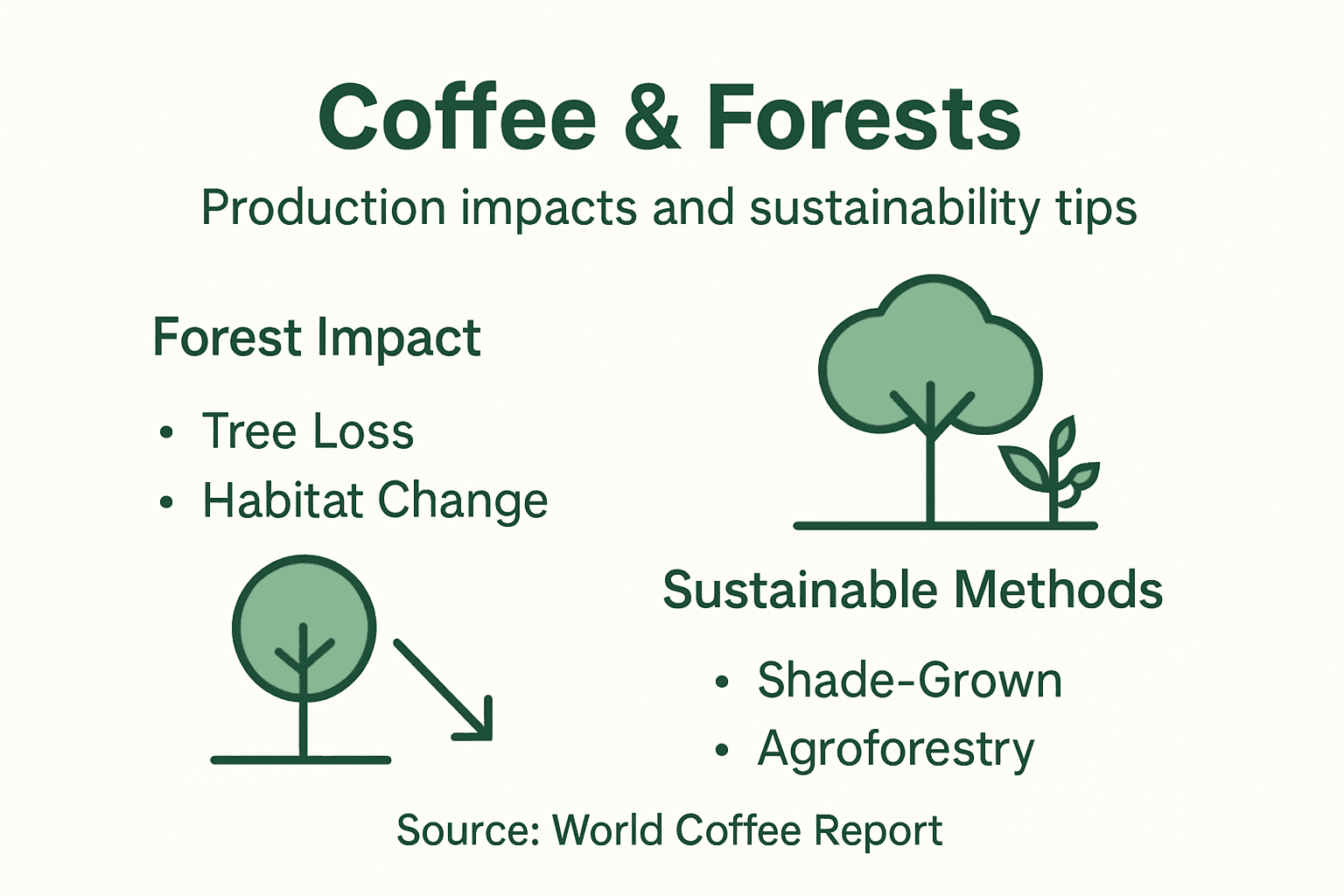
Beyond formal certifications, sustainable coffee practices encompass farming methods that regenerate rather than deplete. Shade-grown coffee, grown under a native tree canopy, maintains forest structure and biodiversity while producing coffee beans. Agroforestry systems integrate coffee production with other crops like fruit trees or timber species, creating diversified income streams while preserving ecosystem functions. Regenerative practices rebuild soil health through composting, cover cropping, and reduced tillage. Direct trade relationships between roasters and farmers bypass certification intermediaries entirely, allowing buyers to verify practices firsthand and negotiate prices directly. Water management practices like rainwater harvesting and improved irrigation reduce consumption. Processing innovations minimize wastewater and capture byproducts for compost or energy production. The most sustainable coffee operations combine multiple practices: they grow under shade, manage water carefully, build soil health, and ensure farmers receive fair compensation. These operations cost more to establish and operate, which is why they cost more to purchase. That higher price reflects the real environmental and social value that industrial coffee doesn’t account for.
What matters for you as a consumer is recognizing that certifications represent a spectrum rather than a binary. Something labeled organic is genuinely better than conventional coffee in some ways, even if it doesn’t address all sustainability dimensions. Shade-grown coffee with fair trade certification hits multiple sustainability metrics simultaneously. Direct-trade coffee from a transparent roaster who publishes their sourcing practices might offer the deepest sustainability assurance, even without official labels. The reality is that no single certification or practice solves all the problems coffee production creates. But combinations of certifications and practices move in the right direction. When you choose coffee that emphasizes shade-growing, biodiversity protection, water conservation, and fair farmer compensation, you’re supporting a system that works against the deforestation cycle. You’re creating market demand for farming methods that preserve forests instead of destroying them. You’re making economics work for sustainability rather than against it. That’s how individual consumer choices aggregate into industry transformation.
Pro tip: Look for coffee that combines multiple sustainability signals: Fairtrade certification for fair pricing, Organic or Regenerative certification for reduced chemical inputs, and shade-grown or agroforestry practices documented by the roaster—this combination provides the strongest environmental and social outcomes across the entire production system.
Below is a summary of sustainability certifications and what they guarantee for coffee:
| Certification | Focus Area | Forest Protection Requirement | Benefit to Farmer Income |
|---|---|---|---|
| Fairtrade | Fair wages, social | Not always required | Guarantees minimum pricing |
| Organic | Chemical-free farming | Rarely covers deforestation | Access to premium markets |
| Rainforest Alliance | Ecosystem, biodiversity | Mandates shade/agroforestry | Promotes sustainable practices |
| Direct Trade | Transparent sourcing | Varies by roaster | Negotiated, higher payments |
How Consumers Reduce Coffee’s Forest Impact
Here’s something that might surprise you: your individual coffee purchases matter more than you think. The coffee industry doesn’t operate in isolation from consumer preferences. When millions of people shift their buying habits toward sustainable options, supply chains reshape themselves to meet that demand. Coffee companies source what consumers will buy. Farmers plant what they can sell. Certification systems expand when demand justifies their cost. The system responds to market signals, which means your choices at the checkout counter send real messages through the entire production network. This isn’t about feeling good through consumption. It’s about understanding how markets actually work and leveraging that knowledge to redirect incentives toward forest preservation instead of forest destruction.
Your most direct lever as a consumer involves making informed purchasing decisions, and that starts with understanding what you’re actually buying. Supporting deforestation-free coffee through purchasing choices informed by certifications and traceability standards directly reduces the environmental footprint of coffee consumption. When you choose certified sustainable coffee, you’re signaling to producers and retailers that you’ll pay for practices that preserve forests. This creates a market advantage for sustainable producers compared to those using destructive methods. Over time, this preference pattern reshapes production incentives. Farmers considering whether to expand into forest lands face a different calculation when sustainable methods command higher prices. Roasters weighing their sourcing strategies make different choices when consumers reward sustainability. Retailers reorganize shelf space when certified coffee sells better than conventional options. The cumulative effect of millions of consumers making this choice is industry transformation. But this only works if your purchases actually reflect your values. If you occasionally buy certified sustainable coffee but routinely purchase conventional options because they’re cheaper, you’re sending a mixed signal that undermines the market mechanism. Consistency matters. When sustainable coffee becomes your default choice rather than an occasional premium purchase, you contribute meaningfully to shifting industry norms.
Beyond individual purchasing, consumer collective action amplifies impact dramatically. European consumers’ preferences and regulations requiring proof of deforestation-free coffee supply chains drive producer compliance worldwide, demonstrating how market demand and regulatory frameworks work together. The European Union’s Deforestation Regulation requires companies to prove their coffee came from deforestation-free supply chains, which means European consumers’ purchasing power influences global production practices far beyond Europe’s borders. When large consumer markets demand transparency and sustainability, producers worldwide must comply or lose access to those markets. This regulatory environment empowers consumers in those regions while also pushing producers everywhere toward more sustainable practices to maintain market access. You can participate in this collective action by supporting brands and retailers that advocate for stronger sustainability standards, demand supply chain transparency, and push back against greenwashing. When you voice support for companies taking environmental commitments seriously, you’re adding your voice to consumer pressure that influences industry-wide practices.
Your consumer impact extends beyond purchasing into other forms of engagement. Asking your favorite coffee roaster direct questions about their sourcing practices signals that consumers care about these details. Leaving reviews that specifically mention sustainability when evaluating coffee products helps other consumers make informed choices while sending signals to retailers about what matters to buyers. Sharing information about coffee and deforestation through social networks spreads awareness that changes how others approach coffee purchasing. Supporting policies and regulations that require supply chain transparency creates structural changes that make it easier for conscientious producers and harder for destructive ones. Participating in conversations about coffee sustainability within your social circles amplifies individual impact. When you explain to friends why you choose certain coffee brands, you’re normalizing sustainable purchasing as a standard practice rather than a niche preference. Over time, this cultural shift changes what counts as normal consumption, which fundamentally reshapes market incentives. The most powerful consumer impact comes not from individual purchasing decisions alone but from individual decisions combined with advocacy, communication, and support for systemic change.
Pro tip: Create a sustainable coffee checklist and stick to it consistently: verify certifications, research roaster sourcing practices, check for shade-grown or agroforestry methods, and commit to this choice even when conventional coffee is cheaper—your consistent purchasing pattern sends stronger market signals than occasional sustainable purchases.
Take a Stand Against Coffee-Driven Deforestation with Every Sip
The challenge of coffee production driving global deforestation calls for conscious choices that prioritize forest preservation and sustainable farming methods. Consumers like you face the urgent goal of supporting shade-grown, agroforestry, and regenerative coffee practices that combat the destruction of biodiversity and soil health highlighted in this article. Making informed buying decisions backed by credible certifications can shift market incentives to protect tropical ecosystems and empower farmers.

Explore our carefully curated selection of sustainably sourced coffees and teas at Coffee and Tea example products – EcoVibe Roast. Each purchase not only guarantees quality but directly supports initiatives that plant mangrove trees and remove ocean-bound plastics. Join the community of eco-conscious consumers demanding transparency, fair compensation, and environmental stewardship. Visit EcoVibe Roast today and make your coffee habit a force for positive change. Start your journey now by browsing our Best Sellers – EcoVibe Roast and choose coffee that helps preserve forests and combat climate change.
Frequently Asked Questions
What is the connection between coffee production and deforestation?
Coffee production contributes to deforestation through the conversion of biodiverse forests into monoculture plantations. This shift often requires the complete clearing of forests, leading to significant ecological damage and biodiversity loss.
How does coffee farming impact biodiversity?
The transition to sun-grown coffee monocultures eliminates diverse ecosystems. When forests are cleared for coffee plantations, countless plant and animal species lose their habitats, which results in biodiversity collapse.
What are sustainable coffee farming practices?
Sustainable coffee farming practices include shade-grown cultivation, agroforestry, and regenerative farming methods. These practices help preserve forest structure and biodiversity while enhancing soil health and reducing the environmental impact of coffee production.
How can consumers make a difference in coffee sustainability?
Consumers can promote coffee sustainability by choosing certified products, supporting brands that prioritize eco-friendly practices, and advocating for transparency within coffee supply chains. Consistent purchasing of sustainable coffee helps shift market demand towards practices that preserve forests.


