

Reducing ocean-bound plastics prevents biodiversity loss, lowers your exposure to harmful chemicals, and protects the coastal economies that millions of Americans and global communities depend on. Every piece of plastic stopped before it reaches the sea benefits marine life, human health, and coastal economies that feed and employ coastal families.
Here’s the quick case for action:
- Wildlife protection: Seabirds, sea turtles, whales, and fish face entanglement and ingestion risks from plastic debris that never fully breaks down.
- Fewer microplastics in your food: Plastics fragment into microscopic particles that enter seafood, drinking water, and even the air you breathe.
- Lower public-health burdens: Phthalates and bisphenols from plastic packaging are linked to hormonal disruption and other health risks.
- Economic savings: Coastal cleanup costs, lost tourism revenue, and damaged fishing gear represent real financial losses for communities.
- Climate co-benefits: Cutting virgin plastic production reduces greenhouse gas emissions from petrochemical manufacturing.
Programs like CleanHub, the Oceanic Society, and the Ocean Bound Plastic Certification are already turning these reasons into measurable results. Read on to see how the science, the economics, and the solutions all connect.
Table of Contents
- What is ocean-bound plastic, and which materials does it include?
- How much plastic reaches the ocean, and what are the main pathways?
- How do ocean-bound plastics harm marine ecosystems?
- How do ocean-bound plastics affect human health and coastal economies?
- What are the direct benefits of reducing ocean-bound plastics?
- What systems-level solutions actually prevent ocean-bound plastics?
- High-impact actions you can take right now
- Three case studies that show what works
- How quickly do reductions start delivering benefits?
- Key Takeaways
- The case for caring before the plastic hits the water
- Your morning cup can support ocean-bound plastic removal
- Useful sources for further reading
What is ocean-bound plastic, and which materials does it include?
“Ocean-bound plastic” (OBP) is not the same as debris scooped from the open sea. According to ISCC PLUS guidance, OBP refers to waste collected within roughly 50 kilometers of a coastline that is at high risk of leaking into the ocean if left unmanaged. Think overflowing coastal dumpsites, open riverbanks near tidal zones, and informal waste streams in high-risk regions where collection infrastructure is thin or absent.
The distinction matters because brands and certifiers use it to define sourcing claims. “Ocean-recovered” plastic is pulled from the water itself; OBP is intercepted before it gets there. Both are valuable, but they are not interchangeable, and certification documents are the only reliable way to verify which you are actually supporting.
Common materials classified as OBP include:
- Single-use packaging: bottles, sachets, wrappers, and food containers
- Flexible films and caps: low-value items that recyclers often reject
- Fishing gear: nets, lines, and traps abandoned near coastal communities
- Mixed-grade plastics: materials that require sorting before they can re-enter a recycling stream
The term “grades” simply describes how clean, sorted, and processable a batch of plastic is. High-grade OBP (clear PET bottles, for example) commands recycling market value. Low-grade mixed films are harder to sell and often end up in landfills or burned unless a funded program covers the collection cost. That gap is exactly where programs like CleanHub and the Oceanic Society step in.
How much plastic reaches the ocean, and what are the main pathways?
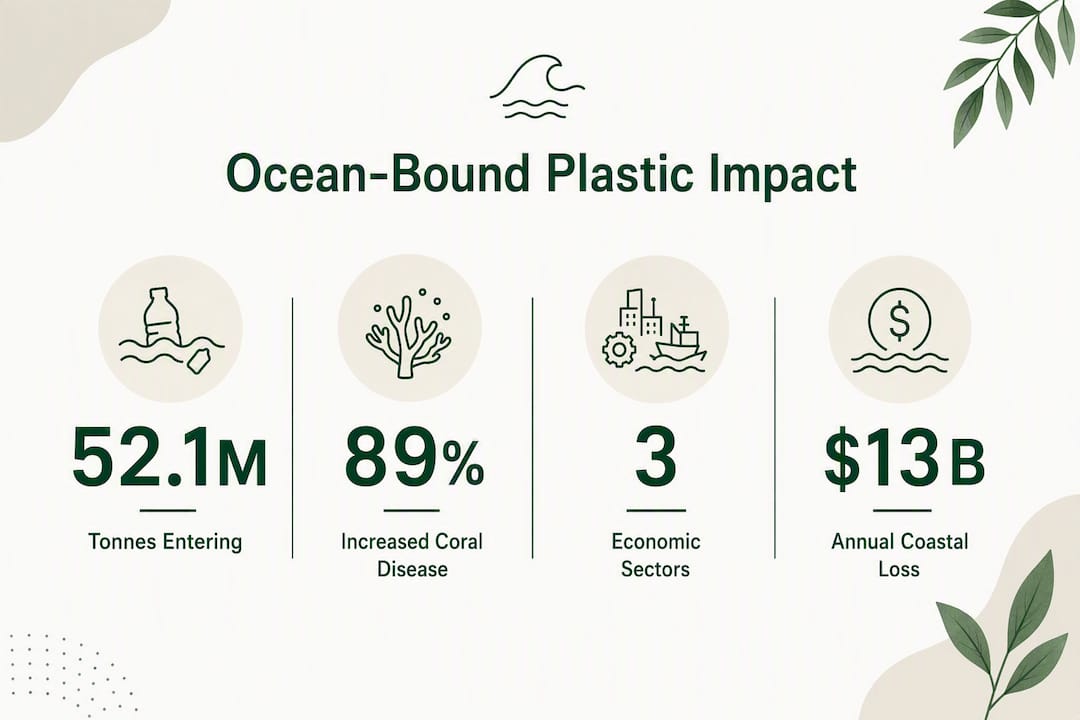
The scale is staggering. Annual plastic waste emissions into the ocean are estimated at 52.1 million metric tonnes per year, yet floating or beach-found macroplastics account for only 3–4% of that total. The vast majority sinks, fragments, or disperses in ways that make cleanup extraordinarily difficult after the fact.
52.1 million metric tonnes of plastic waste enter the ocean annually. Visible beach and floating debris represents just 3–4% of that total — the rest is largely invisible and nearly impossible to recover once dispersed.
| Pathway | Key mechanism | Intervention point |
|---|---|---|
| Mismanaged coastal waste | Open dumpsites, uncollected household waste near shorelines | Collection infrastructure, EPR funding |
| Rivers and storm runoff | Waterways carry inland waste to estuaries and coasts | River barriers, urban waste management |
| Fishing and maritime gear | Lost or abandoned nets, lines, and traps | Gear marking, retrieval programs |
| Fragmentation into microplastics | UV and wave action break larger pieces into particles | Prevention upstream; microplastics cannot be recalled |
Rivers are the dominant land-to-sea conveyor belt, carrying plastic from inland cities through estuaries and into coastal waters. Storm drains amplify the flow during heavy rain events, which is why U.S. coastal cities with aging stormwater infrastructure remain significant leakage points. Once plastic fragments into microplastics, no technology can cost-effectively remove it at scale. Prevention upstream is the only realistic answer.
How do ocean-bound plastics harm marine ecosystems?
The ecological damage runs deeper than the images of tangled sea turtles that most people picture. Direct harms are severe and well-documented by NOAA’s Marine Debris Program:
- Entanglement: Marine mammals, seabirds, and fish become trapped in derelict fishing nets and plastic packaging rings, often fatally.
- Ingestion: Animals mistake plastic fragments for prey. Seabirds feed plastic to their chicks; fish consume microplastic-laden water column particles.
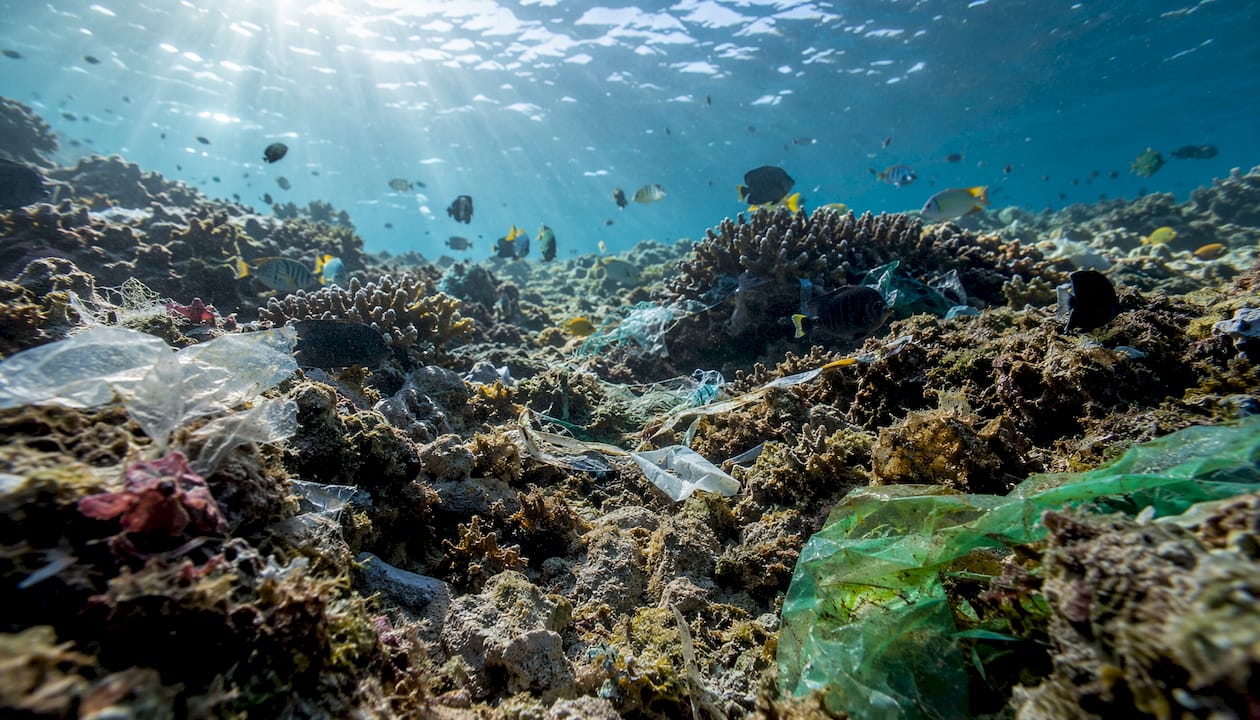
- Habitat smothering: Plastic sheets and films smother coral reefs and seagrass beds, blocking light and oxygen exchange.
- Seabed accumulation: Heavier plastics sink and alter benthic habitats where bottom-dwelling species feed and reproduce.
The indirect harms are arguably more pervasive. Microplastics absorb persistent organic pollutants, pesticides, flame retardants, and dyes from surrounding seawater, then concentrate those toxins as they move up the food chain. A small fish ingests microplastic-bound chemicals; a larger predator eats thousands of those fish. The plastics lifecycle also contributes to climate change through greenhouse gas emissions from production and open burning, creating a feedback loop that stresses marine ecosystems already coping with warming and acidification.
Coral reefs face a compounding threat: plastic debris increases disease risk in corals by up to 89% in some studied reef systems, according to peer-reviewed research. Seagrass meadows, which sequester carbon and serve as nursery habitat for commercially important fish species, are similarly vulnerable to smothering by plastic films.
How do ocean-bound plastics affect human health and coastal economies?
The health risks are no longer theoretical. The PERTH Trial, published in Nature Medicine, found that reducing plastic-wrapped foods and plastic touchpoints measurably lowered urinary levels of phthalates and bisphenols in participants. These chemicals are endocrine disruptors linked to reproductive harm, metabolic disorders, and developmental issues in children. The trial’s finding is significant because it shows that upstream changes to packaging and diet are modifiable exposure routes — you can actually lower your body burden by changing what you buy and how it’s packaged.
A lifecycle assessment model00056-X) projects a cumulative 83 million DALYs (disability-adjusted life years) associated with business-as-usual plastics trajectories from 2016 to 2040. Systemic changes combining production cuts, improved waste collection, and increased recycling could reduce annual DALYs by 43% by 2040.
The economic toll is equally concrete. The U.S. EPA identifies coastal tourism, fisheries, and shipping as sectors facing measurable losses from plastic pollution. Beach closures cost tourism-dependent communities millions in lost visitor spending. Fishing vessels spend significant time and fuel clearing plastic debris from gear. Coastal livelihoods in fishing communities — disproportionately lower-income households — absorb cleanup costs that are never reimbursed. For food service operators, the sustainability pressures from plastic waste are increasingly shaping procurement and packaging decisions industry-wide.
What are the direct benefits of reducing ocean-bound plastics?
Prevention consistently outperforms downstream cleanup on every metric that matters. Here’s what the evidence shows you gain:
- Reduced leakage: Less plastic entering waterways means less fragmentation into microplastics that can never be recovered.
- Improved recycling quality: Intercepting OBP before it degrades preserves material value and supports recycling markets.
- Lower chemical exposure: Fewer plastic-packaged products means lower dietary intake of phthalates, bisphenols, and other plastic-associated chemicals.
- Protected fisheries and tourism: Cleaner coastlines support the industries that employ coastal communities and generate tax revenue.
- Climate co-benefits: Cutting virgin plastic production reduces petrochemical emissions; a 30% reduction in annual virgin plastic production by 2040 relative to 2019 is achievable under far-reaching policy scenarios.
- Equity gains: Plastic pollution burdens fall hardest on lower-income coastal communities; prevention reduces those disproportionate harms.
The synthesis here is straightforward: prevention is cheaper, more effective, and more equitable than cleanup. A tonne of plastic stopped at a coastal dumpsite costs a fraction of what it would take to recover the same material after it has fragmented across a reef system. Choosing plastic-free packaging at the product level is one concrete way individuals and brands can act on this logic every day.
What systems-level solutions actually prevent ocean-bound plastics?
Systemic change requires action at three levels: policy, infrastructure, and corporate accountability. Treating this as purely an individual recycling problem, as LSHTM researchers emphasize, misses where most of the leverage lives.
Policy levers that work:
- Extended Producer Responsibility (EPR): Requires manufacturers to fund end-of-life collection and recycling for the packaging they put into the market. Several U.S. states have passed EPR legislation for packaging, shifting costs from municipalities to producers.
- Product design rules: Mandating recyclability, reducing problematic additives, and phasing out unnecessary single-use formats at the design stage.
- Bans and limits: Targeted restrictions on the highest-leakage items (thin films, sachets, expanded polystyrene) have shown measurable reductions in coastal debris in jurisdictions that enforce them.
- International treaty momentum: The UN Global Plastics Treaty negotiations represent the most significant opportunity for coordinated global action on production and waste management.
Infrastructure investment:
Funding collection systems in high-risk coastal and riverine regions delivers stronger, more durable results than product-level OBP sourcing alone. Integrating informal waste workers into formal collection systems both improves coverage and provides fair wages and safer conditions for some of the world’s most vulnerable laborers.
Programs and certifications to know:
- CleanHub connects brands to verified plastic collection programs in high-risk coastal regions, providing transparent reporting on tonnes recovered and communities supported.
- Ocean Bound Plastic Certification (governed by standards like ISCC PLUS) provides third-party verification that plastic was genuinely sourced within the 50-kilometer coastal zone before ocean entry.
- Oceanic Society funds and coordinates community-based marine conservation programs, including plastic reduction initiatives tied to local livelihoods.
Pro Tip: Before trusting any corporate OBP claim, ask three questions: Is the collection verified by a named third-party certifier? Does the brand publish annual tonnage reports with audited figures? Are local waste workers and communities named as partners? Transparency on all three is the baseline for a credible program.

High-impact actions you can take right now
You don’t need to wait for policy to catch up. Here are the actions ordered by their actual impact on plastic leakage:
- Reduce virgin-plastic purchases. Choose products with minimal or no plastic packaging. Every purchase you skip is plastic that never enters the waste stream.
- Switch to reusable and refill systems. Reusable bottles, bags, and containers eliminate the single-use cycle at its source.
- Support EPR policies. Contact your state and federal representatives to back packaging EPR legislation. Policy change scales individual action by millions.
- Donate to credible collection programs. CleanHub and the Oceanic Society both publish transparent impact reports. Verify tonnage figures and community partnerships before giving.
- Press brands for lifecycle accountability. Ask companies you buy from what their plastic footprint is and whether they publish third-party-verified reduction targets.
Community checklist:
- Join or organize local coastal and riverbank cleanups through verified programs.
- Advocate for your municipality to fund waste collection in underserved neighborhoods where leakage rates are highest.
- Support waste worker cooperatives and fair-wage collection initiatives in your region.
- Monitor local leakage hotspots (storm drains, riverbanks, coastal dumpsites) and report them to municipal authorities.
- Choose plastic-free tea and coffee products that use certified sustainable packaging.
Pro Tip: Before volunteering with or donating to a cleanup charity, ask: Do they publish annual impact reports with audited tonnage figures? Do they partner with local waste workers rather than replacing them? Do they track leakage prevention, not just debris collected? Programs that answer yes to all three are the ones worth your time and money.
Three case studies that show what works
CleanHub’s verified coastal collection model
CleanHub operates plastic collection programs in coastal communities across South and Southeast Asia, regions where mismanaged waste and limited infrastructure create high leakage risk. The model funds local collection hubs, pays waste workers fair wages, and provides brands with real-time dashboards showing verified tonnes recovered. The key lesson: transparent, infrastructure-first funding creates durable local capacity rather than one-off cleanup events. Brands that fund CleanHub programs can point to audited tonnage figures, which is the standard every corporate recovery claim should be held to.
Ocean Bound Plastic Certification in practice
The Ocean Bound Plastic Certification, governed by standards including ISCC PLUS, has enabled brands across the consumer goods sector to source verified OBP resin for packaging and products. The certification’s 50-kilometer sourcing definition prevents “ocean-washing” by requiring documented chain of custody from collection point to processing. One transferable lesson from practitioners: using OBP resin in products is a lower-tier intervention compared to funding the collection infrastructure itself. Both matter, but the hierarchy is clear.
Community-integrated livelihoods programs
The Oceanic Society has supported community-driven programs that integrate plastic collection with sustainable fishing and ecotourism livelihoods. In coastal communities where fishing income is declining due to habitat degradation, supplemental income from verified plastic collection provides economic resilience while reducing leakage. The metric that matters most in these programs is not just tonnes recovered but whether local households report stable income gains and whether collection rates hold after initial funding ends. Programs that embed collection into existing livelihood structures tend to sustain themselves; those that rely on external volunteer labor typically do not.
Statistic to remember: Systemic changes combining production cuts, improved waste management, and increased recycling could reduce annual DALYs by 43% by 2040 compared to business-as-usual, according to lifecycle assessment modeling.
How quickly do reductions start delivering benefits?
Realistic timelines vary by intervention type, and it helps to know what to measure at each stage.
- Within months: Collection programs in high-risk coastal zones show measurable reductions in local leakage rates. Individual dietary changes (reducing plastic-wrapped foods) can lower urinary phthalate and bisphenol levels within weeks, as the PERTH Trial demonstrated.
- Within 1–3 years: Municipal EPR programs begin shifting collection costs to producers and improving recycling infrastructure. Coastal tourism and fisheries operators report lower debris-clearing costs as local collection improves.
- Within 5–10 years: Regional recycling markets strengthen as OBP collection volumes grow and material quality improves. Coral reef and seagrass recovery begins in areas where plastic smothering is reduced.
- By 2040: Far-reaching global policy could reduce annual virgin plastic production by roughly 30% relative to 2019, with corresponding reductions in mismanaged waste and greenhouse gas emissions.
| Milestone | Timeframe | Key metric |
|---|---|---|
| Urinary phthalate/bisphenol reduction | Weeks to months | Urinary biomarker levels (individual) |
| Local leakage rate improvement | 3–12 months | Tonnes prevented per collection zone |
| Recycling market strengthening | 1–3 years | OBP material value and offtake rates |
| Fisheries/tourism cost savings | 1–5 years | Gear-clearing costs, beach closure days |
| Reef and seagrass recovery | 5–10 years | Habitat coverage and coral health indices |
| Virgin production reduction (30%) | By 2040 | Annual global production vs. 2019 baseline |
The most important takeaway from these timelines: early-stage benefits are real and measurable, which means there is no reason to wait for perfect policy before acting. Collection programs deliver results now; production cuts deliver results at scale over decades. Both tracks need to run simultaneously.
Key Takeaways
Reducing ocean-bound plastics delivers measurable benefits across ecology, public health, and coastal economies, and the most effective path combines upstream production cuts with funded collection infrastructure in high-risk regions.
| Point | Details |
|---|---|
| Scale of the problem | An estimated 52.1 million metric tonnes of plastic enter the ocean annually; visible debris is just 3–4% of the total. |
| Health burden | Business-as-usual plastics trajectories project 83 million cumulative DALYs from 2016 to 2040; systemic changes could cut annual DALYs by 43% by 2040. |
| Prevention beats cleanup | Stopping plastic at coastal collection points costs far less than recovering fragmented microplastics from marine ecosystems. |
| Top individual actions | Reduce virgin-plastic purchases, support EPR policy, and donate only to programs with audited tonnage reports and local community partnerships. |
| Ecoviberoast’s approach | Ecoviberoast links every purchase to ocean-bound plastic removal and mangrove planting, offering a verified, purchase-linked way to support collection programs. |
The case for caring before the plastic hits the water
There’s a tendency in sustainability conversations to focus on what’s already in the ocean — the images of garbage patches and stranded whales. Those images matter, but they can make the problem feel irreversible, like we’re always cleaning up after ourselves rather than changing the conditions that created the mess.
What the evidence actually shows is more hopeful than that. The PERTH Trial proved that individual dietary and packaging changes lower chemical body burdens within weeks. CleanHub’s verified collection programs show that funded infrastructure in high-risk coastal zones reduces leakage measurably within months. The lifecycle modeling shows that combining production cuts with better waste management could cut the global health burden from plastics by 43% by 2040. None of that requires waiting for a perfect global treaty.
The piece of this that often gets lost is the equity dimension. Plastic pollution is not distributed equally. Coastal communities in lower-income regions bear the highest leakage rates and the lowest capacity to fund their own cleanup. When brands and consumers in wealthier markets fund verified collection programs in those regions, they are not just removing plastic. They are paying for infrastructure that those communities deserve but have been denied. That reframing, from charity to justice, changes how you evaluate which programs are worth supporting and which are just greenwashing.
My honest view: the most underrated action any eco-conscious person can take is not the reusable bag. It’s demanding that the brands they buy from publish audited, third-party-verified plastic footprint data and fund collection in the regions where their packaging actually leaks. That’s where the leverage is.
Your morning cup can support ocean-bound plastic removal
Every bag of coffee or box of tea you buy is a small vote for the kind of supply chain you want to exist. Ecoviberoast makes that vote count in a specific, verifiable way: each purchase is linked to ocean-bound plastic removal and mangrove tree planting, two interventions with documented ecological benefits.

Ecoviberoast’s single-serve coffee pods use sustainably sourced beans and eco-conscious packaging, and the brand publishes its environmental commitments openly, so you can hold them accountable. If you prefer to start smaller, the 12-pack option is a low-commitment way to try the coffee and support the program at the same time. You can also browse the full single-serve collection to find the roast that fits your morning ritual.
A note on verification: Ecoviberoast’s removal commitments are tied to real programs, but as with any brand claim, you should check the program reports and partner documentation. The brand’s coffee-that-removes-plastic page explains the specifics of how the program works. Verified impact, not just good intentions, is the standard worth holding every brand to, including this one.
Useful sources for further reading
These are the primary and peer-reviewed sources behind the claims in this article. Each one is worth bookmarking if you want to go deeper on the data, the policy options, or the programs.
- UN News: Five things you need to know about ocean plastics — The source for the 52.1 million metric tonne annual estimate and the 3–4% floating/beach debris figure. A clear, accessible overview of the latest scale data.
- PMC / The Lancet Planetary Health: Global health burdens of plastics lifecycle model — Peer-reviewed lifecycle assessment modeling the 83 million cumulative DALYs and the 43% reduction achievable under systemic change scenarios. The most rigorous health-burden analysis available.
- Nature Medicine: The PERTH Trial — Clinical trial evidence that low-plastic dietary interventions measurably reduce urinary phthalate and bisphenol levels. Essential reading for the personal health case.
- U.S. EPA: Benefits of Addressing Plastic Pollution — The EPA’s summary of economic and ecological benefits from reducing plastic leakage, including fisheries, tourism, and recycling market gains.
- LSHTM: 10 actions to tackle plastic pollution and protect health — Policy expert recommendations emphasizing producer responsibility and lifecycle accountability over individual recycling focus.
- Systemiq: Towards Ending Plastic Pollution by 2040 — Modeling report showing that far-reaching policy could reduce annual virgin plastic production by roughly 30% by 2040 relative to 2019, with corresponding climate and waste management benefits.
- ISCC PLUS Guidance for OBP v1.2 — The certification standard that defines ocean-bound plastic sourcing within 50 kilometers of coastlines. Essential for verifying any OBP product claim.
- NOAA: A Guide to Plastic in the Ocean — NOAA’s accessible overview of plastic pathways, marine debris impacts, and the entanglement and ingestion harms documented across marine species.


