

Choosing coffee isn’t just about flavor for eco-conscious millennials and Gen Z seeking a sustainable lifestyle. With every cup, you’re linked to real communities in Colombia, Guatemala, Ethiopia, and beyond who shape both your morning ritual and their own futures. Community support in coffee means investing in people, local economies, and ecosystems, ensuring your choices empower farmers, protect biodiversity, and drive positive impact at the roots of the coffee value chain.
Table of Contents
- Community Support In Coffee Explained
- Types Of Community Support In Coffee
- Fair Trade And Economic Support
- Education And Skill Development
- Environmental Conservation Initiatives
- Women’s Empowerment And Gender Equity
- Infrastructure And Healthcare
- How Community Initiatives Drive Sustainability
- Empowering Farmers Through Collective Action
- Consumer Roles In Building Coffee Communities
Key Takeaways
| Point | Details |
|---|---|
| Support Coffee Communities | Investing in coffee farmers and their communities strengthens the entire ecosystem, leading to sustainable practices and better livelihoods. |
| Choose Conscious Brands | Opt for companies that invest in direct relationships with farmers and demonstrate transparency in their sourcing practices. |
| Education Drives Sustainability | Programs that educate farmers on modern sustainable techniques enhance both yields and environmental health. |
| Collective Action Empowers Farmers | When farmers organize into cooperatives, they gain negotiating power and improve their economic conditions significantly. |
Community Support in Coffee Explained
Community support in coffee means real people taking action to strengthen the entire ecosystem around coffee production. It’s not just about buying a bag of beans—it’s about investing in farmers, local economies, and environmental health all at once.
When you support coffee communities, you’re connecting with the network of growers, cooperatives, and workers who make your morning cup possible. These aren’t distant abstractions. They’re actual people managing land, growing crops, and building better futures for their families.
What Community Support Actually Looks Like
Community support operates across multiple levels:
- Farmer cooperatives pooling resources to negotiate fair prices and access better markets
- Direct trade relationships that eliminate middlemen and send more money directly to growers
- Environmental initiatives where farming communities implement sustainable ecosystem practices like agroforestry and soil conservation
- Education programs teaching next-generation farmers modern sustainable techniques
- Local economic development strengthening communities through stable, reliable income
These efforts work together. When you buy from companies supporting these initiatives, farmers can invest in better equipment, healthier soils, and protected water sources.
Why It Matters for Sustainability
Here’s the reality: sustainable coffee doesn’t happen by accident. It requires active community involvement and long-term commitment from everyone in the supply chain.
Community-driven sustainability in coffee farms extends beyond individual fields. Strong farming communities protect biodiversity, maintain healthy ecosystems, and create resilience against climate challenges. When communities thrive economically, they’re more likely to invest in conservation practices that benefit everyone.
Community support transforms coffee farming from a survival hustle into a sustainable livelihood that protects both people and the planet.
Farmers who receive fair compensation can implement agroforestry systems, protect pollinator habitats, and maintain healthy soil structures. Without stable income and community backing, these practices become luxuries they can’t afford.
Your Role in Community Support
You have more power than you think. Every purchase decision sends a signal about what you value:
- Choose coffee from companies investing in direct relationships with farmers
- Look for certifications showing fair wages and community investment
- Support brands that share transparency about where your coffee comes from
- Learn the stories behind the beans you’re drinking
When you understand the people and communities behind your coffee, your daily ritual becomes something deeper. That warm cup connects you to specific families, specific landscapes, and specific efforts to build a better system.
Pro tip: When shopping for coffee, ask about the farm community’s specific projects—whether that’s a school, water system, or conservation program—so you know exactly how your purchase creates impact.
Types of Community Support in Coffee
Community support in coffee takes many forms, each addressing different needs within farming communities. Understanding these types helps you see exactly how your coffee purchases create tangible change beyond just the farm gate.
The strongest coffee communities benefit from multiple support systems working together. When one type of support exists in isolation, it rarely creates lasting transformation. But when they overlap and reinforce each other, communities truly thrive.
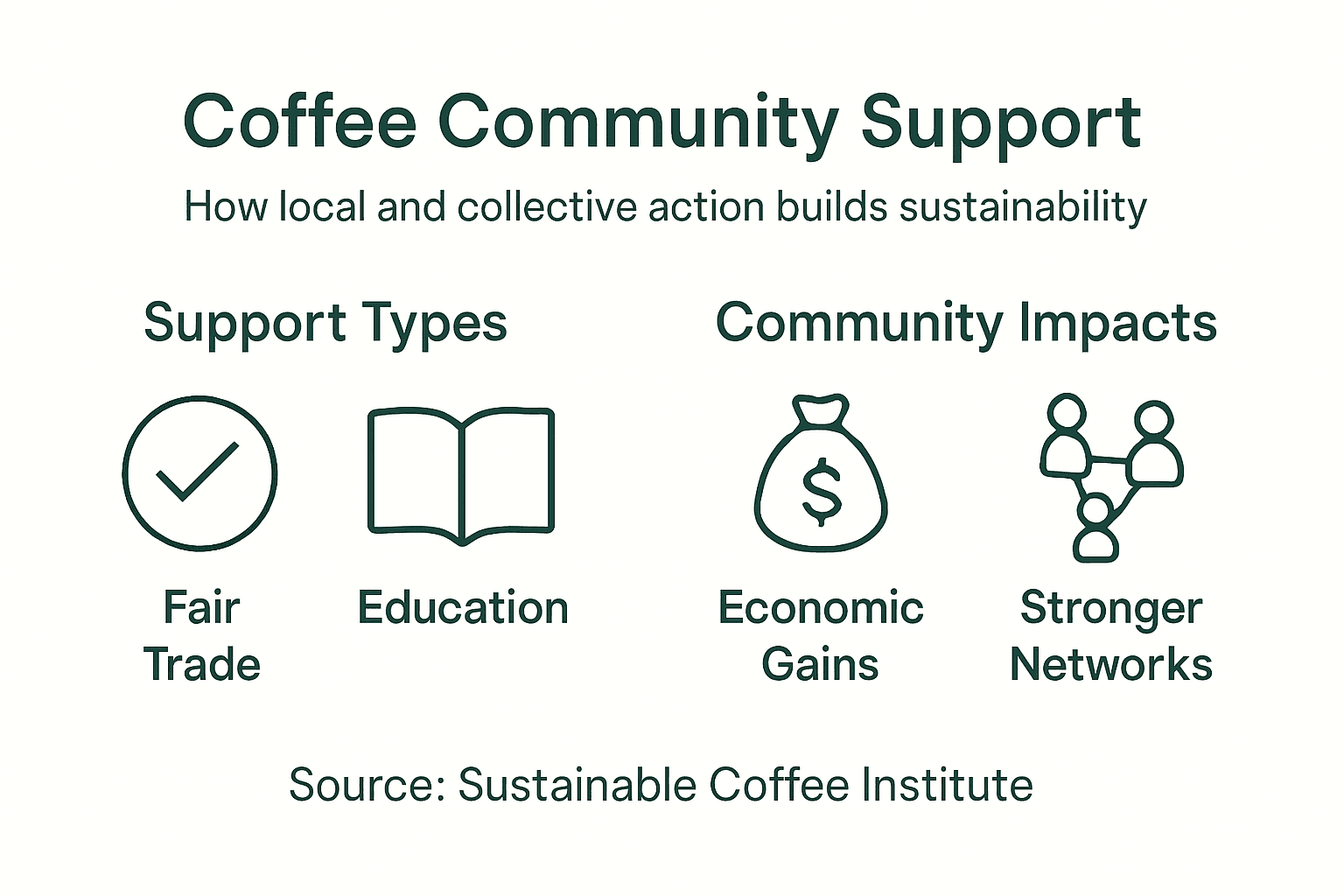
Here’s a concise overview of the main types of community support in coffee and their impacts:
| Support Type | Primary Impact | Key Beneficiaries |
|---|---|---|
| Fair Trade Partnerships | Stable income, planning power | Smallholder farmers |
| Education Initiatives | Increased yields, skills | Next-generation growers |
| Environmental Programs | Healthy ecosystem, resilience | Farming communities |
| Gender Equity Efforts | Improved livelihoods, fairness | Women in coffee sector |
| Infrastructure Funding | Better health, education | Families, local workers |
Fair Trade and Economic Support
Fair trade partnerships guarantee farmers receive stable, predictable prices for their coffee. This isn’t charity—it’s a business model that ensures growers can actually plan ahead and invest in their futures.
Without fair trade mechanisms, coffee farmers face brutal price volatility. One year they earn enough to improve their homes; the next year, global price crashes leave them struggling. Fair trade eliminates this uncertainty.
Direct relationships between roasters and farmers create another layer of economic security. When middlemen are removed, more money flows directly to the people growing the coffee. Fair trade assures sustainable income streams that enable farmers to think beyond survival.
Education and Skill Development
Education programs teach farming communities modern sustainable techniques that increase both yields and environmental health. Younger farmers learn advanced soil management, water conservation, and pest control methods that protect their land.
These programs also create economic opportunity. When farmers can produce higher-quality, sustainably grown coffee, they access specialty markets that pay premium prices. Education transforms communities from commodity suppliers into skilled producers.
Schools and vocational training funded by coffee revenue ensure children can learn without their families losing labor. This breaks cycles of poverty across generations.
Environmental Conservation Initiatives
Coffee-growing communities implement specific conservation practices that protect local ecosystems:
- Agroforestry systems where shade trees grow alongside coffee plants, protecting biodiversity
- Water source protection ensuring clean water for farming and household use
- Soil health programs that build fertility without chemical dependency
- Pollinator habitat restoration supporting bees and insects essential to crop success
These aren’t separate from farming—they’re integrated practices that make farms more resilient and productive long-term.
Women’s Empowerment and Gender Equity
Women perform significant labor in coffee production but often lack land ownership, fair wages, or decision-making power. Community support specifically addressing gender equality includes:
- Equal pay for equal work
- Training programs targeting women farmers
- Access to credit and business resources
- Leadership roles in farming cooperatives
When women control income, they reinvest in community health, education, and local economies. Gender equality isn’t just fair—it’s economically transformative.
Infrastructure and Healthcare
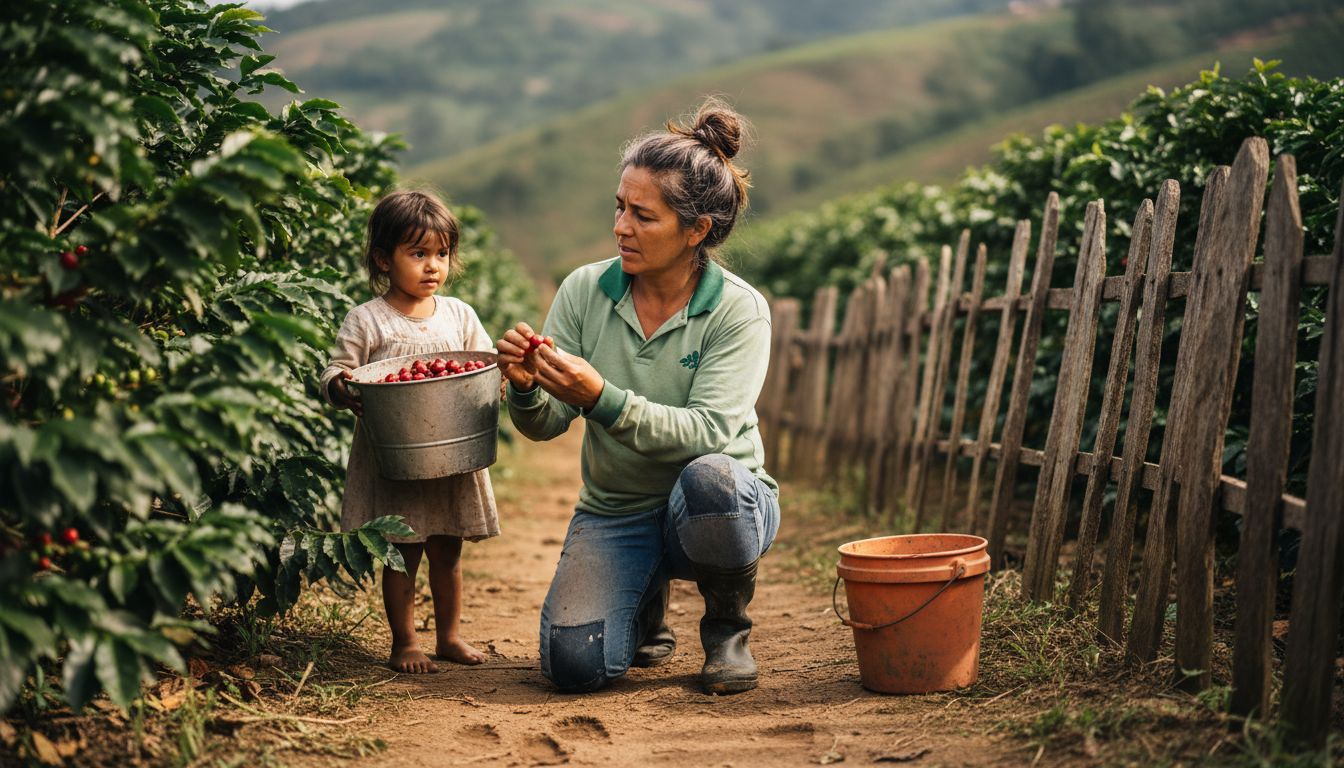
Community development extends to basic services that improve quality of life. Coffee revenue can fund road improvements, clean water systems, and healthcare clinics. These foundational supports build stronger communities by addressing poverty’s root causes.
The most sustainable coffee comes from communities where farmers earn enough to invest in their families, their land, and their futures.
Infrastructure improvements mean children can attend school without traveling hours on dangerous paths. Healthcare access means treatable illnesses don’t become financial catastrophes.
Pro tip: When evaluating a coffee brand’s community claims, look for specificity—which schools exist, what healthcare services operate, how many farmers participate—rather than vague statements about “supporting communities.”
How Community Initiatives Drive Sustainability
Community-led initiatives are the backbone of real, lasting sustainability in coffee. When farmers and local communities lead the charge, sustainability transforms from something imposed on them into something they own and control.
Here’s the critical difference: top-down sustainability programs fail because they ignore local realities. Community initiatives succeed because they’re designed by people who actually live with the consequences of their decisions.
Local Control Shapes Better Decisions
When communities lead sustainability efforts, they tailor solutions to their specific environment. A farmer in Ethiopian highlands faces different challenges than one in Colombian mountains. Local knowledge matters.
Community-led governance empowers farmers to implement practices suited to their unique ecological, economic, and cultural contexts. They’re not following a one-size-fits-all rulebook handed down from corporate headquarters.
This local control means farmers actually care about implementation. They’re solving their own problems, not complying with external requirements. The difference in commitment and outcomes is massive.
Addressing Real Barriers Together
Coffee farmers face interconnected challenges: pest infestations, climate unpredictability, labor shortages, and limited market access. Single solutions don’t work.
Cross-sector community collaborations bring together diverse stakeholders:
- Farmers with firsthand knowledge
- Agricultural researchers with technical expertise
- Government officials with policy influence
- NGOs with funding and resources
- Buyers demanding sustainable practices
When these groups collaborate under farmer leadership, they tackle systemic barriers rather than symptoms. Real transformation happens.
Integration of Ecology and Economics
Community initiatives don’t separate environmental conservation from economic survival. They recognize that farmers can’t protect the planet while struggling to feed their families.
Successful initiatives build practices that improve both ecological health and farmer income simultaneously. Shade-grown coffee protects biodiversity while earning premium prices. Water conservation projects reduce environmental impact while lowering farmer costs. Soil building increases productivity while securing long-term farm viability.
This integration is key. Sustainability only sticks when it’s profitable for the communities practicing it.
Building Lasting Participation
Community initiatives thrive when participation is sustained over years, not months. Farmers need to see results before they fully commit to new practices.
The strongest initiatives celebrate early wins while working toward long-term goals. A successful harvest using new techniques builds confidence. Fair prices for sustainable coffee prove the economic case. School improvements funded by community revenue show tangible family benefits.
Sustainable coffee isn’t created by regulations or certifications alone—it emerges when communities control their future and see real rewards for their commitment.
When farmers experience success, they become champions recruiting neighbors. This peer-to-peer adoption spreads practices faster than any top-down mandate ever could.
Pro tip: Before buying from a brand, ask specifically how their community partners made decisions about sustainability practices—if farmers didn’t have a voice in designing these practices, the commitment likely won’t last.
Empowering Farmers Through Collective Action
A single coffee farmer alone has almost no power. They can’t negotiate prices with large buyers. They can’t afford equipment upgrades. They can’t access premium markets. But when farmers organize collectively, everything changes.
Collective action transforms isolated producers into a unified force with real leverage. This is where genuine farmer empowerment begins.
Strength in Numbers
Farmers in cooperatives and collective organizations gain immediate advantages that individual growers cannot achieve. Pooled resources mean shared investment in better equipment, training, and infrastructure.
Collective organizations strengthen farmers’ capacity to coordinate production, access new markets, and negotiate improved terms with buyers. A cooperative representing 500 farmers carries negotiating power that one farmer never could.
When farmers act together, they’re no longer price-takers forced to accept whatever buyers offer. They become price-negotiators with actual leverage.
Market Access and Economic Gains
Collectives open doors to markets individual farmers cannot reach. Specialty roasters want to work with organized groups because it simplifies logistics and ensures consistent supply quality.
These relationships bring premium prices for sustainably grown coffee. A farmer selling individually might receive commodity pricing. The same farmer in a cooperative selling directly to roasters could earn 30-50% more for the same beans.
Better prices mean farmers can actually invest in their operations and communities.
Knowledge Sharing Within Groups
Collectives become knowledge hubs where farmers learn from each other:
- One farmer discovers a pest management technique and shares it with the group
- Another learns water conservation from a visiting agronomist and teaches neighbors
- Success stories spread faster through trusted community networks than through any external training program
This peer-to-peer learning is incredibly powerful. Farmers trust farmers. When a neighbor succeeds with a new technique, others will try it.
Accessing Resources and Support
Organized farmer groups attract external support that reaches individual farmers. Development organizations, governments, and nonprofits prioritize working with cooperatives because they can reach many farmers efficiently.
Collectives access:
- Training in sustainable farming practices
- Financial services and credit for investment
- Technology and equipment improvements
- Health and education services for communities
These resources magnify what individual farmers could achieve alone.
Voice in Decision-Making
When farmers organize, they gain collective voice in decisions affecting their livelihoods. Cooperatives participate in setting standards, choosing which practices to adopt, and determining how to invest community resources.
This agency matters. Farmers making choices about their own futures commit differently than those following external mandates.
Collective action doesn’t just improve farmers’ incomes—it restores their agency and control over their own futures.
Organized farmers influence supply chains in ways that isolated producers cannot. They advocate for fair policies, negotiate better terms, and shape sustainability standards aligned with their actual needs.
Pro tip: When choosing coffee, look specifically for brands sourcing from farmer cooperatives and collectives rather than individual farms or large plantations—this indicates farmers have organized power and likely better compensation.
Consumer Roles in Building Coffee Communities
You’re not just a consumer. You’re a stakeholder in a global network of coffee farmers, roasters, and communities. Your choices ripple through supply chains in ways that actually matter.
The coffee industry is shifting. Buyers are no longer passive—they’re becoming active participants shaping how coffee gets produced and who benefits from it.
From Passive Buyer to Active Participant
Traditionally, consumers bought coffee without knowing where it came from or who grew it. That model is changing fast.
Consumers are evolving from passive buyers into active participants who drive value creation and sustainability throughout coffee supply chains. You’re no longer just purchasing a product—you’re voting for a system.
This shift matters enormously. When millions of consumers demand transparency, fair wages, and environmental protection, companies respond.
Building Connection Through Stories
Consumers strengthen community bonds by engaging with coffee’s narrative. When you know the farmer’s name, see their farm’s landscape, and understand their challenges, coffee becomes personal.
This connection isn’t sentimental—it’s powerful. Stories create loyalty that transcends price. They build relationships between consumers and communities thousands of miles away.
Brands that share these stories effectively transform customers into advocates who recommend the coffee and the values behind it.
Supporting Local Coffee Hubs
Coffee shops function as community spaces far beyond simple consumption. They’re where neighbors meet, ideas exchange, and social bonds form.
When you frequent local coffee shops, you’re directly supporting your community’s social fabric. These businesses employ local people, pay local rent, and foster neighborhood connection.
Your presence and patronage sustain these spaces as gathering points where community happens.
Making Informed Purchase Decisions
Your buying choices create direct incentives throughout the supply chain. Every dollar spent on community-supported coffee funds farmer cooperatives, education programs, and environmental initiatives.
Consumers who understand where their coffee comes from make purchases that align with their values:
- Fair trade certified coffee ensures stable farmer income
- Direct trade relationships remove middlemen and increase farmer earnings
- Women-focused cooperatives support gender equality in farming communities
- Shade-grown varieties protect biodiversity while supporting premium prices
These choices aren’t marginal. They’re foundational to building sustainable communities.
Advocating for Systemic Change
You have influence beyond individual purchases. Consumer demand shapes industry standards. When enough people ask for transparency, companies implement it. When consumers refuse unethical products, businesses restructure their sourcing.
You can advocate by asking questions, demanding accountability, and supporting brands aligned with your values.
Consumer choices aren’t personal preferences—they’re votes for the kind of coffee system you want to exist.
Collective consumer action has transformed entire industries. In coffee, it’s driving transparency, fair wages, and environmental protection at scale.
Pro tip: Engage directly with coffee brands by asking specific questions about their farmer relationships, wages, and community investments—companies respond to customer interest by increasing transparency and accountability.
The following table compares how consumer actions can influence coffee community outcomes:
| Consumer Action | Short-Term Effect | Long-Term Effect |
|---|---|---|
| Buying certified coffee | Ensures fair wages | Builds sustainable markets |
| Asking about farm projects | Reveals transparency | Deepens community impact |
| Supporting cooperatives | Higher farmer earnings | Stronger local economies |
| Advocating for practices | Signals market demand | Drives industry change |
Support Sustainable Coffee Communities with Every Sip
Understanding the critical role of community support in coffee production reveals the true power of your purchasing decisions. Millions of coffee farmers face unstable incomes, environmental challenges, and limited resources. By choosing coffee that backs fair trade partnerships, education, and environmental programs, you become part of a movement that transforms livelihoods and protects ecosystems. EcoVibe Roast offers a thoughtfully curated selection that aligns with these values, making it easy to support farmers and communities dedicated to sustainable practices.

Explore our Coffee and Tea example products to find ethically sourced blends that invest in direct trade and community development. Join countless conscious consumers embracing responsible sourcing by shopping from our Best Sellers collection. Take action today and make your daily cup count for the planet and the people behind it. Visit EcoVibe Roast now and support coffee that empowers farmers with fair wages, environmental stewardship, and long-term sustainability.
Frequently Asked Questions
What is community support in coffee?
Community support in coffee refers to the collective efforts of real people, organizations, and cooperatives that strengthen the coffee production ecosystem, focusing on investing in farmers, local economies, and environmental health.
How do farmer cooperatives benefit coffee growers?
Farmer cooperatives pool resources to negotiate fair prices and access better markets, empowering smallholder farmers with stable income and planning power, which ultimately contributes to their economic security and sustainability.
Why is education important for coffee farming communities?
Education initiatives provide training in sustainable farming techniques, helping farmers increase their yields and improve their environmental practices. This leads to access to specialty markets and enhances economic opportunities for the next generation of growers.
How can consumers contribute to community support in coffee?
Consumers can contribute by choosing coffee from brands that prioritize direct trade relationships, look for fair trade certifications, and support companies that transparently share information about their sourcing and community investment practices.


