

For anyone choosing coffee with both taste and the planet in mind, the story behind each cup matters. As more coffee drinkers look to make choices that reflect their values, understanding how regenerative agriculture transforms coffee farming is increasingly important. This approach goes far beyond reducing harm, instead restoring soil, supporting biodiversity, and strengthening the resilience of both ecosystems and farmers across places like Brazil, Colombia, and Ethiopia. Discover what sets regenerative coffee apart and why these practices are at the heart of authentic sustainability.
Table of Contents
- Regenerative Agriculture In Coffee Defined
- Major Types And Principles In Coffee Farms
- How Regenerative Practices Transform Coffee Cultivation
- Benefits For Soil, Biodiversity, And Farmers
- Challenges, Misconceptions, And Real-World Barriers
- Comparisons: Regenerative Vs. Organic And Conventional
Key Takeaways
| Point | Details |
|---|---|
| Regenerative Agriculture Enhances Ecosystem Health | This approach goes beyond sustainability by actively restoring soil health, biodiversity, and water management in coffee farming. |
| Support Economic Stability for Farmers | Adopting regenerative practices leads to more stable livelihoods through diversified income and reduced input costs. |
| Combat Misconceptions for Adoption | Educating stakeholders about the benefits and practicality of regenerative methods helps overcome barriers to widespread adoption. |
| Differentiate Farming Approaches | Understanding the differences between conventional, organic, and regenerative practices is essential for promoting sustainable coffee production. |
Regenerative agriculture in coffee defined
Regenerative agriculture in coffee represents a transformative approach that goes beyond traditional sustainable farming practices. This holistic method focuses on restoring and enhancing ecosystem health while simultaneously supporting coffee farmer livelihoods. Unlike conventional agricultural models that merely aim to minimize environmental damage, regenerative agriculture seeks to actively rebuild and revitalize natural systems.
At its core, regenerative agriculture is a comprehensive strategy with four critical impact areas:
- Soil Health: Rebuilding soil microbiome and organic matter
- Biodiversity: Encouraging ecological diversity within coffee farms
- Water Management: Implementing conservation and efficient irrigation techniques
- Farmer Resilience: Supporting economic stability and community development
The framework goes far beyond traditional sustainability by actively regenerating ecosystem functions. Coffee farms practicing regenerative techniques integrate multiple ecological strategies, such as:
- Implementing agroforestry systems
- Using cover crops to prevent soil erosion
- Practicing minimal soil disruption
- Developing natural pest management approaches
By prioritizing ecological balance, regenerative agriculture transforms coffee production from an extractive industry into a restorative practice. This approach recognizes that healthy ecosystems are fundamental to sustainable coffee production, creating a symbiotic relationship between agricultural productivity and environmental preservation.
Pro tip: Start supporting regenerative coffee by seeking out brands that transparently share their farming practices and ecological commitments.
Major types and principles in coffee farms
Regenerative agriculture in coffee farms encompasses a diverse range of innovative practices designed to restore ecosystem health and support sustainable agricultural production. These practices are fundamentally rooted in understanding and working harmoniously with natural ecological systems, moving far beyond conventional farming approaches. Regenerative principles focus on holistic ecosystem management that simultaneously address environmental, economic, and social challenges.
The major types of regenerative agricultural practices in coffee farms can be categorized into several key strategic approaches:
- Agroforestry Systems: Integrating trees and coffee plants to enhance biodiversity
- Soil Regeneration: Implementing cover crops and organic fertilization techniques
- Water Conservation: Developing efficient irrigation and watershed management strategies
- Biodiversity Enhancement: Creating habitats that support multiple species
- Climate Resilience: Developing adaptive farming techniques
Coffee farmers practicing regenerative agriculture typically employ multiple interconnected strategies to improve ecosystem functionality. These strategies include:
- Planting leguminous cover crops to fix nitrogen in the soil
- Implementing minimal tillage practices
- Creating diverse plant and tree configurations
- Using organic pest management techniques
- Developing composting and organic waste recycling systems
These principles are not just theoretical concepts but practical approaches that transform coffee farms into dynamic, self-sustaining ecosystems. By prioritizing biodiversity, soil health, and farmer well-being, regenerative agriculture offers a comprehensive solution to the environmental challenges facing coffee production.
Pro tip: Research local coffee farms implementing regenerative practices and support them through your purchasing decisions.
How regenerative practices transform coffee cultivation
Regenerative practices are revolutionizing coffee cultivation by fundamentally reshaping how farmers interact with their agricultural ecosystems. Low-carbon resilient farming approaches are transforming traditional coffee production from an extractive industry into a restorative agricultural system that nurtures both environmental and economic sustainability.
The transformation occurs through several key mechanistic shifts:
- Soil Ecosystem Restoration: Rebuilding microbiological diversity and organic matter
- Natural Pest Management: Creating ecological balance instead of chemical interventions
- Water Resource Conservation: Improving moisture retention and reducing irrigation needs
- Biodiversity Enhancement: Supporting multiple species within coffee farm landscapes
- Carbon Sequestration: Converting farms into active carbon capture environments
These regenerative approaches fundamentally change coffee cultivation by introducing holistic strategies that work with natural systems rather than against them. Specific transformative practices include:
- Implementing multilayered agroforestry systems
- Using extensive cover cropping techniques
- Developing comprehensive composting methodologies
- Practicing minimal soil disruption
- Creating natural pest management corridors
By prioritizing ecosystem health, regenerative practices dramatically improve coffee farm resilience. Farmers adopting these methods experience more stable crop yields, enhanced bean quality, and increased agricultural system durability. The approach represents a profound paradigm shift from extractive farming to a more symbiotic relationship with natural environments.

Pro tip: Ask coffee producers about their specific regenerative agriculture practices before making purchasing decisions.
Benefits for soil, biodiversity, and farmers
Regenerative agriculture in coffee farming creates a multifaceted ecosystem of benefits that extend far beyond traditional agricultural practices. Regenerative approaches transform farming landscapes by simultaneously addressing environmental health, biodiversity, and farmer economic sustainability.
The profound benefits for soil health include:
- Soil Structure Improvement: Enhanced organic matter and microbiological diversity
- Erosion Prevention: Reduced soil degradation and improved water retention
- Nutrient Cycling: More efficient natural nutrient exchange mechanisms
- Carbon Sequestration: Increased carbon storage capacity in agricultural landscapes
- Microbial Activity: Boosted beneficial organism populations
Biodiversity benefits emerge through multiple interconnected strategies:
- Creating multilayered habitat environments
- Supporting pollinator populations
- Developing natural pest management systems
- Preserving genetic diversity
- Establishing wildlife corridors within agricultural spaces
Farmers experience transformative economic and professional advantages through these regenerative practices. By diversifying income streams, reducing chemical input costs, and creating more resilient agricultural systems, coffee producers can build more sustainable and economically stable livelihoods.
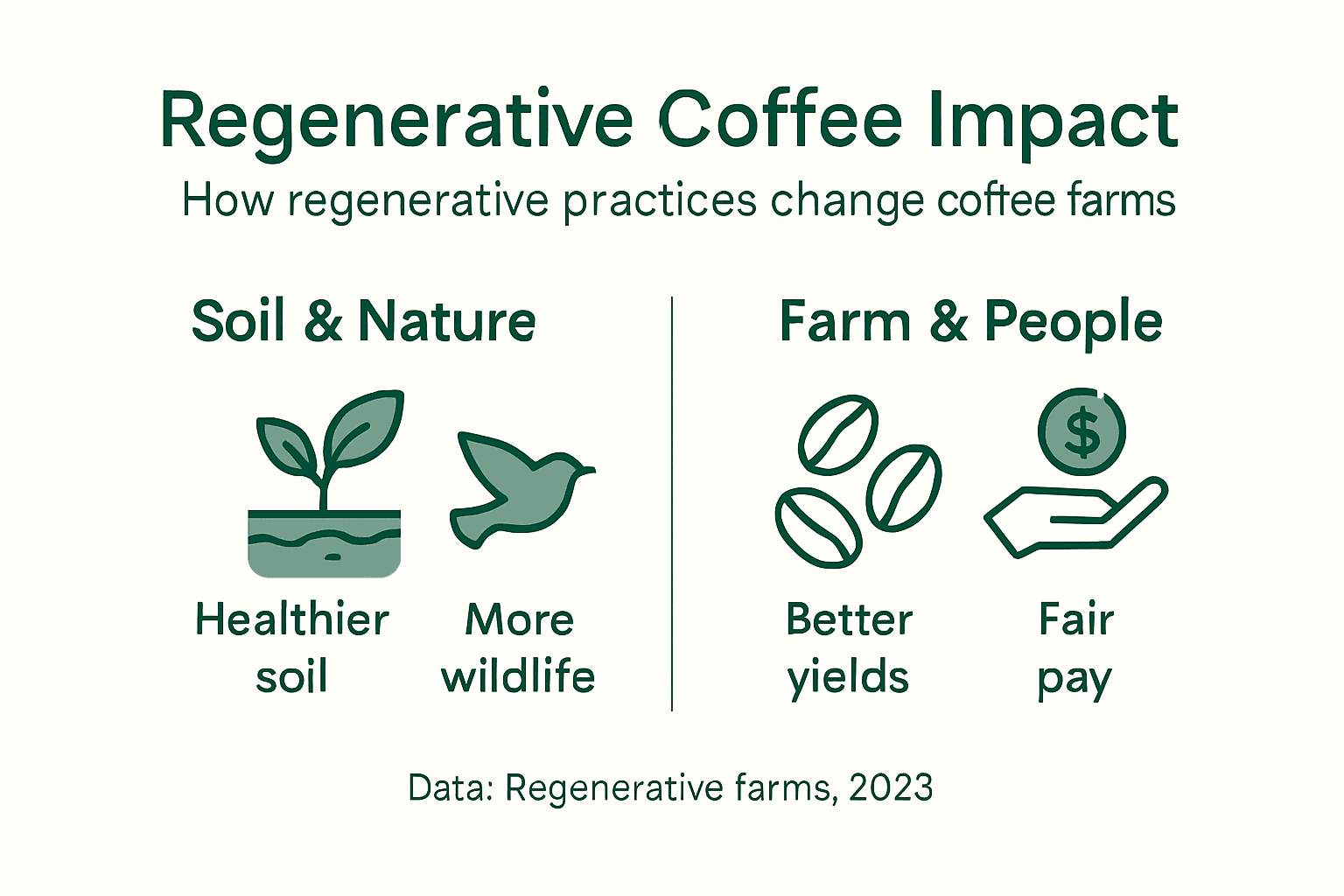
The following table summarizes how regenerative agriculture affects key coffee farming outcomes:
| Outcome Area | Traditional Impact | Regenerative Impact |
|---|---|---|
| Soil Health | Gradual decline over time | Notable improvement and restoration |
| Biodiversity | Reduced, favors few species | Enhanced, supports many species |
| Farmer Livelihoods | Volatile and input-dependent | More stable and diversified |
| Carbon Storage | Neutral or emitter | Active carbon sequestration |
Pro tip: Ask coffee farmers about their specific regenerative agriculture techniques to understand their unique ecosystem approach.
Challenges, misconceptions, and real-world barriers
Regenerative agriculture in coffee confronts significant systemic obstacles that prevent widespread adoption. Practical barriers limit transformative potential across global coffee production landscapes, requiring nuanced understanding and strategic interventions.
Common misconceptions about regenerative agriculture include:
- Practice Misunderstanding: Viewing it as simply organic farming
- Complexity Perception: Believing it’s a fixed set of techniques
- Economic Skepticism: Assuming reduced productivity is inevitable
- Implementation Doubt: Considering it too complex for small farmers
- Outcome Uncertainty: Questioning measurable environmental impacts
The real-world barriers confronting regenerative coffee agriculture are multifaceted:
- High upfront transformation costs
- Limited technical knowledge and training
- Short-term yield uncertainty
- Insufficient financial support mechanisms
- Complex stakeholder coordination requirements
Addressing these challenges requires comprehensive strategies that combine policy support, farmer education, and market incentives. Successful implementation demands collaborative approaches that recognize the unique contexts of different coffee-growing regions and provide tailored, flexible support systems.
Pro tip: Connect with local agricultural extension services to understand specific regenerative agriculture transition strategies for your region.
Comparisons: Regenerative vs. organic and conventional
Coffee farming approaches represent distinctly different paradigms of agricultural management, with regenerative agriculture emerging as a transformative model beyond traditional organic and conventional practices. Regenerative approaches create a common language for understanding sustainable agricultural ecosystems that transcend simple input restrictions.
Key differences between farming approaches include:
-
Conventional Farming: - Chemical-dependent monoculture systems
- Focus on maximizing short-term yields
- Minimal ecological consideration
-
Organic Farming: - Prohibits synthetic chemical inputs
- Follows specific certification standards
- Limited ecosystem restoration focus
-
Regenerative Agriculture: - Holistic ecosystem restoration
- Measurable environmental outcomes
- Dynamic and adaptive strategies
Comparative framework highlights fundamental distinctions:
Here’s how the key types of coffee farming differ across major factors:
| Factor | Conventional | Organic | Regenerative |
|---|---|---|---|
| Input Use | Reliant on synthetic chemicals | Restricts to natural inputs | Integrates natural cycles |
| Ecosystem Focus | Low, single crop dominant | Moderate, limited diversity | High, promotes diversity |
| Measurement of Success | Yield maximization | Certification compliance | Environmental outcomes |
| Economic Resilience | Prone to market shocks | Improved stability | Strong risk mitigation |
- Ecosystem Perspective
- Measurement of Impact
- Long-term Sustainability Goals
- Biodiversity Integration
- Carbon Sequestration Potential
Regenerative agriculture represents a more nuanced and comprehensive approach to coffee production. Unlike conventional methods that extract resources and organic practices that merely restrict inputs, regenerative strategies actively rebuild and enhance ecological systems, creating a truly sustainable agricultural model.
Pro tip: Request detailed environmental impact reports from coffee producers to understand their genuine sustainability practices.
Experience the Real Impact of Regenerative Coffee Today
Regenerative agriculture in coffee presents complex challenges like restoring soil health, enhancing biodiversity, and supporting farmer resilience. If you seek coffee that truly reflects these values and leads the way in ecological restoration, EcoVibe Roast offers a carefully curated selection that aligns perfectly with these goals. Our commitment to sustainable sourcing means every purchase supports farms adopting regenerative methods that rebuild ecosystem functions and foster economic stability.

Discover our Best Sellers featuring coffee beans and products that embody regenerative principles. Join a community of conscious consumers who appreciate the powerful connection between quality coffee and environmental stewardship. Take action now by exploring our Coffee and Tea example products and make a difference for farmers and the planet at EcoVibe Roast. Your choice matters in supporting a restorative future for coffee.
Frequently Asked Questions
What is regenerative agriculture in coffee?
Regenerative agriculture in coffee is a holistic approach aimed at restoring ecosystem health while enhancing farmer livelihoods. It goes beyond traditional sustainable practices by implementing strategies that actively rebuild natural systems, focusing on areas such as soil health, biodiversity, water management, and farmer resilience.
How does regenerative agriculture benefit soil health?
Regenerative agriculture benefits soil health by improving soil structure, preventing erosion, enhancing nutrient cycling, increasing carbon sequestration, and boosting microbial activity. These practices lead to a more resilient and productive agricultural system.
What are some common practices in regenerative coffee farming?
Common practices in regenerative coffee farming include implementing agroforestry systems, using cover crops, practicing minimal tillage, creating natural pest management solutions, and developing composting methods. These strategies help enhance biodiversity and ecosystem functionality.
How does regenerative agriculture compare to organic and conventional farming?
Regenerative agriculture prioritizes holistic ecosystem restoration and measurable environmental outcomes, contrasting with conventional farming, which relies on synthetic chemicals and focuses on short-term yields, and organic farming, which restricts synthetic inputs but lacks a comprehensive restoration focus.
Recommended
- Role of Social Impact in Coffee – Why It Matters – EcoVibe Roast
- Social Impact Coffee: Creating Positive Change With Every Cup – EcoVibe Roast
- How Coffee Production Drives Global Deforestation – EcoVibe Roast
- Sustainability Trends in Coffee 2026: Impact on Ethical Choices – EcoVibe Roast
- Change thats baked in: How our family run bakery is responding to the – St Mawes bakery, family run bakery.
- Why Sustainable Gardening Practices Matter for Americans – AMAZING GARDEN
- Какво е био кафе: ползи, стандарти и избор – Neurofuel™️


