

Grabbing your favorite coffee can feel empowering, but with so many buzzwords and labels, it’s easy to get lost in what actually makes a brew eco-conscious. Coffee is produced on 10 million hectares across 12.5 million farms in countries like Brazil, Ethiopia, and Vietnam, connecting you to global communities and ecosystems every morning. This guide breaks down the truths and myths behind sustainable coffee, uncovering what your cup really supports and how your choices can drive real environmental change.
Table of Contents
- Eco-Conscious Coffee: Core Concepts and Myths
- Types of Sustainable Coffee Practices Explained
- Environmental and Social Impact of Coffee Choices
- How Eco-Conscious Coffee Empowers Communities
- Common Pitfalls and How Consumers Can Help
Key Takeaways
| Point | Details |
|---|---|
| Understanding Labels | Not all “sustainable” coffee labels are equal; research specific practices to support genuine eco-conscious efforts. |
| Support Local Economies | Purchasing eco-conscious coffee not only benefits the environment but also provides fair wages and empowers local farming communities. |
| Ripple Effect | Individual coffee choices can drive market demand for sustainable practices, influencing wider agricultural shifts. |
| Combat Greenwashing | Be wary of vague marketing terms; look for reputable certifications and detailed sourcing information to ensure authenticity. |
Eco-Conscious Coffee: Core Concepts and Myths
When you grab your morning coffee, you’re connecting to one of the world’s most complex supply chains. Coffee ranks among the top traded commodities globally, with production spread across 10 million hectares on 12.5 million farms in countries throughout Latin America, Africa, and Asia-Pacific. But here’s where most people get confused: eco-conscious coffee isn’t just about the beans tasting better or feeling good about your purchase. It’s about understanding what actually happens behind the scenes, separating real environmental impact from marketing hype.
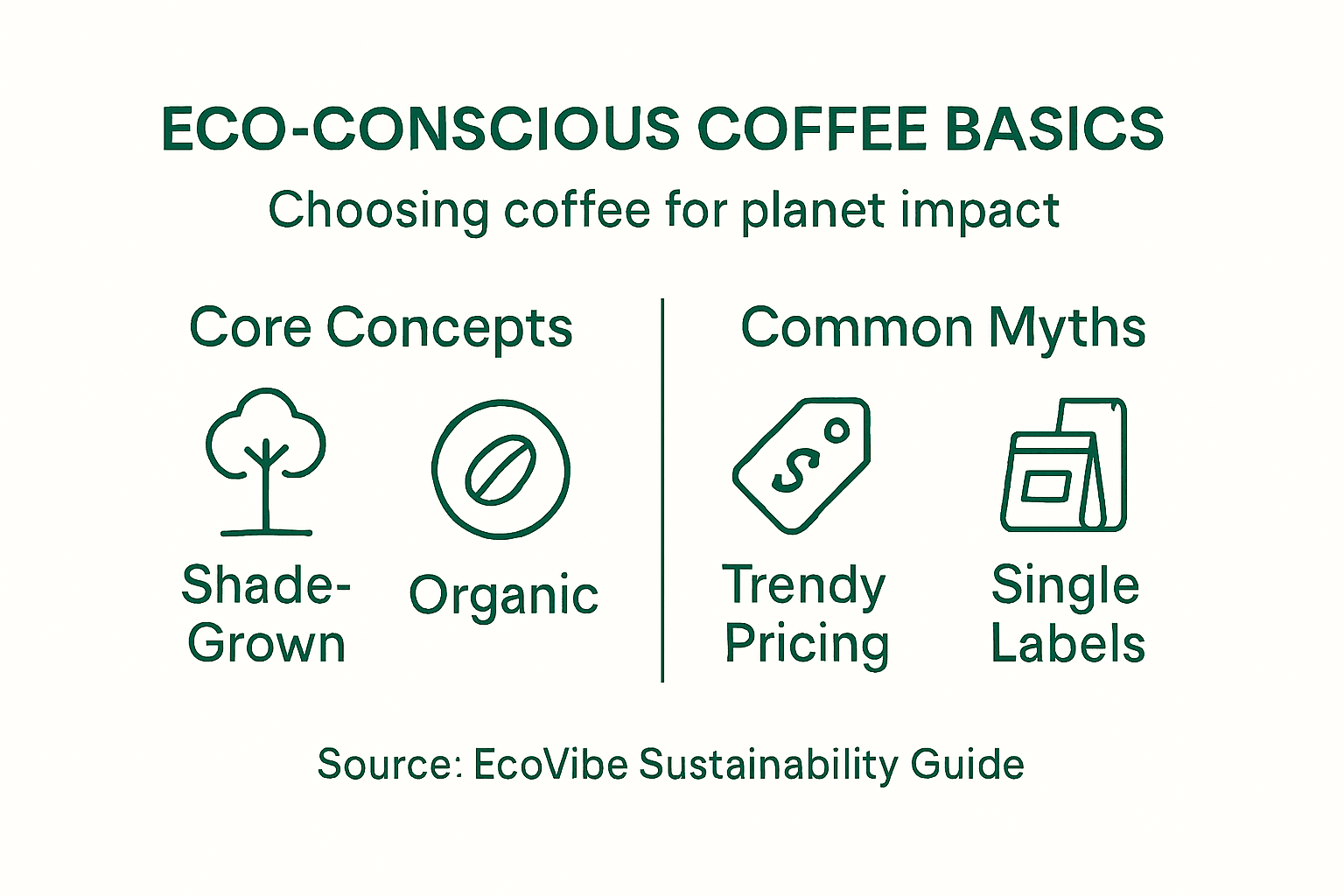
Let’s clear up some common misconceptions right away. Many people think that simply buying coffee labeled “sustainable” or “organic” means they’re saving the rainforest. That’s partially true, but incomplete. The reality is messier. Some certification schemes focus purely on economic outcomes for large corporations, while others emphasize community-led initiatives that give local farmers real decision-making power. Effective collaboration between governments, civil society, and businesses is essential for addressing the complex challenges facing coffee producers, including climate change, resource scarcity, and socio-economic pressures. Not all “sustainable” labels carry the same weight. Some certifications guarantee shade-grown practices that protect biodiversity and bird habitats, while others simply verify that farmers weren’t using the worst possible chemicals. The difference matters enormously when you understand what you’re actually supporting.
Another myth that needs debunking: eco-conscious coffee costs more because it’s trendy. The actual reason is straightforward. Sustainable practices require more labor, better soil management, and often lower yields per plant. Farmers who transition from monoculture plantations to shade-grown methods initially produce less coffee but grow it on land that remains fertile for decades. They also receive fair wages that actually cover their living expenses, unlike the exploitative prices that drive producers into poverty. When you buy from ethical sourcing practices, those costs directly support farm families, invest in better agricultural techniques, and protect the ecosystems surrounding coffee regions. The premium isn’t a markup for trendiness; it’s the true cost of coffee that doesn’t destroy the planet and exploit the people growing it.
Understanding the core concepts also means recognizing that your individual coffee choices do create ripple effects, even if they feel small. When enough consumers shift toward eco-conscious options, market demand increases. Producers see that sustainable methods command better prices. Banks become more willing to finance farms transitioning away from chemical-intensive monocultures. Entire regions can shift their agricultural practices. That’s not magical thinking; that’s how market economics actually work. Your decision to support environmentally responsible coffee producers sends a signal that influences which farms get investment, which farming methods become standard, and which ecosystems get protected versus cleared for quick profits.
Pro tip: When evaluating coffee claims, look beyond single certifications and research what specific practices a brand actually supports—whether that’s shade-grown farming, living wages for farmers, or active environmental restoration projects in coffee-producing regions.
Types of Sustainable Coffee Practices Explained
Sustainable coffee isn’t a one-size-fits-all approach. The practices that protect the environment and support farmers vary significantly depending on geography, climate, farm size, and local conditions. Understanding the different methods helps you recognize what you’re actually supporting when you choose a particular coffee. The range spans from formal certification programs recognized internationally to grassroots farmer-led initiatives that prioritize community control. Diverse sustainable approaches target farmer prosperity and sustainable sourcing through collective action strategies that improve environmental and social conditions across coffee-producing countries.
Shade-Grown and Organic Methods
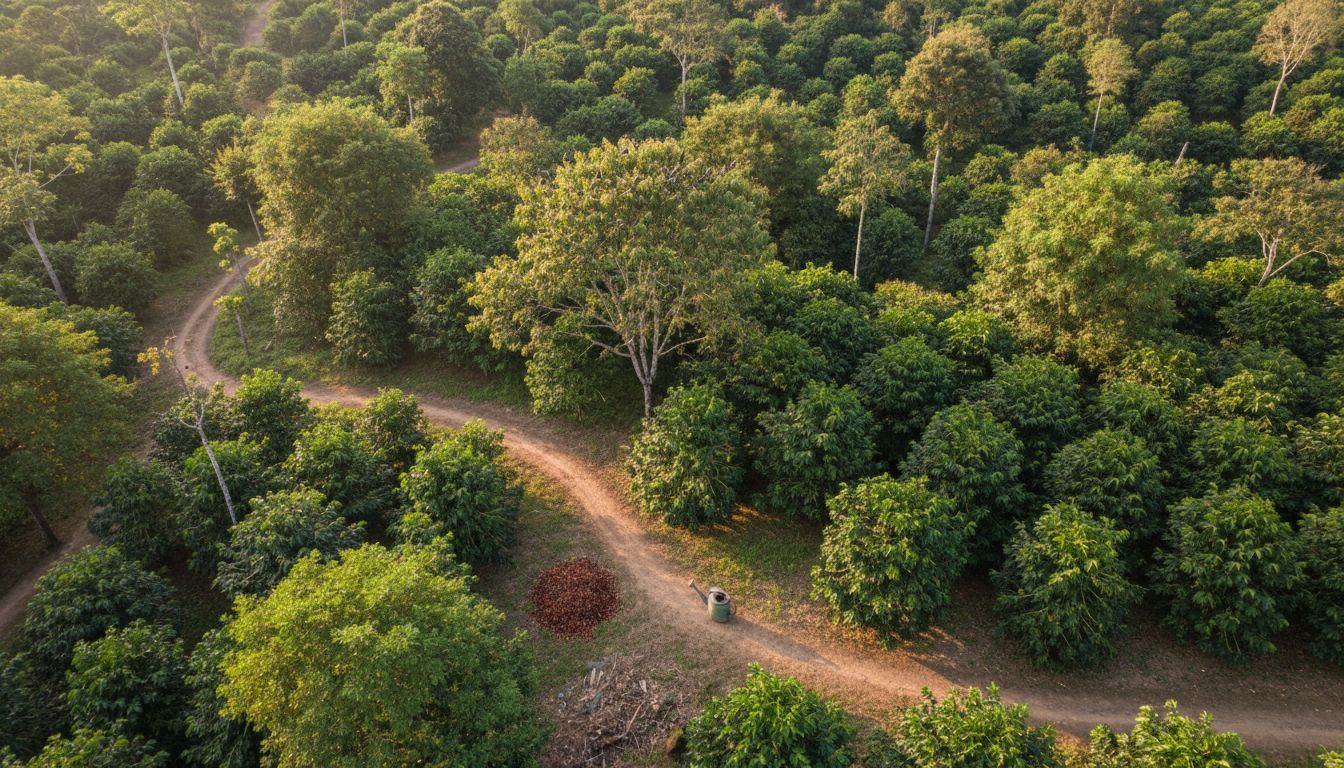
Shade-grown coffee represents one of the most environmentally beneficial practices. Instead of clearing forests to plant coffee in full sun, farmers cultivate coffee plants beneath a canopy of native trees. This approach maintains biodiversity, prevents soil erosion, and creates bird habitats that support migratory species. The shade also naturally regulates temperature and moisture, reducing water consumption during growth cycles. Organic farming complements these methods by eliminating synthetic pesticides and fertilizers that contaminate groundwater and harm surrounding ecosystems. When combined, shade-grown organic coffee creates a system that regenerates the land rather than depleting it.
Another critical practice involves renewable resources and integrated approaches that balance ecological preservation with economic viability. Farmers increasingly use compost made from coffee pulp waste, implement water conservation techniques, and rotate crops to maintain soil health. These methods require more knowledge and labor upfront but create resilient farms that remain productive for generations rather than degrading into unusable land within a decade.
Certification and Fair Trade Standards
Certification schemes like Fair Trade, Rainforest Alliance, and UTZ provide third-party verification that coffee meets specific environmental and social standards. Fair Trade certification guarantees minimum prices that actually cover production costs plus a premium for community development projects. Rainforest Alliance focuses on ecosystem protection and biodiversity conservation. These certifications create accountability, though it’s important to recognize that different programs emphasize different priorities. Some prioritize farmer income above all else, while others stress environmental restoration or biodiversity protection.
Beyond certifications, direct relationships between roasters and farmers offer another sustainable model. Small-scale importers and coffee companies build long-term partnerships with specific farmers, often visiting farms annually and paying prices that reflect the true value of sustainable practices. These relationships create transparency that no certification can match. You know exactly which farm your coffee comes from, what practices they use, and how your purchase directly impacts that family’s livelihood.
Here is a comparison of the main sustainable coffee practices and what makes each unique:
| Practice Type | Core Focus | Main Benefit | Common Challenges |
|---|---|---|---|
| Shade-Grown | Biodiversity, bird habitat | Protects forests, wildlife | Lower initial yields |
| Organic | No synthetic chemicals | Reduces pollution & runoff | Certification costs, training |
| Fair Trade Certified | Fair pricing, social goals | Ensures fair farmer income | Varies by certification scheme |
| Direct Trade | Farm-roaster relationships | Full transparency, traceability | Relies on relationship strength |
| Community-Led Initiatives | Local control, tailored standards | Empowers farmers, local solutions | Limited by organizational capacity |
Community-Led Governance and Local Initiatives
The most powerful sustainable practices often emerge from farmers themselves making decisions about their land. Community-led governance initiatives empower local producers to set standards, manage resources, and control how sustainability is defined in their region. These grassroots movements recognize that outsiders, no matter how well-intentioned, cannot understand local environmental and economic conditions as thoroughly as the people living there. When farmers lead sustainability efforts, the results reflect their actual needs and priorities rather than importing models that might not work in their specific context.
Programs connecting local cooperatives with international buyers create channels where farmers receive fair prices without intermediaries taking massive cuts. Producer organizations collectively negotiate better terms, invest in processing equipment, and fund community projects like schools and healthcare clinics. Your coffee purchase supports not just individual families but entire communities building sustainable futures.
Pro tip: Look for coffee brands that share specific farm information, farmer names, and detailed sustainability practices on their packaging or website, as this transparency signals genuine commitment beyond basic certification labels.
Environmental and Social Impact of Coffee Choices
Your morning coffee ritual connects to a chain of consequences that stretches across continents. The choices you make at the checkout counter ripple through ecosystems and into the lives of millions of coffee farmers. When you select conventional coffee grown on deforested land with heavy pesticide use, you’re indirectly supporting practices that destroy biodiversity, contaminate water supplies, and trap farmers in cycles of poverty. Conversely, when you choose eco-conscious coffee, you’re actively funding agricultural methods that regenerate soil, protect forests, and provide farmers with dignified livelihoods. Voluntary certification schemes reduce deforestation and pesticide use while simultaneously supporting fair wages and improving farmers’ economic conditions globally.
The Environmental Consequences
Conventional coffee production ranks among the most environmentally destructive agricultural practices on the planet. Industrial farms clear vast tracts of rainforest to establish monoculture plantations, eliminating habitat for thousands of species including jaguars, harpy eagles, and resplendent quetzals. The lack of shade trees means soil erodes rapidly, requiring synthetic fertilizers to maintain productivity. These chemicals leach into groundwater, poisoning drinking supplies for rural communities. Pesticides kill not just target insects but also pollinators, soil organisms, and aquatic life downstream. A single conventional coffee farm can consume enormous quantities of water, straining resources in regions already experiencing drought.
Eco-conscious coffee practices reverse these patterns. Shade-grown coffee preserves forest canopy structure, allowing birds to nest and migrate safely. Organic methods rebuild soil through natural processes rather than chemical inputs. Water conservation techniques reduce consumption to sustainable levels. Farms practicing regenerative agriculture actually sequester carbon, helping counteract climate change rather than accelerating it. The environmental difference between a conventional farm and a sustainable one isn’t marginal. It’s the difference between land that degrades with each harvest and land that becomes more productive and resilient over time.
The Human Cost of Coffee Choices
Here’s what the economics often look like for conventional coffee farmers: they produce coffee at prices set by global commodity markets that rarely cover actual production costs. When harvest prices crash, as they frequently do, farmers face an impossible choice between feeding their families and investing in their farms. Many turn to clearing more rainforest to plant more coffee, hoping volume compensates for low prices. Others abandon farming entirely, migrating to cities where they find limited opportunities and face exploitation in other industries.
Farmers producing sustainable coffee receive better compensation and improved livelihoods through fair trade premiums, direct trade relationships, and certification schemes that guarantee minimum prices. This financial stability allows them to invest in their land, educate their children, and build futures beyond subsistence. When you purchase eco-conscious coffee, you’re not paying extra for marketing hype. You’re paying prices that reflect the actual value of the work and honor the dignity of the people producing your coffee.
Below is a summary of environmental and social outcomes from choosing eco-conscious versus conventional coffee:
| Impact Area | Conventional Coffee | Eco-Conscious Coffee |
|---|---|---|
| Forests | Deforestation, habitat loss | Preserves biodiversity |
| Soil & Water | Erosion, polluted runoff | Healthy soil, cleaner water |
| Farmer Wages | Below living wages | Fair compensation, stability |
| Local Community | Profit leaves region | Funds schools, clinics, jobs |
| Climate Impact | Releases carbon, high inputs | Sequesters carbon, low impact |
Creating Systemic Change Through Consumer Choices
Individual coffee purchases might seem insignificant against massive global supply chains. But market signals compound. When enough consumers shift toward eco-conscious options, roasters adjust their sourcing. When roasters demand sustainable coffee, importers invest in relationships with certified farms. When importers compete for certified coffee, farmers receive better prices and banks become willing to finance sustainable transitions. Entire regions begin shifting away from destructive practices toward regenerative agriculture.
Your choice matters because it’s not made in isolation. Millions of eco-conscious consumers worldwide are making similar decisions simultaneously. That collective demand is already reshaping global coffee production. Farmers in Colombia, Ethiopia, and Vietnam are transitioning to shade-grown methods because market demand exists. Processing cooperatives are investing in equipment to meet specialty buyer standards. Communities are funding schools and healthcare clinics with premiums from sustainable coffee sales. These aren’t theoretical benefits. They’re happening right now because consumers decided their coffee choices reflected their values.
Pro tip: Track the environmental and social impact of your purchases by choosing brands that clearly communicate their farm locations, certification details, and specific community initiatives they support, creating accountability for genuine sustainability claims.
How Eco-Conscious Coffee Empowers Communities
When you purchase eco-conscious coffee, you’re not just buying a product. You’re funding a shift in power dynamics within coffee-producing regions. Communities that have historically had decisions made for them by distant corporations and international buyers are reclaiming agency over their own futures. This empowerment represents one of the most profound impacts of the sustainable coffee movement, creating ripple effects that extend far beyond individual farms into entire regions and generations.
Local Leadership and Community Control
The most effective sustainable coffee initiatives place decision-making power directly in the hands of farmers and their communities. Community-led governance empowers local actors to assess risks and benefits directly impacting their farming practices and livelihoods, fostering resilience against climate change and strengthening socio-economic conditions. When farmers set their own sustainability standards rather than following blueprints imposed from outside, the results reflect actual local priorities. A community might prioritize biodiversity protection in one region, water conservation in another, and cultural preservation in a third. They understand their specific ecosystems, markets, and challenges better than any external consultant ever could.
This shift from top-down management to community leadership creates genuine buy-in. Farmers are more likely to adopt practices they designed themselves than mandates handed down from distant bureaucracies. Local organizations can adjust strategies as conditions change, respond to emerging challenges, and celebrate successes in ways that matter to their specific communities. When a cooperative successfully transitions 50 farms to shade-grown methods, that achievement strengthens the group’s confidence to pursue even more ambitious goals. Community leadership builds institutional knowledge and capacity that compounds over time.
Economic Empowerment Through Fair Compensation
Eco-conscious coffee creates direct economic benefits for farming families. When communities receive fair prices for their coffee, resources flow into local economies in meaningful ways. Families invest in education for their children, building a foundation for economic mobility across generations. Health clinics receive funding to serve rural areas that governments often neglect. Infrastructure improves as communities collectively invest in roads, electricity, and water systems. Small processing facilities open, creating jobs beyond farming and allowing communities to capture more value from their coffee production.
The difference between exploitative and fair pricing is staggering. A conventional coffee farmer might receive two to three dollars per pound of coffee while the final retail price exceeds ten dollars per pound. A farmer producing eco-conscious coffee through direct trade relationships or certified programs might receive six to eight dollars per pound. That gap represents the difference between subsistence and stability. It’s the difference between borrowing money at exploitative interest rates to survive the off-season versus having savings to weather economic challenges. It’s the difference between children attending school versus working in the fields.
Building Knowledge and Innovation Capacity
Empowered communities become laboratories for innovation. Applied research and knowledge-building empower coffee-growing communities through innovations that improve quality, sustainability, and economic outcomes while enhancing livelihoods and promoting resilience. Farmer networks share techniques for shade-grown cultivation, soil health improvement, and water management. Universities and research institutions increasingly partner with farmers as genuine collaborators rather than subjects of study. When farmers participate in research design and implementation, the results address real problems rather than theoretical questions.
This knowledge empowerment creates compound benefits. Techniques that prove effective in one community spread to neighboring regions. Young people see opportunities in sustainable agriculture instead of viewing it as a dead-end livelihood. Women’s groups organize to address gender-specific challenges in coffee production. Innovations emerge from unexpected places because farmers, not distant scientists, are driving the research agenda toward solving problems they actually face. A farmer might develop a new composting method that significantly reduces pest pressure, or discover that a particular shade tree combination improves both coffee quality and local food security.
Long-Term Community Resilience
Ultimately, eco-conscious coffee empowers communities to build resilience against shocks that previously threatened their survival. Climate change brings unpredictable rainfall patterns, unexpected frosts, and new pests. Communities practicing regenerative agriculture with diversified shade trees, healthy soil, and strong local knowledge adapt more effectively than monoculture operations dependent on external inputs. Economic shocks hit less severely when communities control their own processing, have direct buyer relationships, and aren’t entirely dependent on commodity market prices.
Political empowerment also emerges as communities grow stronger economically and organizationally. Farmer associations have voice in regional and national policy discussions. Cooperative leaders participate in trade negotiations. Indigenous communities practicing sustainable coffee production gain leverage to protect territorial lands and cultural practices. This political influence extends protection to forest ecosystems, water sources, and the cultural heritage of coffee-growing regions.
Pro tip: Support eco-conscious coffee that benefits communities by choosing brands that transparently share how their purchasing practices fund community development projects, and consider following producer organizations on social media to learn directly about their work and priorities.
Common Pitfalls and How Consumers Can Help
Buying eco-conscious coffee is a great start, but genuine sustainability extends beyond the checkout counter. Many well-intentioned consumers unknowingly undermine their environmental impact through common pitfalls that waste resources, create pollution, or support practices that contradict their values. Understanding these pitfalls and learning how to avoid them transforms your coffee routine into a truly sustainable practice. The good news is that most pitfalls have straightforward solutions that actually improve your coffee experience while reducing your environmental footprint.
The Overconsumption and Waste Problem
One of the most overlooked pitfalls is simply drinking more coffee than you need or wasting what you purchase. Overconsumption defeats the purpose of buying sustainable coffee because you’re essentially multiplying the environmental impact of production across unnecessary cups. A person drinking five cups daily is demanding five times the resources of someone drinking one intentional cup. Beyond consumption volume, waste represents a massive hidden problem. Many people discard coffee grounds without considering their potential, creating unnecessary landfill waste that decomposes and releases methane, a potent greenhouse gas.
Sustainable coffee consumption habits address overconsumption and waste management through education about responsible disposal of coffee grounds and circular economy principles. Coffee grounds contain nitrogen and potassium, making them valuable for composting and gardening rather than garbage. They can also be repurposed into natural scrubs, odor eliminators, or fuel for renewable energy. When you shift from viewing coffee grounds as waste to recognizing them as a resource, you close a loop in the coffee system. Even the packaging deserves consideration. Single-serve pods create enormous waste streams that persist in landfills for decades, while whole beans in compostable packaging or bulk bins minimize packaging waste entirely.
The Greenwashing Trap
Another critical pitfall involves falling for greenwashing, where brands use environmental marketing language without substantive practices behind it. A coffee labeled “natural,” “eco-friendly,” or “green” might mean almost nothing. These unregulated terms allow companies to sound sustainable while continuing destructive practices. You might purchase coffee believing you’re supporting environmental protection when you’re actually funding farms that use heavy pesticides, clear-cut forests, and exploit workers.
The solution requires becoming a skeptical consumer. Look beyond marketing language to actual certifications from established third-party organizations like Fair Trade International, Rainforest Alliance, or UTZ. Research the company’s sourcing practices. Do they publish information about where their coffee comes from? Can you identify specific farms or regions? Do they disclose their supply chain transparently? Legitimate eco-conscious coffee companies provide detailed information about their sourcing, farming practices, and community relationships because they have nothing to hide. Companies vague about their sourcing or overly reliant on vague language are raising red flags.
Making Informed Purchasing Decisions
Educating yourself about sustainable coffee transforms you from a passive consumer into an active participant in the industry’s transformation. Educating consumers on sustainable habits is essential to avoiding pitfalls like overconsumption, waste, and unsustainable purchasing through accessible educational content and digital tools. Start by asking questions. What certifications does the coffee have? Where exactly was it grown? What specific sustainability practices does the farmer use? How much of your purchase price reaches the farmer? Which environmental initiatives does the company support? Companies genuinely committed to sustainability answer these questions readily and enthusiastically.
Consider building a relationship with a local roaster who knows their suppliers personally. Direct relationships create accountability that no certification can match. You can ask about specific farms, visit if possible, and understand exactly what your money supports. Small roasters often provide traceability that major corporations cannot match. If you prefer larger brands, at least choose ones with strong sustainability credentials and transparent sourcing information.
Your Role in Systemic Change
As a consumer, you hold more power than you might realize. When you ask questions, demand transparency, and refuse to purchase greenwashed products, you send market signals that influence how companies operate. When you compost coffee grounds instead of discarding them, you demonstrate that circular economy practices work. When you choose smaller portions of higher quality coffee over larger quantities of mediocre coffee, you reduce demand for industrial production. These individual choices compound when multiplied across millions of consumers.
You can also advocate beyond your personal purchases. Share what you learn with friends and family. Support policies promoting sustainable agriculture and fair trade. Choose cafes and restaurants that prioritize eco-conscious coffee. Participate in community discussions about sustainability. Your voice amplifies when joined with others pushing for systemic change. The coffee industry is transforming because consumers demanded better alternatives. That transformation continues only when we maintain pressure for genuine sustainability rather than settling for marketing hype.
Pro tip: Create a simple sustainability checklist for coffee purchases by verifying three things before buying: authentic third-party certification, transparent farm location information, and confirmation that the company funds specific environmental or community initiatives you can actually identify.
Choose Eco-Conscious Coffee That Truly Makes a Difference
The challenge with sustainable coffee lies in understanding how your choices impact the environment and the lives of farmers around the globe. This article uncovers key issues like deforestation, unfair wages, and misleading “green” labels that many consumers face. At EcoVibe Roast, we share your commitment to authentic sustainability by offering coffee that reflects real eco-conscious practices such as shade-grown farming, fair pricing, and community empowerment.
Browse our Best Sellers – EcoVibe Roast to discover responsibly sourced coffee varieties carefully selected to align with these values.

Make a meaningful impact today by choosing coffee and tea from EcoVibe Roast. Your purchase supports environmental stewardship through mangrove planting and ocean-bound plastic removal while empowering farming communities to thrive. Start exploring our carefully curated Coffee and Tea example products – EcoVibe Roast and join a community dedicated to sustainability at EcoVibe Roast. Your conscious choice sends ripples of positive change that go far beyond the cup.
Frequently Asked Questions
What is eco-conscious coffee?
Eco-conscious coffee refers to coffee produced with sustainable practices that prioritize environmental health and social equity. This includes methods such as shade-grown farming, organic techniques, and fair trade certifications that support both ecosystems and the livelihoods of coffee farmers.
How does eco-conscious coffee impact the environment?
Eco-conscious coffee practices help preserve biodiversity, protect soil health, and conserve water. By using methods like shade-grown farming, these practices maintain forest ecosystems and prevent soil erosion, reducing the environmental footprint of coffee production.
Why is eco-conscious coffee often more expensive than conventional coffee?
Eco-conscious coffee may cost more due to the labor-intensive sustainable methods employed, fair wages for farmers, and potential lower yields. The price reflects the true cost of environmentally responsible practices that ensure long-term viability for both the land and the people working it.
How can my coffee choices create a positive impact?
Your coffee choices can drive demand for sustainable practices, encouraging producers to adopt eco-friendly methods. When consumers prioritize eco-conscious coffee, it signals to the market that there is a demand for better environmental practices, leading to systemic change in the coffee industry.


