

TL;DR:
- Coffee’s flavor mainly depends on its origin, which accounts for about 60 percent of the taste profile before roasting or brewing. Altitude, soil type, and processing methods further influence flavor, body, and acidity, shaping each region’s signature notes. Properly controlling brewing parameters allows for accurate comparison and a deeper appreciation of regional differences.
Coffee origin is the single strongest predictor of what your cup will taste like, accounting for roughly 60% of a coffee’s flavor profile before roast or brewing even enter the picture. This coffee origin flavor guide breaks down how geography, altitude, soil type, and processing method work together to create the aromatic, fruit-forward brightness of an Ethiopian Yirgacheffe or the smooth, chocolatey depth of a Brazilian Santos. The Specialty Coffee Association’s Coffee Flavor Wheel gives enthusiasts a shared vocabulary for these differences, while altitude classifications like SHB (Strictly Hard Bean) and SHG (Strictly High Grown) signal bean density and flavor complexity. Understanding these factors transforms you from someone who picks coffee by bag design into someone who selects with real intention.
What are the major coffee origin regions and their flavor profiles?
Coffee’s flavor diversity maps almost perfectly onto geography. Volcanic soils drive acidity and complexity, clay soils build body and earthiness, and laterite soils produce mineral-driven profiles. Think of it the way chefs think about terroir in food and drink: the land leaves a fingerprint on everything grown in it.
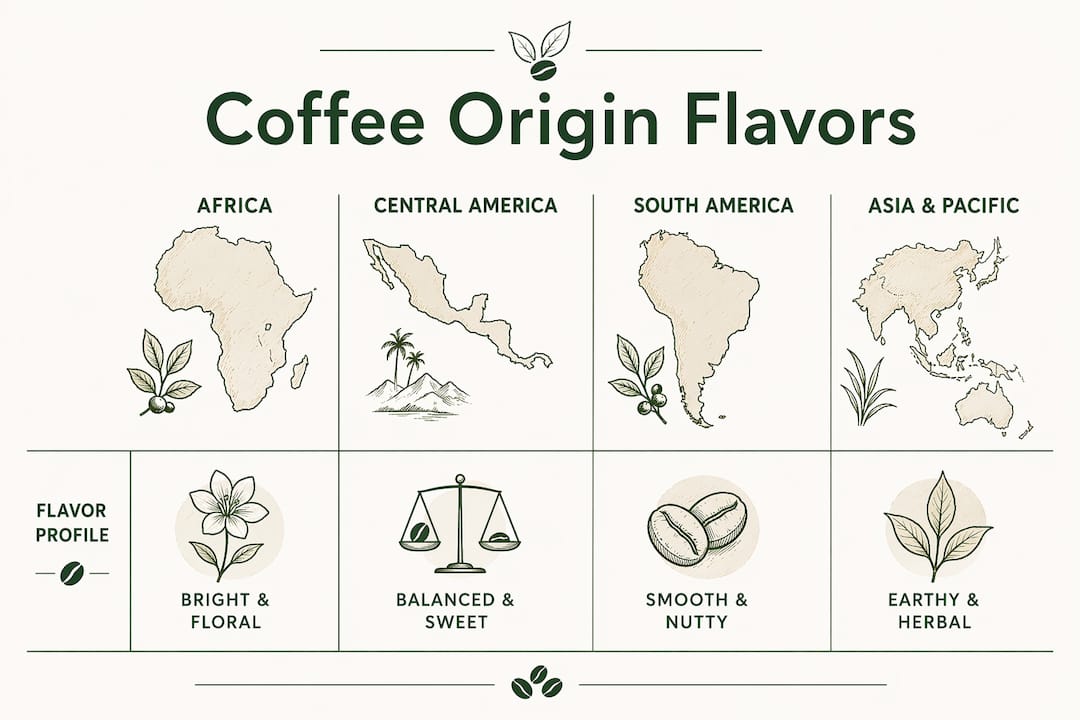
Africa: bright, floral, and fruit-forward
African coffees set the standard for complexity. Ethiopian Yirgacheffe and Sidamo deliver jasmine, blueberry, and stone fruit notes, while Kenya AA produces a wine-like blackcurrant brightness that stops experienced tasters mid-sip. High altitude, volcanic soils, and a vast pool of heirloom varietals combine to make East Africa the most expressive coffee region on earth. If you want a cup that genuinely tantalizes your taste buds with something unexpected, start here.
Central America: balanced, sweet, and crisp
Guatemala, Costa Rica, and Honduras produce coffees that sit in a satisfying middle ground. You get bright acidity, but it never overwhelms. Caramel sweetness, milk chocolate, and gentle spice notes show up consistently, making Central American beans ideal for enthusiasts who want complexity without the intensity of African coffees. The volcanic highlands of Guatemala’s Antigua region are a particularly reliable source of this profile.
South America: smooth, nutty, and chocolatey
Brazil and Colombia dominate global supply, and for good reason. Brazilian beans grown at lower altitudes produce a naturally lower acidity, with nutty, milk chocolate, and caramel notes that feel like a warm hug in the morning. Colombian coffees add a little more brightness and a clean sweetness from the country’s two annual harvest cycles. Peru’s high-altitude beans are gaining recognition for their delicate floral notes alongside that familiar chocolate base.
Asia and the Pacific: earthy, herbal, and full-bodied
Indonesian coffees from Sumatra, Java, and Sulawesi occupy a completely different flavor universe. Wet-hulled processing, unique to Indonesia, combines high-humidity drying with a distinctive fermentation step that produces earthy, cedar, and dark chocolate flavors rarely found anywhere else. Indian Monsooned Malabar takes a different route, exposing beans to seasonal monsoon winds to create a low-acid, heavy-bodied cup with a musty, woody depth.
| Region | Signature Notes | Acidity | Body |
|---|---|---|---|
| Africa (Ethiopia, Kenya) | Floral, berry, citrus | High | Light to medium |
| Central America (Guatemala, Costa Rica) | Caramel, spice, apple | Medium | Medium |
| South America (Brazil, Colombia) | Chocolate, nuts, caramel | Low to medium | Medium to full |
| Asia/Pacific (Indonesia, India) | Earth, cedar, herbs | Low | Full |
How do altitude and processing methods shape flavor?
Altitude slows cherry maturation at elevations above 1,200 meters, giving the bean more time to develop complex sugars and organic acids. That extra time is why a high-grown Guatemalan coffee tastes more layered than a flat-land Brazilian. The SHB and SHG labels signal this density directly: denser beans hold more flavor precursors and respond better to careful roasting.
Processing method is the other major lever. Washed, natural, and honey processing each produce dramatically different results from the same raw cherry.
| Processing Method | Flavor Character | Body | Best For |
|---|---|---|---|
| Washed | Clean, bright, high acidity | Light to medium | Showcasing origin terroir |
| Natural | Fruity, wine-like, heavy | Full | Bold, complex cups |
| Honey | Balanced sweetness, smooth | Medium | Middle-ground preference |
Washed coffees strip the fruit away before drying, so the bean’s inherent terroir character shines through cleanly. Natural processing dries the whole cherry intact, letting fruit sugars ferment into the bean and producing that heavy, wine-like body you find in many Ethiopian naturals. Altitude and processing together account for roughly 40% of flavor variability that origin alone cannot explain. Two coffees from the same country can taste radically different based on these two factors alone.
Pro Tip: Honey processing is the best entry point if you want fruit-forward sweetness without the full intensity of a natural process coffee. Look for “yellow honey” or “red honey” labels, which indicate how much fruit mucilage was left on the bean during drying.
How does roast level affect origin flavor expression?
Roast level determines how much of the origin’s character survives into your cup. Light roasts preserve bright acidity and fruit notes, keeping the terroir front and center. A light-roasted Ethiopian Yirgacheffe will taste like blueberry and jasmine. Roast the same bean dark, and those notes disappear behind smoke and bitterness.
The chemistry behind this is straightforward. The Maillard reaction creates caramelization and new aromatic compounds as heat increases. Strecker degradation then breaks down amino acids into roasted, nutty aromas at higher temperatures. Both processes are irreversible, which is why dark roasting is a one-way door away from origin character.
- Light roast: Preserves floral, fruity, and citrus notes; highest acidity; best for single-origin African and Central American coffees
- Medium roast: Balances origin brightness with roast-driven caramel and chocolate; works well with Colombian and Guatemalan beans
- Dark roast: Emphasizes smoky, bitter, roasted flavors; origin character is largely muted; suits Indonesian and Brazilian beans that already carry low acidity
Matching roast level to origin is one of the most underused skills in home brewing. A dark-roasted Ethiopian is not a bad coffee. It is just a coffee where you paid for origin complexity and then roasted it away.
Pro Tip: If you want to taste what a region actually offers, always start with a light or medium roast from that origin. Dark roast the same bean later if you prefer that style, but learn the origin’s baseline first.
How do you taste and compare coffees from different origins?
Consistent brewing is the foundation of any useful coffee flavor comparison. If you change your grind size, water temperature, or brew time between coffees, you are comparing your technique, not the beans. Lock in your parameters first, then swap only the coffee.
A simple five-question framework makes tasting approachable without requiring you to memorize the entire Coffee Flavor Wheel on day one:
- Fruit or chocolate? Does the cup lean toward berry, citrus, and floral notes, or toward nuts, caramel, and dark chocolate?
- Bright or round? Is the acidity sharp and lively, or does the cup feel smooth and mellow?
- Light or full body? Does it feel like tea in your mouth, or more like whole milk?
- Sweet or bitter? Where does the finish land after you swallow?
- Clean or complex? Is there one dominant note, or do flavors shift as the cup cools?
These five questions map directly onto the regional profiles covered earlier. A “fruit, bright, light, sweet, complex” answer points toward Africa. A “chocolate, round, full, sweet, clean” answer points toward South America. You can build your coffee tasting palate systematically this way without needing a professional cupping setup.
The Specialty Coffee Association’s Coffee Flavor Wheel is worth learning once you have a few tastings under your belt. It organizes flavors into families, moving from broad categories like “fruity” or “nutty” down to specific notes like “blackcurrant” or “hazelnut.” Using it alongside your five questions gives you a precise vocabulary for what you are tasting.
Pro Tip: Let your coffee cool to around 140°F before your first real sip. Many origin flavors, especially floral and fruit notes, are masked by heat. The cup reveals more as it cools.
Key Takeaways
Coffee origin, altitude, processing method, and roast level each play a defined role in shaping flavor, and understanding all four together gives you reliable control over what ends up in your cup.
| Point | Details |
|---|---|
| Origin predicts flavor | Geography accounts for roughly 60% of a coffee’s flavor profile before processing or roast. |
| Altitude adds complexity | Beans grown above 1,200 meters develop denser structure and more nuanced acidity. |
| Processing transforms taste | Washed, natural, and honey methods each produce distinct sweetness, body, and clarity. |
| Roast level is a choice | Light roasts preserve origin character; dark roasts replace it with roast-driven notes. |
| Consistent brewing isolates origin | Standardizing grind, temperature, and brew time lets you compare origins fairly. |
What I have learned from years of tasting across origins
I spent my first two years as a coffee enthusiast chasing dark roasts because they felt “serious.” That was a mistake I am glad I made early. The moment I tried a light-roasted Ethiopian natural side by side with a washed Kenyan, I realized I had been tasting the roaster’s preference, not the farmer’s work.
The most useful shift in my thinking came from accepting that origin labels are a starting point, not a guarantee. A single-origin coffee from Ethiopia does not automatically taste better than a well-crafted blend. Quality depends on the specific farm, the harvest year, the processing care, and the freshness of the roast. I have had disappointing Yirgacheffes and extraordinary Sumatrans. The label tells you the direction, not the destination.
What I would tell any enthusiast starting this path: buy small quantities from multiple regions in the same week and brew them back to back with identical parameters. The contrast is more educational than any article, including this one. You will feel the difference between a bright Kenyan and a heavy Sumatran in a way that sticks with you permanently. And once you start noticing how altitude and processing shift the flavor even within a single country, the whole world of coffee opens up in a genuinely exciting way.
— LaSaundra
Ecoviberoast makes origin exploration easy and sustainable
Ecoviberoast curates single-origin coffees sourced from the regions covered in this guide, with clear tasting notes and processing details on every product page. Each purchase supports mangrove tree planting and ocean-bound plastic removal, so your flavor curiosity does real good in the world.

Whether you want to compare a washed Ethiopian with a honey-processed Costa Rican or follow the expanded brew guide to dial in your extraction, Ecoviberoast has the resources to support every step. If you want to round out your tasting sessions with something equally expressive, the Hibiscus Berry Tea brings the same fruit-forward brightness you love in African coffees, in a caffeine-free herbal form that is refreshing any time of day.
FAQ
What does coffee origin mean for flavor?
Coffee origin refers to the geographic region where beans are grown. Origin accounts for roughly 60% of a coffee’s flavor profile, with altitude, soil, and climate all contributing to its signature taste.
Which coffee origin has the most complex flavor?
African origins, particularly Ethiopia and Kenya, produce the most complex flavor profiles. Ethiopian Yirgacheffe and Sidamo are known for jasmine, blueberry, and citrus notes driven by high altitude and heirloom varietals.
How does processing method change coffee flavor?
Processing method dramatically alters sweetness, body, and clarity. Washed processing yields clean, bright acidity, natural processing adds fruity, wine-like body, and honey processing delivers a balanced middle ground.
Does roast level affect origin character?
Yes, roast level directly determines how much origin flavor survives. Light roasts preserve floral and fruit notes, while dark roasts replace origin character with smoky, bitter, roast-driven flavors.
Can two coffees from the same country taste completely different?
Absolutely. Altitude and processing together account for roughly 40% of flavor variability beyond origin alone, meaning two Colombian coffees processed differently at different elevations can taste like they come from separate continents.


