

If you want a guaranteed price floor and direct cash back to farming communities, look for Fairtrade. If you care more about forest protection, biodiversity, and on-farm environmental practices, Rainforest Alliance is your match. Plenty of great products carry both seals, and some brands, including Ecoviberoast, weigh both when sourcing beans and leaves.
Neither seal is a magic shield against every supply chain problem. Certification reduces risk and builds in outside verification, but it does not promise a perfectly clean chain from farm to cup.
- Fairtrade International anchors its model around a minimum price and a community premium.
- Rainforest Alliance anchors its model around farm-level environmental standards and buyer-funded payments.
- Both are members of ISEAL, the umbrella group that vets credible standards systems.
Key Takeaways
Fairtrade guarantees a fixed minimum price and premium, while Rainforest Alliance relies on variable buyer-funded payments tied to environmental farm standards.
| Point | Details |
|---|---|
| Different core promise | Fairtrade guarantees price and community premium; Rainforest Alliance emphasizes farm-level environmental standards. |
| Money flow varies | Fairtrade Premium is fixed and disclosed; Rainforest Alliance’s Sustainability Differential varies by contract. |
| Traceability matters most | Look for “identity-preserved” claims over vague “supports farmers” language. |
| Both share oversight | Fairtrade and Rainforest Alliance are both ISEAL members with third-party audits. |
| Income impact is mixed | Independent research shows benefits depend on how much output sells under certified terms. |
Table of Contents
- Fair Trade vs. Rainforest Alliance at a Glance
- How the Money Actually Moves From Buyer to Farmer
- Standards, Audits, and What Each Program Enforces on the Ground
- What These Labels Actually Promise You at the Shelf
- Where Both Certifications Fall Short
- A Buyer’s Checklist for Choosing Between the Two
- Ecoviberoast’s Sourcing Stance
- Editorial Take: What Actually Matters When You’re Standing at the Shelf
- Sources
Fair Trade vs. Rainforest Alliance at a Glance
The two certifications solve different problems, and once you see them side by side, the choice gets a lot less confusing.
- Core focus: Fairtrade centers on trade terms and producer income; Rainforest Alliance centers on farm sustainability and environmental risk. If you want economic protection for growers first, lean Fairtrade.
- Payment mechanism: Fairtrade uses a fixed minimum price plus a cash premium; Rainforest Alliance uses a variable Sustainability Differential and optional Sustainability Investments. If you want price predictability, Fairtrade’s model is more transparent.
- Environmental criteria: Rainforest Alliance’s standard leans heavily on biodiversity, water, and deforestation safeguards. If forest protection matters most, prefer Rainforest Alliance.
- Labor protections: Both address forced labor, child labor, and gender equality, but Fairtrade ties worker benefits more directly to premium spending decisions made by producer groups.
- Traceability: Rainforest Alliance and Fairtrade both offer mass-balance and identity-preserved options depending on the supply chain, so check the brand’s own disclosure.
- Consumer claim: Fairtrade signals “farmers got a guaranteed floor price.” Rainforest Alliance signals “this farm met environmental and social criteria.”
How the Money Actually Moves From Buyer to Farmer
Money is where these two programs diverge the most, and it is the detail most shoppers never dig into.
- Fairtrade Minimum Price. Buyers must pay at least a set floor price for Fairtrade-certified crops, regardless of how far the commodity market drops. On top of that floor, buyers pay a separate Fairtrade Premium directly to the producer organization, which democratically decides how to spend it. That might mean a new well, a school scholarship fund, or a cash bonus. This structure protects growers when global prices crash, which is exactly when they need protection most.
- Rainforest Alliance SD and SI. Rainforest Alliance’s 2020 Certification Program asks buyers to pay a Sustainability Differential on top of the market price, plus optional Sustainability Investments that fund farm improvements. Unlike Fairtrade’s fixed floor, SD amounts are negotiated contract by contract, so the dollar figure a farmer actually receives can vary a lot between buyers.
- What this means at checkout. A Fairtrade label tells you a floor price was paid, full stop. A Rainforest Alliance label tells you a differential was paid, but the size of that differential is not something you can read off the package. Look for brand pages that disclose actual SD or premium amounts if you want real transparency.
Here’s the honest caveat: independent research on Fairtrade and Rainforest Alliance in cocoa found that income effects for farmers are genuinely mixed. Certification helped with monitoring and productivity in many cases, but translating that into durable livelihood gains depended heavily on how much of a farm’s output actually sold under certified terms.
Standards, Audits, and What Each Program Enforces on the Ground
Both seals run on third-party audits, but the substance of what gets checked is different.
- Rainforest Alliance enforces a farm sustainability standard covering deforestation limits, agrochemical management, water protection, and a risk-based approach to social compliance, meaning higher-risk farms face closer scrutiny.
- Fairtrade builds its standard around producer-organization governance: how cooperatives are run, how the minimum price is guaranteed, and how the premium gets allocated for community benefit, layered with its own environmental and social criteria.
- Both organizations are ISEAL members, and both participate in the Global Living Wage Coalition, which pushes standards systems toward living-wage benchmarks rather than legal minimums alone.
- The mechanics differ, though: Rainforest Alliance’s enforcement runs through farm audits and buyer contracts, while Fairtrade’s runs through price guarantees baked directly into trade terms. Learning more about rainforest coffee’s sustainability practices helps clarify what “farm management” actually covers on the ground.
Pro Tip: Look for the phrase “identity-preserved” on a bag or product page. That means the beans stayed segregated from farm to roaster, which is a stronger traceability claim than “mass-balance,” where certified and non-certified beans mix in the supply chain and only a percentage is tracked on paper.
What These Labels Actually Promise You at the Shelf
A seal on a bag is shorthand, and shorthand always loses some detail.
- “Supports farmers” is marketing language, not a disclosure. It tells you almost nothing about dollar amounts.
- A quantified premium disclosure, like a brand stating exactly how much Fairtrade Premium or Sustainability Differential it paid per pound, tells you far more than the seal alone.
- Identity-preserved sourcing and percentage-certified statements (“100% certified” versus “30% certified blend”) matter more than which single seal appears.
- Some brands stack both seals on one product. That usually signals the brand sources from farms meeting both sets of criteria, though it does not automatically mean a higher payout to farmers. Browsing a list of rainforest-friendly coffees shows how often dual certification shows up in practice.
Where Both Certifications Fall Short
Certification is a floor, not a ceiling, and both programs have real, documented gaps worth knowing before you shop.
- Income benefits are uneven. Gains depend heavily on how much of a farm’s total harvest actually sells at certified terms, since farmers often sell only a fraction of their crop into certified markets.
- Rainforest Alliance has faced criticism over how much of its Sustainability Differential actually reaches farmers, and how consistently buyers disclose that figure.
- Fairtrade has faced criticism that its minimum price does not always cover full production costs in every region, and that reach into smaller, less organized farmer groups remains limited.
Watchdog groups like Fair World Project argue that Rainforest Alliance certification should not be read as equivalent to Fairtrade, since the two programs guarantee fundamentally different things to producers.
Even with these limits, certification still beats the alternative. Audited standards, third-party verification, and structured incentives give you far more accountability than an uncertified supply chain with no outside checks at all.
A Buyer’s Checklist for Choosing Between the Two
Pick your priority first, then let that priority drive the label you look for.
- Ask yourself: do I care most about guaranteed price and community investment? If yes, prioritize Fairtrade and look for premium-use disclosures on the brand’s site.
- Ask yourself: do I care most about forest and biodiversity protection? If yes, prioritize Rainforest Alliance, especially for products from regions with active deforestation pressure.
- Ask yourself: do I want to know exactly where my beans or leaves came from? If yes, search for “identity-preserved” language rather than a general percentage-certified claim.
- Check the brand’s transparency. Does it publish actual premium or SD amounts, or just repeat the word “sustainable” without numbers?
- Watch for red flags: vague phrases like “ethically sourced” with no certification named, no traceability claim at all, or inconsistent labeling between a product page and the physical packaging.
Pro Tip: Bookmark a brand’s sourcing or impact page before you buy. A company confident in its numbers will show them; one that only offers a feel-good tagline usually has less to disclose. For deeper reading on how to spot real ethical sourcing versus marketing gloss, this guide to ethical sourcing in coffee and tea walks through concrete examples.
Ecoviberoast’s Sourcing Stance
Ecoviberoast plants mangrove trees and removes ocean-bound plastic with every purchase, and that same transparency mindset carries into how the brand thinks about certification.
- Ecoviberoast looks for documented premium or Sustainability Differential disclosures, not just a logo, when evaluating a supplier.
- The brand favors partners who can show real numbers behind their sustainability claims, echoing the same standards discussed in this guide to food quality standards.
- For a closer look at what Rainforest Alliance certification means in practice, see why buy Rainforest Alliance certified, and for the Fairtrade side, see reasons to buy fair trade coffee.
If you’re ready to put this into practice, Ecoviberoast’s single-serve coffee pods are sourced with exactly this kind of transparency in mind, whether you grab the 60-pack for your weekly routine or start smaller with the 12-pack original roast. Every bag or pod supports the mangrove planting and plastic removal work that makes your morning cup count for more than just flavor.
Editorial Take: What Actually Matters When You’re Standing at the Shelf
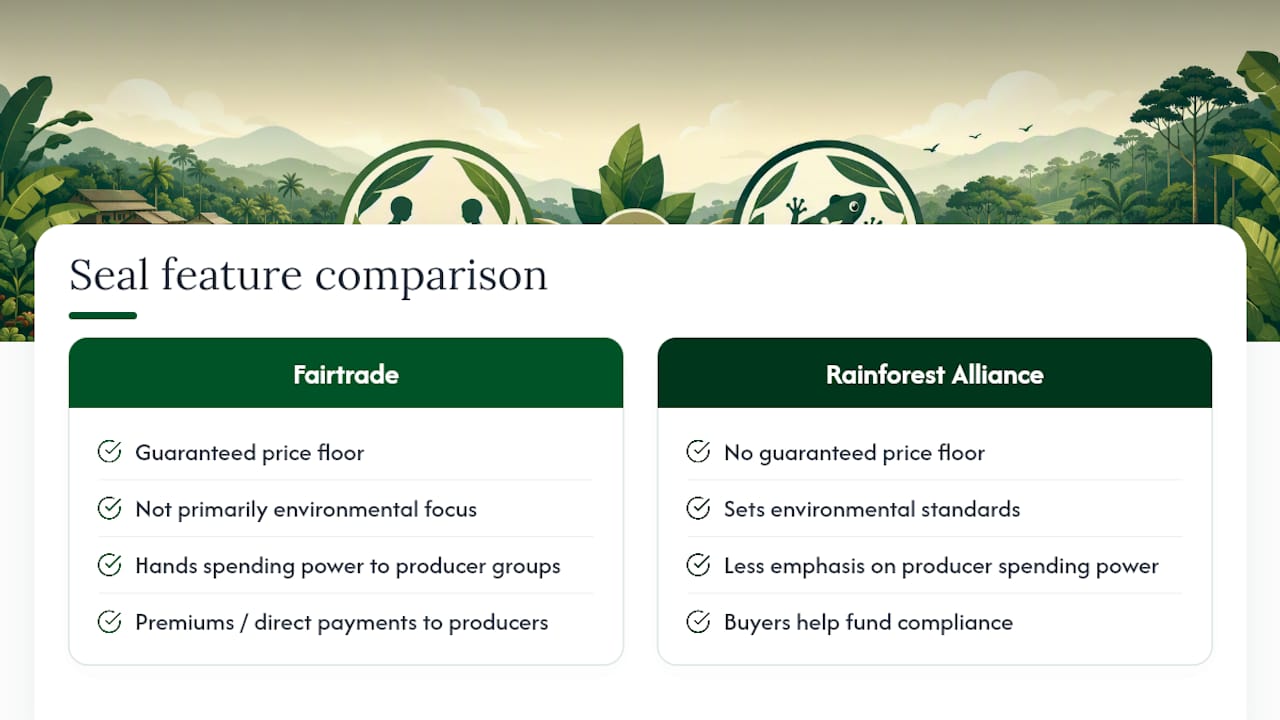
Most comparisons treat this as a scorecard, tallying points until one seal “wins.” That framing misses the point. Fairtrade and Rainforest Alliance are not competing for the same job. One guarantees a price floor and hands spending power to producer groups. The other sets environmental rules and asks buyers to help fund compliance. Asking which is “better” is a bit like asking whether a smoke detector is better than a seatbelt.
What gets underweighted in most write-ups is disclosure. A seal tells you a floor was cleared, not how far above that floor a farmer actually landed. If you only read one thing on a brand’s page before buying, read the actual premium or differential number, if they publish one. Brands that hide behind the logo alone, without a dollar figure or percentage anywhere, are giving you less than the certification itself intended to guarantee.
Prioritize transparency over the sticker. The seal gets you in the door; the disclosure tells you what’s actually inside.
— LaSaundra


