

TL;DR:
- Rainforest Alliance Certified is a broad, independent verification of environmental, social, and climate standards.
- Certification benefits smallholder farmers through training, improved yields, and ecosystem preservation.
- To maximize impact, consumers should seek dual certifications and support transparent, small-scale brands.
That little green frog on your coffee bag looks reassuring, but most of us stop there and assume the job is done. The truth is that Rainforest Alliance Certified (RAC) is one of the most far-reaching sustainability labels in the world, covering millions of farmers across 62 countries, yet it carries real nuances that every conscious consumer deserves to understand. This guide cuts through the noise. You’ll walk away knowing what the seal actually guarantees, how it helps farmers and ecosystems, where it falls short, and how to shop in a way that genuinely moves the needle for people and the planet.
Table of Contents
- What does Rainforest Alliance Certified mean?
- How does RAC make a difference for farmers and the environment?
- What are the limitations and criticisms of RAC?
- How to shop smarter: Maximizing the impact of your purchases
- Our perspective: The real value of Rainforest Alliance Certified for conscious consumers
- Taste sustainability: Try Rainforest Alliance Certified coffee and tea
- Frequently asked questions
Key Takeaways
| Point | Details |
|---|---|
| Certification scope | Rainforest Alliance Certification covers sustainability, human rights, and climate resilience for millions of smallholder farmers globally. |
| Impact varies | Certification can drive real improvements in yield, biodiversity, and training, though effects differ by crop and region. |
| No perfect label | RAC is a useful but imperfect tool—combine it with other ethical certifications and transparency for the most impact. |
| Smart shopping | Prioritize dual-certified and transparent brands to maximize positive social and environmental outcomes from your purchases. |
What does Rainforest Alliance Certified mean?
Now that you’re curious about what lies behind the green frog seal, let’s break down what Rainforest Alliance Certified truly means.
At its core, RAC is a third-party verified label. That means an independent auditor, not the brand selling you the coffee, checks whether farms and supply chains meet a defined set of standards. Those standards, known as the Sustainable Agriculture Standard, cover environmental protection, human rights, fair livelihoods, and climate resilience all at once. It’s a broad mandate, and the scale is genuinely impressive.
Key facts about RAC’s reach:
- Covers more than 6 million hectares of farmland worldwide
- Supports 7.9 million farmers and workers across 62 countries
- Appears on over 40,000 products globally
- Focuses heavily on coffee, tea, and cocoa
- 99% of certified producers are smallholder farms
That last point matters a lot. We’re not talking about industrial agribusiness. We’re talking about family-scale growers who depend on fair access to global markets to survive.
| Certification element | What it covers |
|---|---|
| Environment | Biodiversity, water, soil, deforestation |
| Human rights | Labor conditions, child labor protocols |
| Livelihoods | Income support, training, market access |
| Climate resilience | Agroforestry, emissions reduction |
One thing that sets RAC apart from some other labels is its continuous improvement approach. Audits don’t work as a simple pass-or-fail gate. Instead, farms are expected to show ongoing progress over time. This makes the system more realistic for smallholder farmers who can’t overhaul operations overnight, though it also means some farms are certified while still working toward full compliance.
A new Regenerative Agriculture Standard add-on is rolling out in 2026, raising the bar further for soil health and carbon sequestration. If you care about coffee certifications impact, this is a meaningful evolution worth watching. And if you’re just getting started learning about sustainably sourced coffee, RAC is one of the most important labels to recognize.
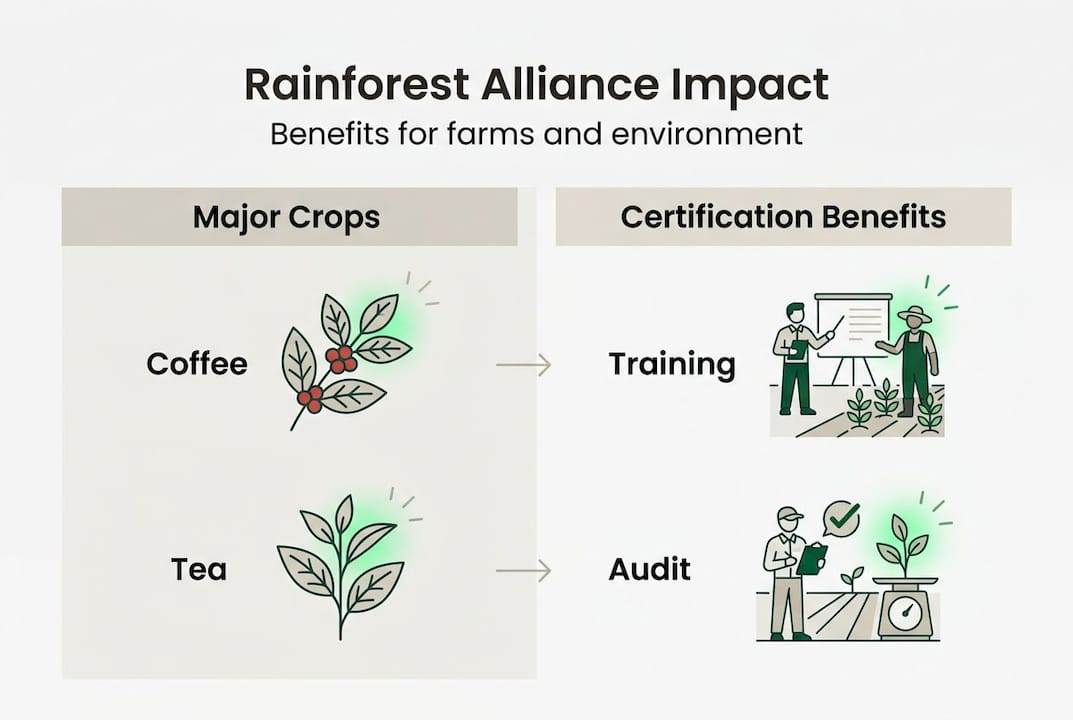
The third-party audit process applies to major crops including coffee, tea, and cocoa, making it one of the most widely applicable sustainability certifications available today.
How does RAC make a difference for farmers and the environment?
With a clear idea of RAC’s standards and scope, let’s examine what buying certified products actually achieves for people and the planet.
For farmers, the most tangible benefits often come through training and technical support. Certified farms receive guidance on better growing practices, pest management, and water conservation. The result? Higher yields and improved crop quality, which translate directly into better prices and more reliable income.
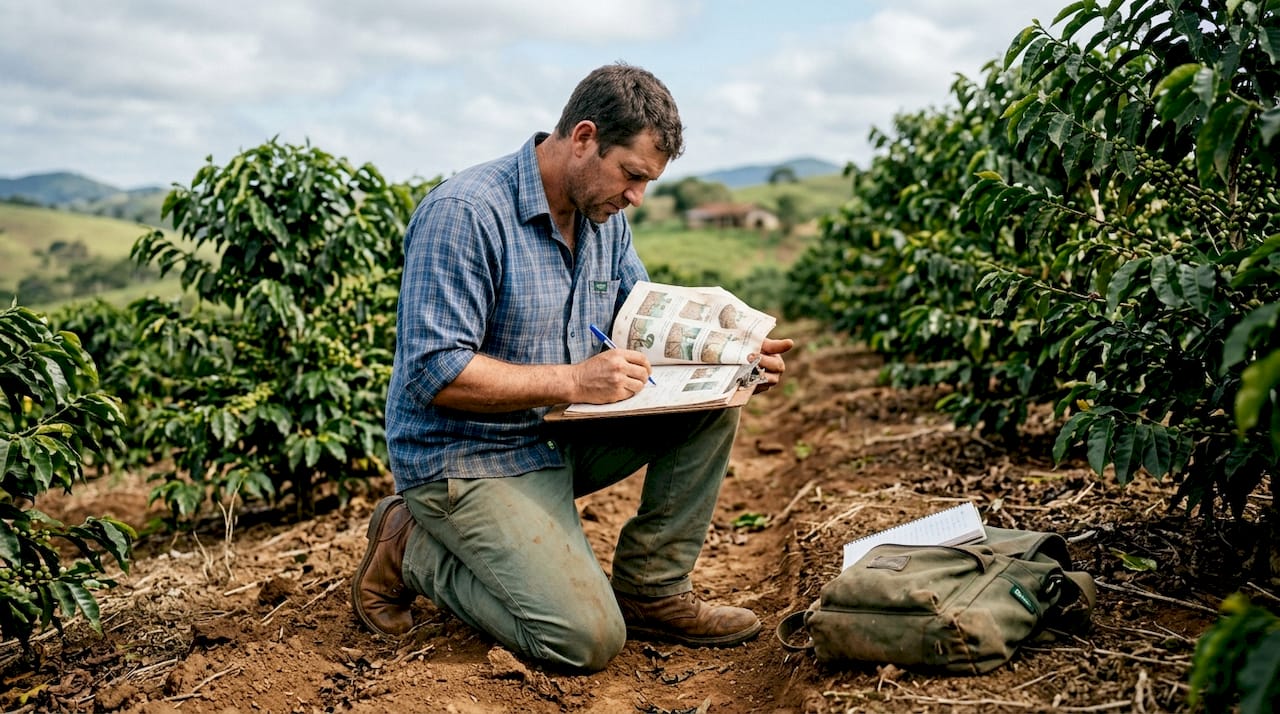
Certification outcomes research shows that training improves yields, crop prices, and income in many cases, though household income benefits are not always fully realized. The gains tend to be stronger where farms have robust local support networks alongside certification.
For farms adopting regenerative agriculture practices under the new standard, income boosts of 20 to 30% are possible. That’s life-changing for a smallholder family.
On the environmental side, the picture is genuinely encouraging for coffee in particular. Agroforestry coffee reduces biodiversity loss by 35 to 42% compared to non-certified conventional farming. Shade-grown, certified coffee supports bird populations, insect diversity, and soil health in ways that monoculture farming simply cannot.
“Certified farms are not just growing coffee. They’re maintaining living ecosystems that support communities and wildlife for generations.”
Real-world benefits of RAC for farmers and ecosystems:
- Access to better markets and premium pricing opportunities
- Reduced chemical use through integrated pest management
- Stronger community infrastructure through collective certification programs
- Protection of water sources and forest cover
- Improved resilience to climate shocks like drought and flooding
That said, the eco-friendly coffee benefits are not uniform across every region or crop. Impact varies depending on local governance, farm size, and how rigorously the certification is implemented. The coffee biodiversity results are strongest where agroforestry is genuinely practiced, not just documented on paper. Certification under sustainable agriculture standards sets the floor, but local commitment determines the ceiling.
What are the limitations and criticisms of RAC?
It’s just as important to understand where RAC has room to improve as to know its strengths.
RAC is a process-focused certification, meaning it rewards farms for following the right procedures rather than guaranteeing specific outcomes. That distinction matters. Enforcement on shade and biodiversity requirements is sometimes weaker than what you’d find under Organic or Fairtrade standards. A farm can be certified while still falling short of ideal biodiversity targets.
Here are the most commonly cited criticisms, laid out honestly:
- Child labor protocol: RAC uses an “assess-and-address” approach rather than automatic decertification when child labor is detected. Critics argue this is too lenient.
- Minimum price gap: RAC’s Sustainability Differential adds about $70 per ton to the commodity price. Fairtrade’s minimum price guarantee adds closer to $200. That’s a significant difference for farmer income floors.
- Audit evasion: There are documented cases where farms have evaded audits or misrepresented practices, raising greenwashing concerns.
- Greenwashing risk: Brands that rely solely on RAC certification as their only sustainability action can use the label as a shield rather than a genuine commitment.
- Mixed impact evidence: Studies show results vary widely by region, making blanket claims about RAC’s effectiveness hard to justify.
“A certification is only as strong as the system enforcing it and the culture surrounding it.”
Pro Tip: When evaluating a brand’s sustainability claims, look beyond the seal. Do they publish sourcing reports? Do they name their farm partners? Transparency is the real tell.
None of this means RAC is worthless. Far from it. But understanding these gaps helps you make smarter choices. Pairing RAC with other coffee certifications like Organic or Fairtrade creates a much stronger safety net. And understanding sustainable agriculture importance helps you see why even imperfect systems are better than no standards at all. The continuous improvement program is actively working to address many of these gaps.
How to shop smarter: Maximizing the impact of your purchases
With a realistic understanding of RAC’s strengths and weaknesses, here’s how you can use your buying power effectively.
The single most powerful upgrade you can make is seeking out dual-certified products. A coffee that carries both RAC and Organic certification, for example, gets you stronger biodiversity protections and reduced chemical use alongside the broad social and environmental framework RAC provides. Add Fairtrade into the mix and you also get a higher income floor for farmers.
RAC is strongest when paired with complementary certifications, especially for smallholder farmers who benefit most from stacked protections. And expert guidance consistently points to dual-certified products as the best choice for consumers who want strong ethical coverage without having to research every brand from scratch.
Your practical shopping checklist:
- Look for RAC combined with Organic, Fairtrade, or Bird-Friendly labels
- Choose brands that publish sourcing details and name their farm partners
- In 2026, watch for the new Regenerative Agriculture Standard label on coffee and tea
- Support smaller, transparent brands where your purchase has a more direct impact
- Ask brands directly about their farmer relationships and impact reporting
Pro Tip: Check the certification FAQs on the Rainforest Alliance website if you want to verify a specific product’s certification status before buying.
Think of RAC as a starting point on a journey, not the final destination. Every certified purchase you make supports sustainable farm practices and nudges supply chains in the right direction. And keeping an eye on 2026 coffee trends will help you stay ahead of new standards and emerging labels that raise the bar even further.
Our perspective: The real value of Rainforest Alliance Certified for conscious consumers
By now you can see why RAC is both praised and criticized. Here’s our take after seeing how certifications shape sustainable choices over time.
RAC isn’t a perfect system, and we’d never pretend otherwise. But perfection isn’t the standard we should be holding it to. The real question is: does it move major supply chains toward greater accountability? The answer is yes, and that matters enormously at scale.
Scale and continuous improvement may not be glamorous talking points, but they make a real difference over time, especially for smallholder farmers who have few other pathways to global markets. When millions of consumers choose certified products, they collectively create pressure on entire industries to raise their standards.
Your individual choice, especially when you support small and transparent brands, helps tip the scales. It signals to the market that accountability matters. We believe the most powerful thing you can do is be an informed, honest, and supportive critic of the certification system. Favor transparency. Seek dual certification. Reward green coffee initiatives that go beyond the minimum. That combination is how real, lasting change happens.
Taste sustainability: Try Rainforest Alliance Certified coffee and tea
Ready to put your values into action? Experience the taste and impact of sustainably sourced choices.
At EcoVibe Roast, we believe every cup should feel like a warm hug for both you and Mother Earth. That’s why our range includes options that align with everything you’ve just learned.

Our aromatic 6 Bean Blend coffee brings together rich, complex flavors from responsibly sourced farms, while our delicate Jasmine tea offers a soothing, ethically grown sip. For convenience without compromise, explore our single-serve collection and enjoy certified sustainability in every brew. With every purchase, we plant mangrove trees and remove ocean-bound plastics, because your morning ritual should do more than just taste good.
Frequently asked questions
What does the Rainforest Alliance Certified seal guarantee?
The seal means the product meets environmental and ethical standards verified by independent auditors, but it does not guarantee perfect outcomes in every area such as biodiversity or wage floors.
Is Rainforest Alliance Certified better than Organic or Fairtrade?
RAC covers broad sustainability well but is typically weaker on wage minimums and strict biodiversity enforcement compared to Organic or Fairtrade, so dual certification gives you the strongest protection.
Does buying Rainforest Alliance Certified coffee really help farmers?
It can improve yields, knowledge, and sometimes incomes through training and market access, but effects on household income are mixed and depend heavily on local conditions and support systems.
Can brands misuse the Rainforest Alliance label?
Yes. Audit evasion and greenwashing risks exist, particularly when certification is a brand’s only sustainability claim rather than part of a broader, transparent commitment.
How can I recognize ‘better’ Rainforest Alliance Certified products?
Look for dual certifications or the new Regenerative Agriculture label, and choose brands with transparent sourcing and impact reports that go beyond simply displaying the green frog seal.


