

Many people assume farming is either inherently harmful or entirely benign, but the truth is far more nuanced. Sustainable agriculture offers a balanced approach that protects the environment, supports farming communities, and ensures economic viability, particularly in coffee and tea production. As eco-conscious consumers, understanding why these practices matter helps you make informed choices that align with your values. This article explores how sustainable agriculture addresses critical environmental and social challenges, the specific benefits it brings to coffee and tea farming, and why your purchasing decisions can drive meaningful change in global food systems.
Table of Contents
- Key takeaways
- What is sustainable agriculture and why does it matter?
- Benefits of sustainable agriculture for coffee and tea farming
- Challenges and critiques of sustainable agriculture
- How sustainable agriculture helps protect the planet’s boundaries
- Explore sustainable coffee and tea options with EcoVibe Roast
- Frequently asked questions
Key Takeaways
| Point | Details |
|---|---|
| Environmental benefits | Sustainable agriculture protects soil, biodiversity, and water while cutting emissions from farming. |
| Farm resilience and income | Sustainable methods build resilient farms that endure climate shocks and keep farming livelihoods stable. |
| Coffee and tea benefits | In coffee and tea farming, practices like agroforestry and composting rebuild soil health and boost resilience. |
| Consumer impact on food systems | Your purchases help fund sustainable shifts in global food systems. |
What is sustainable agriculture and why does it matter?
Sustainable agriculture represents a farming approach that balances food production with environmental protection, social equity, and economic viability through specific practices designed to work with natural systems rather than against them. Unlike conventional methods that often prioritize short-term yields at the expense of soil health and ecosystem stability, sustainable agriculture focuses on long-term productivity while minimizing environmental harm. The three core pillars include environmental stewardship, which protects natural resources and biodiversity; social responsibility, ensuring fair labor practices and community well-being; and economic viability, supporting farmer livelihoods and market stability.
Several key techniques define sustainable agriculture in practice:
- No-till farming preserves soil structure and reduces carbon emissions by eliminating plowing
- Crop rotation breaks pest cycles and naturally replenishes soil nutrients
- Agroforestry integrates trees with crops, creating diverse ecosystems that support wildlife
- Precision agriculture uses technology to apply water and nutrients exactly where needed, reducing waste
- Cover cropping prevents erosion and adds organic matter to soil between growing seasons
These methods directly address critical environmental challenges including land degradation, which affects over 40% of global agricultural land, and biodiversity loss driven by habitat destruction. By reducing reliance on synthetic inputs and promoting soil health, sustainable practices also cut greenhouse gas emissions from agriculture, which currently accounts for roughly one quarter of global emissions. For coffee and tea drinkers, these techniques ensure that your morning beverage doesn’t come at the cost of forest destruction or soil depletion. The environmental impact of coffee production demonstrates why these changes matter, as conventional farming often leads to deforestation and water pollution.
Sustainable agriculture maintains food availability by building resilient farming systems that can withstand climate shocks, pests, and market fluctuations. Healthy soils store more water and carbon, creating a buffer against drought and extreme weather. Diverse cropping systems reduce the risk of total crop failure, protecting both farmers and consumers from supply disruptions. For ecosystems, sustainable practices create habitat corridors, support pollinators, and maintain watershed health, ensuring that agriculture contributes to rather than degrades natural systems.
Benefits of sustainable agriculture for coffee and tea farming
Coffee and tea production benefit enormously from sustainable and regenerative practices that rebuild soil health and create resilient farming systems. Agroforestry, which integrates shade trees with coffee plants, protects crops from temperature extremes while providing habitat for beneficial insects and birds that control pests naturally. Composting and mulching return organic matter to the soil, feeding microorganisms that break down nutrients for plant uptake. Cover cropping between rows prevents erosion on steep hillsides common in coffee regions and adds nitrogen to the soil without synthetic fertilizers.
Research shows that regenerative practices improve soil health, reduce disease by 89% for Coffee Berry Disease and 93% for Coffee Leaf Rust, and increase yield by 1.12 kg per tree in Kenyan coffee farms. These aren’t marginal gains but transformative improvements that directly impact farmer livelihoods and product availability. Disease resistance is particularly crucial because coffee leaf rust and other pathogens can devastate entire harvests, forcing farmers into cycles of expensive chemical treatments that damage soil biology. By building healthy soil ecosystems, regenerative methods create natural disease suppression that reduces input costs while improving yields.
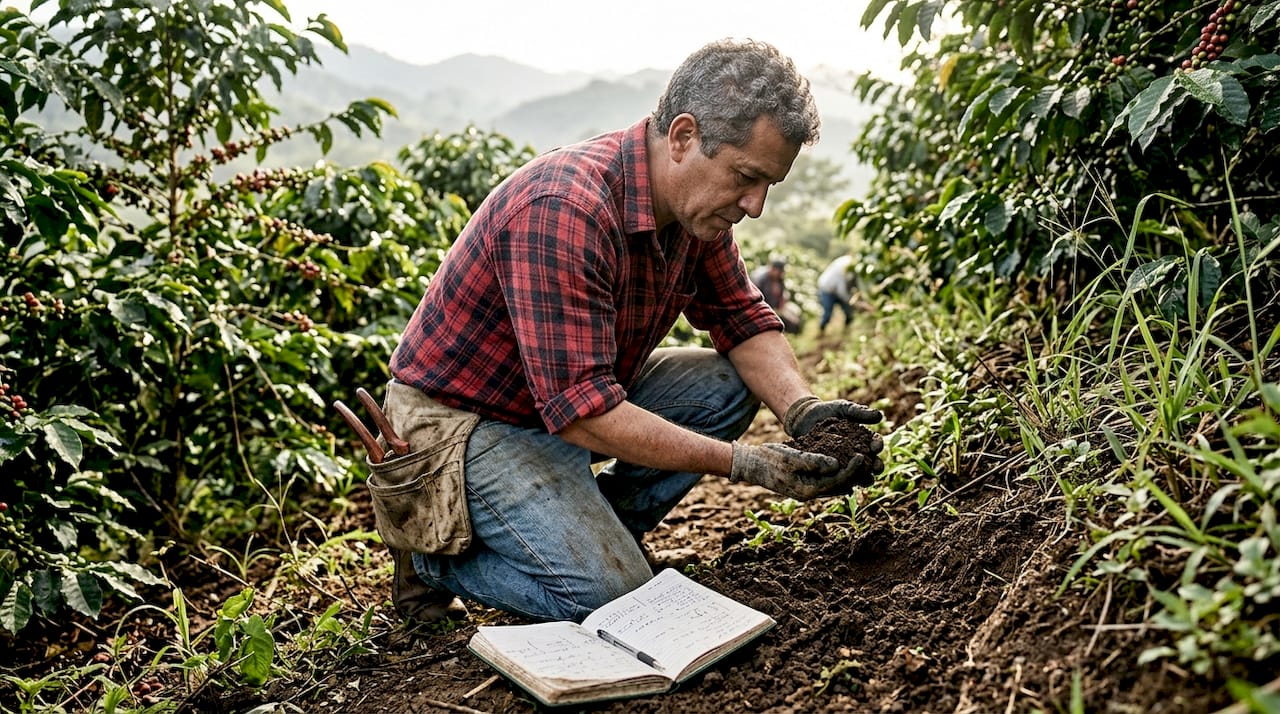
For tea production, similar benefits emerge from sustainable management. Studies demonstrate that agroecological practices increase soil organic matter by 0.8% and pH by 0.5 units, leading to improved yields, better quality tea leaves, and increased net income by USD 8,400 per hectare annually for Vietnamese tea farmers. These economic gains make sustainable practices attractive to farmers who might otherwise view them as risky experiments. Higher soil organic matter directly translates to better water retention during dry periods and improved nutrient availability, both critical for producing the complex flavor compounds that define high-quality tea.
| Practice | Soil Health Impact | Yield Change | Economic Benefit |
|---|---|---|---|
| Regenerative coffee (Kenya) | Improved disease resistance | +1.12 kg/tree | Reduced input costs |
| Agroecological tea (Vietnam) | +0.8% organic matter, +0.5 pH | Increased yields | +$8,400/ha/year |
| Coffee agroforestry | Enhanced biodiversity | Variable positive | Premium prices |
The connection between soil health and beverage quality cannot be overstated. Soil organic matter influences the availability of minerals and trace elements that contribute to coffee’s acidity, body, and flavor complexity. Tea plants grown in biologically active soils produce leaves with more nuanced flavor profiles and higher concentrations of beneficial compounds like catechins and polyphenols. When you taste a vibrant, complex cup of coffee or tea, you’re experiencing the direct result of healthy soil ecosystems that sustainable practices create.
Pro Tip: When shopping for coffee, look for certifications like Rainforest Alliance or Regenerative Organic Certified that verify farms use practices proven to improve soil health. These certifications often indicate better working conditions for farmers and more flavorful beans, making them a win for everyone in the supply chain. For deeper insight into how these practices work, explore regenerative agriculture in coffee and learn about responsible sourcing standards that ensure your purchase supports positive change. Additional research on coffee yield gains provides further evidence of these benefits.
Challenges and critiques of sustainable agriculture
Despite compelling benefits, sustainable and regenerative agriculture faces legitimate criticism that deserves honest examination. Critics argue that sustainable methods reject beneficial technologies like GMOs, produce lower yields, and rely on certification programs that can be costly and ineffective for smallholder farmers. The technology question is particularly contentious, as some sustainable agriculture advocates oppose genetic modification and synthetic inputs categorically, even when these tools could reduce environmental impact or improve farmer outcomes. This ideological stance can limit options for farmers facing specific challenges like drought or pest pressure.
Yield concerns represent another significant critique. While regenerative practices often improve yields over time as soil health rebuilds, the transition period can see temporary decreases that financially vulnerable farmers cannot afford. Critics point to data showing that organic and low-input systems sometimes produce 20 to 30% less than conventional high-input systems, raising questions about whether sustainable agriculture can feed growing populations without converting more land to farming. This land use question, known as the land sparing versus land sharing debate, asks whether it’s better to farm intensively on less land or extensively on more land, with valid arguments on both sides.
Certification effectiveness presents practical problems for the coffee and tea sectors:
- High certification costs exclude many small-scale farmers who practice sustainable methods but cannot afford audits
- Multiple competing certification schemes confuse consumers and dilute market premiums
- ‘Coffeewashing’ and greenwashing allow companies to make sustainability claims without meaningful practice changes
- Verification challenges make it difficult to ensure certified farms maintain standards over time
These issues don’t invalidate sustainable agriculture but highlight the need for more accessible, transparent systems that support rather than burden farmers. Some experts advocate for outcome-based verification using remote sensing and soil testing rather than expensive on-site audits, which could democratize certification access. Others suggest that government support and supply chain partnerships should share certification costs rather than placing the burden entirely on farmers.
“The romanticization of traditional farming methods and rejection of modern agricultural science can actually harm both environmental outcomes and farmer livelihoods when it prevents adoption of proven technologies that reduce pesticide use or improve resource efficiency.”
Balancing these critiques with sustainable agriculture’s documented benefits requires nuanced thinking. The goal isn’t to return to pre-industrial farming but to thoughtfully integrate traditional knowledge with modern science, selecting practices based on evidence rather than ideology. Understanding sustainability trends in coffee helps you navigate these debates and make informed choices that acknowledge both progress and ongoing challenges.
How sustainable agriculture helps protect the planet’s boundaries
Planetary boundaries represent scientifically defined thresholds beyond which Earth’s systems risk destabilization, threatening the stable conditions that allow human civilization to thrive. Current research shows that food systems exceed safe limits for climate change, land system change, biogeochemical flows, and biosphere integrity, making agricultural transformation urgent rather than optional. Agriculture contributes roughly 26% of global greenhouse gas emissions through land clearing, livestock production, and synthetic fertilizer use. Land conversion for farming has destroyed half of Earth’s forests and grasslands, driving species extinction at rates not seen since the dinosaurs disappeared.
Sustainable agriculture directly addresses these planetary boundary transgressions through specific mechanisms:
| Impact Category | Conventional Agriculture | Sustainable Agriculture |
|---|---|---|
| Greenhouse gases | High emissions from synthetic inputs, tillage | Reduced emissions through carbon sequestration, less tillage |
| Land use | Expansion into forests and grasslands | Intensification on existing land, agroforestry |
| Biodiversity | Monocultures, habitat destruction | Diverse systems, habitat integration |
| Nutrient cycles | Excess nitrogen and phosphorus runoff | Precision application, biological nitrogen fixation |
Reducing greenhouse gas emissions starts with rebuilding soil carbon through practices like cover cropping and composting, which can sequester 0.4 to 1.2 tons of carbon per hectare annually. No-till farming prevents the release of stored soil carbon that occurs when plowing exposes organic matter to oxygen. Agroforestry systems in coffee and tea production create additional carbon storage in tree biomass while providing the shade and biodiversity benefits that improve crop resilience. These practices don’t just slow climate change but actively reverse it by pulling carbon from the atmosphere into stable soil organic matter.
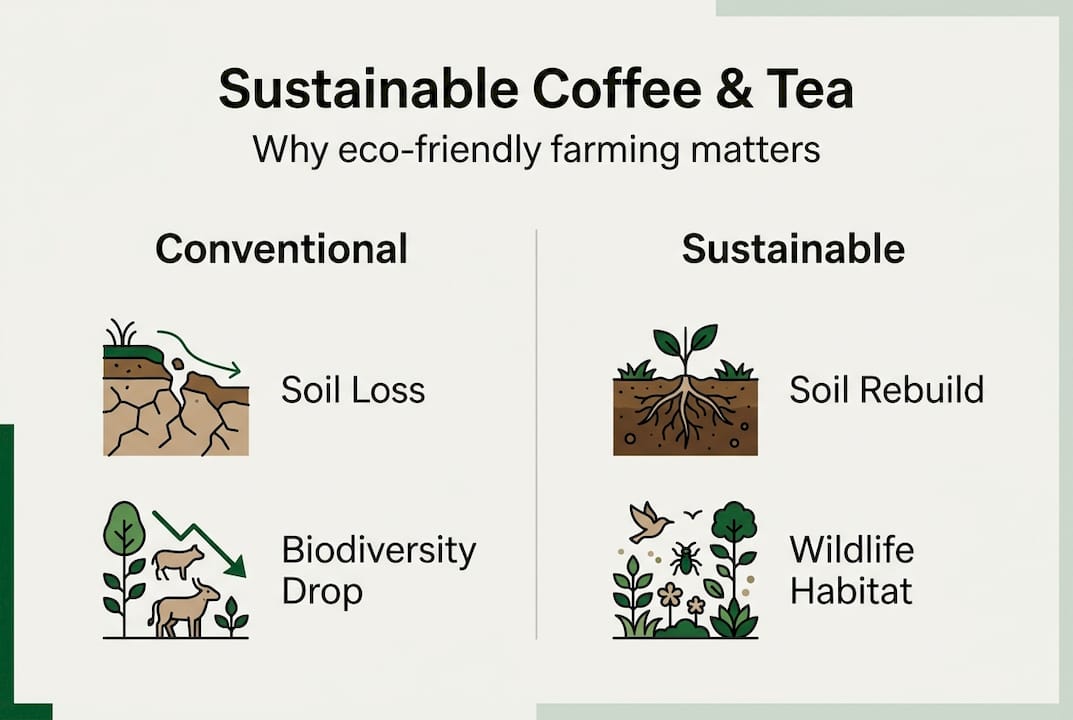
Stopping land conversion requires increasing productivity on existing farmland without degrading soil or water resources. Sustainable intensification achieves this through integrated pest management, which reduces crop losses without toxic chemicals, and precision agriculture technologies that optimize water and nutrient use. For coffee and tea, agroforestry allows farmers to maintain production while preserving forest cover, creating landscapes that support both agriculture and conservation. This approach protects biodiversity hotspots in coffee-growing regions like Ethiopia and Colombia, where unique ecosystems face pressure from agricultural expansion.
Better fertilizer management prevents the nutrient pollution that creates dead zones in coastal waters and contaminates drinking water supplies. Sustainable systems use compost, cover crops, and biological nitrogen fixation to provide nutrients in forms that plants can use gradually, reducing runoff. Precision application technologies ensure synthetic fertilizers, when used, go exactly where needed rather than washing into waterways. These practices protect both freshwater and marine ecosystems while reducing the energy-intensive production of synthetic nitrogen fertilizers.
Pro Tip: Your coffee and tea choices directly influence these planetary systems. Prioritize products from farms using agroforestry and regenerative practices, which you can identify through certifications or direct farm relationships that brands highlight. Small purchasing decisions aggregate into market signals that encourage more farmers to adopt sustainable methods. Learn more about supporting eco-friendly coffee and tea to reduce your personal carbon footprint while enjoying quality beverages.
Explore sustainable coffee and tea options with EcoVibe Roast
Now that you understand why sustainable agriculture matters, you can put this knowledge into action by choosing coffee and tea products that support these practices. EcoVibe Roast offers a carefully curated selection of sustainably sourced beverages that align with the principles discussed throughout this article, making it easy to enjoy your daily cup while contributing to positive environmental and social outcomes.

Our single serve coffee collection provides convenient options for busy mornings without compromising on sustainability. The 60 pack single serve coffee pods feature responsibly sourced beans from farms practicing regenerative agriculture, delivering the complex flavors that healthy soils create. Beyond sourcing, EcoVibe Roast commits to planting mangrove trees and removing ocean-bound plastics with every purchase, extending environmental impact beyond the farm. Explore our environmental impact initiatives to see how your coffee and tea choices support broader conservation efforts.
Frequently asked questions
Is sustainable agriculture always better for coffee and tea?
Sustainable agriculture generally outperforms conventional methods for long-term soil health, biodiversity, and farmer resilience, but trade-offs exist during transition periods. Some farms experience temporary yield decreases as soil biology rebuilds, which can strain farmer finances. The best outcomes occur when farmers receive technical support and fair prices that compensate for transition risks, making supply chain partnerships crucial for success.
How does sustainable agriculture impact the quality of coffee and tea?
Higher soil organic matter improves coffee and tea flavor by providing balanced nutrition that enhances complex compounds responsible for taste and aroma. Sustainable practices help maintain consistent quality across harvests because healthy soils buffer against weather variability and stress. Disease control through biological methods supports crop health without chemical residues that can affect flavor profiles.
What certifications indicate truly sustainable coffee and tea?
Rainforest Alliance, Fair Trade, Regenerative Organic Certified, and Bird Friendly certifications represent meaningful standards with third-party verification, though each emphasizes different aspects of sustainability. Look for certifications that address both environmental practices and social equity, as genuine sustainability requires both. Be aware that certification costs can exclude small farmers practicing sustainable methods, so direct trade relationships and transparent sourcing stories also indicate responsible production.
What are practical ways consumers can support sustainable agriculture?
Choose responsibly sourced coffee and tea products from brands that transparently share their sourcing practices and farm partnerships. Support certifications that are meaningful and transparent, using your purchasing power to reward companies investing in sustainable supply chains. Advocate for regenerative practices by asking your favorite coffee shops and retailers about their sourcing, creating market demand that encourages more farmers to adopt these methods. Learn how to support sustainable coffee farms through everyday choices.
Does sustainable agriculture produce enough food for growing populations?
Sustainable agriculture can meet food needs when properly implemented with appropriate technology and farmer support, though this remains an active area of research and debate. Regenerative practices often increase yields over time as soil health improves, particularly in degraded lands where conventional methods have depleted resources. The real question isn’t just total production but equitable distribution, reduced food waste, and dietary shifts that together can ensure food security within planetary boundaries.
Recommended
- Why support responsible sourcing for coffee and tea – EcoVibe Roast
- What Is Sustainable Coffee and Why It Matters – EcoVibe Roast
- Biodiversity in Coffee Farming: Why It Matters – EcoVibe Roast
- What Is Sustainably Sourced Coffee and Why It Matters – EcoVibe Roast
- Sustainable Coffee Wholesale | Eco Friendly Supplier | Devon Somerse


