

Every year, coffee and tea production generates over 40 million tonnes of waste, yet most consumers remain unaware of this staggering environmental cost hidden behind their daily cup. Traditional linear production models follow a wasteful take-make-dispose pattern, creating mountains of spent grounds, husks, and packaging destined for landfills. The circular economy offers a transformative alternative by converting this waste into valuable products like biofuels, compost, and food ingredients. This guide reveals how circular economy principles are revolutionizing the beverage industry and shows you practical ways to choose sustainable coffee and tea that minimize environmental impact while supporting innovative businesses committed to closing the loop.
Table of Contents
- Key takeaways
- Understanding circular economy in the beverage industry
- Circular economy practices in coffee production and waste valorization
- Circular economy in tea production: compostable packaging and waste reuse
- Environmental impact and challenges in adopting circular economy for beverages
- How to choose sustainable beverages using circular economy principles
- Explore EcoVibe Roast’s sustainable coffee and tea collection
- FAQ
Key Takeaways
| Point | Details |
|---|---|
| Circular economy shift | The beverage sector is transitioning from a linear take make dispose model to closed loop systems that reuse, recycle and recover value from waste. |
| By product valorization | By product valorization converts production waste into valuable outputs such as energy, compost, animal feed, and agricultural inputs. |
| Refillable packaging impact | Refillable bottles and containers reduce single use packaging waste and lower carbon footprints when supported by proper infrastructure and consumer habits. |
| Barriers and challenges | Upfront costs, underdeveloped collection and cleaning systems, and long transport distances can diminish recycling benefits and slow adoption. |
| Consumer sustainability actions | Consumers can support circular beverage systems by choosing sustainable packaging and products and by backing policies that enable reuse and recycling. |
Understanding circular economy in the beverage industry
The circular economy in beverage industry shifts from linear ‘take-make-dispose’ to closed-loop systems minimizing waste via reuse, recycling, and by-product valorization. Traditional linear models extract raw materials, manufacture products, and discard waste at every stage, creating massive environmental burdens. Circular systems instead design out waste by keeping materials in productive use through continuous cycles of recovery and regeneration.
Three core techniques drive circular beverage production. Reuse involves refillable bottles and containers that eliminate single-use packaging waste. Recycling transforms used materials back into new products, reducing virgin resource extraction. By-product valorization converts production waste into valuable outputs like energy, animal feed, or agricultural inputs. Germany demonstrates circular success with 82% refillable beer bottles, proving that consumer acceptance and infrastructure can support sustainable systems at scale.
Environmental benefits multiply across the supply chain. Carbon emissions drop significantly when materials circulate rather than requiring new extraction and processing. Landfill waste decreases as organic materials return nutrients to soil through composting. Resource efficiency improves because fewer raw inputs are needed when existing materials stay productive. Water consumption falls when production systems recapture and reuse process water instead of drawing fresh supplies.
“Circular economy principles can transform beverage waste from an environmental liability into a valuable resource stream, creating economic opportunity while protecting ecosystems.”
Despite proven advantages, obstacles remain. Single-use packaging often costs less upfront, making refillable systems economically challenging without policy support. Consumer habits favor convenience over sustainability when choosing beverages. Infrastructure for collection, cleaning, and redistribution of reusable containers remains underdeveloped in many regions. Transportation distances can negate recycling benefits when materials travel far for processing, especially for heavy glass bottles.
You can reduce coffee waste sustainably by understanding these circular principles and making informed purchasing decisions. The beverage industry’s transition requires both business innovation and consumer support to overcome economic and logistical barriers. Having grasped these circular economy basics, we next focus on specific practices and benefits in coffee production.
Circular economy practices in coffee production and waste valorization
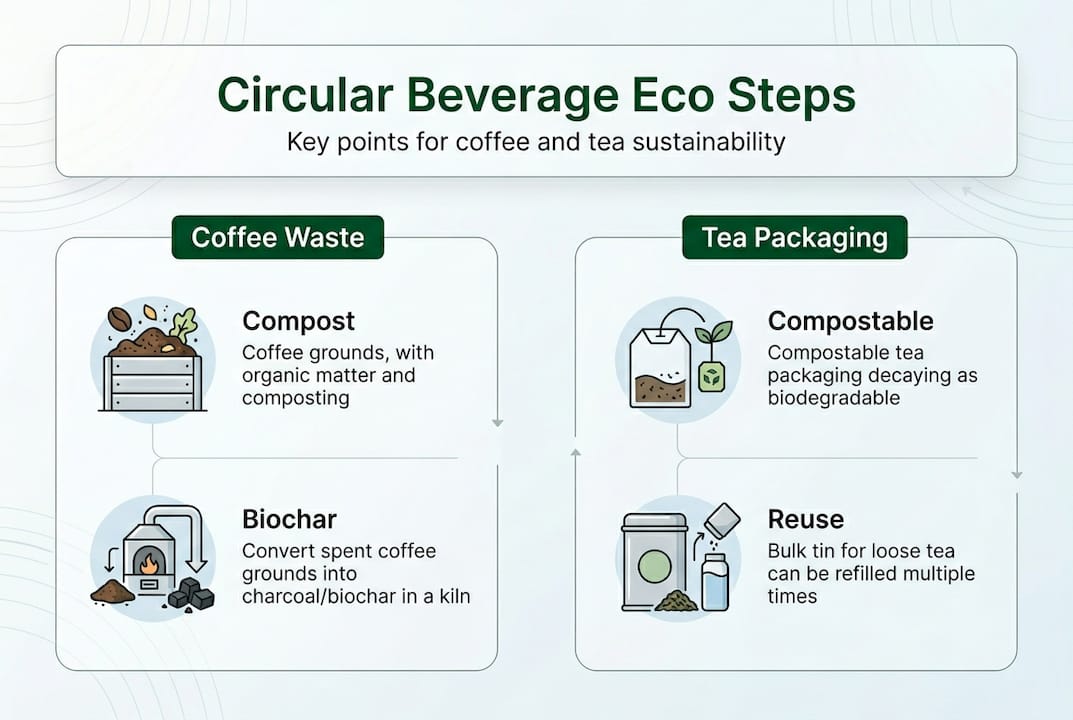
Coffee production creates distinct waste streams at multiple stages, each offering valorization opportunities. Coffee cherry husks and pulp represent 95-99% of the fruit but are discarded after bean extraction. Spent coffee grounds accumulate at cafes and homes after brewing. Silver skin sheds during roasting. Collectively, these waste types total approximately 40 million tonnes yearly, creating both environmental challenges and resource opportunities.
Innovative businesses transform coffee waste into diverse valuable products:
- Cascara tea brewed from dried coffee cherry husks offers a fruity beverage with antioxidants
- Biochar produced from coffee waste improves soil quality and sequesters carbon
- Animal feed formulated with coffee husks provides nutritional value for livestock
- Biofuels extracted from spent grounds generate renewable energy
- Food ingredients derived from coffee flour add fiber and nutrients to baked goods
| Coffee Waste Type | Annual Volume | Primary Valorization Uses |
|---|---|---|
| Coffee cherry pulp and husk | 38-39.6 million tonnes | Cascara tea, animal feed, fertilizer |
| Spent coffee grounds | 6-8 million tonnes | Biofuels, biochar, food ingredients |
| Silver skin | 200,000 tonnes | Dietary fiber, antioxidant extraction |
Environmental impact assessments reveal significant differences between valorization methods. Indonesia coffee husk conversion to fertilizer or feed performs best in life cycle analysis, minimizing carbon emissions and resource consumption compared to disposal or incineration. Local processing reduces transportation impacts while returning nutrients to agricultural systems. Biochar production sequesters carbon for centuries while improving soil water retention and fertility.
Practical industry examples demonstrate commercial viability. Lavazza partners with Colombian farmers to convert coffee cherry waste into cascara beverages and compost, creating additional revenue streams while reducing environmental impact. Startups extract coffee oils for cosmetics and bioplastics. Breweries use spent grounds to cultivate mushrooms, then compost the substrate. These closed-loop systems prove that waste valorization supports both profitability and sustainability.
Pro Tip: Support circular coffee by purchasing products made from recycled coffee materials like biochar soil amendments or cascara tea, and choosing brands that transparently report their waste valorization practices.
You can reduce coffee waste 30 percent through conscious consumption choices and reduce waste with coffee pods by selecting compostable options. With coffee’s circular strategies covered, next explore how tea production applies similar principles to waste reduction.
Circular economy in tea production: compostable packaging and waste reuse
Tea production generates substantial organic waste requiring sustainable management solutions. Global black tea production is projected to reach 4.4 million tons by 2027 with approximately 30% becoming waste during processing and consumption. Tea dust, stems, and spent leaves accumulate at processing facilities and in consumer homes. Traditional disposal in landfills releases methane as organic matter decomposes anaerobically, contributing to greenhouse gas emissions.
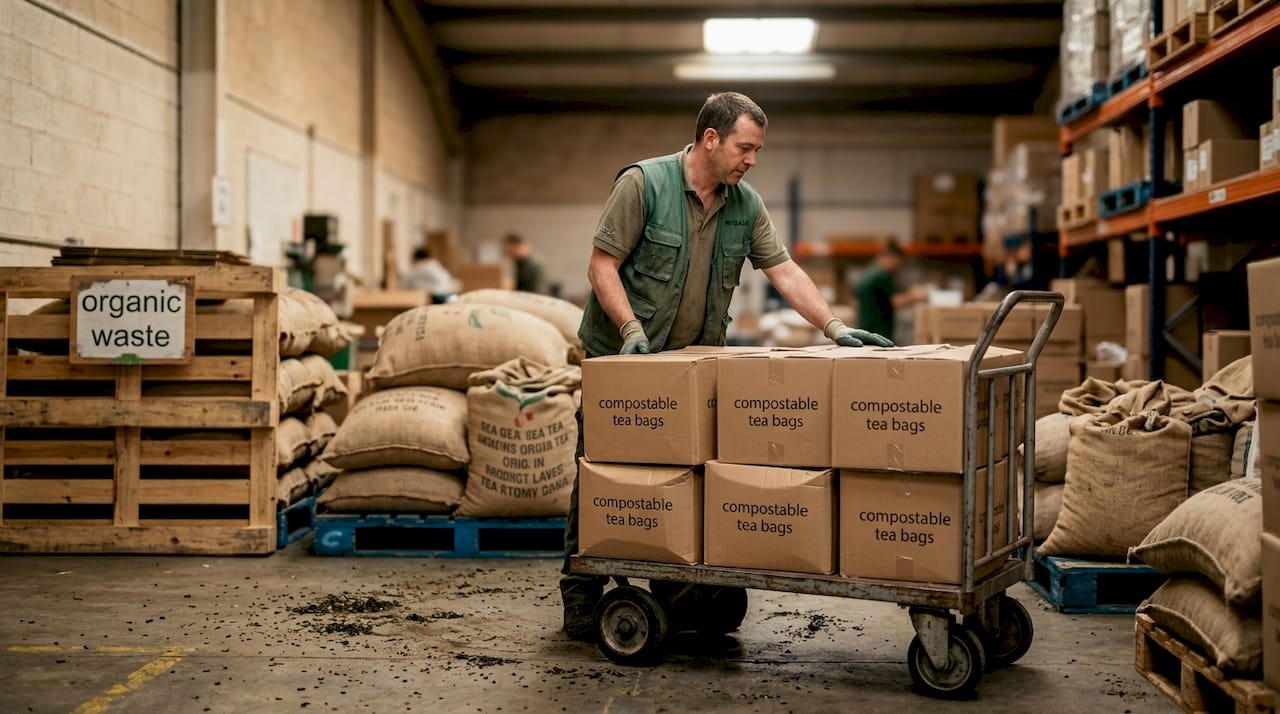
Compostable teabag innovations address packaging waste that previously contaminated compost streams. Tea waste is converted to compost, mulching sheets, peat substitutes, biochar, and catalyst supports, while compostable teabags enable nutrient recycling. Modern teabags use PBS (polybutylene succinate) and PLA (polylactic acid) bioplastics derived from plant starches instead of conventional plastics. These materials break down completely in industrial or home composting systems within months, leaving no toxic residues.
Tea waste valorization creates multiple value streams:
- Compost rich in nitrogen and organic matter improves garden soil fertility
- Mulching sheets made from compressed tea waste suppress weeds and retain moisture
- Peat alternatives formulated from tea waste reduce environmentally damaging peat extraction
- Biochar produced from tea stems sequesters carbon and enhances soil structure
- Catalyst supports utilizing tea waste activate chemical processes in green chemistry applications
Composting tea waste for nutrient cycling follows these steps:
- Collect spent tea leaves and compostable teabags in a dedicated container
- Mix tea waste with carbon-rich materials like dry leaves or shredded paper at a 1:3 ratio
- Maintain moisture similar to a wrung-out sponge and turn the pile weekly
- Monitor temperature rise indicating active decomposition
- Harvest finished compost after 2-4 months when material becomes dark and crumbly
- Apply nutrient-rich compost to gardens, returning minerals to soil
Pro Tip: Choose teas packaged in compostable materials and maintain a small countertop compost bin for daily tea waste, creating a personal circular system that enriches your garden while eliminating disposal costs.
You can explore sustainable packaging beverages and understand compostable coffee packaging impact to make informed purchasing decisions. After examining coffee and tea circular practices, the next section discusses wider environmental impacts and challenges in circular economy beverage adoption.
Environmental impact and challenges in adopting circular economy for beverages
Measurable environmental improvements demonstrate circular economy effectiveness in beverage operations. Tsingtao Brewery reduced carbon emissions by 35.7% through closed-loop supply chain implementation, recovering waste heat, recycling water, and converting organic waste to biogas. Similar systems in food and beverage manufacturing cut energy consumption by 20-40% while reducing water use by 30-50%. These quantified benefits prove that circular models deliver substantial climate and resource advantages.
| Packaging Type | Carbon Footprint (kg CO2e per 1000 servings) | Reuse Cycles |
|---|---|---|
| Refillable glass bottles | 45-60 | 20-50 trips |
| Single-use glass bottles | 180-220 | 1 trip |
| Single-use PET plastic | 90-110 | 1 trip |
| Aluminum cans | 140-160 | 1 trip (recyclable) |
Refillable packaging dramatically outperforms single-use alternatives when reused multiple times. Glass bottles used 25 times reduce per-serving carbon footprint by 70% compared to single-use glass. The environmental advantage grows with each additional reuse cycle as production impacts are amortized across more servings.
Challenges complicate circular economy scaling despite proven benefits. Economic factors favor single-use packaging because upfront costs appear lower, even though lifecycle costs tell a different story. Consumer habits prioritize convenience and variety over sustainability, making behavior change difficult without incentives. Infrastructure limitations constrain collection and processing capacity for reusable containers. Transport distance reduces recycling benefits when materials travel hundreds of miles for processing, especially for heavy glass.
“Transportation distances can negate the environmental benefits of recycling when glass bottles travel more than 200 kilometers between collection and reprocessing facilities.”
Key barriers and potential solutions include:
- Economic viability requires policy support like deposit-return schemes to make refillable systems competitive
- Slow energy intensity improvements need technology investment in efficient processing equipment
- Infrastructure gaps demand coordinated development of collection and cleaning networks
- Extended Producer Responsibility (EPR) policies shift waste management costs to manufacturers, incentivizing upstream design improvements
- Consumer education programs build awareness of lifecycle impacts and sustainable choices
EPR frameworks prove particularly effective by making producers financially responsible for end-of-life management. This incentivizes designing products for durability, reuse, and recyclability from the outset. Germany’s packaging ordinance requiring manufacturers to fund collection and recycling has achieved high recovery rates while spurring innovation in sustainable materials.
You can support eco-friendly coffee tea choices and understand eco-friendly packaging impact to align purchases with circular principles. With environmental context and challenges clear, we next focus on how you can apply these insights and choose sustainable beverages yourself.
How to choose sustainable beverages using circular economy principles
Selecting beverages that support circular economy requires evaluating specific product and packaging attributes. Compostable packaging made from plant-based materials eliminates persistent waste while returning nutrients to soil. Refillable bottles reduce manufacturing impacts through multiple use cycles. Waste valorization claims indicate producers convert production waste into useful products rather than sending it to landfills. Transparent supply chain information helps verify sustainability commitments beyond marketing claims.
Eco-labels and certifications provide shortcuts for identifying circular economy products. Look for compostable certifications like BPI (Biodegradable Products Institute) or TUV Austria OK Compost HOME, which verify materials break down in home composting. Fair Trade certification often correlates with sustainable production practices including waste reduction. B Corporation status indicates comprehensive sustainability assessment including circular economy practices. Organic certifications suggest regenerative agricultural approaches that align with circular principles.
Practical tips for supporting circular beverage systems:
- Buy local beverages to minimize transportation impacts and support regional circular infrastructure
- Choose refillable containers when available and return them for reuse
- Minimize single-use plastics by selecting glass, aluminum, or compostable packaging
- Compost tea bags and coffee grounds at home to close the nutrient loop
- Support brands with transparent waste valorization and carbon reduction commitments
- Purchase larger package sizes to reduce per-serving packaging waste
Pro Tip: Contact beverage brands directly to ask about their circular economy practices. Companies with genuine commitments will provide detailed information about waste valorization, packaging recyclability, and carbon reduction targets, while vague responses indicate superficial sustainability claims.
You can find tips for conscious coffee consumption and review eco-friendly packaging examples to guide your purchasing decisions. Understanding eco-friendly packaging impact helps you evaluate competing product claims and make choices aligned with circular economy values. Having explored practical consumer steps, next discover our website’s offerings that embody these circular economy principles.
Explore EcoVibe Roast’s sustainable coffee and tea collection
EcoVibe Roast demonstrates circular economy principles through carefully curated sustainable beverage offerings. Our single serve coffee pods 60 pack features compostable materials that break down completely in home composting systems, eliminating the persistent waste associated with conventional pods. The hibiscus berry tea comes in packaging designed for minimal environmental impact while delivering vibrant flavor from responsibly sourced ingredients.

Every purchase supports environmental restoration through our commitment to planting mangrove trees and removing ocean-bound plastics. This creates a positive impact loop where your beverage choice actively contributes to ecosystem recovery. Browse our complete single serve coffee collection to find options that align with your taste preferences and sustainability values. Make your daily coffee and tea ritual part of the circular economy solution by choosing products designed to minimize waste and maximize positive environmental impact.
FAQ
What materials are used in compostable teabags?
Compostable teabags use PBS and PLA materials enabling nutrient recycling through complete biodegradation. PBS (polybutylene succinate) and PLA (polylactic acid) are bioplastics derived from plant starches like corn or sugarcane rather than petroleum. These materials break down in composting conditions within 90-180 days, leaving no toxic residues and returning organic matter to soil.
How much carbon emission reduction does circular economy deliver in beverages?
Closed-loop supply chains cut carbon emissions by 35.7% in documented brewery operations. This reduction comes from recovering waste heat for energy, recycling process water, and converting organic waste to biogas that replaces fossil fuels. Similar systems in food and beverage manufacturing achieve 20-40% energy savings alongside carbon reductions.
What are the main challenges in implementing circular economy for beverages?
Economic factors and infrastructure constraints create significant barriers to circular beverage systems. Single-use packaging costs less upfront despite higher lifecycle impacts, making refillable systems economically challenging without policy support. Limited collection and processing infrastructure restricts reuse programs, while long transport distances can negate recycling benefits for heavy materials like glass. Extended Producer Responsibility policies help overcome these obstacles by shifting end-of-life costs to manufacturers.
How can consumers support circular economy in their beverage choices?
Choose beverages with compostable or refillable packaging and return containers for reuse when deposit systems exist. Support brands with transparent circular economy commitments verified through third-party certifications or detailed sustainability reports. Practice home composting of tea bags and coffee grounds to close the nutrient loop, and prioritize local beverages to minimize transportation impacts while supporting regional circular infrastructure development.
Recommended
- Sustainable packaging in beverages: eco-conscious guide 2026 – EcoVibe Roast
- 7 Actionable Tips for Eco-Conscious Coffee Drinkers – EcoVibe Roast
- Master Eco-Conscious Coffee Making Workflow for Sustainability – EcoVibe Roast
- Top tips for eco-conscious tea selection in 2026 – EcoVibe Roast
- Sustainable Coffee Wholesale | Eco Friendly Supplier | Devon Somerse


