

TL;DR:
- Green certifications like Fairtrade, Rainforest Alliance, and Organic ensure audited standards for ethical and environmental practices.
- These certifications support farmers through premiums, training, and community projects, but benefits often don’t reach farmers directly.
- Certified farms improve biodiversity, soil health, and resilience, but certification alone isn’t a guarantee of perfect sustainability.
Most of us have glanced at a Fairtrade or Rainforest Alliance logo on a coffee bag and thought, “That’s probably just marketing.” But these labels are far more than decorative. Certified programs like Fairtrade, Rainforest Alliance, and Organic operate through audited, documented standards that govern everything from soil health to worker wages. When you choose a certified coffee or tea, you’re casting a vote for a cleaner supply chain and a healthier planet. This guide breaks down what those certifications actually mean, who they help, where they fall short, and how you can shop smarter starting with your very next cup.
Table of Contents
- What does green certification really mean?
- The socioeconomic impact: Who really benefits?
- Environmental gains: What certifications actually deliver
- Limitations, criticisms, and how to shop smarter
- A fresh take: Certifications are your ethical starter kit—here’s what’s missing
- Explore certified, eco-conscious beverages with EcoVibe Roast
- Frequently asked questions
Key Takeaways
| Point | Details |
|---|---|
| Look beyond the label | Not all green certifications are created equal, so always verify standards and company transparency. |
| Socioeconomic and environmental gains | True certifications can support farmers and ecosystems, but impact varies by scheme and brand. |
| Third-party is best | Third-party verified certifications help avoid greenwashing and build consumer trust. |
| Multiply your impact | Choose products carrying multiple strong certifications for better ethical and ecological assurance. |
| Stay informed, shop smart | Read beyond marketing claims and pick brands with clear, credible supply chain practices. |
What does green certification really mean?
Now that you know these certifications aren’t just labels, let’s break down what they really mean when you see them on your coffee or tea.
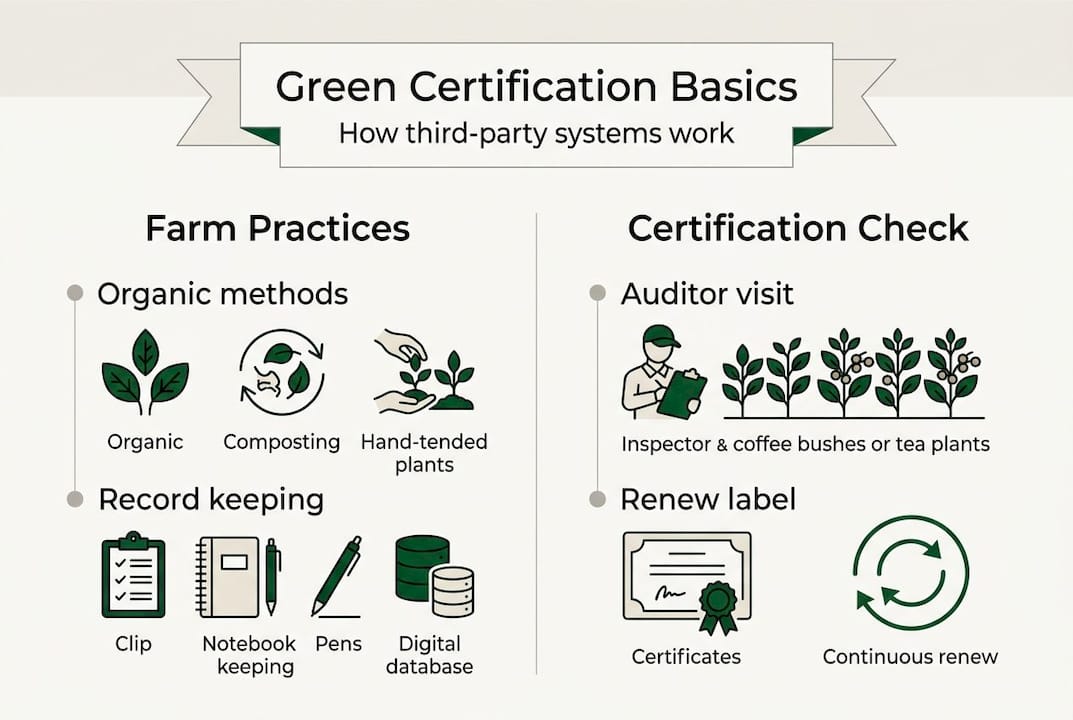
At their core, green certifications are third-party verified systems. An independent auditor visits farms, reviews records, and checks that producers meet a defined set of standards before granting the right to display a logo. That process gets repeated on a renewal cycle, so it’s not a one-time rubber stamp. You can learn more about the full spectrum of types of coffee certifications to see how each one stacks up.
Here’s a quick comparison of the three most common labels:
| Certification | Focuses on | Key standards |
|---|---|---|
| Fairtrade | Social and economic equity | Minimum price floors, community premiums, labor rights |
| Rainforest Alliance | Environment and livelihoods | Biodiversity, agroforestry, water management, worker welfare |
| Organic (USDA) | Soil and chemical use | No synthetic pesticides or fertilizers, soil health practices |
Each scheme covers different ground, which is exactly why no single label tells the whole story. Fairtrade sets a price floor so farmers aren’t crushed when global coffee prices drop. Rainforest Alliance pushes for shade-grown, agroforestry-based farming that protects biodiversity. Organic certification bans synthetic chemicals and prioritizes long-term soil vitality.
Enforcement matters too. Certifiers conduct surprise audits, require detailed record-keeping, and can revoke certification for non-compliance. Farms must reapply regularly, and standards evolve over time to close loopholes. This is what separates a credible certification from a brand simply printing “eco-friendly” on its packaging.
- Fairtrade: Price minimums, social premium fund, democratic farmer cooperatives
- Rainforest Alliance: Agroforestry requirements, biodiversity benchmarks, reduced agrochemical use
- Organic: No synthetic inputs, soil-building practices, traceability through the supply chain
Understanding responsible sourcing in coffee and tea helps you see why these standards were created in the first place. Conventional farming often prioritizes yield over everything else, leaving farmers underpaid and ecosystems depleted.
Pro Tip: Look for products carrying both Organic and Fairtrade certifications. That combination covers chemical use, soil health, fair wages, and community investment all at once, giving you the most well-rounded ethical assurance.
The socioeconomic impact: Who really benefits?
Understanding the principles is just the first step. Let’s see how those standards translate into tangible benefits for the people and communities growing your coffee and tea.
The numbers are encouraging. Fairtrade supports 1.9 million farmers globally, providing a price premium of around 5 cents per pound above market rate, along with a separate community social premium. That social premium funds schools, health clinics, and clean water projects in farming villages. It’s not abstract. It’s a child getting a better education because you chose one bag of coffee over another.
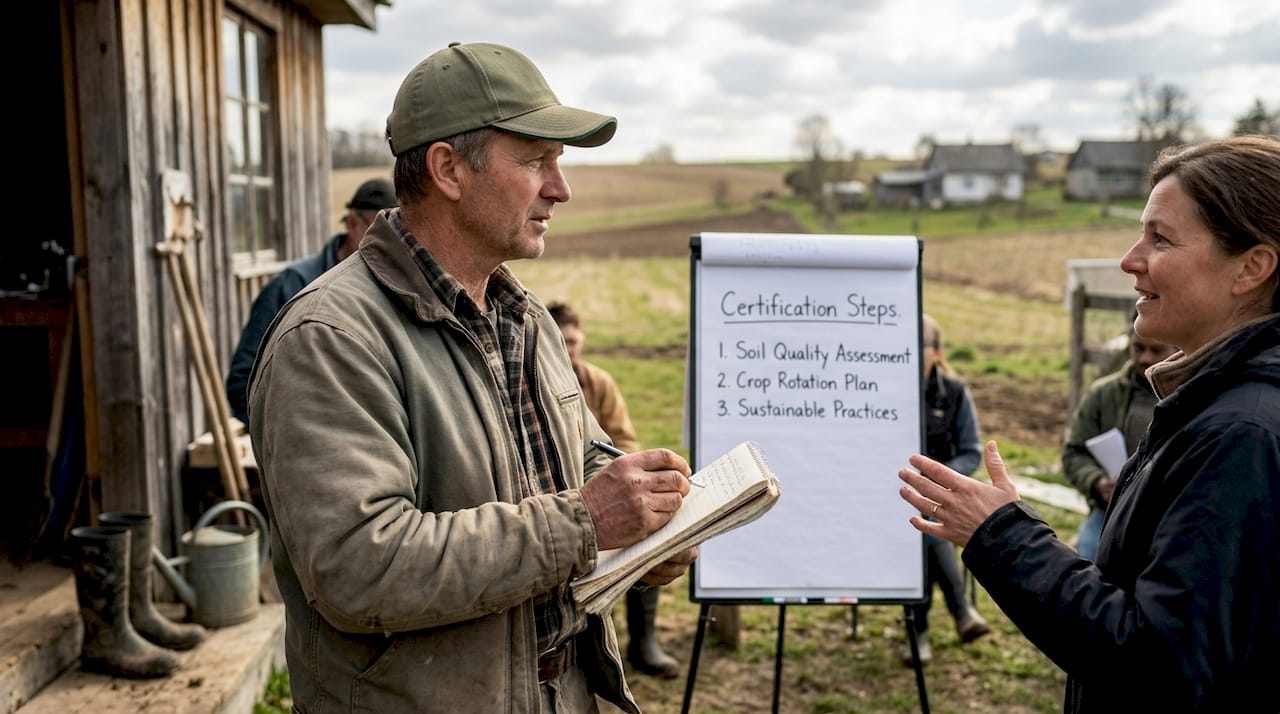
Certifications also provide training. Farmers learn better agronomic practices, record-keeping, and business skills. This leads to improved yields, more stable income, and greater resilience when weather or markets turn against them. Community support in coffee is one of the most underappreciated outcomes of buying certified.
Here’s a data snapshot:
| Certification | Price premium | Community fund | Farmers reached |
|---|---|---|---|
| Fairtrade | ~$0.05/lb above floor | Yes, mandatory social premium | 1.9 million |
| Rainforest Alliance | Variable, market-based | Partially, via sustainability differential | Millions of smallholders |
| Organic | Market-driven premium | No dedicated fund | Varies widely |
But here’s the uncomfortable truth. Research shows that between 61% and 70% of price premiums are often captured by roasters and retailers rather than reaching the farmer directly. That means the extra dollar you spend on a certified bag doesn’t always flow back to the source the way you’d hope. Transparency in supply chains is still a work in progress.
“Fairtrade provides real socioeconomic benefits, but the distribution of those benefits depends heavily on how transparent and accountable the brand is throughout its supply chain.”
Some brands publish full supply chain reports and show exactly how premiums are distributed. Others don’t. Supporting brands that openly share how they boost farmer income is one of the most powerful things you can do as a conscious consumer.
Pro Tip: Before you buy, check the brand’s website for a sourcing transparency report or a breakdown of how premiums reach farmers. If that information doesn’t exist, that tells you something too.
Environmental gains: What certifications actually deliver
But are these programs actually better for the planet? Let’s unpack the proven environmental impacts of certified versus conventional coffee and tea.
The evidence is genuinely exciting. Certified agroforestry systems show 32 to 42% more biodiversity compared to conventional monoculture farms. Yield loss from pests and disease drops by around 31%, and pest risk itself falls by approximately 24%. That means certified farms are not just greener, they’re more resilient and productive over the long run.
Here’s what certified farming typically looks like on the ground:
- Agroforestry: Coffee and tea grown under a canopy of native trees, creating habitat for birds, insects, and mammals
- Reduced agrochemicals: Fewer synthetic pesticides and fertilizers, which protects waterways and soil microbiomes
- Water management: Certified farms often implement buffer zones near rivers and better irrigation practices
- Soil health: Organic matter builds up over time, improving water retention and carbon sequestration
The environmental impact of coffee production is significant at scale, so these improvements matter enormously when multiplied across millions of acres.
“Agroforestry is the single most powerful tool we have for combining climate resilience, soil regeneration, and biodiversity protection in one farming system.”
That said, certification alone is not a guarantee of perfect environmental outcomes. Results vary by region, farm size, and how rigorously standards are applied. A certified farm in one country might outperform its conventional neighbor dramatically, while another certified operation might just barely meet the minimum threshold. Learning about sustainable agriculture for coffee and tea helps you understand why on-the-ground practices matter just as much as the logo on the bag.
The bottom line is that certified products consistently outperform conventional ones on environmental metrics, but they’re a floor, not a ceiling.
Limitations, criticisms, and how to shop smarter
Of course, no system is perfect. Here’s what you should watch out for if you want your choices to really count.
Certifications have real weaknesses. Rainforest Alliance certification can cost farms around $58 per hectare, which is a significant barrier for the smallest smallholders. Some schemes allow “mass balance” supply chains, meaning certified and non-certified beans can be mixed during processing as long as the volumes roughly balance out. That’s a loophole that dilutes the integrity of the label. Not all certifications are equally robust, and some corporate self-certification programs use the language of sustainability without the independent oversight.
Here are the top three pitfalls to watch for as a shopper:
- Confusing logos: Some brands design their own green icons that mimic official certification marks. Always look for recognized third-party logos like Fairtrade International, USDA Organic, or Rainforest Alliance.
- Corporate self-certification: Programs run entirely by the company selling the product lack independent verification. They can set their own benchmarks and declare success without outside scrutiny.
- Assuming organic covers everything: Organic certification addresses chemical use and soil health, but it says nothing about fair wages, worker safety, or biodiversity. An organic tea can still come from a farm with poor labor conditions.
Understanding the role of coffee certifications in the broader ethical landscape helps you avoid being misled. And if you enjoy tea, knowing how to choose sustainable tea and understanding ethical tea sourcing gives you an equally sharp lens for that side of your cup.
Third-party certifications are the gold standard precisely because they remove the conflict of interest that comes with self-reporting. When an independent body is doing the auditing, you get a much cleaner signal.
Pro Tip: Prioritize products with two or more third-party certifications, and spend a few minutes researching the brand’s sourcing transparency. A company that openly shares its supply chain data is one worth trusting.
A fresh take: Certifications are your ethical starter kit—here’s what’s missing
With all these nuances in mind, what’s the bigger picture when it comes to green certifications?
We believe certifications are genuinely valuable, but they’re a starting point, not the finish line. They give you a verified baseline: a guarantee that certain minimum standards were met. That’s meaningful. But the brands doing the most good go further. They invest directly in farming communities, publish farm-level impact reports, and pursue multiple certifications rather than just the easiest one to obtain.
Supporting eco-conscious brands that treat certifications as a floor rather than a ceiling is where your purchasing power really compounds. Direct trade relationships, where roasters buy directly from farms at above-market prices with full transparency, often deliver more impact than any single certification can.
Here’s the thing: certifications are evolving, and so is the misinformation around them. Stay curious, stay a little skeptical, and remember that the most impactful choice is one made with eyes open. Look beyond the logo. Ask who grew it, how they were paid, and what the land looks like now. That’s where real change lives.
Explore certified, eco-conscious beverages with EcoVibe Roast
If you’re ready to put this knowledge into action, EcoVibe Roast makes it easy to shop with confidence.

We carefully curate coffees and teas that carry recognized third-party certifications, so every sip supports the values you care about. Try our aromatic Hibiscus Berry Tea or the delicate, floral Jasmine Tea for a beautifully sourced experience in every cup. And every purchase plants mangrove trees and removes ocean-bound plastics, because we believe your beverage choice should be a warm hug for both you and Mother Earth. Explore our environmental impact to see exactly what your support makes possible.
Frequently asked questions
What is the most reliable green certification for coffee and tea?
Fairtrade leads on social criteria like fair wages and community investment, while Organic and Bird-Friendly certifications deliver the strongest ecological protections. For the best overall assurance, look for products that carry more than one third-party certification.
Do green certifications really help small farmers?
Yes, but unevenly. Certifications provide price premiums, training, and community funds, yet 61 to 70% of premiums are often absorbed by roasters and retailers before reaching the farmer. Choosing brands with transparent supply chains helps ensure more benefit flows to the source.
How can I tell if a certification is legitimate?
Look for recognized third-party auditors like Fairtrade International or USDA Organic, and check whether the brand publishes sourcing reports. Third-party audits are the clearest signal that a certification isn’t just self-promotional greenwashing.
Are all organic teas and coffees eco-friendly?
Not entirely. Organic certification covers chemical use and soil practices but doesn’t address labor rights or ecosystem protections like biodiversity and agroforestry. Pairing Organic with Fairtrade or Rainforest Alliance gives you much more complete ethical coverage.
Recommended
- Coffee Certifications: Impact on Sustainability and Ethics – EcoVibe Roast
- How to choose sustainable tea for ethical enjoyment – EcoVibe Roast
- 7 Types of Coffee Certifications for Conscious Consumers – EcoVibe Roast
- What is fair trade tea and why it matters for buyers – EcoVibe Roast
- Coffee tasting guide for Colorado Springs enthusiasts
- Mushroom Powder For Coffee: Benefits And How To Use It – LongevityBotanicals


