

Most tea drinkers assume their favorite brew arrives ethically sourced, but the reality behind your morning cup is far more complex. The journey from plantation to teapot involves intricate social, environmental, and economic factors that directly impact farming communities and fragile ecosystems worldwide. Ethical tea sourcing involves fair wages, safe working conditions, and community development, yet many brands fall short of these standards. This guide will decode what ethical tea sourcing truly means, explore the certifications that matter, and equip you with practical strategies to make informed choices that align with your values while supporting sustainable agriculture and farmer empowerment.
Table of Contents
- Understanding Ethical Tea Sourcing: Core Principles And Practices
- Comparing Ethical Sourcing Certifications And Trade Models
- Rainforest Alliance Certification: Global Impact And Market Significance
- Making Informed Ethical Tea Choices: Practical Tips For Consumers
- Shop Eco-Conscious Teas And Support Ethical Sourcing
- Frequently Asked Questions
Key takeaways
| Point | Details |
|---|---|
| Fair labor standards | Ethical sourcing guarantees fair wages, safe working conditions, and investments in community health and education programs. |
| Environmental protection | Practices like agroforestry increase biodiversity by 30% while organic farming eliminates harmful synthetic chemicals. |
| Certification differences | Fair Trade ensures minimum prices, Rainforest Alliance prioritizes sustainability, and Direct Trade emphasizes quality relationships. |
| Consumer impact | Your purchasing decisions directly empower farming families and promote regenerative agricultural practices globally. |
Understanding ethical tea sourcing: core principles and practices
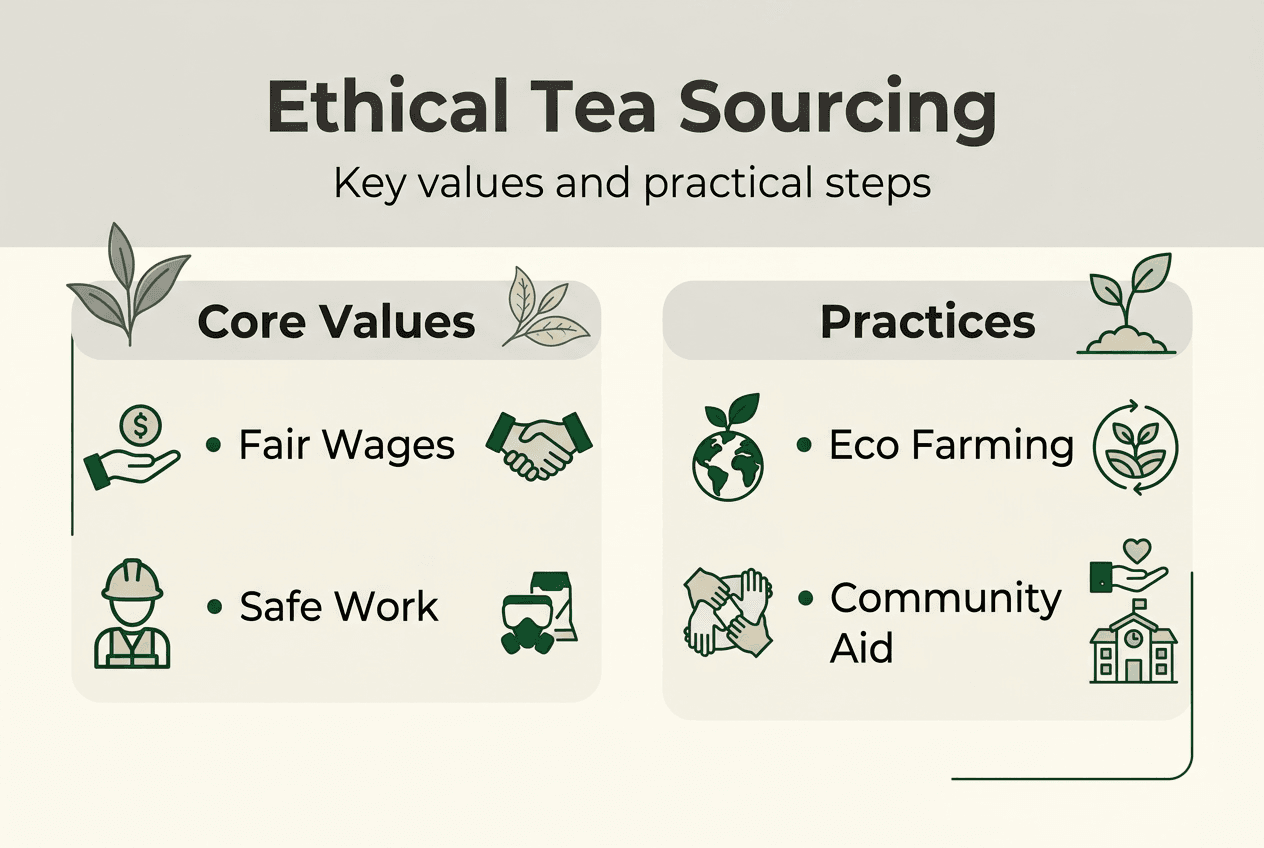
Ethical tea sourcing represents a holistic approach that extends far beyond simply growing leaves. It encompasses fair compensation for workers, safe employment conditions, and meaningful investments in the communities that cultivate your tea. When you choose ethically sourced tea, you support a system that values human dignity alongside product quality.
Environmental stewardship forms the backbone of responsible tea production. Agroforestry practices integrate diverse plant species within tea gardens, creating habitats that boost biodiversity by up to 30% compared to monoculture plantations. Water conservation techniques reduce usage by 20 to 40%, protecting precious resources in regions where scarcity threatens both crops and communities. Organic farming methods eliminate synthetic pesticides and fertilizers, safeguarding soil health and preventing chemical runoff into local water systems.
Community development initiatives distinguish truly ethical brands from those offering surface-level commitments. Progressive tea companies invest in education programs that give farming families access to better schools. They fund healthcare facilities that serve entire villages. Infrastructure improvements like roads and clean water systems transform quality of life for thousands of workers and their families. These investments create lasting change that ripples through generations.
Pro Tip: Look beyond certification labels to investigate how brands invest in farmer training programs and infrastructure improvements. This reveals genuine ethical partnerships rather than minimum compliance with standards.
The most impactful sourcing relationships involve ongoing collaboration between buyers and producers. Brands that provide agricultural training help farmers improve yields and quality naturally. Technical support for transitioning to organic methods reduces environmental harm while opening premium market opportunities. Financial assistance for equipment upgrades enables communities to process tea locally, capturing more value from their labor. When you support responsible sourcing practices, you become part of a system that prioritizes people and planet alongside profit.
Comparing ethical sourcing certifications and trade models
Navigating the landscape of tea certifications requires understanding what each label actually guarantees. Fair Trade certification provides minimum prices that protect smallholder farmers from volatile market fluctuations. This price floor ensures economic stability even when global tea prices plummet. Fair Trade also mandates democratic organization of farming cooperatives and provides community development premiums that fund local projects chosen by farmers themselves.
Direct Trade operates differently, focusing on quality relationships rather than standardized certification. Direct Trade relies on trust and transparency between buyers and producers without formal third-party regulation. Buyers typically pay premium prices for exceptional quality and maintain direct communication with farming partners. This model often results in higher compensation than Fair Trade minimums, but lacks the universal standards that certifications provide. Direct Trade works best when brands demonstrate genuine transparency about their partnerships and payment structures.
Rainforest Alliance certification emphasizes environmental sustainability alongside social responsibility. The certification focuses on biodiversity protection, limits pesticide use, and requires farms to respect worker rights including union participation. Unlike Fair Trade, Rainforest Alliance does not guarantee fixed minimum prices, though it does encourage sustainability premiums. The certification demands comprehensive environmental management including forest conservation, water protection, and climate adaptation strategies.
Organic certification addresses chemical inputs exclusively. While critically important for environmental and health reasons, organic status alone does not guarantee fair wages or safe working conditions. A tea can be organically grown yet still produced under exploitative labor practices. The most ethically sound teas combine organic certification with social equity standards like Fair Trade or demonstrate robust Direct Trade relationships.
| Certification | Price Guarantee | Environmental Focus | Social Standards | Verification |
|---|---|---|---|---|
| Fair Trade | Minimum price floor | Moderate requirements | Strong labor protections | Third-party audits |
| Direct Trade | Quality-based premiums | Varies by relationship | Relationship dependent | Buyer verification |
| Rainforest Alliance | Sustainability premiums | Comprehensive standards | Worker rights required | Independent certification |
| Organic | None | Chemical-free only | Not addressed | Government/third-party |
Pro Tip: Evaluate certifications alongside brand transparency because some certifications permit minimum legal wages that fall short of living wages. The best ethical tea combines multiple certifications with documented community investments.
When choosing eco-friendly tea products, consider how certifications complement each other. A tea bearing both Rainforest Alliance and Organic certifications demonstrates commitment to environmental excellence. Fair Trade plus Organic signals attention to both ecological and social dimensions. Direct Trade claims require deeper investigation into brand practices, but can indicate the strongest farmer relationships when backed by transparent reporting.
Rainforest Alliance certification: global impact and market significance
Rainforest Alliance certification has emerged as a leading sustainability standard in the global tea industry. The certification mandates biodiversity protection, limits pesticide applications, respects union rights, and prohibits deforestation on certified farms. These requirements create measurable environmental benefits while improving working conditions for millions of agricultural workers worldwide.
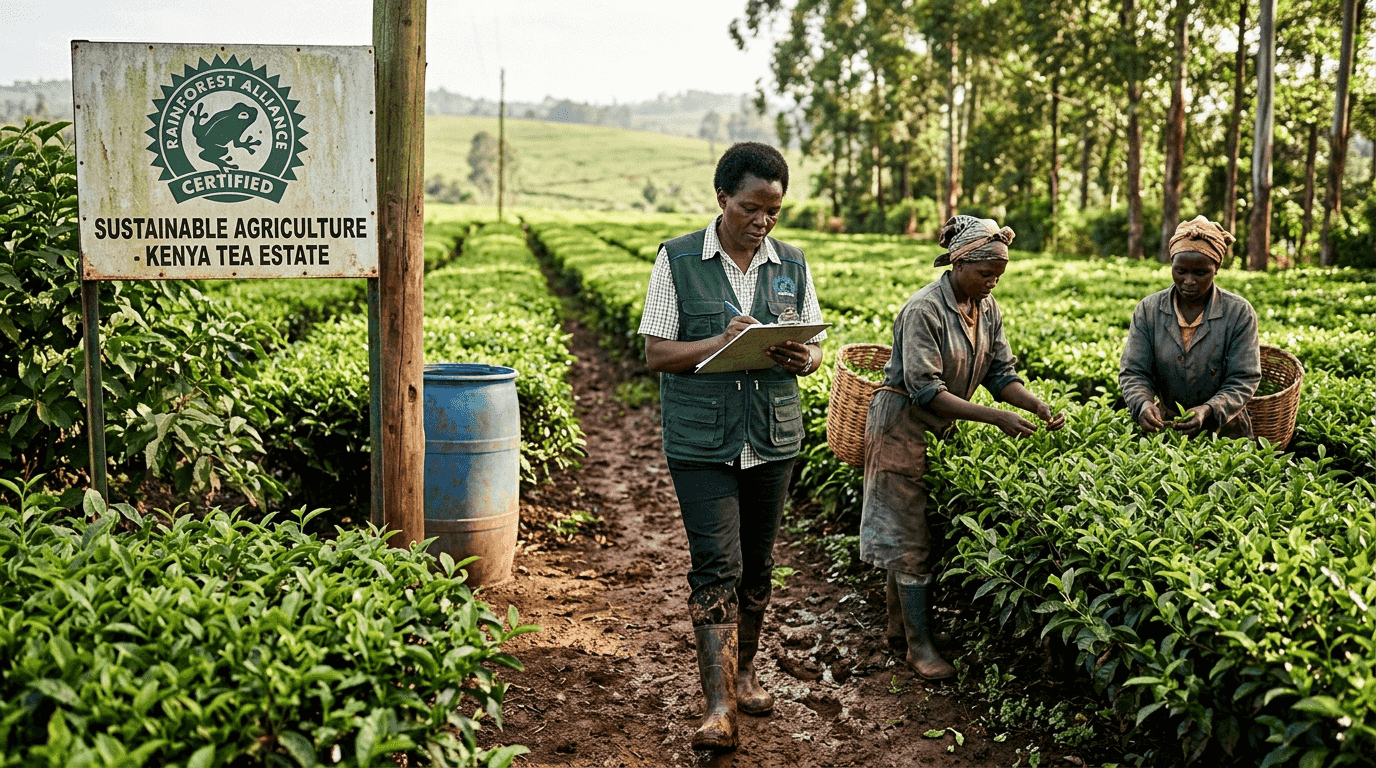
The Sustainability Differential represents an additional payment mechanism within Rainforest Alliance certification. Farmers receive premiums based on their sustainability performance, incentivizing continuous improvement beyond minimum standards. While the certification does not establish fixed minimum prices like Fair Trade, the differential rewards farms that excel in environmental stewardship and social responsibility. For crops like cocoa, minimum pricing does exist, showing the certification’s evolution toward stronger economic protections.
Kenya demonstrates the transformative potential of widespread certification adoption. Rainforest Alliance certification supports over 34,000 tea and coffee smallholders across the country, improving their access to premium markets in the European Union, United Kingdom, and United States. As due diligence regulations tighten in these markets, certification provides crucial documentation that products meet sustainability requirements. This market access translates directly into better incomes and more stable livelihoods for farming families.
Unilever’s Kericho tea plantation became the first major estate to achieve Rainforest Alliance certification, illustrating how large brands successfully integrate sustainability standards into mainstream sourcing. The certification helped Unilever expand into premium markets including Japan and the United States where consumers increasingly demand verified sustainability claims. This case study proves that certification benefits extend beyond smallholders to commercial operations seeking competitive advantages through ethical practices.
| Certification Benefit | Farm Impact | Exporter Advantage | Buyer Value |
|---|---|---|---|
| Market access | Premium prices | EU/UK/US compliance | Verified sustainability |
| Technical support | Improved practices | Quality consistency | Supply chain security |
| Brand reputation | Community recognition | Differentiation | Consumer trust |
| Risk management | Climate resilience | Audit readiness | Due diligence proof |
Rainforest Alliance certification reduces supply chain risks for exporters and buyers in several ways. It ensures farms maintain audit-ready documentation of their practices. It provides standardized sustainability metrics that satisfy corporate responsibility reporting requirements. It creates traceability systems that track tea from specific farms through processing and export. These benefits become increasingly valuable as governments implement mandatory due diligence laws requiring companies to prove their supply chains are free from deforestation and human rights abuses.
Digital traceability systems now complement Rainforest Alliance certification in many supply chains. These platforms use blockchain or similar technologies to record every transaction and movement of certified tea. Farmers can document their sustainability practices digitally. Exporters can verify the certified status of incoming tea. Buyers can trace their purchases back to specific farms and cooperatives. This transparency ensures premiums reach intended recipients and provides consumers with unprecedented visibility into their tea’s origins. The environmental benefits of certified tea extend from farm to cup when robust traceability supports certification claims.
The certification also strengthens community support initiatives by requiring farms to invest in worker welfare. Certified estates must provide safe housing, clean water, and healthcare access. They must offer education opportunities for workers’ children. These requirements transform tea production from extractive industry into community development engine, creating shared prosperity that extends far beyond the farm gate.
Making informed ethical tea choices: practical tips for consumers
Certifications provide essential baselines, but deeper brand transparency and documented farm partnerships indicate stronger ethical commitments. The most responsible tea companies go beyond minimum certification requirements to build lasting relationships that transform farming communities. Your purchasing power amplifies when you support brands that demonstrate comprehensive commitment to people and planet.
Follow this five-step process to assess the ethical integrity of any tea brand. First, check for multiple certifications rather than relying on a single label. A tea bearing Fair Trade, Organic, and Rainforest Alliance certifications meets rigorous standards across social, environmental, and economic dimensions. Second, research the brand’s investments in farm infrastructure and community development. Look for specific examples of schools built, healthcare provided, or agricultural training delivered. Third, evaluate transparency about tea origins and farmer support. Brands should clearly identify where their tea grows and how they compensate producers.
Fourth, prioritize Direct Trade relationships or documented premium payments for quality. Direct Trade pays more for quality and invests in farm infrastructure, creating incentives for continuous improvement. These relationships often result in the highest farmer compensation, though they require trust in brand claims. Fifth, support brands that reinvest profits in community development rather than maximizing shareholder returns. Companies structured as benefit corporations or certified B Corps legally commit to balancing profit with social and environmental impact.
Pro Tip: Beware of certifications alone without accompanying evidence of community investments and environmental stewardship. Top ethical sourcing involves ongoing partnerships and measurable improvements in farmer welfare and ecosystem health.
Ask brands direct questions about their supply chain practices. Request information about digital traceability systems and third-party audits. Companies with nothing to hide eagerly share details about their sourcing relationships. Evasive answers or vague marketing language often signal superficial commitments. The most ethical brands publish detailed sustainability reports with specific metrics on farmer payments, environmental impacts, and community investments.
Look beyond pricing strategies or charitable donation claims to tangible benefits delivered to farming communities. Many small farmers cannot export directly and rely on trusted partners to handle logistics and quality investments. Ethical brands fill this role by providing technical support, market access, and fair compensation. They ensure safe working conditions that protect employee health. They pay wages sufficient to cover basic needs plus savings. They implement biodiversity preservation practices that protect native species. They fund education programs that break cycles of poverty.
Consider the complete impact of your tea purchase. Does it support organic farming that regenerates soil? Does it fund clean water projects in tea-growing regions? Does it ensure children of tea workers attend school rather than laboring in fields? When you choose ethical products, you vote for a food system that values human dignity and ecological health. Your daily tea ritual becomes an act of solidarity with farming families working to build better futures while stewarding the land for generations to come.
Shop eco-conscious teas and support ethical sourcing
Now that you understand what ethical tea sourcing truly means, you can put this knowledge into action with confidence. EcoVibe Roast offers a curated collection of ethically sourced teas that meet rigorous sustainability standards while delivering exceptional flavor. Every purchase supports responsible farming practices and contributes to environmental restoration through tree planting and ocean plastic removal initiatives.

Our Hibiscus Berry Tea exemplifies our commitment to organic, sustainably sourced ingredients that benefit both your health and farming communities. Explore our complete tea selection to discover varieties that align with your values. Learn more about our comprehensive approach to sustainability and measurable impact on our environmental initiatives page, where we document exactly how your purchases create positive change for people and planet.
Frequently asked questions
What is ethical tea sourcing?
Ethical tea sourcing ensures fair wages, safe working conditions, and environmental sustainability throughout the supply chain. It involves paying farmers living wages, investing in community development, protecting biodiversity, and eliminating harmful chemicals. Truly ethical sourcing creates lasting positive impact for farming families and ecosystems.
How do Fair Trade and Direct Trade differ for tea?
Fair Trade provides certified minimum prices and democratic cooperative structures with third-party verification. Direct Trade emphasizes quality relationships and premium payments without formal certification, relying on transparency between buyers and producers. Both can deliver strong farmer benefits when implemented with genuine commitment.
Does Rainforest Alliance certification guarantee fair prices?
Rainforest Alliance does not mandate fixed minimum prices like Fair Trade, instead encouraging sustainability premiums based on performance. The certification focuses primarily on environmental standards including biodiversity protection, pesticide limits, and forest conservation. It requires respect for worker rights but does not specify wage levels.
Can organic tea still be unethically sourced?
Yes, organic certification addresses only chemical inputs and farming methods, not labor practices or fair compensation. A tea can be organically grown while workers receive inadequate wages or face unsafe conditions. Look for organic certification combined with Fair Trade, Rainforest Alliance, or documented Direct Trade relationships.
How can I verify a brand’s ethical sourcing claims?
Request detailed information about certifications, farm partnerships, and community investments. Look for published sustainability reports with specific metrics on farmer payments and environmental impacts. Check for third-party verification and digital traceability systems. Ethical brands eagerly share transparent information about their supply chains and measurable outcomes.
Recommended
- Transparency in tea sourcing empowers eco-conscious buyers – EcoVibe Roast
- Why support responsible sourcing for coffee and tea – EcoVibe Roast
- How to choose eco tea products for sustainable benefits – EcoVibe Roast
- Why Support Eco-Friendly Coffee & Tea in 2026: Cut 50% Carbon – EcoVibe Roast
- Why Sustainable Business: Complete Guide for UK Professionals - Kefihub


