

Choosing coffee that aligns with your values should feel empowering, not confusing. As eco-conscious millennials and Gen Z coffee lovers, you want your daily ritual to support fair labor and sustainability instead of harming people or the planet. This article busts myths about ethical coffee, breaks down real-world impacts, and spotlights how responsible choices can elevate quality, protect ecosystems, and drive meaningful change from Honduras to Japan. Discover what makes ethical coffee a true force for global good.
Table of Contents
- Defining Ethical Coffee And Common Myths
- How Ethical Coffee Supports Sustainability
- Social Impact: Empowering Coffee Communities
- Flavor And Quality Benefits For Consumers
- Comparing Ethical Coffee With Conventional Options
Key Takeaways
| Point | Details |
|---|---|
| Ethical Coffee Prioritizes Sustainability | It encompasses fair labor practices, environmental stewardship, and social responsibility, creating a holistic production approach. |
| Consumer Preferences Are Complex | While many support ethical sourcing, price sensitivity remains a significant barrier to purchasing ethical coffee. |
| Quality Enhancements | Ethical coffee often features superior flavors and aromas due to sustainable cultivation and processing methods. |
| Differences with Conventional Coffee | Ethical coffee focuses on transparency in its supply chain and fair compensation for farmers, contrasting sharply with conventional practices. |
Defining Ethical Coffee and Common Myths
Ethical coffee represents far more than a trendy buzzword - it’s a holistic approach to coffee production that prioritizes environmental sustainability, fair labor practices, and social responsibility. At its core, ethical coffee means supporting coffee farming practices that respect both people and the planet.
Researchers have found that consumer motivations for purchasing ethical coffee are complex. In a fascinating study examining consumer behavior, ethical sourcing attitudes reveal nuanced consumer preferences that go beyond simple environmental concerns. While environmental sustainability matters, labor treatment and worker conditions often play an even more significant role in purchasing decisions.
Several key characteristics define ethical coffee production:
- Fair wages for coffee farmers
- Sustainable farming practices that protect ecosystems
- Transparent supply chains with minimal intermediary exploitation
- Biodiversity preservation in coffee-growing regions
- Reduced environmental impact through responsible cultivation methods
Common myths about ethical coffee often mislead consumers. Many people believe ethical coffee automatically means higher prices, but innovative sourcing strategies are making responsible coffee more accessible. Another prevalent misconception is that ethical coffee compromises taste - in reality, many ethically sourced beans represent the highest quality available.
Consumer research indicates that while most people support ethical production, price sensitivity remains a significant barrier. Consumer purchasing behavior demonstrates complex ethical trade-offs between cost and social responsibility.
Ethical coffee isn’t just about what’s in your cup - it’s about supporting a global ecosystem of fair treatment and sustainable practices.
Pro tip: Start by researching coffee brands that provide transparent sourcing information and actively support fair trade practices.
How Ethical Coffee Supports Sustainability
Sustainable coffee production goes far beyond simply growing beans - it represents a comprehensive approach to environmental stewardship, social justice, and economic empowerment. Sustainability initiatives transform local coffee ecosystems by creating holistic strategies that address ecological, economic, and cultural challenges.
At its core, ethical coffee sustainability focuses on multiple interconnected dimensions:
- Protecting biodiversity in coffee-growing regions
- Supporting fair economic practices for farmers
- Reducing environmental degradation
- Promoting community development through education
- Implementing regenerative agricultural techniques
In Honduras, remarkable examples demonstrate how sustainable coffee production can drive meaningful change. Innovative community-driven sustainability efforts have integrated indigenous knowledge with modern agricultural practices, creating powerful models of social and environmental transformation.
Ethical coffee sustainability requires a multifaceted approach that considers environmental protection, social equity, and economic viability. By prioritizing responsible farming methods, coffee producers can simultaneously address climate challenges, improve farmer livelihoods, and protect delicate ecological systems.
Sustainable coffee is not just about producing a beverage - it’s about cultivating hope, preserving ecosystems, and creating opportunities for marginalized communities.
Pro tip: Look for coffee brands that provide detailed information about their sourcing practices and community impact initiatives.
Social Impact: Empowering Coffee Communities
Coffee communities represent far more than agricultural production sites - they are vibrant ecosystems of human potential and social transformation. Collaborative community development strategies demonstrate how coffee can become a powerful tool for economic empowerment and social connection.
The social impact of ethical coffee production encompasses several critical dimensions:
- Creating sustainable economic opportunities for farmers
- Providing educational resources for rural communities
- Supporting women’s economic empowerment
- Developing local infrastructure through fair trade practices
- Preserving cultural heritage and traditional agricultural knowledge
Social enterprise strategies transform coffee supply chains by bridging economic gaps and creating meaningful connections between producers and global consumers. These approaches go beyond simple financial transactions, focusing on holistic community development and long-term social sustainability.
By prioritizing human connections and economic justice, ethical coffee production becomes a powerful mechanism for social change. The approach recognizes that true sustainability requires investing in people - supporting their dreams, protecting their communities, and creating pathways for generational progress.
Ethical coffee is more than a beverage - it’s a catalyst for social transformation, economic empowerment, and community resilience.
Pro tip: Research coffee brands that transparently showcase their community impact and direct support for farming communities.
Flavor and Quality Benefits for Consumers
Ethical coffee isn’t just about social responsibility - it’s a gateway to exceptional taste and unparalleled sensory experiences. Coffee fermentation techniques dramatically enhance flavor complexity by developing intricate aroma compounds that transform an ordinary cup into a remarkable culinary journey.
The quality of ethical coffee encompasses several critical flavor dimensions:
- Deeper, more complex taste profiles
- Enhanced aromatic characteristics
- Nuanced flavor notes from careful processing
- Consistent quality through sustainable practices
- Preservation of regional flavor signatures
Comprehensive coffee quality research reveals that ethical sourcing directly correlates with superior sensory experiences. By prioritizing careful cultivation, precise processing, and respectful agricultural methods, ethical coffee producers create beverages that tantalize the palate and tell a rich story of origin.
Beyond flavor, ethical coffee represents a holistic approach to consumption that respects both agricultural traditions and consumer expectations. Each carefully crafted bean carries the potential for an extraordinary drinking experience, connecting global consumers with meticulous farmers who pour their expertise into every harvest.
Quality in coffee is not an accident - it’s a deliberate journey from seed to cup, guided by passion and precision.
Pro tip: Experiment with single-origin ethical coffees to discover the unique flavor profiles from different global regions.
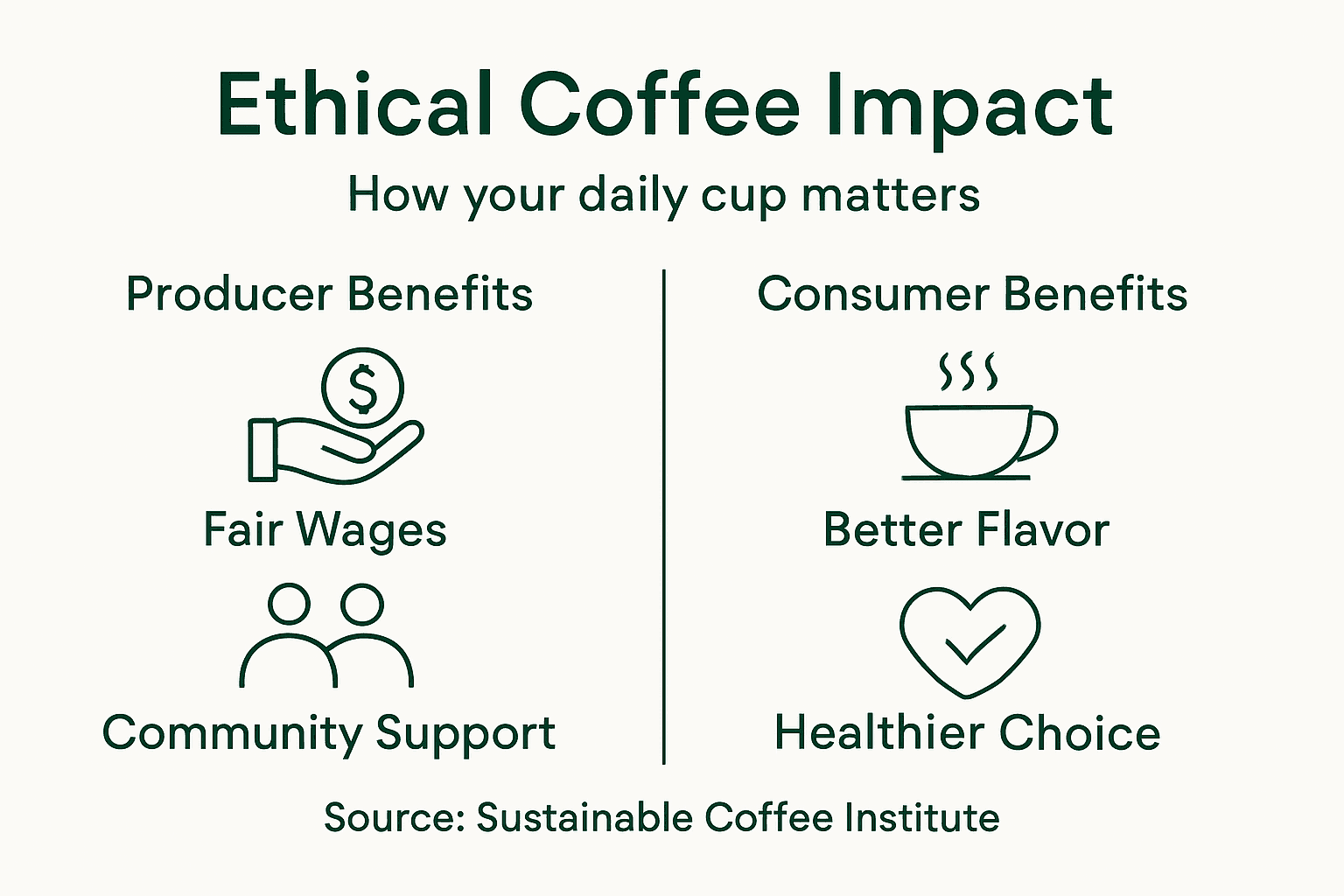
This table summarizes unique benefits ethical coffee provides to both producers and consumers:
| Benefit Type | For Producers | For Consumers |
|---|---|---|
| Economic Security | Stable income, investment | Quality assurance, story behind cup |
| Social Integration | Empowered local community | Support for global equity |
| Environmental Value | Biodiversity protection | Healthier, eco-friendly choice |
| Quality Enhancement | Incentivized best practices | Distinct flavor, premium taste |
Comparing Ethical Coffee with Conventional Options
The distinction between ethical and conventional coffee extends far beyond price tags - it represents a fundamental difference in production philosophy, environmental impact, and global responsibility. Life cycle assessments reveal critical sustainability differences that challenge traditional coffee production models and highlight the comprehensive advantages of ethical sourcing.
Key differences between ethical and conventional coffee include:
- Environmental footprint dramatically reduced in ethical production
- Transparent supply chains versus opaque traditional networks
- Fair compensation for farmers instead of exploitative pricing
- Biodiversity preservation in growing regions
- Higher quality beans through careful cultivation techniques
Conventional coffee production often prioritizes volume and short-term economic gains, while ethical coffee approaches production as a holistic ecosystem. This means considering environmental sustainability, worker welfare, and long-term agricultural health in every step of the process.

Ethical coffee represents a comprehensive approach that recognizes coffee as more than a commodity - it’s a complex agricultural product with profound human and environmental implications. By choosing ethical options, consumers directly support more sustainable, equitable, and high-quality coffee production systems.
Here’s a concise comparison of ethical coffee and conventional coffee across key factors:
| Factor | Ethical Coffee | Conventional Coffee |
|---|---|---|
| Supply Chain | Transparent and traceable | Opaque, often unclear origins |
| Farmer Compensation | Fair and equitable payments | Often low and exploitative |
| Environmental Impact | Reduced, uses sustainable methods | Higher, with frequent deforestation |
| Consumer Appeal | Values-driven, specialty segment | Mass-market focused, price-driven |
The true value of coffee isn’t measured in cents per pound, but in the lives transformed and ecosystems preserved.
Pro tip: Compare coffee labels and look for certifications that demonstrate transparent, ethical sourcing practices.
Experience Ethical Coffee That Truly Makes a Difference
Choosing ethical coffee means embracing more than just a great taste. The article highlights how ethical coffee production tackles challenges like environmental sustainability, fair wages for farmers, and community empowerment. It shows that many consumers struggle with balancing price and social responsibility while wanting to enjoy a premium coffee experience.
At EcoVibe Roast, we understand these concerns and are committed to providing you with high-quality, responsibly sourced coffee and tea that supports these values every day. Our selection includes carefully curated offerings that emphasize transparent supply chains, eco-friendly farming methods, and a direct positive impact on coffee-growing communities.
Discover our Best Sellers – EcoVibe Roast to start your journey with ethical coffee that aligns with your values.

Make a meaningful impact with every sip. Explore our Coffee and Tea example products – EcoVibe Roast and choose beverages that support fair practices, environmental stewardship, and community resilience. Visit EcoVibe Roast now and join a growing community of conscious coffee lovers dedicated to sustainability and quality.
Frequently Asked Questions
What is ethical coffee?
Ethical coffee refers to coffee produced with a focus on environmental sustainability, fair labor practices, and social responsibility. It emphasizes supporting practices that respect both the planet and its people.
How does ethical coffee impact the environment?
Ethical coffee production reduces environmental degradation by implementing sustainable farming practices, preserving biodiversity, and minimizing the ecological footprint of coffee cultivation.
Does ethical coffee taste different from conventional coffee?
Yes, ethical coffee often features deeper, more complex flavors due to careful cultivation and processing methods, resulting in a higher quality and richer tasting experience for consumers.
Why is price a concern for consumers when choosing ethical coffee?
While many consumers support ethical production, price sensitivity can be a barrier. Ethical coffee is sometimes perceived as more expensive, although innovative sourcing strategies are making it more accessible.


