

You want to enjoy tea that aligns with your values, but sorting through certification labels and packaging claims feels overwhelming. Terms like Fairtrade, Rainforest Alliance, and Organic appear on countless packages, yet their actual impact remains unclear. Some brands tout eco-friendly credentials that don’t hold up under scrutiny. This guide cuts through the confusion by explaining what certifications truly mean, how to verify their legitimacy, and which packaging and sourcing practices deliver genuine environmental and social benefits. By the end, you’ll confidently select tea that supports both planetary health and fair labor practices in 2026.
Table of Contents
- Understanding Sustainable Tea Certifications And Their Meanings
- Verifying Certifications And Avoiding Greenwashing
- Packaging Choices And Sourcing Transparency For Environmental Impact
- The Environmental Benefits Of Sustainable Tea And Climate Resilience
- Discover Sustainable Coffee And Tea Options With Ecovibe Roast
- What Certifications Should I Look For When Buying Sustainable Tea?
- Why Is Loose Leaf Tea Better For Sustainability Than Tea Bags?
- How Can I Avoid Greenwashing When Selecting Sustainable Tea?
- Are Direct Trade Or B Corp Teas More Sustainable Than Certified Teas?
Key takeaways
| Point | Details |
|---|---|
| Certifications vary in scope | Fairtrade emphasizes economic fairness, Rainforest Alliance targets environmental standards, and Organic excludes synthetic chemicals but ignores labor rights. |
| Verification prevents greenwashing | Checking certification renewal dates and requesting audit documents helps confirm authenticity and avoid misleading claims. |
| Packaging impacts environment | Loose leaf tea with compostable or recyclable packaging eliminates microplastic pollution from nylon tea bags. |
| Transparency matters | Direct trade and B Corp brands often provide greater sourcing visibility and pay higher premiums to farmers. |
| Sustainable tea combats climate change | Tea plantations function as carbon sinks and support biodiversity when managed with agroforestry practices. |
Understanding sustainable tea certifications and their meanings
Certifications provide a starting point for identifying sustainable tea, but each label prioritizes different aspects of environmental and social responsibility. Fairtrade ensures minimum price and premiums benefiting farmers, Rainforest Alliance focuses on environmental standards with no price guarantee, and Organic excludes synthetic chemicals but does not cover labor rights. Understanding these distinctions helps you choose tea that matches your specific values, whether you prioritize fair wages, ecosystem protection, or chemical-free cultivation.
Fairtrade certification guarantees farmers receive a minimum price plus a community development premium, protecting them from market volatility. This economic security enables long-term planning and investment in sustainable practices. However, Fairtrade standards address environmental concerns only at a basic level, so you might see conventional pesticide use on Fairtrade farms. Rainforest Alliance takes the opposite approach, requiring comprehensive environmental management plans that protect forests and waterways. Yet this certification offers no price floor, leaving farmers vulnerable to commodity price crashes. USDA Organic prohibits synthetic pesticides and fertilizers, reducing chemical runoff and soil degradation. The catch? Organic standards say nothing about worker wages or community investment.
No single certification covers all sustainability pillars, which explains why the most responsible brands pursue multiple credentials. A tea carrying both Organic and Fairtrade labels delivers chemical-free cultivation plus fair economic terms. Some producers add Rainforest Alliance certification to demonstrate ecosystem stewardship alongside these other commitments. When you see dual or triple certifications, you’re looking at a product that addresses environmental, social, and economic sustainability comprehensively.
Key certification strengths and limitations:
- Fairtrade: Guarantees minimum prices and premiums; limited environmental requirements
- Rainforest Alliance: Strong ecosystem protection standards; no price guarantees for farmers
- USDA Organic: Eliminates synthetic chemicals; silent on labor rights and fair wages
- Dual certifications: Address multiple sustainability dimensions simultaneously
Pro Tip: Prioritize teas with at least two certifications to ensure both environmental protection and social equity. A combination like Organic plus Fairtrade or Rainforest Alliance plus Fairtrade indicates comprehensive sustainability efforts rather than a narrow focus on one aspect.
Exploring choosing eco tea products can deepen your understanding of how different product features contribute to sustainability goals beyond basic certifications.
Verifying certifications and avoiding greenwashing
Authentic certifications require annual renewal and third-party audits, yet some brands display outdated or fabricated credentials. Annual renewal and valid certification documents are crucial as 38% of online organic teas in 2023 lacked valid certificates, and UK brands faced fines for false claims. Taking a few minutes to verify certification legitimacy protects you from supporting companies that exploit sustainability marketing without delivering real impact.
Follow these steps to confirm certification authenticity:
- Check the certification logo for a license number or code that you can verify on the certifying body’s website
- Look for the farm or cooperative name on the packaging, then search that name in the certification database
- Contact the brand directly to request current certificates or audit summaries if information isn’t publicly available
- Verify the certification year matches the current or previous year, as expired credentials indicate lapsed compliance
- Review the certifying organization’s standards document to understand what practices the certification actually requires
Mass balance certification presents a particularly deceptive loophole. Under this system, certified and non-certified tea can be physically mixed during processing, with the certified volume tracked only on paper. You might purchase tea labeled as certified that contains zero certified leaves. Full segregation certification ensures physical separation throughout the supply chain, guaranteeing that certified tea stays certified from field to package. Always favor brands that specify segregation and name the specific estates or cooperatives that grew your tea.
Some forward-thinking brands publish Certificates of Analysis showing pesticide residue testing or third-party audit reports on their websites. This transparency goes beyond minimum certification requirements and demonstrates genuine commitment to accountability. If a brand’s marketing emphasizes sustainability but provides no way to verify claims, that’s a red flag. Legitimate sustainable tea companies welcome scrutiny and make verification easy.
Pro Tip: Bookmark the certification databases for organizations like Fairtrade International, USDA Organic, and Rainforest Alliance. Spending two minutes to verify a brand’s claims before your first purchase saves you from repeatedly buying products that don’t deliver the impact you’re paying for.
Learning about tea sourcing transparency reveals how supply chain visibility creates accountability and enables informed purchasing decisions.
Packaging choices and sourcing transparency for environmental impact
Packaging decisions significantly affect tea’s environmental footprint, sometimes outweighing the sustainability benefits of certified cultivation. Nylon tea bags release billions of microplastic particles into your cup and eventually into waterways, creating pollution that persists for centuries. Loose leaf tea eliminates this contamination while typically using less packaging material overall. When you do choose bagged tea, look for unbleached paper bags without plastic sealants or nylon mesh.
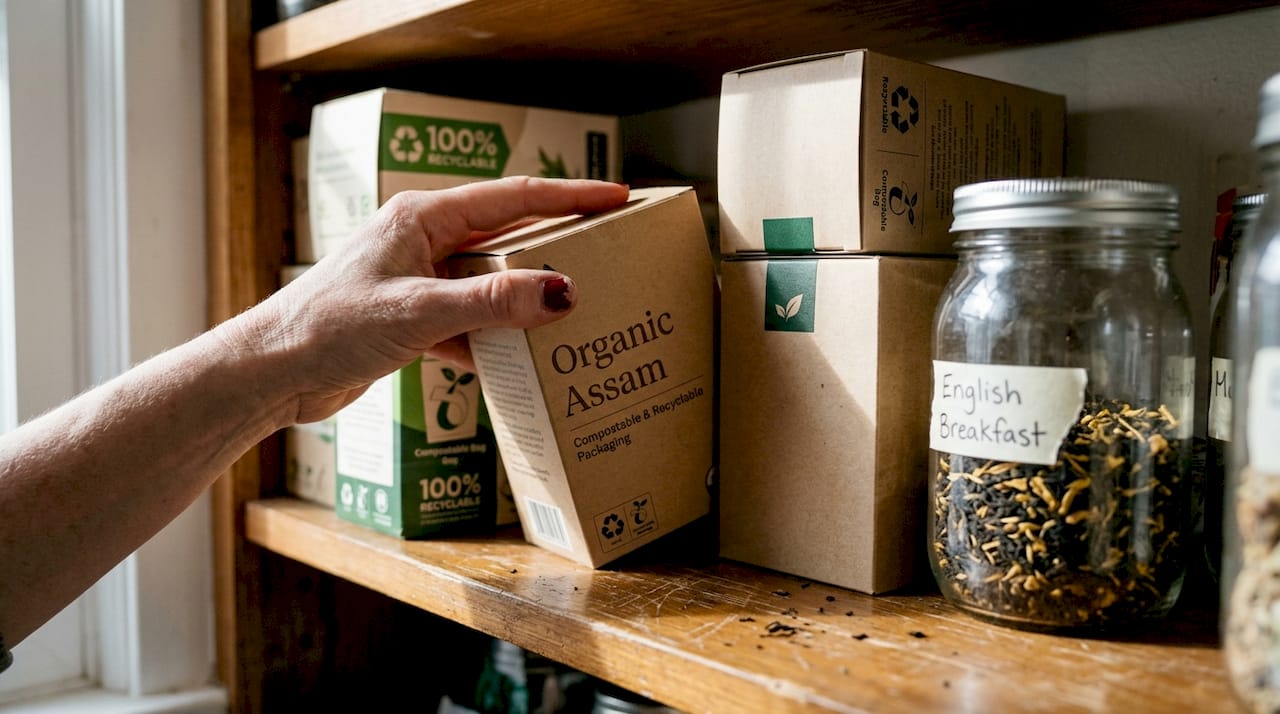
Compostable packaging made from plant-based materials breaks down naturally without leaving toxic residues. Recyclable metal tins or glass jars offer another sustainable option, especially when brands provide refill programs that eliminate single-use containers entirely. Avoid multilayer foil pouches that combine plastic, aluminum, and paper in ways that prevent recycling. The most environmentally responsible packaging uses a single material that your local waste system can actually process.
Direct trade and B Corp certifications signal sourcing transparency that often exceeds traditional certification standards. Direct trade brands establish long-term relationships with specific farms, paying premiums well above fair trade minimums in exchange for quality and traceability. You can usually find detailed information about the farmers, their cultivation practices, and the prices paid on the brand’s website. B Corp certification evaluates a company’s entire social and environmental performance, including supply chain practices, worker treatment, and community investment. While not tea-specific, B Corp status indicates comprehensive sustainability commitment.
The Ethical Tea Partnership monitors labor conditions and environmental practices across tea-growing regions, providing brands with audit services and improvement programs. However, this industry-funded initiative lacks the independence of third-party certifications, so treat it as a supplementary indicator rather than a primary credential. Brands participating in ETP demonstrate awareness of supply chain issues, but verification through independent certifications remains important.
Packaging and transparency features to prioritize:
- Loose leaf format or unbleached paper bags without plastic components
- Compostable packaging certified to ASTM D6400 or EN 13432 standards
- Recyclable single-material containers with refill options
- Named estates or cooperatives with published farmer relationships
- Direct trade partnerships with transparent pricing information
- B Corp certification indicating comprehensive sustainability assessment
Exploring eco-conscious tea selection tips provides additional strategies for minimizing environmental impact through informed purchasing choices.
The environmental benefits of sustainable tea and climate resilience
Sustainable tea cultivation delivers measurable climate benefits that extend beyond reducing chemical use. Fujian tea plantations increased carbon sink capacity by nearly 95% from 2010 to 2022, demonstrating how well-managed tea farms actively remove atmospheric carbon. Tea plants, especially when grown under shade trees in agroforestry systems, sequester carbon in both plant biomass and soil organic matter. This makes your tea purchase a direct investment in climate change mitigation.
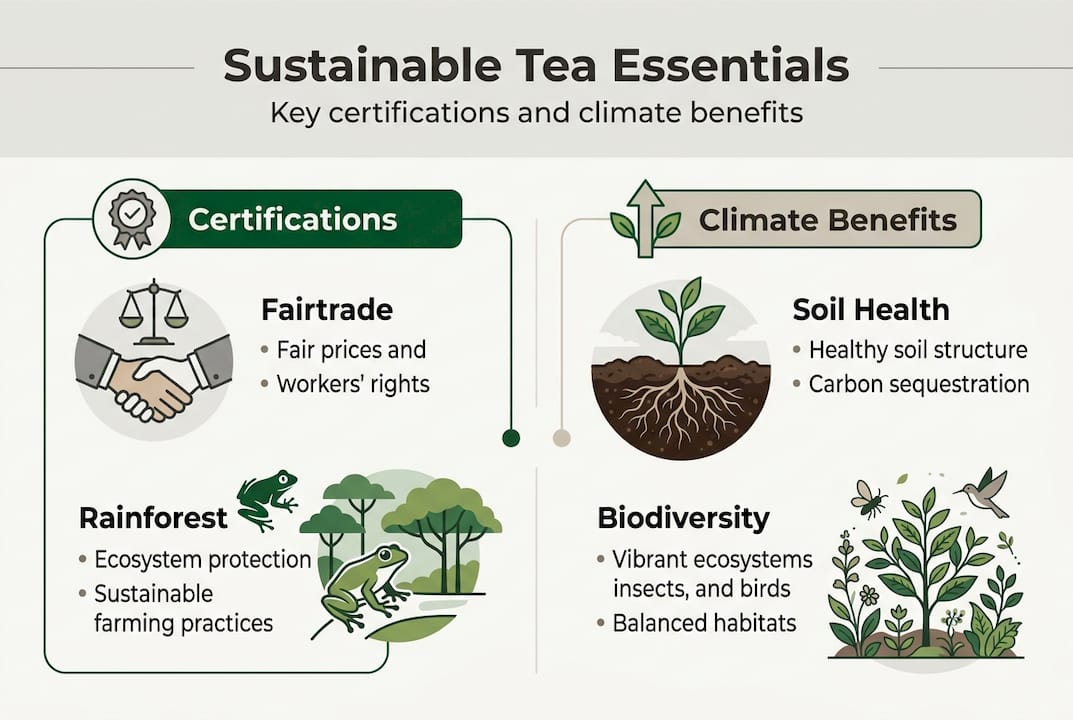
Biodiversity thrives in sustainable tea plantations that incorporate native trees, maintain buffer zones along waterways, and avoid broad-spectrum pesticides. These farms provide habitat for pollinators, birds, and beneficial insects that control pests naturally. Monoculture tea plantations offer little ecological value, but diversified systems that integrate fruit trees, nitrogen-fixing plants, and forest corridors support complex ecosystems. Some organic tea farms harbor species diversity comparable to natural forests.
The carbon footprint of your tea depends on more than just growing practices. Transportation method, processing energy source, and packaging materials all contribute to total emissions. Counterintuitively, some imported teas may have lower carbon footprints than local due to scale efficiencies in shipping and processing. Large-scale tea production in traditional growing regions often uses renewable hydroelectric power and ships by ocean freight, which emits far less per kilogram than small-batch air freight or truck transport.
| Tea type | Typical carbon footprint | Key factors |
|---|---|---|
| Local small-batch | 3.5 to 5.2 kg CO2e per kg | Truck transport, small-scale processing, limited economies of scale |
| Imported sustainable (sea freight) | 1.8 to 2.4 kg CO2e per kg | Ocean shipping efficiency, renewable processing energy, bulk packaging |
| Conventional imported | 2.2 to 3.1 kg CO2e per kg | Synthetic fertilizer production, chemical processing, standard packaging |
| Agroforestry certified | 1.2 to 1.9 kg CO2e per kg | Carbon sequestration offset, shade-grown systems, biodiversity benefits |
Climate change threatens tea production through shifting rainfall patterns, increased pest pressure, and temperature stress. Supporting sustainable farms helps build resilience by promoting soil health, genetic diversity, and adaptive management practices. Farms that rely on synthetic inputs struggle when climate disruptions affect supply chains, while organic and agroforestry systems prove more adaptable to changing conditions.
Pro Tip: Seek out tea from farms implementing agroforestry systems with shade trees and diverse plantings. These operations maximize carbon sequestration, support biodiversity, and often produce more complex flavor profiles than monoculture plantations. The premium you pay funds climate-positive agriculture that benefits everyone.
Understanding responsible sourcing benefits connects your purchasing decisions to broader environmental and social outcomes across global supply chains.
Discover sustainable coffee and tea options with EcoVibe Roast
Applying these sustainability principles becomes easier when you shop with brands that prioritize transparency and environmental responsibility. EcoVibe Roast sources coffee and tea products with verified sustainable credentials, focusing on both quality and measurable positive impact. Every purchase contributes to mangrove reforestation and ocean plastic removal, extending your environmental contribution beyond the product itself.

Our 60 pack single serve coffee pods and 12 pack single serve coffee pods use eco-friendly materials designed to minimize waste while delivering convenient, sustainably sourced beverages. We publish detailed information about our sourcing partnerships and environmental initiatives on our environmental impact page, giving you full visibility into how your purchase creates positive change. When you choose EcoVibe Roast, you’re supporting a business model that treats sustainability as fundamental rather than optional.
What certifications should I look for when buying sustainable tea?
Fairtrade certification guarantees farmers receive minimum prices and community development premiums, addressing economic sustainability and protecting producers from market exploitation. Rainforest Alliance focuses on environmental management, requiring farms to protect forests, waterways, and biodiversity while using pesticides responsibly. USDA Organic prohibits synthetic chemicals but doesn’t address labor rights or fair compensation. Look for teas carrying multiple certifications to ensure comprehensive coverage of environmental, social, and economic sustainability dimensions.
Why is loose leaf tea better for sustainability than tea bags?
Loose leaf tea eliminates microplastic pollution from nylon mesh bags, which release billions of plastic particles into your beverage and eventually into aquatic ecosystems. Loose leaf typically comes in compostable paper packaging or recyclable metal tins that create less waste than individually wrapped tea bags. The format also allows you to control portion sizes precisely, reducing waste from over-brewing or discarding unwanted tea.
How can I avoid greenwashing when selecting sustainable tea?
Verify certification validity by checking license numbers against certifying body databases and confirming that credentials are current rather than expired. Request certificates or audit reports directly from brands if packaging information seems vague or incomplete. Look for specific farm or cooperative names on labels rather than generic sustainability claims, as traceability indicates genuine supply chain knowledge. Favor brands that publish lab test results or third-party audit summaries, demonstrating transparency that goes beyond marketing slogans.
Are direct trade or B Corp teas more sustainable than certified teas?
Direct trade relationships often pay farmers premiums significantly above fair trade minimums while providing complete transparency about sourcing and pricing. B Corp certification evaluates comprehensive social and environmental performance across a company’s entire operation, including supply chain equity and community impact. Both models can complement or exceed traditional certifications by addressing sustainability holistically rather than meeting minimum standards. Many of the most responsible tea brands combine direct trade or B Corp status with product-specific certifications like Organic or Rainforest Alliance. Exploring an ethical tea sourcing guide reveals how different sourcing models create distinct impacts across environmental and social dimensions.
Recommended
- How to choose eco tea products for sustainable benefits – EcoVibe Roast
- What is ethical tea sourcing: a 2026 guide – EcoVibe Roast
- Top tips for eco-conscious tea selection in 2026 – EcoVibe Roast
- Why Choose Eco-Friendly Tea for a Greener Planet – EcoVibe Roast
- How to select ethical coffee gifts that impress in 2026 – House Coffee


