

Want the fast answer? Buy from a transparent specialty roaster or mission-driven store, EcoVibe Roast among them, where you can actually see who grew your coffee and when it was roasted. Before you check out anywhere, run a quick three-item scan on the product page: origin and roast date, a certification or clear direct-trade statement, and packaging that tells you what to do with it when the bag is empty.
That’s really the whole system. Once you know what to look for, comparing stores that store coffee beans for sale takes about ninety seconds per product page.
- Origin and roast date: look for a named farm or cooperative and a roast date within the last few weeks.
- Traceability or certification: Fairtrade, Organic, Rainforest Alliance, or a specific direct-trade statement with pricing detail.
- Packaging and shipping: monomaterial or recyclable bags, and shipping options that don’t force you to choose between freshness and footprint.
Ready to act? Grab a sampler pack or a 12-ounce whole-bean bag first, or start a subscription trial if you already know the roaster’s beans work for your taste and your values.
Key Takeaways
Sustainably sourced coffee earns its price through verifiable traceability, matched certifications, and packaging built for a real end-of-life path, not through logos alone.
| Point | Details |
|---|---|
| Scan origin and roast date first | A named farm or cooperative plus a recent roast date beats a vague country label every time. |
| Match certification to priority | Choose Fairtrade for farmer income, Bird Friendly or Organic for habitat and environmental impact. |
| Prefer monomaterial packaging | Monomaterial bags can cut packaging carbon footprint by about 50% versus multimaterial designs. |
| Start small, then subscribe | Try a sampler or single bag first, then move to a subscription once flavor and freshness check out. |
| EcoVibe Roast models transparency | Its listings publish origin, roast date, certifications, and packaging details alongside mangrove and ocean-plastic impact commitments. |
Table of Contents
- What to Look for When You Store Coffee Beans From an Online Roaster
- What Do Fairtrade, Organic, and Rainforest Alliance Labels Actually Guarantee?
- Sustainable Packaging: What to Prefer and What to Watch For
- Single Bags, Sampler Packs, or Pods: Which Format Fits You?
- How Do You Verify a Roaster’s Sustainability Claims Before Buying?
- Single Bags, Sampler Packs, and Subscriptions: Weighing the Trade-Offs
- How Can You Confirm a Roaster’s Direct-Trade Claims Are Real?
- How Do You Match Roast Level and Flavor to Your Taste?
- What Does Sustainably Sourced Coffee Cost Compared to Conventional Beans?
- How Should You Store Coffee Beans After They Arrive?
- The Uncomfortable Truth About “Sustainable” Coffee Shopping
- Ready to Buy? Start With EcoVibe Roast’s Single-Serve Collection
- Frequently Asked Questions
- Sources
What to Look for When You Store Coffee Beans From an Online Roaster
A good product page reads like a short farmer bio, not a marketing slogan. If a roaster names the farm, the cooperative, or the specific region down to the district, that’s a real signal of traceability, not just flavor branding. Vague terms like “sourced from South America” tell you almost nothing about who grew your coffee or how they were paid.
Roasters who publish farm and cooperative names, roast dates, and processing details generally offer stronger traceability and are more likely practicing direct trade or paying above-market prices. That single detail, a name instead of a region, is often the fastest way to separate genuine sourcing from a green-washed label.
- Check the roast date first. Whole-bean coffee peaks in flavor within a few weeks of roasting, and any store that hides or omits this date is asking you to buy blind.
- Look for processing notes. Washed, natural, or honey-processed coffees taste noticeably different, and a roaster who names the process at the lot level usually knows the farm well enough to describe it.
- Scan for pricing transparency. Statements about a living-income price or a specific premium paid above commodity rates carry more weight than a generic “we pay fair prices” line.
- Compare whole bean versus ground. Whole bean holds aroma and oils longer, so prioritize it unless you have no working grinder.
- Read the tasting notes against the origin. If the flavor description matches known characteristics of that region (bright acidity from high-altitude African lots, heavier body from Sumatra, for example), the copy is more likely written by someone who has actually cupped the coffee.
Pro Tip: Bookmark two or three roasters that pass this scan, then compare their roast dates on the day you’re ready to buy. The freshest bag wins, even if it means switching from your usual favorite that month.
For a deeper walkthrough of this exact process, EcoVibe Roast’s guide to choosing responsible coffee beans breaks down each signal step by step.
What Do Fairtrade, Organic, and Rainforest Alliance Labels Actually Guarantee?
Each certification protects something different, and none of them covers everything, so matching the label to what you personally care about matters more than chasing the most logos on a bag.
- Fairtrade: Fair Trade Certified standards mandate protections against forced labor and child labor, plus a guaranteed minimum price and community premium. If your top priority is farmer income, this is the label built for it.
- USDA Organic: bars synthetic pesticide and fertilizer use, protecting farmworker and environmental health, though it doesn’t directly guarantee a farmer’s income.
- Rainforest Alliance: sets farm-practice standards covering biodiversity and worker welfare; its newer Regenerative Agriculture add-on pushes further into soil health and carbon practices than the base certification.
- Smithsonian Bird Friendly: the strictest habitat standard on the market, requiring organic certification as a baseline before adding shade-cover and canopy requirements that protect migratory bird habitat.
- 4C and similar baseline schemes: signal a floor of responsible practice rather than a ceiling, useful as a minimum filter but not a substitute for farm-level detail.
According to a review of certified coffee criteria from the University of Florida, certifications vary widely in focus and rigor, and no single label guarantees every sustainability outcome at once. That’s not a knock against certification. It’s a reminder that a Fairtrade bag optimized for farmer income might not carry the same habitat protections as a Bird Friendly bag, and vice versa. Decide which outcome matters most to you, then shop that label first.
Sustainable Packaging: What to Prefer and What to Watch For
Not every “eco-friendly” bag is created equal, and packaging claims deserve almost as much scrutiny as the coffee itself.
- Monomaterial packaging (a single recyclable plastic type instead of layered foil-and-plastic laminate) can cut carbon footprint by roughly 50% compared with multimaterial flexible packaging, according to a life-cycle analysis, though some multimaterial designs still win on oxygen and moisture barrier performance.
- “Compostable” only works if your city has industrial composting. A compostable bag in a landfill behaves like any other plastic bag, so check your local infrastructure before treating that label as an automatic win.
- Recyclable claims depend entirely on local systems too. Flexible film pouches often aren’t accepted in curbside bins even when the label says “recyclable.”
- Single-serve pods aren’t automatically worse. Life-cycle work from PAC found single-serve systems can lower total environmental impact in some cases by reducing brewed coffee waste, but end-of-life handling of the pods themselves remains the deciding factor.
- Fast shipping isn’t free. Expedited individual shipments carry a heavier footprint than a consolidated order, so batching your coffee purchases with other essentials trims your footprint without sacrificing freshness by much.
Single Bags, Sampler Packs, or Pods: Which Format Fits You?
The right format depends on how much you already trust the roaster and how you brew.
- Sampler packs are the smartest first move with any new roaster. They let you taste multiple origins or roast levels before committing to a full bag, which cuts down on wasted coffee if a flavor profile misses.
- Whole-bean bags protect flavor longest and support better traceability, since a whole bean holds up under scrutiny (and taste tests) better than pre-ground coffee. Order ground only if you genuinely lack a grinder.
- Single-serve pods win on convenience, especially for offices or mixed-preference households, but check the packaging material and whether the brand runs a real take-back or recycling program before buying in bulk.
- Subscriptions keep a steady supply of fresh-roasted beans arriving on schedule and often support more consistent premiums for farmers, since the roaster can plan purchasing further ahead. Confirm the pause and cancellation policy before you sign up so a schedule change doesn’t feel like a trap.
How Do You Verify a Roaster’s Sustainability Claims Before Buying?
A trustworthy product page reads less like an ad and more like a shipping manifest. EcoVibe Roast, for example, models this by publishing farm or cooperative origin, roast date, certification status, packaging material, and specific impact commitments (mangrove tree planting and ocean-bound plastic removal tied to purchases) directly on its listings.
When a page falls short of that detail, email the roaster and ask directly:
- Where exactly did this coffee come from, down to the farm or cooperative?
- What did you pay the farmers, and how does that compare to commodity price?
- Can you share harvest or cooperative details, not just a country name?
Pro Tip: If a roaster can’t answer those three questions within a day or two, treat that silence as data. A roaster with real traceability usually has the harvest paperwork on hand already.
Watch for these red flags: a country-only origin with no farm name, a missing roast date, packaging with no material specified, or a certification badge you can’t verify against the certifier’s own database. For more on why this traceability layer matters so much, see EcoVibe Roast’s breakdown of transparency in the coffee supply chain.
Single Bags, Sampler Packs, and Subscriptions: Weighing the Trade-Offs
Every purchase format online trades convenience for something else, and knowing what you’re giving up helps you buy smarter.
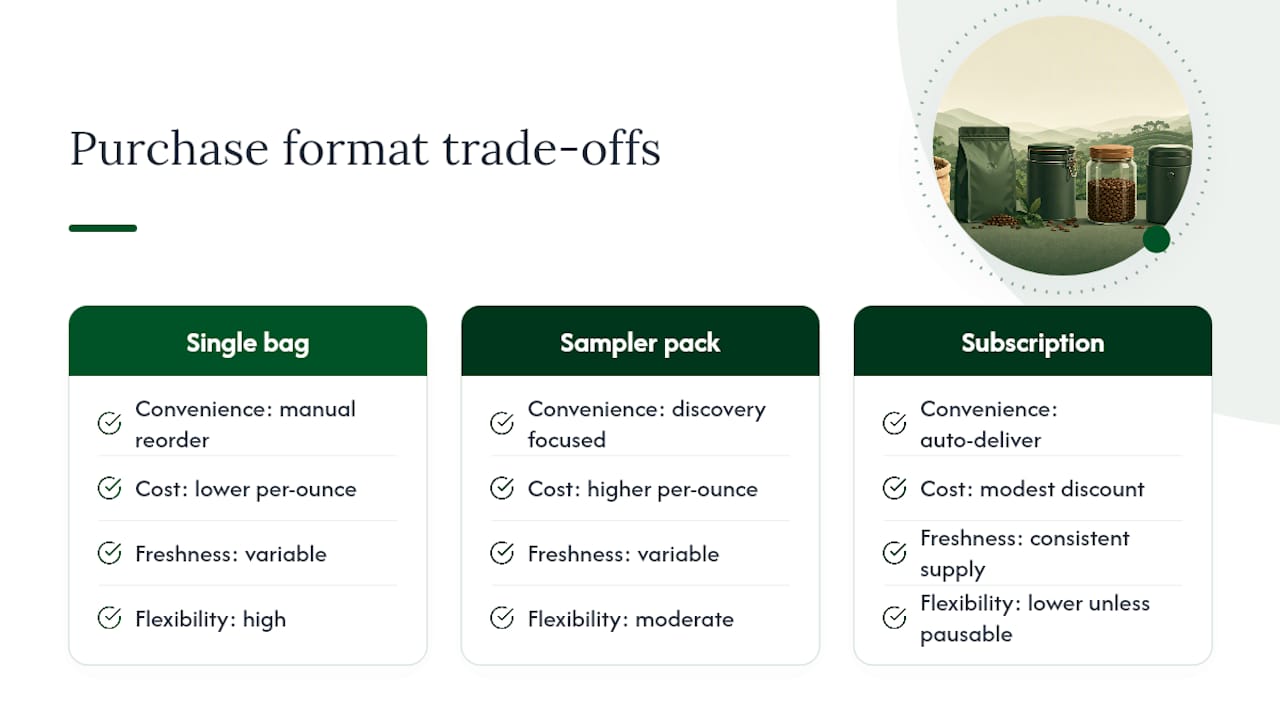
A single bag gives you full control over quantity and origin with no ongoing commitment, but you’re on your own for remembering to reorder before you run out. A sampler pack solves the discovery problem well, letting you compare two or three origins side by side, though the per-ounce cost usually runs higher than buying a full bag. Subscriptions solve the opposite problem: you’ll never run dry, and many roasters extend a modest discount to subscribers, but you lose some flexibility unless the plan allows easy pausing or swapping.
The pros and cons stack up differently depending on your habits. A once-a-week drinker might do best with a single 12-ounce bag bought every few weeks. A household running through coffee daily might save money and hassle with a subscription, provided the cancellation terms are painless. Gift buyers tend to prefer sampler packs, since they let the recipient taste-test before committing to a favorite. For a full walkthrough of how these formats compare on cost and freshness, EcoVibe Roast’s guide to buying sustainable coffee online lays out the math.
How Can You Confirm a Roaster’s Direct-Trade Claims Are Real?
“Direct trade” has no legal definition, so the phrase alone tells you nothing. What separates a real direct-trade relationship from marketing copy is specificity: a named importer, a specific price paid per pound, and details about how long the roaster has worked with that particular farm or cooperative.
Genuine traceability usually includes a lot number or harvest year tied to a specific plot, not just a country of origin. Roasters serious about transparency will often publish the price they paid relative to the commodity “C price,” since that comparison is the clearest way to show a farmer actually earned more than the market floor. If a site claims direct trade but can’t name an importer, a specific cooperative, or a price comparison, treat the label as aspirational rather than verified.
Cross-checking helps too. A quick search of the named cooperative or farm should turn up some independent confirmation, whether through the certifying body’s own database or coverage from agricultural or trade publications. Sourcing that emphasizes local relationships over long, opaque supply chains tends to hold up better under this kind of scrutiny, a principle that applies well beyond coffee, as this overview of local sourcing benefits and challenges lays out clearly.
How Do You Match Roast Level and Flavor to Your Taste?
Roast level shapes flavor more than origin does for a lot of drinkers, so it’s worth learning your own preference before you start comparing farms.
Light roasts preserve more of the bean’s original acidity and origin character, often showing floral, citrus, or berry notes, especially from high-altitude African or Central American lots. Medium roasts balance acidity with body and tend to bring out caramel or chocolate notes, a safe starting point if you’re new to specialty coffee. Dark roasts emphasize the roasting process itself, roast development flavors like smoke or bittersweet chocolate, often at the expense of the bean’s original origin character.
Processing method matters just as much as roast level. Washed coffees tend toward clean, bright acidity. Natural or dry-processed coffees often carry heavier fruit or wine-like notes because the fruit stays on the bean longer during drying. Honey-processed lots land somewhere in between, usually rounder and sweeter than washed but cleaner than natural.
The most reliable way to find your preference is a sampler pack that spans roast levels and processing methods rather than guessing from a single bag. Once you know you gravitate toward washed, medium-roast Central American coffee, or natural-processed light-roast Ethiopian, shopping gets a lot faster.
What Does Sustainably Sourced Coffee Cost Compared to Conventional Beans?
Certified and traceable coffee generally costs more per pound than commodity-grade beans, and the reason isn’t marketing markup. It’s the actual mechanics of the supply chain: guaranteed minimum prices, community premiums, and the added cost of maintaining certification paperwork all get built into the price you pay at checkout.
Certification and supply-chain transparency can raise farmer premiums, though research on voluntary certification schemes notes that certification costs and shifting market demand sometimes limit how much of that premium actually reaches smallholder farmers. That’s a fair thing to know going in: paying more doesn’t automatically mean every extra dollar lands with the farmer, but it does generally correlate with better labor and environmental standards along the way.
In practice, most sustainably sourced whole-bean coffee sits in a noticeably higher price band than big-box commodity coffee, largely because commodity pricing rarely reflects the true cost of production at all. Think of the price gap less as a premium for a logo and more as the actual cost of coffee farming done right finally showing up on the receipt.
How Should You Store Coffee Beans After They Arrive?
Freshness fades the moment a bag is opened, so what you do in the first ten seconds after opening matters more than any fancy container.
Keep beans in an airtight coffee container, away from direct light and heat, ideally somewhere cool and dark like a pantry shelf rather than next to the stove. Ceramic, dark glass, or opaque stainless coffee storage containers with a sealed lid all work well, and many specialty bags already include a one-way valve that lets gas escape without letting air back in during coffee degassing time, the period right after roasting when beans release carbon dioxide.
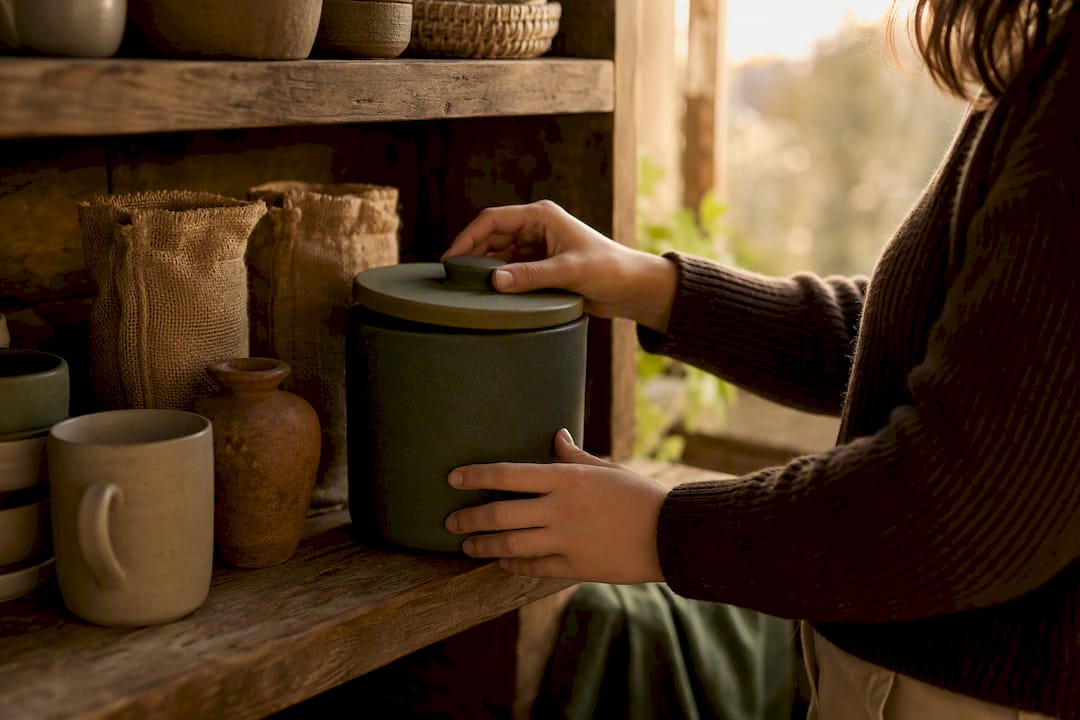
Should you freeze coffee beans? Freezing coffee beans works if you buy in bulk and won’t finish a bag within a few weeks, but only in an airtight, moisture-proof container, and only if you commit to portioning it out so you’re not repeatedly thawing and refreezing the same beans. Repeated temperature swings introduce condensation, and condensation is the fastest way to dull flavor. If you’re working through a bag within two or three weeks, skip the freezer and just keep it sealed at room temperature.
The Uncomfortable Truth About “Sustainable” Coffee Shopping
Most guides treat certification logos like a finish line: see the Fairtrade seal, check the box, done. That’s backwards. A logo tells you a floor was met, not that this specific farmer got paid fairly this season, and treating any single label as proof of full sustainability lets a lot of vague sourcing slide through unquestioned.
The more useful habit is reading product pages the way you’d read a résumé: specific details (farm names, harvest years, price comparisons) carry more weight than credentials alone. A roaster willing to publish that level of detail is telling you something a certification badge can’t. That’s the standard EcoVibe Roast holds its own listings to, and it’s worth expecting from anyone else you buy from too.
What should you prioritize first? Roast date and origin specificity, ahead of certification logos. A fresh, traceable bag without a certification often beats a certified bag that’s been sitting on a shelf for four months. Sustainability and freshness aren’t competing goals. The best roasters manage both at once.
Ready to Buy? Start With EcoVibe Roast’s Single-Serve Collection
Skip the guesswork on origin and roast dates. Every EcoVibe Roast listing publishes farm and cooperative detail, the roast date, and the packaging material up front, and every purchase supports mangrove tree planting and the removal of ocean-bound plastics, so your coffee habit does double duty.

If you’re new to the brand, the 12-pack single-serve trial is the lowest-commitment way to test the flavor and the packaging before you buy bigger. Already sold on the convenience? The 60-pack bulk single-serve pods cut the per-cup cost while keeping the same sourcing standards. For a broader look at every format available, browse the full single-serve collection and pick whichever roast level matches the flavor notes you’ve already learned to love. Start with a sampler, confirm the roast date and flavor work for you, then move to a subscription once you know it’s a keeper.
Frequently Asked Questions
Is it better to buy whole bean or ground coffee for freshness? Whole bean holds aroma and flavor longer since grinding exposes far more surface area to oxygen. Buy whole bean and grind just before brewing whenever your setup allows it.
What does the roast date on a bag actually mean? The roast date marks when the beans were roasted, not packaged or shipped. It’s the single most reliable freshness indicator on any bag, more useful than a “best by” date.
Should you freeze coffee beans if you buy in bulk? Yes, freezing coffee beans works for long-term storage if you portion the beans into airtight, moisture-proof containers and avoid repeated freeze-thaw cycles, which introduce condensation and dull flavor.
How long does coffee degassing take after roasting? Coffee degassing time typically runs from a few days to about two weeks after roasting, which is why many specialty bags include a one-way valve to release built-up carbon dioxide safely.
Do all sustainability certifications guarantee fair pay to farmers? No. Fairtrade guarantees a minimum price and premium, but labels like Organic or Rainforest Alliance focus more on environmental and farm-practice standards than direct income guarantees.
Sources
- Fair Trade Certified — what we certify: coffee
- UW351 — Certified coffees overview and certification criteria
- From multimaterial to monomaterial: An LCA of flexible coffee packaging
- Packaging, Food Waste and the Environment: A coffee case study (PAC LCA)


