

TL;DR:
- Rainforest Alliance certified tea supports environmental protection and fair treatment of workers through rigorous performance standards. Only 20% of globally consumed tea is certified, but choosing it promotes biodiversity and sustainable farming practices. For health and ecological benefits, consumers should look for both the green frog seal and organic certifications.
Rainforest-friendly tea is defined as tea grown on farms certified by the Rainforest Alliance, a global nonprofit that sets strict environmental, social, and health standards for agricultural production. The industry term for this category is “Rainforest Alliance certified tea,” and it covers 1.1 million tea farms worldwide. That scale is impressive, yet certified tea still represents only 20% of all tea consumed globally. So why drink rainforest-friendly tea? Because your cup connects directly to protected forests, fairly paid workers, and farming practices that hold up under real scrutiny. This article breaks down every reason to make the switch, from ecological impact to what it means for your health.
Why drink rainforest-friendly tea: certification explained
Rainforest Alliance certification is not a marketing label. It is a performance-based system that requires farms to meet measurable standards across environmental protection, worker welfare, and farm management. The certification covers everything from how trees are planted near waterways to how workers are paid and treated.
The core environmental standards include:
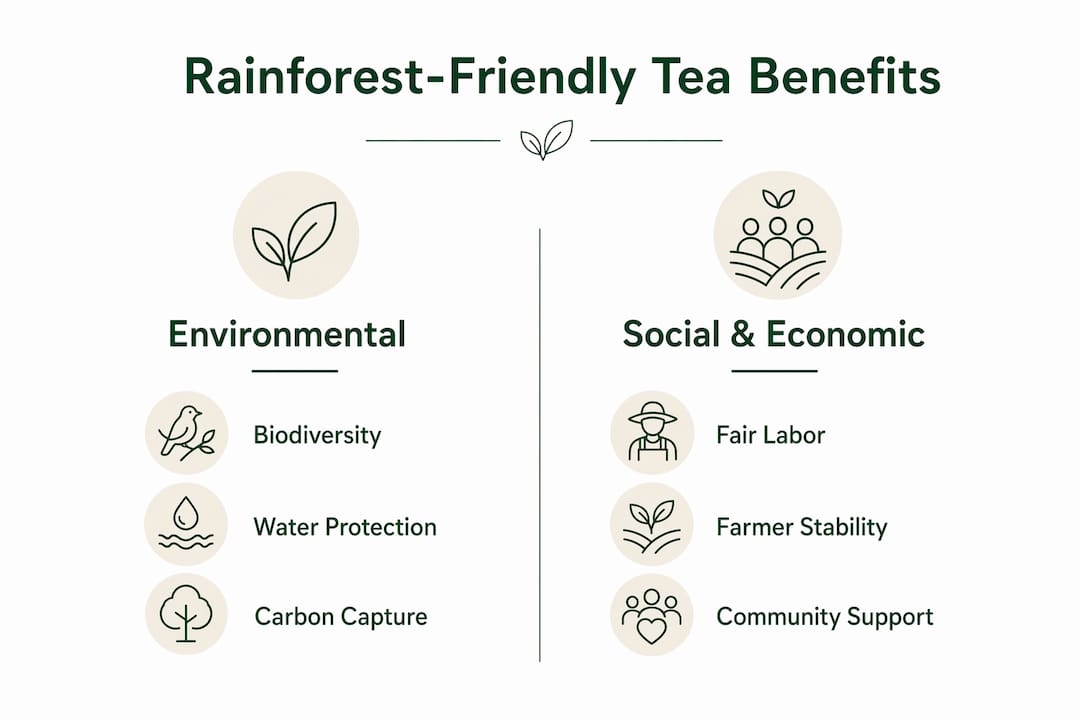
- No deforestation. Certified farms prohibit deforestation and must plant trees alongside crops and near streams and rivers to protect biodiversity and water quality.
- Soil and water conservation. Farms must manage soil health, prevent erosion, and protect clean water sources that local communities depend on.
- Integrated pest management. Synthetic pesticides are permitted but tightly controlled. Farms must minimize chemical use and prioritize safer alternatives wherever possible.
- Climate resilience. Certification helps farms adapt to climate impacts like droughts and floods, which is increasingly critical as weather patterns shift.
What makes this system credible is its performance scoring approach. Farms are not simply graded pass or fail. They receive scores and must show continuous improvement over time. A farm that passes today must do better next cycle. That ongoing accountability separates Rainforest Alliance certification from a one-time audit.
Pro Tip: Look for the green frog logo on tea packaging. That is the official Rainforest Alliance seal, and it confirms the farm met verified sustainability standards, not just a brand’s internal claims.
How do farmers benefit from rainforest-friendly tea?
The social side of certified tea is just as compelling as the environmental side. Rainforest Alliance certification mandates safe working conditions, fair wages, and the right to freedom of association for workers. Those protections cover an estimated 1.5 million tea workers globally.
Here is what that looks like in practice:
- Living wages. Workers on certified farms receive wages that meet or exceed local living wage benchmarks, not just minimum legal requirements.
- Safe conditions. Farms must provide protective equipment, limit exposure to chemicals, and maintain safe housing where applicable.
- Freedom of association. Workers have the legal right to organize and join unions without retaliation, a protection that is far from guaranteed in conventional tea supply chains.
- Training and income diversification. Certification programs include training that helps farmers develop additional income streams, reducing dependence on a single crop.
Market volatility is one of the biggest threats to small tea farmers. When global tea prices drop, uncertified farmers often absorb the full financial hit. Certification stabilizes farmer livelihoods by providing a verified framework that commands better prices from buyers and builds long-term supply chain relationships. That stability is a genuine lifeline, not a talking point.
When you choose a certified tea, you are not just buying a beverage. You are supporting a system that treats the people who grow your tea as partners, not just labor.
Is rainforest-friendly tea healthier than conventional tea?
This is where many consumers get confused, and the answer requires a clear distinction. Rainforest Alliance certification is not the same as organic certification. The two certifications address different concerns. Organic certification, such as USDA Organic, prohibits all synthetic pesticides. Rainforest Alliance certification permits controlled synthetic pesticide use under strict guidelines.
That distinction matters for your health decisions. Here is a side-by-side comparison:
| Feature | Rainforest Alliance Certified | USDA Organic |
|---|---|---|
| Synthetic pesticides | Controlled and minimized | Prohibited entirely |
| Deforestation protection | Required | Not specifically required |
| Worker welfare standards | Comprehensive and verified | Not covered |
| Environmental biodiversity | Core requirement | Not a primary focus |
| Climate resilience support | Included | Not included |
The practical health takeaway is this: if your primary concern is zero synthetic chemical exposure, you want a tea that carries both Rainforest Alliance and USDA Organic certifications. True chemical-free tea requires both environmental and organic certification, as they address different sustainability aspects. Many premium teas now carry both seals, giving you the full picture.
Rainforest-friendly teas are also often shade-grown, which slows leaf development and produces a richer, more complex flavor profile. That is not just a taste preference. Slower growth concentrates antioxidants like catechins and polyphenols, which are the compounds linked to green tea’s well-documented health benefits.
Pro Tip: If you want both environmental assurance and pesticide-free confidence, look for teas labeled with both the green frog seal and the USDA Organic circle. That combination covers all the bases.
How do you identify truly sustainable tea at the store?
Consumer confusion between Rainforest Alliance, organic, and Fair Trade certifications is extremely common and affects purchase decisions in real ways. Knowing what to look for cuts through the noise.
Follow these steps to select genuinely sustainable teas:
- Check for the green frog logo. The Rainforest Alliance seal is a green frog on a green circle. If you see it, the farm met verified third-party standards.
- Read the sourcing statement. Reputable brands name the region or farm where their tea originates. Vague phrases like “ethically sourced” without specifics are a red flag.
- Look for stacked certifications. A tea carrying both Rainforest Alliance and USDA Organic certifications offers the strongest combination of environmental and health assurances.
- Avoid “natural” and “eco-friendly” claims without seals. These terms have no legal definition in the U.S. and require no third-party verification.
- Research the brand’s supply chain transparency. Brands that publish sourcing reports or partner with named farms are far more accountable than those that do not.
For a deeper checklist, the eco-conscious tea guide at Ecoviberoast walks through every label and certification worth knowing. Pairing that resource with the steps above gives you a reliable filter for every tea purchase you make.
What is the environmental impact of rainforest-friendly tea?
The ecological benefits of certified tea farming extend well beyond the farm boundary. Certified farms actively protect habitat corridors that wildlife depends on for survival. The Rainforest Alliance documents that certified farms support conservation of iconic species including elephants, rhinos, and gliding tree frogs through habitat protection requirements.
Here is a summary of the key ecological outcomes:
| Environmental Benefit | How Certification Delivers It |
|---|---|
| Biodiversity protection | Tree planting near waterways creates habitat corridors for wildlife |
| Soil health | Erosion controls and organic matter practices restore degraded land |
| Clean water | Buffer zones around rivers prevent chemical runoff into water systems |
| Carbon sequestration | Trees planted on certified farms absorb and store atmospheric carbon |
| Deforestation reduction | Strict prohibition on clearing forest land for new tea cultivation |
The ripple effects are significant. When a tea farm plants trees along a riverbank, it does not just protect that river. It creates a corridor that connects fragmented forest patches, allowing species like gliding tree frogs and forest elephants to move, breed, and survive. That connectivity is what keeps ecosystems functional over the long term.
Conventional tea farming, by contrast, often involves clearing shade trees to maximize sun exposure and yield. That practice degrades soil, reduces biodiversity, and increases water runoff. Choosing sustainable tea options actively counters that pattern with every purchase you make.
Key takeaways
Rainforest Alliance certified tea delivers verified environmental protection, fair labor standards, and quality you can trust, making it the most complete sustainable tea option available to conscious consumers.
| Point | Details |
|---|---|
| Certification scope | Rainforest Alliance covers 1.1 million farms but only 20% of global tea consumed. |
| Environmental protection | Certified farms prohibit deforestation and plant trees near waterways to protect biodiversity. |
| Worker welfare | Certification guarantees fair wages, safe conditions, and freedom of association for 1.5 million workers. |
| Health distinction | Rainforest Alliance permits controlled pesticides; combine with USDA Organic for full chemical-free assurance. |
| Consumer action | Look for the green frog seal and stacked certifications to avoid misleading eco-friendly claims. |
What i’ve learned from years of choosing certified tea
I have been drinking and researching certified teas for years, and the single most surprising thing I have learned is how much the certification label undersells itself. Most people assume it is just a feel-good sticker. It is not. The performance scoring system means farms are held to a rising standard every single cycle. That is more rigorous than most food certifications I have encountered.
What I have also noticed is that certified teas consistently taste better. Not because of marketing, but because shade-grown, carefully managed tea plants produce leaves with more depth and complexity. The aromatic quality of a well-sourced jasmine green tea or a rich hibiscus blend is noticeably different from a commodity bag tea.
The harder truth is that certified tea still represents only 20% of the global market. Consumer demand is the lever that changes that number. Every time you choose a certified tea over a conventional one, you send a signal to brands and retailers that this standard matters. That signal compounds over time. I genuinely believe the choices individual consumers make at the shelf are the most direct way to push the industry toward better practices. You do not need to overhaul your lifestyle. You just need to reach for the right cup.
— LaSaundra
Sip sustainably with ecoviberoast’s certified teas
If you are ready to put these principles into your daily routine, Ecoviberoast makes it easy to start. Every tea in the Ecoviberoast collection is sourced with environmental and ethical standards at the forefront, so you can enjoy your cup knowing it supports both people and the planet.

Two standout options to explore are the Hibiscus Berry Tea, a refreshing organic herbal blend with a bright, tangy flavor, and the Jasmine Tea, a floral loose-leaf green tea with aromatic jasmine blossoms. Both are a warm hug for you and Mother Earth. Ecoviberoast also plants mangrove trees and removes ocean-bound plastics with every purchase, so your tea habit becomes a small act of environmental stewardship. Explore the full range and find your favorite sustainable sip today.
FAQ
What does “rainforest-friendly tea” mean?
Rainforest-friendly tea is the informal term for Rainforest Alliance certified tea, grown on farms that meet verified environmental, social, and labor standards set by the Rainforest Alliance nonprofit. The certification currently covers 1.1 million tea farms globally.
Is rainforest alliance tea the same as organic tea?
No. Rainforest Alliance certification permits controlled synthetic pesticide use, while USDA Organic certification prohibits all synthetic chemicals. For the strongest health and environmental assurance, look for teas that carry both certifications.
How do i spot a genuinely certified tea on the shelf?
Look for the official green frog logo on the packaging. That seal confirms third-party verification. Avoid teas that use vague terms like “natural” or “eco-friendly” without a recognized certification mark.
Does buying certified tea actually help the environment?
Yes. Certified farms prohibit deforestation, plant trees near waterways, and protect habitat corridors for species like elephants and gliding tree frogs. Your purchase supports those practices directly by funding farms that maintain certification standards.
How does rainforest alliance certification help tea farmers?
Certification provides fair wage requirements, safe working conditions, and climate resilience support that helps farmers survive market volatility and extreme weather. It also connects farmers to buyers who pay premium prices for verified sustainable sourcing.
Recommended
- Sustainable tea checklist: essential steps for eco-conscious drinkers – EcoVibe Roast
- Unlock 5 benefits of eco-friendly teas for health & planet – EcoVibe Roast
- Step-by-step eco-friendly tea preparation for sustainable sipping – EcoVibe Roast
- Why Choose Eco-Friendly Tea for a Greener Planet – EcoVibe Roast


