

Use a one-way valve on whole-bean bags you seal within days of roasting and on any retail or shipped package above roughly 8 oz. Pair it with a high-barrier film, since the valve alone can’t stop staling. Skip it for single-serve pods, stick packs, or instant coffee. Expect the valve to add about $0.03 per unit, and check the comparison guide below for the supplier that fits your volume.
TL;DR:
- Valves with a diameter of about 8mm suit bags weighing 8 to 12 ounces, but larger sizes are needed for bags over 1 pound or bulk formats.
- Custom printing options from Bowepack and ePac are best for branding at higher volumes, while stock options from ClearBags suit small, fast-turnaround retail sales.
- The typical opening pressure for valves ranges from 0.5 to 1.5 psi, and proper sizing depends on your roast-to-pack timeline and fill weight.
- Applying a valve is unnecessary for small packs like single-serve pods, ground coffee, or products with long resting periods before sealing.
- Recyclable options are available but often require selecting mono-material films compatible with valves to balance freshness with environmental impact.
Table of Contents
- What Is a One-Way Valve Coffee Bag, and Which Supplier Fits Your Order?
- How Do You Choose the Right Valve Size for Your Bags?
- How Does a One-Way Valve Actually Work?
- When Should You Skip the Valve Entirely?
- Where Can You Buy Valved Bags, and What Should You Ask For?
- Can You Choose a Valved Bag That’s Also Recyclable?
- Freshness or Sustainability: Do You Really Have to Choose?
- Ready to Pair Great Coffee With Packaging That Matches Your Values?
- Sources
What Is a One-Way Valve Coffee Bag, and Which Supplier Fits Your Order?
A one-way valve coffee bag is a flexible pouch with a small plastic or elastomer fitting that lets carbon dioxide escape while blocking oxygen from getting back in. That’s the whole job. Freshly roasted beans keep releasing CO2 for 24 to 72 hours after roasting, with residual gas escaping for up to 10 days, so a sealed bag without an escape route eventually swells, pops a seam, or arrives at a customer’s door looking like a balloon.
Once you know you need one, the real question becomes which supplier and format match your production line, batch size, and budget. Here’s how the main players stack up.
Plitek manufactures the valve itself rather than finished bags. If you run your own packaging line and apply valves in-house, Plitek’s degassing valve datasheets give you the flow rates and opening-pressure specs to match against your roast-to-pack timeline. ePac works more like a packaging consultant. It builds custom flexible pouches and will tell you outright when a valve isn’t necessary for your product, which is refreshingly honest for a supplier trying to sell you bags.
The Bag Broker leans into education. Its guidance on why coffee bags have valves walks through placement and sizing basics, useful if you’re specifying your first order and don’t yet know the vocabulary. ClearBags solves a different problem entirely: speed. Its matte black 11 to 12 oz valved stand-up pouch ships in 50-piece packs with published specs, no custom art files required. Bowepack goes the opposite direction, offering full custom printing across capacities from 8 oz up to 5 lb, which makes it a natural fit once you have brand assets ready and want your packaging to look like yours instead of a stock template. Fres-co rounds out the group as an applicator-systems provider built for operations running valves through high-volume machinery rather than hand-sealing small batches.
| Supplier | Best for | Valve type | Typical capacity | Material / barrier | Sealing method |
|---|---|---|---|---|---|
| ClearBags | Retail bags needing fast stock fulfillment | External | 8 to 12 oz | Matte film, aluminum barrier | Heat sealer |
| Bowepack custom one-way valve coffee bags | Brands wanting custom printing across sizes | Internal or external | 8 oz to 5 lb | Metallized/aluminum barrier film | Heat sealer, zipper |
| Plitek | In-house valve application, high-flow needs | Internal (applied) | N/A (valve only) | Elastomer disc, various film compatibility | Heat sealer |
| ePac | Custom flexible packaging with consultative fit | Internal or external | 8 oz to bulk | High-barrier laminate options | Heat sealer, zipper |
| The Bag Broker | First-time buyers needing spec guidance | Internal or external | 8 oz to 1 lb+ | Kraft, metallized, clear options | Heat sealer, tin tie |
| Fres-co valve technology and applicator systems | High-volume lines with automated applicators | Internal (machine-applied) | N/A (valve/applicator systems) | Compatible with multiple laminates | Automated form-fill-seal |
A few patterns worth noting once you look across the table:
- Stock SKUs (ClearBags) win on lead time but limit you to whatever sizes and finishes are already on the shelf.
- Custom printers (Bowepack, ePac) need more lead time but let you match your brand exactly, which matters once you’re selling beyond a farmers market table.
- Valve manufacturers and applicator providers (Plitek, Fres-co) only make sense once your volume justifies bringing valve application in-house rather than buying pre-fitted bags.
For retail shelf presence in the 8 to 12 oz range, a pre-made valved pouch from a supplier like ClearBags gets you selling fastest. For wholesale accounts or private-label runs, custom capability from Bowepack or ePac earns back its longer lead time in brand consistency.
How Do You Choose the Right Valve Size for Your Bags?
Six variables determine whether a valve performs the way its datasheet promises: roast profile, bean density, fill weight, sealing timeline, storage temperature, and expected shelf life. Change any one of them and the valve that worked last batch might not work this one.
Here’s a practical sequence for narrowing down your spec:
- Nail your roast-to-pack timeline first. If you’re sealing bags within hours of roasting, you need a higher-flow valve to keep pace with the CO2 surge. Wait a day or two and you can size down.
- Match valve diameter to fill weight. Industry sizing guidance puts 8 to 12 oz bags at roughly 8mm valves, 1 to 2 lb bags at 10mm, and bulk 5 lb formats at dual valves or a single 15mm valve.
- Confirm opening pressure fits your film. Standard valves open around 0.5 to 1.5 psi; too low and the film distends before venting, too high and you get bloating anyway.
- Run a sample-batch test. Seal a real batch with your candidate spec, weigh it, and observe headspace and pressure release over 72 hours to confirm the valve is actually doing its job.
- Decide on custom versus stock based on volume. Custom printing usually makes financial sense once you’re ordering in the thousands; stock bags win below that threshold.
Pro Tip: Don’t buy the valve with the fanciest name on the datasheet. Buy the one sized correctly for your fill weight and sealing timeline. A correctly sized 8mm valve on a 10 oz retail bag will outperform an oversized “premium” valve every time.
Cost and minimum order quantity move together here. Stock SKUs carry low minimums (ClearBags starts around 50-piece packs) but limited sizing. Custom runs from Bowepack or ePac need larger minimums to justify plate setup and printing, so budget for that upfront rather than getting surprised by a quote.
How Does a One-Way Valve Actually Work?
The mechanism is simpler than it looks. Most valves use a thin elastomer disc sitting over a perforated base. Internal pressure from escaping CO2 pushes the disc up and out, gas escapes through the perforations, and the disc reseats itself, blocking oxygen from flowing back in. No moving parts, no batteries, just a one-directional pressure gate doing continuous work for months.
A few technical points matter when you’re comparing manufacturer specs:
- Opening pressure typically falls between 0.5 and 1.5 psi. Too low, and the valve vents constantly; too high, and pressure builds before it releases.
- Peak CO2 release happens in the first 24 to 72 hours post-roast, tapering off but continuing for up to 10 days.
- Industry target internal oxygen levels sit around 0.5% to 3.0%, a range your valve and barrier film need to hit together, not separately.
Internal valves sit inside the bag wall and look cleaner from the outside, favored on premium stand-up pouches. External valves mount on the surface, which is easier to apply on flat or side-gusset formats and generally cheaper to produce. Neither type compensates for a weak barrier film. A valve keeps oxygen out at the pinhole where it sits, but the surrounding film still has to block moisture and light across the rest of the bag, so treat valve and film as one system, not two separate purchases.
When Should You Skip the Valve Entirely?
Not every bag needs one, and paying for a feature you don’t need is just waste dressed up as quality control. A few clear cases where you can leave the valve off:
- Single-serve pods, stick packs, and instant coffee don’t hold enough volume or residual CO2 to justify the added cost, and very small packs simply don’t build pressure.
- Ground coffee packed in small quantities has usually finished most of its degassing during the grinding process itself, since grinding releases trapped gas faster than whole beans.
- Bulk-degassing workflows, where roasters let beans rest in open bins for 24 to 48 hours before packing, shift the CO2 release earlier in the process, though this ties up storage space and adds a labor step most small roasters would rather skip.
If your coffee sits sealed for weeks before a customer opens it, and it’s shipped in small enough format, the valve becomes optional rather than essential.
Where Can You Buy Valved Bags, and What Should You Ask For?
Buying the right bag comes down to asking the right questions before you place an order, not after the first batch arrives underperforming.
Three supplier categories cover most buyers: wholesale stock suppliers (ClearBags) for fast, low-commitment orders; custom printers (Bowepack, ePac) for branded runs; and valve and applicator manufacturers (Plitek, Fres-co) for operations building or upgrading their own packaging line.
Whichever category you’re working with, request these specs before you commit:
- Valve diameter in millimeters, matched to your fill weight
- Opening pressure range, in psi
- Valve placement coordinates on the bag (affects sealing and shelf presentation)
- Full film construction, including barrier layer material
- Printing capability and color limitations if you need custom branding
- Minimum order quantity and standard lead time
Price scales with volume and customization. Expect somewhere between $0.03 and $0.30 per bag for the valve component alone, with total bag cost depending heavily on film quality and print complexity. Always request physical samples before committing to a production run. A five-minute seal-and-squeeze test on a sample bag tells you more than any spec sheet about whether the valve actually reseats properly under your equipment’s heat settings.
Can You Choose a Valved Bag That’s Also Recyclable?
Here’s the honest trade-off nobody loves discussing: the barrier films that keep coffee fresh longest are usually multi-layer laminates, and multi-layer laminates are hard for most municipal recycling systems to process. A valve doesn’t make that problem better or worse. It just sits on top of whatever film choice you’ve already made.
Where you do have real room to improve is in film selection itself:
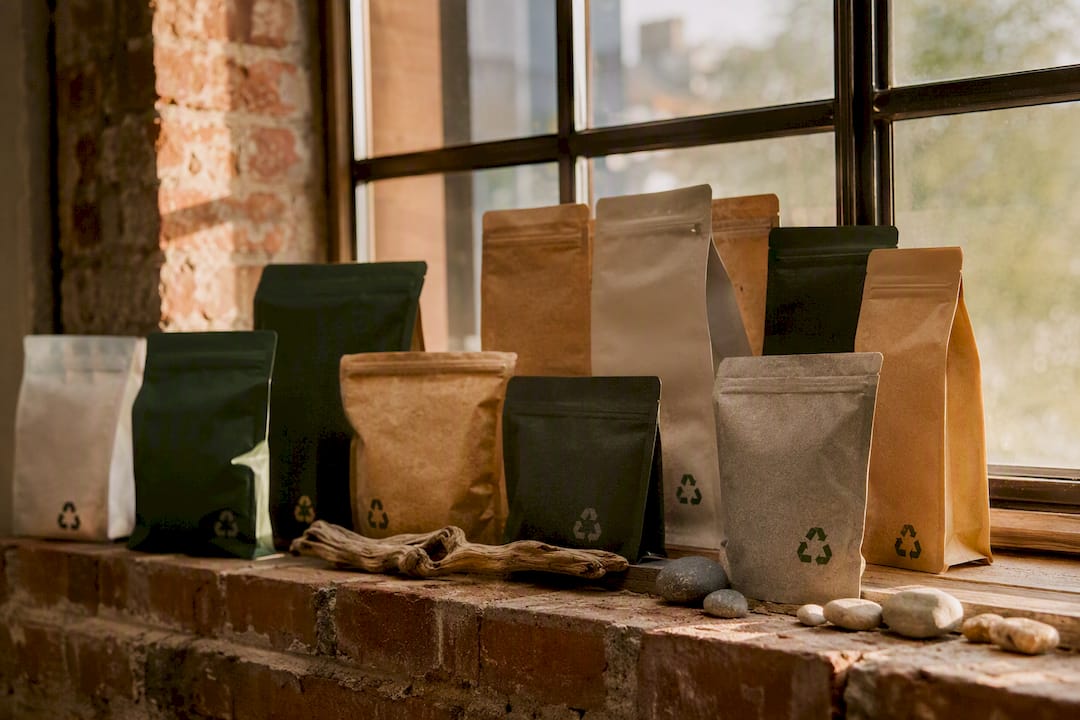
- Recyclable mono-material films paired with specialized compatible valves now exist for buyers willing to trade a small amount of shelf-life margin for genuine end-of-life recyclability.
- Kraft paper with an internal barrier liner offers a lower-impact look and feel for shorter shelf-life products, though it typically isn’t fully recyclable due to the laminate layer.
- Reusable packaging formats work well for direct-to-customer subscription models where the same container gets refilled, though they generally aren’t practical for retail shelf sales.
Pro Tip: If sustainability matters as much to you as it does to us, ask your supplier directly whether their valve is compatible with mono-material recyclable film before you finalize film choice, not after. Retrofitting a valve spec onto a greener film later usually costs more than specifying both together from the start.
Our own guidance on green coffee packaging options goes deeper into balancing barrier performance against recyclability for small-batch roasters navigating this exact decision.
Freshness or Sustainability: Do You Really Have to Choose?
Every packaging decision is a trade-off, and pretending otherwise does nobody any favors. The greenest bag on the market means nothing if the coffee inside goes stale before a customer brews it, and the most airtight, freshness-locked bag imaginable still has an environmental cost if it sits in a landfill for three centuries.
What actually works, based on everything roasters and packaging engineers keep coming back to: size your valve correctly for your real production timeline first, then optimize the film for sustainability within that constraint. Skip the premium marketing valve with a fancy name. Run the sample test. Adjust.
— LaSaundra
Ready to Pair Great Coffee With Packaging That Matches Your Values?
Getting the valve spec right is only half the job. What goes inside the bag matters just as much, and that’s where Ecoviberoast comes in. We roast in small batches, source responsibly, and back every purchase with mangrove tree planting and ocean-bound plastic removal, so your coffee choice does double duty for your customers and for the planet.

If you’re a roaster researching packaging alongside your own sourcing decisions, our guide on how fresh coffee should be breaks down roast-date timing in plain language, and our reusable packaging guidance covers when a valve-equipped single-use bag makes sense versus when a refillable format serves your brand better. For a broader look at flavor timing that pairs well with valve-sealed freshness, Adira Coffee’s piece on roast date is worth a read too.
Ready to taste the difference sustainably sourced, carefully roasted coffee makes? Explore our coffee and tea collection and find your next favorite bag.
Sources
- Coffee Degassing Valve - Plitek
- Why Coffee Bags Have Vents: The Valve Truth Roasters Miss - PackagingBest
- Degassing valves: What are they? Are they necessary for coffee packaging? | ePac


