

TL;DR:
- Coffee grind size is the key variable influencing flavor and extraction in brewing. Matching particle size to specific brewing methods ensures optimal taste, with adjustments based on taste feedback and brew time. Using micron measurements and uniform grinding produces the best, most balanced coffee regardless of grinder brand.
Coffee grind size is the single most important variable controlling flavor in your cup. The types of coffee grinds are defined as distinct particle size categories, each matched to a specific brewing method for optimal extraction. Get the size wrong, and even the most ethically sourced, shade-grown beans will taste flat, bitter, or sour. Get it right, and every brew becomes something worth savoring. This guide covers all seven recognized grind sizes, explains the science behind extraction, and gives you practical tools to dial in your perfect cup.
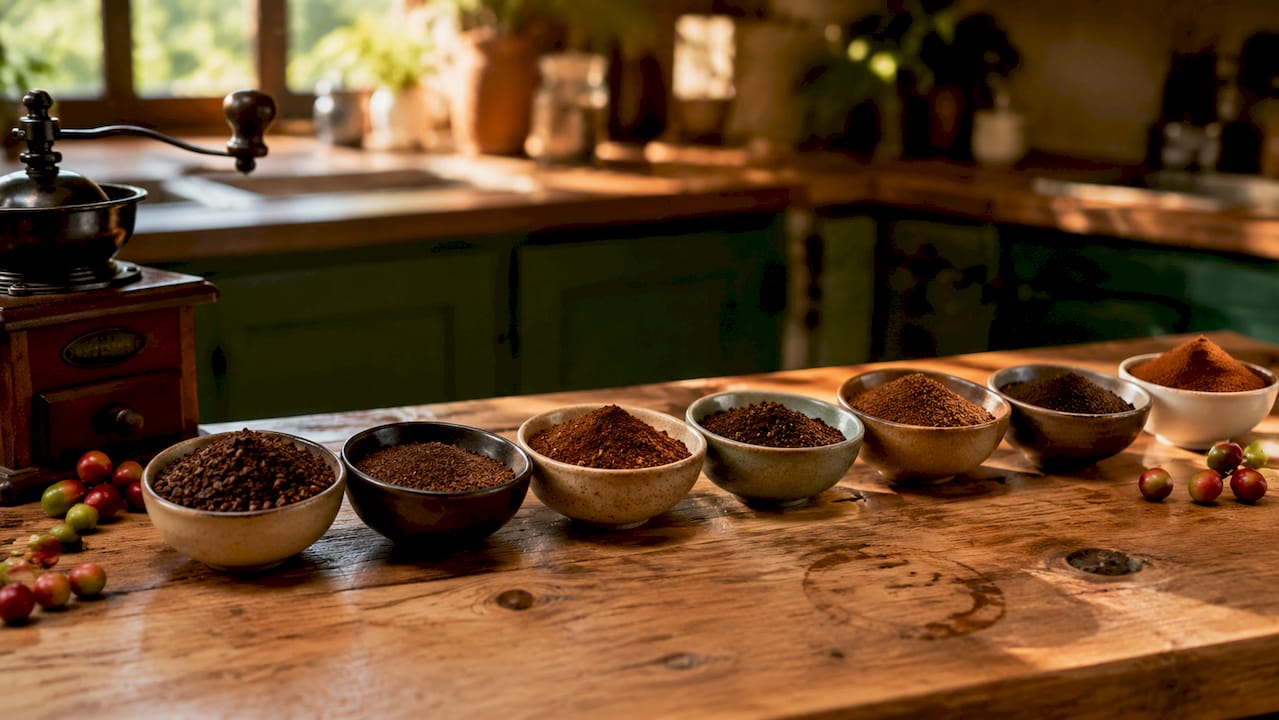
1. the seven types of coffee grinds explained
There are seven widely recognized grind categories, each defined by particle size in millimeters and matched to specific brewing methods. Think of grind size as a dial that controls how fast water pulls flavor from your beans. Here is what each size looks like and where it belongs.
-
Extra Coarse (greater than 1.5 mm): Texture resembles cracked peppercorns. Used for cold brew and cowboy coffee. The large particles slow extraction during long steep times of 12 to 24 hours, producing a smooth, rich concentrate without bitterness or silt.
-
Coarse (1.25–1.5 mm): Texture looks like rough sea salt. The go-to grind for French press and percolator brewing. Metal mesh filters in a French press allow fines to pass through, so a coarser grind keeps your cup clean.
-
Medium-Coarse (1.0–1.25 mm): Texture sits between sea salt and beach sand. Ideal for Chemex and flat-bottom pour-over brewers. Chemex uses thick paper filters that trap fines well, so this size flows at just the right pace.
-
Medium (0.75–1.0 mm): Texture resembles smooth beach sand. The most common default size for drip coffee makers and siphon brewers. Most pre-ground coffee bags default to medium for this reason.
-
Medium-Fine (0.5–0.75 mm): Texture is slightly finer than table salt. Works well for V60 pour-over, Moka pot, and AeroPress. The shorter contact time in these methods demands a finer grind to extract enough flavor.
-
Fine (0.3–0.5 mm): Texture feels like powdered sugar with a little grit. The best grind for espresso machines, where pressurized water passes through the puck in roughly 25–30 seconds.
-
Extra Fine (less than 0.3 mm): Texture is almost powdery. Reserved for Turkish coffee, where grounds are boiled directly in water and never filtered out.
Pro Tip: If you are unsure where to start, match your grind to your filter type first. Metal filters need coarser grinds; paper filters work better with finer ones.
2. how grind size controls extraction and taste
Extraction is the process of water pulling soluble compounds from coffee grounds. Grind size controls extraction speed by changing the surface area exposed to water. Finer grinds expose more surface area, speeding up extraction. Coarser grinds expose less, slowing it down.
Shorter brew methods need finer grinds to maximize surface contact. Longer immersion methods need coarser grinds to avoid over-extraction. This is why extraction balances time and particle size so directly. An espresso shot pulls in 25–30 seconds using a fine grind. A French press steeps for 4–6 minutes using a coarse grind. Both produce balanced cups because the grind and brew time are matched.
Taste is your most reliable feedback tool. If your coffee tastes sour or sharp, the grind is too coarse and extraction is incomplete. If it tastes bitter or harsh, the grind is too fine and extraction has gone too far. The sour-to-bitter spectrum is the clearest guide for adjusting your grind in real time.
“Grind size should be treated as a dynamic setting. Recommended sizes are only starting points; dialing in for taste and brew duration is the real skill.” — Home Coffee Beginner
Pro Tip: Adjust your grind in one direction at a time. If your espresso tastes sour, go finer by one or two clicks and taste again before making another change.
3. coarse vs. fine coffee grind: choosing by brew method
Choosing the right grind comes down to three factors: brew time, filter type, and water pressure. The table below maps each grind size to its ideal brewing context so you can make a confident choice.
| Grind Size | Texture | Best Brew Method | Typical Brew Time |
|---|---|---|---|
| Extra Coarse | Cracked peppercorn | Cold brew, cowboy coffee | 12–24 hours |
| Coarse | Rough sea salt | French press, percolator | 4–6 minutes |
| Medium-Coarse | Beach sand, rough | Chemex, flat-bottom pour-over | 3–5 minutes |
| Medium | Smooth beach sand | Drip coffee maker, siphon | 5–8 minutes |
| Medium-Fine | Fine table salt | V60, Moka pot, AeroPress | 2–4 minutes |
| Fine | Powdered sugar with grit | Espresso machine | 25–30 seconds |
| Extra Fine | Near-powder | Turkish coffee | 3–5 minutes (boiled) |
Filter type is a factor that many brewers overlook. Metal filters require coarser grinds because they allow fine particles to pass through into your cup. Paper filters trap fines, so you can grind finer without ending up with a gritty, murky brew. Chemex uses one of the thickest paper filters on the market, which is why medium-coarse works so well with it.
Common mistakes when choosing grind size include:
- Using a medium grind in a French press, which produces a muddy, over-extracted cup
- Grinding too coarse for espresso, resulting in a watery, sour shot that runs too fast
- Ignoring filter type and grinding the same size for every method
- Switching grinder brands and assuming the same dial number produces the same grind size
That last point matters more than most people realize. Grinder numbering systems are completely arbitrary. A “5” on a Baratza Encore is not the same particle size as a “5” on a Comandante. Check Ecoviberoast’s expanded coffee brew guide for method-specific grind recommendations that cut through that confusion.
4. how to dial in your coffee grind size for perfect taste
Dialing in your grind means adjusting it incrementally until your brew tastes balanced and your brew time falls within the target range. The process is straightforward once you know the steps.
- Start with the recommended grind size for your brewing method using the table above as your baseline.
- Brew a test cup and taste it without adding milk or sugar. Note whether it tastes sour, bitter, or balanced.
- Adjust by one or two clicks in the appropriate direction. Sour means go finer. Bitter means go coarser.
- Check your brew time. Espresso should pull in 25–30 seconds. French press should steep 4–6 minutes. If timing is off, grind adjustment is likely the fix.
- Repeat until balanced. Most brewers find their sweet spot within three to five adjustments.
One factor that complicates dialing in is grinder calibration. Every grinder’s numbering system is arbitrary, so micron measurements are the universal standard for comparing grind sizes across brands. For example, a V60 targets 500–800 microns regardless of whether you use a Baratza Encore, Comandante, or any other grinder. Knowing your target micron range lets you calibrate accurately no matter what equipment you own.
Grind particle uniformity is equally important. All grinders produce a mix of fine particles and larger chunks, often called fines and boulders. High uniformity means more consistent extraction and a cleaner, more balanced cup. Burr grinders produce far more uniform particles than blade grinders, which is why coffee enthusiasts consistently prefer them. Uneven particle distribution causes hollow or astringent flavors because fine particles over-extract while larger ones under-extract simultaneously.
Pro Tip: Keep a simple taste journal for the first two weeks of dialing in a new bean or brewing method. Note the grind setting, brew time, and tasting notes. Patterns emerge quickly and save you from repeating the same mistakes.
For a deeper look at tasting and evaluating your brew, Ecoviberoast’s guide on brewing coffee at home walks through the full sensory evaluation process.
Key takeaways
Grind size is the primary lever controlling extraction speed, flavor balance, and brew quality across every coffee method.
| Point | Details |
|---|---|
| Seven grind sizes exist | Each size from extra coarse to extra fine matches a specific brewing method and brew time. |
| Taste guides adjustment | Sour means grind finer; bitter means grind coarser. Adjust one click at a time. |
| Filter type matters | Metal filters need coarser grinds; paper filters work better with finer particle sizes. |
| Microns are universal | Grinder dial numbers are arbitrary; micron targets let you calibrate across any brand. |
| Uniformity beats quantity | A burr grinder producing even particles extracts cleaner flavor than a blade grinder at any setting. |
Why i think most brewers overlook the most important grind variable
I have watched a lot of coffee enthusiasts obsess over bean origin, roast date, and water temperature while completely ignoring grind uniformity. That is the real gap between a good cup and a great one. You can have the most aromatic, responsibly sourced beans in your kitchen, but if your blade grinder is chopping them into a chaotic mix of dust and pebbles, you are leaving most of that flavor on the table.
The myth I hear most often is that there is one “perfect” grind size for each brewing method. There is not. Grind size is a dynamic setting, and it shifts with every new bag of beans, every change in roast level, and even with seasonal humidity. Lighter roasts are denser and often need a finer grind than darker roasts at the same setting. That surprises most people.
My personal favorite combination right now is a medium-fine grind on a V60 with a light roast from a single-origin Ethiopian farm. The clarity of flavor you get from that pairing is extraordinary. But I got there through about two weeks of small adjustments, not by following a chart perfectly on day one. Home brewing technology in 2026 makes that experimentation genuinely fun. Grinders like the Baratza Encore and Comandante give you enough precision to actually feel the difference between one click and the next. Lean into that. Treat your grind setting as something alive, not a number you set and forget.
— LaSaundra
Skip the grind guesswork with ecoviberoast’s single serve pods
Not every morning calls for a full dialing-in session, and that is completely fine. Ecoviberoast’s 60-pack single serve coffee pods are crafted with an original roast profile optimized for rich, consistent flavor extraction every time. No grinder required, no adjustments, no wasted beans while you find your footing.

Each pod delivers a reliably aromatic, full-bodied cup that feels like a warm hug on a busy morning. And because Ecoviberoast sources responsibly, every purchase supports mangrove tree planting and ocean-bound plastic removal. Great coffee and a cleaner planet, one pod at a time. Explore the full single serve collection and find the option that fits your routine.
FAQ
What are the main types of coffee grinds?
The seven main coffee grind sizes are extra coarse, coarse, medium-coarse, medium, medium-fine, fine, and extra fine. Each size corresponds to a specific brewing method based on brew time and filter type.
What is the best grind for espresso?
Fine grind, with particles in the 0.3–0.5 mm range, is the best grind for espresso. This size allows pressurized water to extract a balanced shot in 25–30 seconds.
How does coarse vs. fine coffee grind affect flavor?
A coarse grind slows extraction and suits long brew methods like French press. A fine grind speeds extraction and suits short, pressurized methods like espresso. Grind too coarse and the cup tastes sour; grind too fine and it tastes bitter.
Why does my grinder’s number setting not match another brand’s?
Grinder numbering systems are arbitrary and vary between brands like Baratza Encore and Comandante. Use micron size targets as the universal standard to calibrate accurately across different grinders.
How do i know when to adjust my grind size?
Taste is the clearest signal. If your coffee tastes sour or sharp, grind finer to increase extraction. If it tastes bitter or harsh, grind coarser and reduce extraction.


