

TL;DR:
- Eco startups are profitable businesses that address environmental issues at scale, supported by a shifting market and policy landscape. They combine measurable impact with strong financial returns, benefiting from advancing technology and growing consumer demand. Careful due diligence on impact metrics and financial fundamentals is essential for successful investment in this space.
Eco startups are ventures that build profitable businesses by solving environmental problems at scale. If you’re asking why invest in eco startups, the answer is both financial and strategic: global renewable energy investment reached $2.2 trillion in 2026, covering two-thirds of all energy spending worldwide. That number signals a structural shift, not a trend. Sustainable startup investment sits at the center of this shift, offering investors and entrepreneurs a rare combination of measurable impact and competitive returns. This guide breaks down the market forces, technology drivers, risk factors, and evaluation criteria you need to make informed decisions in this space.
Why invest in eco startups right now
The macroeconomic case for green business investment is stronger than it has ever been. A 1% rise in green entrepreneurship correlates with an 8.01% increase in long-term economic growth across 23 OECD countries studied from 2005 to 2024. That is not a marginal effect. It means eco entrepreneurship advantages ripple through entire economies, not just individual portfolios.
Government policy is accelerating this momentum. Tax credits, green procurement mandates, and carbon pricing frameworks in the U.S., EU, and Asia are reducing the commercialization risk that once made sustainable startups harder to back. When policy and market demand align, investment risk drops and return potential rises.
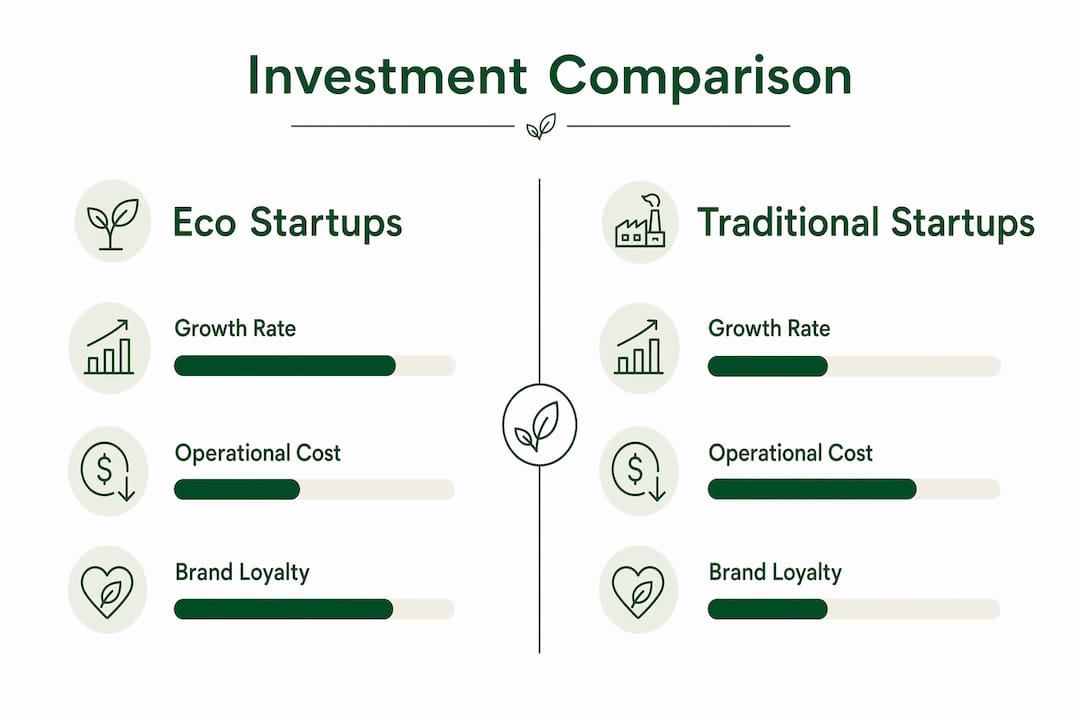
Sustainable businesses also benefit from lower long-term operational costs, stronger brand loyalty, and greater resilience against regulatory changes. This is the part most investors miss: sustainability is a competitive advantage, not a cost center. A startup that reduces waste in its supply chain is not just being ethical. It is protecting its margins.
Here is a snapshot of how eco startup investment compares across key economic indicators:
| Indicator | Eco Startups | Traditional Startups |
|---|---|---|
| Long-term growth correlation | +8.01% per 1% green growth | Variable, sector-dependent |
| Operational cost trajectory | Declining (efficiency-driven) | Stable or rising |
| Regulatory exposure | Decreasing with policy support | Increasing in carbon-heavy sectors |
| Brand loyalty strength | High among conscious consumers | Moderate |
| Capital inflow trend | Rising sharply through 2026 | Mixed by sector |
Pro Tip: Track green fund flows quarterly using resources like BloombergNEF or the International Energy Agency’s annual investment reports. Capital concentration in a sector is one of the earliest signals of durable opportunity.
How technology makes eco startups worth backing
Technology is the engine behind the most compelling eco startup investment reasons in 2026. Advances in AI, data analytics, and material sciences are producing sustainable solutions that were not commercially viable five years ago. Solar panel efficiency, battery storage density, and biodegradable packaging materials have all improved dramatically, and startups are capturing the value of these gains.
The circular economy model is one of the most powerful structural advantages eco startups hold. Instead of the traditional take-make-waste production cycle, circular businesses design products to be reused, repaired, or composted. This reduces input costs, cuts waste disposal expenses, and often creates secondary revenue streams from recovered materials.
Investors are now prioritizing startups with proven unit economics, scalable technologies, and defensible competitive advantages. The era of funding a green mission without financial discipline is over. The strongest eco startups today align profitability with efficiency, and that is exactly what serious capital is chasing.
One metric separating credible eco startups from greenwashed ones is Scope 4 avoided emissions. Many founders fail to quantify the carbon emissions their product prevents relative to incumbent solutions. A startup that replaces a diesel generator with a solar microgrid avoids a specific, calculable volume of emissions. Founders who can prove that number with data attract better investors and command better valuations.
Key technology-driven advantages to look for when evaluating eco startups:
- Proprietary materials or processes that reduce production costs over time
- AI-powered resource management that cuts energy or water use in operations
- Circular supply chain design that converts waste into input, lowering cost of goods
- Verified impact metrics including Scope 4 avoided emissions and lifecycle analysis
- Scalable digital platforms that grow revenue without proportional increases in environmental footprint
Pro Tip: Ask every eco startup founder you meet to walk you through their Scope 4 avoided emissions calculation. If they cannot do it, that is a due diligence red flag, not a minor gap.
What are the real risks of eco startup investment?
Every investment carries risk, and eco startups are no exception. Understanding where those risks differ from traditional ventures helps you size positions and build a resilient portfolio.
The most common challenge is commercialization timeline. Eco startups often work with novel materials, regulatory approvals, or infrastructure dependencies that extend the path from prototype to revenue. A cleantech hardware company may need two to three years longer than a software startup to reach meaningful scale. Patience is not optional in this space.
Renewable energy investments face specific volatility from grid bottlenecks and policy uncertainty. Market strategist Anna Potts notes that ongoing global power demand remains a durable growth driver despite near-term disruptions. The underlying demand is real. The timing of returns is what requires careful management.
Here is how eco startup risk compares to traditional startup risk across the dimensions that matter most:
| Risk Dimension | Eco Startups | Traditional Startups |
|---|---|---|
| Regulatory risk | Moderate, but improving with policy support | Low to moderate |
| Commercialization timeline | Longer (hardware, materials, infrastructure) | Shorter (software, services) |
| Market demand risk | Low (consumer and policy-driven demand growing) | Variable |
| Impact measurement risk | High if metrics are not verified | Not applicable |
| Reputational risk | Elevated if sustainability claims are not substantiated | Low |
The good news is that consumer demand for sustainable products is not slowing. Brands that build genuine environmental credibility, like those that plant trees or remove ocean-bound plastics with every sale, are building the kind of loyal customer base that reduces revenue volatility over time.
Pro Tip: When assessing policy risk, focus on the direction of regulation rather than current rules. Carbon pricing, plastic bans, and emissions standards are tightening globally. Startups positioned ahead of those rules carry less long-term regulatory exposure than incumbents.
How to evaluate eco startups before you invest
Knowing what to look for separates profitable green business investment strategies from well-intentioned but underperforming ones. Use this numbered framework when conducting due diligence on any eco startup:
-
Confirm the value proposition is real, not aspirational. The startup must solve a specific environmental problem with a product or service that customers are already paying for, or have demonstrated willingness to pay for.
-
Verify scalability. A solution that works at 100 units must have a credible path to 100,000 units without proportional cost increases. Ask for unit economics at multiple production scales.
-
Assess impact additionality. Impact investors require rigorous proof that the environmental improvement would not happen without their funding. If the startup cannot demonstrate this, the impact claim is weak.
-
Review financial fundamentals alongside environmental metrics. Gross margin, customer acquisition cost, and churn rate matter as much as carbon reduction numbers. A startup with strong impact but no path to profitability is a charity, not an investment.
-
Evaluate the team’s domain expertise. The best eco startups are led by founders who understand both the technology and the market. A materials scientist who has never sold anything is a risk. A sales leader who does not understand the science is equally risky.
-
Check the investment vehicle fit. Direct equity, venture capital funds focused on cleantech, and green bonds each carry different risk and return profiles. Match the vehicle to your timeline and liquidity needs.
Supporting eco startups goes beyond writing a check. Supply chain integration, sustainable procurement partnerships, and co-marketing with aligned brands all accelerate a startup’s growth while deepening your own brand’s environmental credibility. Ecoviberoast is a strong example of this model: every purchase funds mangrove tree planting and ocean-bound plastic removal, creating a measurable environmental impact that strengthens both the brand and its supplier relationships.
The European Commission found that investing in nature restoration can yield up to €38 in economic returns for every €1 invested. That ratio illustrates why nature-positive business models are attracting serious institutional capital, not just mission-driven angels.
Key takeaways
Eco startups deliver competitive financial returns and measurable environmental impact, making them one of the most strategically sound investment categories available to investors and entrepreneurs in 2026.
| Point | Details |
|---|---|
| Market scale is massive | Global renewable energy investment reached $2.2 trillion, covering two-thirds of all energy spending. |
| Growth correlation is proven | A 1% rise in green entrepreneurship drives an 8.01% increase in long-term economic growth in OECD countries. |
| Technology creates real moats | Circular economy models and Scope 4 emissions metrics separate credible startups from greenwashed ones. |
| Risk is manageable with discipline | Longer timelines and policy uncertainty are real, but growing consumer demand and regulation reduce long-term exposure. |
| Due diligence must cover both impact and financials | Additionality, unit economics, and scalability are all non-negotiable evaluation criteria. |
My honest view on where eco investing is headed
I have watched investor priorities shift over the past several years, and the change is not subtle anymore. Capital that once chased pure growth at any cost is now asking harder questions about durability. Sustainability has become a proxy for operational discipline, and that is a healthy development for everyone in this space.
What I find most encouraging is the rise of rigorous impact measurement. When I see a founder who can articulate their Scope 4 avoided emissions with the same confidence they bring to their gross margin, I know I am looking at a serious operator. That combination of mission and financial literacy is rare, and it is exactly what the best eco startups are building toward.
My honest advice: be patient, but not passive. The renewable energy and sustainability trends shaping 2026 are not going to reverse. Regulatory pressure, consumer demand, and technology costs are all moving in the same direction. The investors who will win are the ones who do their homework now, choose startups that blend technology, economics, and genuine mission, and hold through the inevitable near-term volatility. The returns, both financial and environmental, are worth it.
— LaSaundra
Taste the mission: eco-conscious products from Ecoviberoast
If you want to support eco-conscious business with every sip, Ecoviberoast makes it easy and delicious. Every purchase plants mangrove trees and removes ocean-bound plastics, so your morning cup does real good in the world.

Start with the Hibiscus Berry Tea, a refreshing organic herbal blend that is responsibly sourced and packed with vibrant flavor. Or grab the single-serve coffee pods for rich, aromatic coffee that fits your busy day without compromising your values. Ecoviberoast proves that eco-conscious businesses can be both profitable and deeply purposeful. When you choose products that fund real environmental action, you are not just buying a beverage. You are backing a model worth investing in.
FAQ
What is an eco startup, exactly?
An eco startup is a business built to solve environmental problems while generating profit. These ventures operate across sectors including renewable energy, sustainable food and beverage, circular materials, and clean transportation.
Are eco startups financially competitive with traditional startups?
Yes. Sustainable businesses benefit from lower long-term operational costs, stronger brand loyalty, and growing policy support, making them increasingly competitive with traditional ventures on financial metrics.
What is scope 4 avoided emissions and why does it matter?
Scope 4 avoided emissions measure the carbon a product prevents relative to incumbent alternatives. Founders who can quantify this metric demonstrate high-additionality impact, which differentiates credible climate investments from greenwashed ones.
How do i start investing in green businesses?
Begin with direct equity in early-stage eco startups, cleantech-focused venture capital funds, or green bonds. Match the investment vehicle to your risk tolerance, timeline, and desired level of involvement.
Does supporting eco startups require large capital?
No. Supporting eco-friendly startups can include sustainable procurement, supply chain partnerships, and purchasing from mission-driven brands like Ecoviberoast, all of which channel capital toward environmental impact at any scale.


