

TL;DR:
- Running an environmentally conscious cafe begins with a thorough sustainability audit to establish baseline waste and energy use. Effective eco-friendly practices include verifying local composting capabilities, upgrading to energy-efficient appliances, and integrating composting programs for organic waste. Engaging staff and customers through education and transparent communication fosters loyalty and amplifies your cafe’s positive environmental impact.
Running a cafe that’s good for your customers AND the planet is one of the most exciting challenges in the food and beverage industry right now. More guests are actively choosing environmentally conscious cafes over competitors, and they’re willing to pay a premium for it. These tips for environmentally friendly cafes will walk you through the real, practical moves that cut costs, build loyalty, and actually move the needle on your environmental impact. No greenwashing, no vague pledges. Just what works.
Table of Contents
- Key takeaways
- 1. Start with a sustainability audit
- 2. Choose eco-friendly packaging with local composting in mind
- 3. Switch to energy-efficient appliances
- 4. Build a composting and organics program
- 5. Update your menu to lower your carbon footprint
- 6. Reduce food waste through smarter inventory
- 7. Engage and educate your customers
- My take on making this work in the real world
- Bring Ecoviberoast into your sustainable cafe setup
- FAQ
Key takeaways
| Point | Details |
|---|---|
| Start with a sustainability audit | Measure your current waste and energy use before making any changes. |
| Match packaging to local composting | Compostable cups only work if your local facility accepts them. |
| Swap dairy for plant-based defaults | Offering oat milk as the default can nearly halve your latte’s carbon footprint. |
| Invest in energy-efficient equipment | ENERGY STAR appliances reduce electricity costs and pay for themselves over time. |
| Train your staff consistently | Sorting, cleaning habits, and customer communication make or break any green program. |
1. Start with a sustainability audit
Before you buy a single compostable cup or LED bulb, you need to know where you actually stand. Think of it as a health check for your cafe’s environmental footprint. A thorough audit gives you the baseline data to set real goals and measure actual progress later.
Start by mapping your consumables: what packaging you use, how much food you throw away each week, what your utility bills look like across different seasons. Then look at your waste streams: where does your trash go, how much of it is food waste, and what currently goes into recycling versus landfill? The EPA’s food waste toolkit frames this kind of facility-wide assessment as the critical first step to reducing both costs and emissions.
- Weigh your waste bins weekly for two to four weeks to establish a true average
- Pull three months of utility bills and look for usage spikes by day or shift
- Survey your staff on where they see the most waste happening daily
- Document every supplier and the packaging each product arrives in
Once you have these numbers, set specific, time-bound targets. “Reduce food waste by 20% in six months” is a plan. “Be greener” is not.
Pro Tip: The EPA’s free food waste assessment workflow gives you a ready-made framework to structure your audit without reinventing the wheel. Download it and adapt it to your cafe before spending a dollar on new products.
2. Choose eco-friendly packaging with local composting in mind
This is where a lot of well-meaning cafe owners trip up. You switch to compostable cups, feel good about it, and then discover those cups are sitting in a landfill because commercially compostable packaging requires industrial facility processing to actually break down. The label says compostable. The reality depends entirely on your local infrastructure.
Before committing to any packaging swap, call your local waste hauler and ask specifically which certifications they accept. Look for certifications like BPI (Biodegradable Products Institute) and confirm whether your city or county has a facility that processes food service organics. Less than 4% of US food waste is currently composted, which tells you the infrastructure gap is real and affects most cafes in most markets.
| Packaging type | End-of-life option | What you need to confirm |
|---|---|---|
| Compostable cups and lids | Industrial composting facility | Local hauler acceptance, BPI certification |
| Recyclable paper sleeves | Curbside recycling | No food contamination on the material |
| Reusable customer cups | Returned and washed in-house | Dishwasher capacity and incentive program |
| Recyclable plastic lids | Curbside recycling | Local recycling program accepts the resin type |
Once packaging is sorted, set up clearly labeled separation bins and train every team member on what goes where. Contamination reduction is listed by the EPA as one of the most critical objectives in any food waste separation program. One wrong item in the organics bin can contaminate an entire batch.
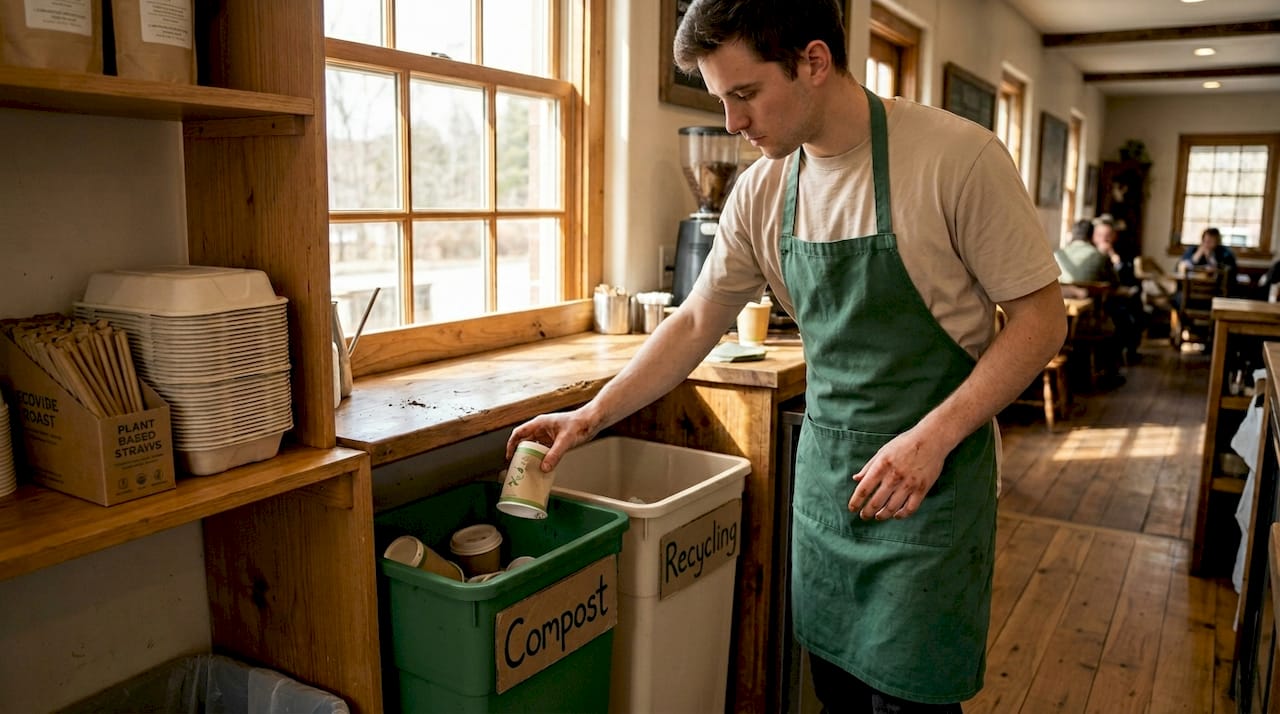
Pro Tip: Map your local composting facilities before you order a single case of compostable packaging. Call, not just check the website, because acceptance lists change frequently.
3. Switch to energy-efficient appliances
Your refrigeration units are almost certainly your largest ongoing energy expense. Upgrading to ENERGY STAR-certified commercial refrigeration can save up to $480 over the lifetime of a single unit, and most cafes run multiple refrigerated displays and prep coolers simultaneously.
The upgrade decision is only half the equation, though. Cleaning coils and checking door seals regularly is what sustains those savings month after month. A dirty condenser coil can force your refrigeration unit to work 30% harder than it should. Build these maintenance checks into your monthly operations calendar as non-negotiable tasks.
Beyond refrigeration, LED lighting in your dining area and prep space dramatically reduces energy draw compared to older fluorescent fixtures. Smart thermostats and timers on non-essential equipment like display lighting and secondary HVAC zones mean you stop paying to cool an empty cafe at 2 a.m.
Pro Tip: Create a simple monthly QA checklist for energy-consuming equipment: coil condition, door seal integrity, temperature logs, and timer settings. It takes 20 minutes and protects your efficiency investments year-round.
Cafes with access to rooftop space might also consider solar. One UK roastery’s solar array cut gas bills by 90% and doubled roasting throughput. Even a partial solar installation in a sun-friendly market can meaningfully offset operating costs while giving you a compelling sustainability story to share with customers.
4. Build a composting and organics program
Setting up an organics program is more than placing a green bin in the kitchen. Sustainable cafe practices around composting require operational discipline: sorting, storage, and hauler coordination. Get those three things right and composting becomes a reliable, low-maintenance system. Skip them and it becomes a mess that staff resent and customers notice.
Start with coffee grounds. They are your highest-volume organic output, consistently available every single day, and accepted by virtually every composting facility. Partnering with a local urban farm or community garden to pick up grounds weekly is a zero-cost way to start before you build out a full organics program. You can find step-by-step guidance on composting coffee grounds that applies directly to a cafe setting.
From there, work with your waste hauler to add food scraps and food-soiled paper to your organics stream. The EPA confirms that adding organics pathways like composting and anaerobic digestion significantly increases the total volume of waste diverted from landfills.
5. Update your menu to lower your carbon footprint
Here is something that surprises most cafe owners: your menu choices have a bigger climate impact than almost any material or equipment swap you make. The dairy milk in your espresso drinks and the origin of your coffee beans are the two largest carbon drivers in a typical cafe’s operation.
Switching from cow’s milk to plant-based alternatives can nearly halve the carbon footprint of a standard latte. Oat milk tends to win on carbon, land use, and water consumption compared to other plant-based options. Rather than waiting for customers to request it, consider making oat milk your barista default and listing dairy as the alternative. This small framing shift consistently increases plant-based uptake without any pressure on customers at all.
Beyond milk, source your coffee from certified Fairtrade or organic farms where shade-grown practices protect biodiversity and support fair wages for farmers. Work with local bakeries and food suppliers to bring in seasonal ingredients that travel fewer miles to reach your counter.
Pro Tip: Make plant milk the default in your most popular drinks and track the uptake shift over 30 days. Most cafes that try this see immediate, measurable carbon reductions without a single customer complaint.
6. Reduce food waste through smarter inventory
Food waste is both an environmental problem and a direct hit to your margins. Fixing it is one of those rare wins where your bottom line and Mother Earth both come out ahead.
Start tracking your prep waste by item. Which pastries go unsold each day? Which garnishes end up in the trash? Once you know the numbers, you can adjust order quantities, change prep schedules, or redesign your menu to use more of each ingredient across multiple items. A half-used avocado that would have been tossed becomes the base for a house dressing when you plan around it. You can explore a workflow to reduce coffee waste that maps this kind of thinking to a cafe environment specifically.
Daily specials are a chef’s classic tool for clearing down aging ingredients before they spoil. They work in cafes too. Train your team to flag slow-moving items at end-of-shift rather than waiting until prep the next morning.
7. Engage and educate your customers
Your customers are your greatest allies in building a genuinely green cafe. Many of them are already curious about eco-friendly coffee shops and will enthusiastically participate when you make it easy and clear. The key is communication without preachiness.
Post simple, specific signs near your bins explaining what goes where. “Coffee grounds here. Compostable cups here. Everything else here.” Clear beats clever every time. If you offer a discount for bringing a reusable cup, make sure your team mentions it at every transaction rather than waiting for customers to ask.
Share your sustainability numbers on your chalkboard or social channels. “We composted 40 lbs of coffee grounds this week” is tangible and memorable. It turns your customers into advocates who talk about your cafe because they feel genuinely proud to support it.
My take on making this work in the real world
I’ve spent a lot of time looking at how cafes actually implement sustainability versus how they talk about it, and the gap is often significant. What I’ve found repeatedly is that the cafes making real progress are treating this like an operational discipline rather than a branding exercise.
Buying compostable cups and calling it done is the most common mistake I see. Sustainability in food service is fundamentally a measurement problem. If you don’t know your baseline waste numbers, your energy costs by shift, or your food loss by menu item, you are guessing. And guessing leads to the comfortable-but-ineffective moves: new packaging, a sign about recycling, maybe a plant on the counter.
The economic benefits also tend to be seriously underestimated. Energy efficiency upgrades, food waste reduction, and smarter inventory don’t just reduce your footprint. They reduce your operating costs in ways that compound over years. I’ve seen cafes recoup the cost of equipment upgrades in 18 months and then enjoy those savings for a decade.
The composting infrastructure challenge is real and genuinely frustrating in many markets. My honest advice: start with coffee grounds, build a local relationship with a community garden or urban farm, and use that partnership as a proof of concept while you work on the larger organics program. It keeps momentum going when the big system feels too complex to start.
The plant milk default tip is the one I wish more owners would just try for 30 days. The carbon impact is real. The customer pushback is almost nonexistent. And the story it gives you to tell is one that genuinely connects with your community.
— LaSaundra
Bring Ecoviberoast into your sustainable cafe setup
Ready to take your green cafe ideas from plan to practice? Ecoviberoast makes it easier to serve rich, aromatic coffee while keeping your environmental commitment front and center for every customer who walks through your door.

Ecoviberoast’s compostable single-serve coffee pods are available in a 60-pack designed with eco-friendly cafes in mind. Every purchase supports mangrove tree planting and ocean-bound plastic removal, so your sourcing decision becomes part of a larger environmental story you can proudly share with your customers. Pair them with the resources on compostable pod impact to understand exactly what the switch means for your waste stream. Good coffee and good values, together in every cup.
FAQ
What are the best first steps for a sustainable cafe?
Start with a waste and energy audit to establish your baseline, then set specific, measurable targets. Knowing your numbers before making any changes prevents costly missteps and keeps your efforts focused.
Does compostable packaging actually work for cafes?
Only if your local industrial composting facility accepts it. Confirm acceptance and certifications with your hauler before switching, since compostable packaging in a landfill offers no environmental benefit.
How much can switching to plant milk reduce a cafe’s carbon footprint?
Switching from dairy to plant-based milk options can nearly halve the carbon footprint of a latte, making it one of the highest-impact menu changes a cafe can make.
What energy upgrades deliver the fastest return for cafe owners?
ENERGY STAR-certified refrigeration and LED lighting offer the most reliable returns. Regular maintenance like cleaning coils and seals is just as important as the initial equipment investment.
How do I get staff on board with green cafe practices?
Train your team specifically on sorting, contamination prevention, and customer communication. When staff understand the “why” behind each practice and see the results tracked visibly, participation becomes consistent and self-reinforcing.
Recommended
- 7 Actionable Tips for Eco-Conscious Coffee Drinkers – EcoVibe Roast
- Why Support Eco-Friendly Coffee & Tea in 2026: Cut 50% Carbon – EcoVibe Roast
- Sustainability Trends in Coffee 2026: Impact on Ethical Choices – EcoVibe Roast
- Top 8 Eco-Friendly Coffee Alternatives in 2026 for Conscious Drinkers – EcoVibe Roast


