

TL;DR:
- Prioritizing soil health can significantly increase coffee yields, reduce pesticide use, and improve ecosystem resilience. Scientific research highlights the critical role of soil properties, microbials, and topography in shaping farm productivity and climate impact. Certified regenerative standards are now emphasizing soil management as a central component for sustainable coffee production.
Think about your morning cup of coffee and what actually goes into making it extraordinary. Most people credit the roaster, the variety, or the elevation. But the real story starts underground. Understanding why prioritize soil health in coffee is one of the most important shifts any grower, buyer, or conscious coffee lover can make. Research now shows that soil properties can outweigh nitrogen fertilization in determining coffee yields, and that regenerative soil management transforms entire farm ecosystems. The implications reach from your taste buds all the way to the planet’s climate.
Table of Contents
- Key Takeaways
- Why prioritize soil health in coffee: what the science says
- Ecosystem benefits: biodiversity and natural pest control
- Soil health, nitrous oxide, and climate resilience
- How topography shapes soil across a single farm
- Regenerative standards and certifications shaping coffee’s future
- My perspective: soil is not a backdrop, it’s the whole story
- Taste the difference that healthy soil makes
- FAQ
Key Takeaways
| Point | Details |
|---|---|
| Soil beats fertilizer for yield | Soil texture and phosphorus levels can double coffee yields even when fertilization rates are identical across plots. |
| Healthy soil cuts pesticide use | Regenerative soil practices attract natural predators that can reduce pesticide dependency by up to 60% on coffee farms. |
| Topography shapes soil quality | Slope position significantly changes organic carbon levels, meaning smart farm management must be site-specific, not uniform. |
| Soil health drives climate outcomes | Soil conditions control the microbial pathways that produce nitrous oxide, a potent greenhouse gas, making soil care a climate issue. |
| Certifications are catching up | Rainforest Alliance’s 2026 regenerative standard puts soil health at the center, rewarding growers who treat soil as a living system. |
Why prioritize soil health in coffee: what the science says
Most coffee farmers focus heavily on nitrogen fertilization schedules. It feels logical. More nutrients in, more cherries out. But a 2024 field trial at Alsacia Coffee Farm in Costa Rica turned that logic on its head. Two farm sectors receiving identical nitrogen applications produced dramatically different yields, with one sector producing roughly double the output of the other. The difference? Soil texture and phosphorus availability. The higher-yielding sector had 50% more clay content and greater available phosphorus in its soil profile.
This finding reframes the whole conversation about the importance of soil health coffee growers should care about. Phosphorus is often the true limiting nutrient in volcanic Andisols common across Latin American coffee regions, and better phosphorus management directly correlates with measurable yield improvements. Clay content matters because it affects water retention, root contact with nutrients, and the structure roots need to thrive.
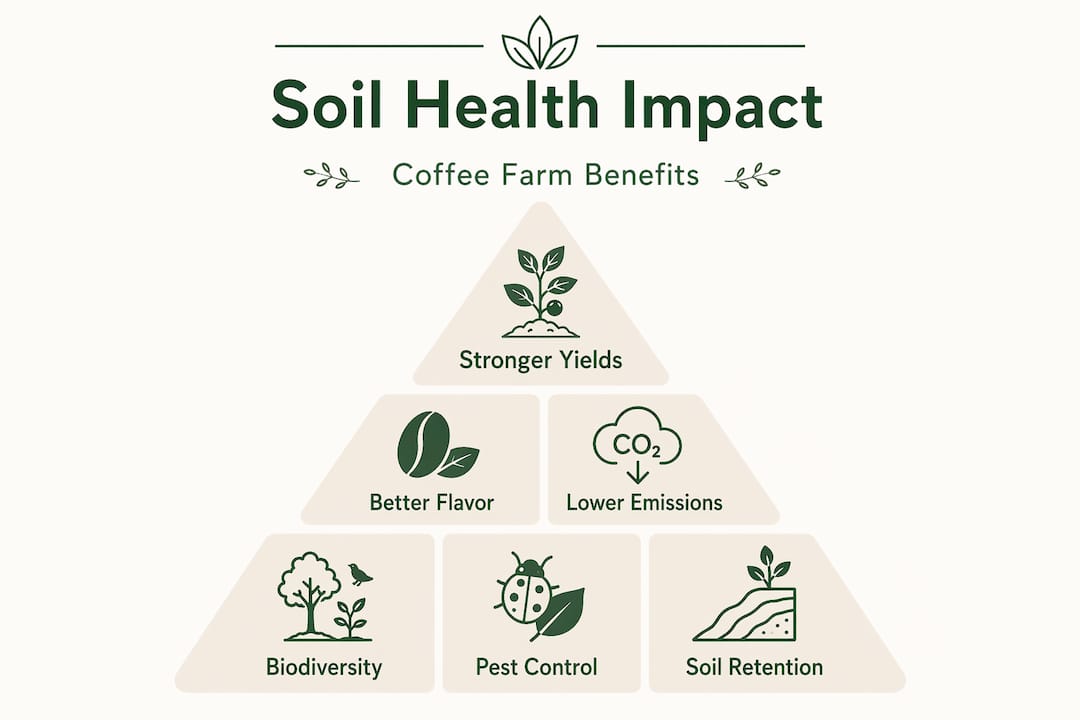
Here is a simplified comparison of what key soil properties actually do for coffee plants:
| Soil property | Effect on coffee growth | Management implication |
|---|---|---|
| Clay content | Improves water and nutrient retention | Avoid compaction; maintain organic matter |
| Available phosphorus | Directly boosts yield in volcanic soils | Targeted P amendments by soil test |
| Organic carbon | Feeds microbial life and improves structure | Add compost, mulch, and cover crops |
| Bulk density | High density restricts root growth | Reduce tillage; increase organic inputs |
Beyond these physical and chemical traits, microbial enzyme activity in shade-grown coffee orchards tells growers which nutrients the soil food web is actively cycling. When enzyme patterns show high carbon, nitrogen, and phosphorus demand, that is a signal the soil biology is working hard to feed the plant but may need support through organic inputs. Treating soil as a living ecosystem rather than just a growing medium is the foundation of why soil health matters in coffee production.
Ecosystem benefits: biodiversity and natural pest control
The benefits of healthy soil coffee farms enjoy go well beyond what shows up in a yield report. On a regenerative coffee farm in Nicaragua, a commitment to improving soil cover and microbial diversity triggered a cascade of ecological changes that most growers did not anticipate. As soil health improved, plant biodiversity around the farm increased. That richer habitat attracted natural predators of the coffee berry borer, one of the most destructive pests in the coffee world.
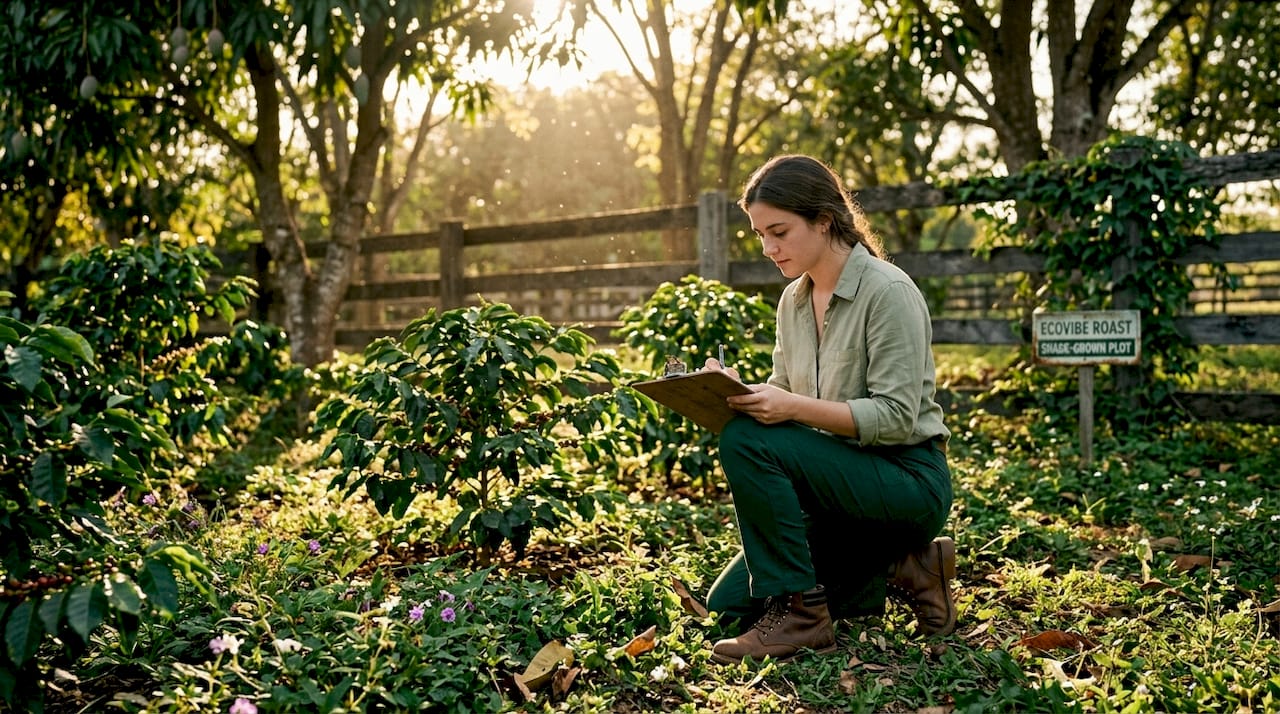
The result? A 60% reduction in pesticide use without sacrificing crop protection. That is not a modest improvement. That is a farm fundamentally changing its relationship with its own ecosystem. Reduced chemical inputs also mean healthier soil biology, which loops back to even better soil structure and nutrient cycling over time.
The ecological benefits of managing soil health on coffee farm biodiversity include:
- Increased soil cover through mulch and cover crops suppresses erosion and retains moisture during dry periods
- Greater microbial diversity means more resilient nutrient cycling that does not crash under stress
- Return of beneficial insects and birds that prey on pests, reducing the chemical load on the farm
- Better water infiltration reduces surface runoff and protects stream health near the farm
Pro Tip: If you are exploring regenerative coffee sourcing, ask producers whether they track ground cover percentage and microbial activity, not just yield. Those two metrics reveal far more about long-term soil vitality than fertilizer application logs.
Soil health, nitrous oxide, and climate resilience
Here is where the conversation gets bigger than any single farm. Soil is not just a production input. It is an active participant in the global climate system. The how soil affects coffee growth question has a climate dimension that most consumers and even many growers have not connected yet.
Nitrous oxide (N2O) is a greenhouse gas roughly 265 times more potent than CO2 over a 100-year period. It is produced in soil through two microbial processes called nitrification and denitrification. A 2026 Frontiers review found that these emission pathways are directly controlled by soil conditions, specifically moisture levels, temperature, organic carbon content, and nitrogen availability. In other words, better soil management can actively reduce greenhouse gas output from coffee farms.
Here is how that plays out in practical terms:
- Improve drainage and aeration. Waterlogged soils favor denitrification, which releases N2O into the atmosphere. Better soil structure means less waterlogging.
- Manage nitrogen inputs carefully. Excess nitrogen in any form feeds the microbial processes that produce N2O. Site-specific application based on soil tests prevents over-application.
- Build organic carbon. Higher soil organic carbon supports a more balanced microbial community that reduces emission spikes after rain or irrigation events.
- Time fertilizer applications. Applying nitrogen during periods of low soil moisture reduces the conditions that drive N2O production.
It is worth being honest about the limits of what we currently know. A 2026 synthesis of carbon research in coffee systems found that most existing soil organic carbon studies are cross-sectional snapshots rather than longitudinal measurements. Robust claims about carbon sequestration in coffee farming require deeper soil sampling and better baseline tracking methodology. The carbon offset role in coffee conversation needs that rigor to be credible and durable.
How topography shapes soil across a single farm
One of the least discussed realities of soil management in coffee farming is that soil health does not look the same across a single farm. Slope position changes everything. A Nature Scientific Reports study on shaded coffee agroforestry systems found striking differences in soil physical and chemical properties depending on whether you sampled from the upper, middle, or lower slope.
| Slope position | Key soil characteristics | Management priority |
|---|---|---|
| Upper slope | Higher macroporosity, lower bulk density | Erosion control, organic mulch retention |
| Middle slope | Transitional properties, variable moisture | Balanced amendment strategy |
| Lower slope | Higher total organic carbon, greater microporosity | Drainage management, avoid compaction |
This spatial variability means that soil gradients by slope require targeted intervention rather than uniform farm-wide treatment. Applying the same compost rate to the top of a hill and the bottom of a valley is a bit like giving the same prescription to two patients with completely different conditions. Upper slopes need erosion control and organic matter retention. Lower slopes, which naturally accumulate carbon and moisture, may need drainage work to prevent N2O-producing waterlogging.
Pro Tip: Ask your sourcing partners or farmer cooperatives whether their soil management plans account for topographic variation. A farm treating every plot identically is likely leaving yield and ecosystem health gains on the table.
Regenerative standards and certifications shaping coffee’s future
The good news is that the industry is catching up to the science. Rainforest Alliance’s 2026 regenerative certification standard places soil health at the center of its framework, treating it as a core impact area alongside biodiversity and climate resilience. The certification does not just ask growers to avoid harmful practices. It requires them to demonstrate active soil improvement over time.
What does this mean for coffee consumers and growers? Quite a lot, actually:
- New certified products are already on shelves. Professional-grade regenerative coffees featuring the Rainforest Alliance regenerative standard launched in mid-2026, giving conscious consumers a concrete way to vote with their wallets.
- Farmer adoption accelerates with economic incentives. Certifications create market access and premium pricing that make soil investment financially rational for smallholders who might otherwise stick with conventional inputs.
- Consumer awareness drives supply chain change. When buyers ask about coffee sustainability certifications, it creates upstream pressure on importers and roasters to source from farms with verified soil health practices.
The connection between certifications and real ecological outcomes depends entirely on whether the standards are demanding enough and whether verification is genuine. That is why understanding what certifications actually measure, rather than just trusting a label, matters so much for sustainable agriculture in coffee.
My perspective: soil is not a backdrop, it’s the whole story
I have spent years working with and writing about regenerative coffee farms, and the thing that still surprises me is how rarely soil gets the credit it deserves. Growers obsess over pruning schedules, fermentation protocols, and drying methods. Roasters focus on curve development and drop temperatures. But the flavor compounds that make a cup memorable start with what the plant can pull from the ground it grows in.
What I have seen consistently is that farms treating soil as a living ecosystem rather than a growing medium produce coffee with more complexity, more resilience to climate stress, and better long-term productivity. Not because they applied more inputs, but because they stopped fighting their soil and started working with it. The farms that rely on blanket fertilization strategies while ignoring phosphorus deficiencies or slope-driven organic carbon losses are essentially leaving potential in the dirt, literally.
My honest take is that the soil conversation in coffee has been too academic for too long. Research confirms what thoughtful growers have known intuitively: you cannot separate the quality in your cup from the health of the ground beneath the tree. The regenerative agriculture impact case is clear. What we need now is more buyers asking harder questions, more roasters sourcing with soil health data in hand, and more consumers who understand that every sip is a vote for the kind of farming we want to see more of.
— LaSaundra
Taste the difference that healthy soil makes
At Ecoviberoast, every coffee we offer is sourced with soil health and sustainability at the heart of the supply chain. We partner with farms committed to regenerative practices, and with every purchase you make, Ecoviberoast plants mangrove trees and removes ocean-bound plastics, because caring for the soil beneath your coffee is part of a bigger commitment to caring for the planet.

Whether you are new to sustainable coffee or deepening your practice, our single-serve coffee pods make it easy to enjoy rich, aromatic coffee that you can feel genuinely good about. Each cup connects you to growers who treat their land as a living system worth protecting. Explore the full range at Ecoviberoast and find your next favorite brew.
FAQ
Why does soil health matter more than fertilization in coffee?
Soil properties like texture and phosphorus availability can double coffee yields even when nitrogen fertilization rates are identical, showing that what is already in the ground shapes outcomes more than what you add to it.
How does healthy soil reduce pesticide use on coffee farms?
Improved soil cover and microbial diversity attract natural predators of the coffee berry borer, and a Nicaraguan regenerative farm cut pesticide use by 60% simply by restoring its soil ecosystem.
Can soil health management reduce greenhouse gas emissions from coffee farms?
Yes. Soil conditions directly control the microbial processes that produce nitrous oxide emissions, meaning better soil aeration, organic carbon, and nitrogen management can meaningfully lower a farm’s climate footprint.
Does soil health vary within a single coffee farm?
Significantly. Slope position affects organic carbon, porosity, and nutrient availability, which is why site-specific soil management rather than uniform farm-wide treatment produces better ecological and yield outcomes.
What certifications focus on soil health in coffee production?
Rainforest Alliance’s 2026 regenerative certification standard makes soil health a core requirement alongside biodiversity and climate resilience, with certified products already available to conscious consumers.


