

TL;DR:
- Waterwise coffee uses farming methods like drip irrigation and agroforestry to significantly reduce water consumption. These environmentally sustainable practices not only conserve water but also improve flavor, support biodiversity, and ensure farmer stability. Choosing certified, transparent brands drives responsible supply chains and helps address global water stress issues.
Your morning cup of coffee is quietly one of the thirstiest beverages on the planet. Coffee production consumes up to 140 liters of water per single cup when you factor in growing, processing, and washing the beans. Most coffee lovers never think about that. But if you care about where your food comes from and what it costs the planet, asking why choose waterwise coffee is exactly the right question. This article unpacks what waterwise coffee actually means, why it delivers benefits far beyond conservation, and how you can make smarter choices starting with your very next bag.
Table of Contents
- Key takeaways
- What waterwise coffee actually is
- Benefits of waterwise coffee beyond conservation
- How to identify and support waterwise brands
- Waterwise vs. conventional coffee farming
- My perspective on waterwise coffee’s real potential
- Explore waterwise coffee with Ecoviberoast
- FAQ
Key takeaways
| Point | Details |
|---|---|
| Water use is staggering | Conventional coffee production uses up to 140 liters of water per cup, making waterwise methods urgent. |
| Drip irrigation saves dramatically | Waterwise farming with drip irrigation cuts water use by 56% and reduces carbon footprint by nearly 60%. |
| Better farming, better flavor | Shade-grown and agroforestry methods improve soil health and produce coffee with more complex, aromatic flavor profiles. |
| Certifications guide your buying | Labels like Rainforest Alliance and Fair Trade include real water stewardship requirements you can trust. |
| Your choice drives change | Consumer demand for waterwise coffee directly pushes supply chains toward more responsible, transparent practices. |
What waterwise coffee actually is
Waterwise coffee is not a marketing buzzword. It describes coffee grown using farming methods specifically designed to reduce water consumption, protect local water systems, and maintain healthy soil. The contrast with conventional coffee farming is significant. Traditional large-scale coffee cultivation often relies on flood irrigation and monoculture planting, both of which drain water tables and strip soil of the nutrients that naturally retain moisture.
Two farming approaches define most waterwise coffee production today: drip irrigation and agroforestry systems.
Drip irrigation delivers water directly to plant root zones through a network of tubes, eliminating the runoff and evaporation that flood irrigation wastes. The results are striking. Drip irrigation reduces water use in coffee cultivation by 56% and cuts the carbon footprint of production by nearly 60%. It also supports over 50% higher yield per hectare compared to traditional methods, which means farmers grow more coffee with fewer resources.
Agroforestry systems take a different angle. Instead of growing coffee in open rows under direct sun, farmers plant coffee beneath a canopy of native trees. Those trees shade the soil, lock in moisture, and create a layered ecosystem that mimics a natural forest. Agroforestry systems reduce irrigation needs by up to 50% and improve yields by 10 to 20%. They also stabilize the local microclimate and support biodiversity that monoculture farms destroy.
How do you know a coffee brand is genuinely practicing these methods? Certifications matter here. Rainforest Alliance and Fair Trade certifications both include water stewardship requirements and deforestation-free sourcing standards. Traceability tools and direct-trade relationships add another layer, letting you follow the bean back to the specific farm.
Pro Tip: When you see a Rainforest Alliance seal on a bag of coffee, look up the brand’s sourcing page. Many certified brands now publish farm-level data on water use and environmental audits so you can see the real numbers.
Benefits of waterwise coffee beyond conservation
Here is where the story gets genuinely exciting. Choosing waterwise coffee is not just a sacrifice for the planet. The advantages of waterwise coffee ripple outward into flavor quality, farmer wellbeing, and community health in ways most consumers never connect.
Start with flavor. Sustainable farming methods that prioritize soil health and biodiversity produce coffee with more complex flavor profiles. Shade-grown beans, which are central to agroforestry systems, develop more slowly. That slower maturation concentrates the aromatic compounds that make a cup of coffee genuinely satisfying. When you taste a bright, layered single-origin coffee with notes that linger on your palate, the farming method behind it is rarely a coincidence.

The impact on farming communities is equally real. Waterwise practices support consistent, long-term yields without depleting the land. That sustainability translates into more reliable income for farmers who depend on each harvest. When paired with fair-trade pricing, the advantages extend to fair wages, safer working conditions, and investment back into local infrastructure.
There is also the chemical picture to consider. Waterwise coffee production reduces chemical use per ton of beans by 46%. That reduction lowers contamination risk for farmworkers and protects the streams and water bodies surrounding coffee-growing regions. Communities downstream from conventional farms often deal with fertilizer and pesticide runoff. Waterwise farms change that equation.
The carbon footprint reduction connects everything. Drip irrigation requires less pumping energy. Agroforestry systems sequester carbon in tree canopies and soil. Taken together, true coffee sustainability comes from integrating water-efficient farming, responsible processing, and energy-saving roasting technologies across the entire supply chain. That is what the best coffee for water conservation actually looks like from farm to cup.
You can read more about the advantages of eco-friendly coffee to see how these benefits stack up across different farming approaches.
How to identify and support waterwise brands
Knowing all this is only useful if it changes what you put in your cart. Here is a practical path to making waterwise coffee choices that actually hold up.
-
Look for credible certifications. Rainforest Alliance, Fair Trade USA, and Bird Friendly (Smithsonian) all include water-use and habitat protection requirements. A bag carrying one of these labels has been audited, not just self-declared.
-
Prioritize transparent brands. The best waterwise coffee brands publish their sourcing practices online. Look for farm names, growing regions, and processing methods. If a brand cannot tell you where its beans come from, that silence is information.
-
Choose shade-grown or agroforestry-labeled coffees. These terms directly signal the farming system most associated with reduced water needs and ecosystem health. They are not always on the front of the bag, but they are usually in the product description.
-
Brew smarter at home. The farm is not the only place where water gets wasted. Heat recovery systems and programmable standby modes in coffee equipment meaningfully reduce energy and water waste during brewing. Choosing efficient equipment completes the loop that waterwise farming starts.
-
Compost your grounds. Coffee grounds are excellent compost feedstock, returning nutrients to soil and keeping organic material out of landfills. It is one of the simplest circular habits you can build around your daily ritual.
-
Support brands with verified environmental impact programs. Mangrove planting, ocean plastic removal, and reforestation partnerships all signal that a brand takes its ecological footprint seriously beyond the farm gate.
Pro Tip: Explore sustainable coffee farm support to understand how your purchasing decisions connect directly to on-the-ground conservation work.
One more thing worth mentioning: water-efficient coffee-making equipment also plays a real role in reducing the overall resource footprint of your daily brew, especially if you are running a café or brewing multiple cups daily.
Waterwise vs. conventional coffee farming
A direct comparison makes the stakes concrete. Here is how the two approaches measure up across the metrics that matter most to eco-conscious consumers.
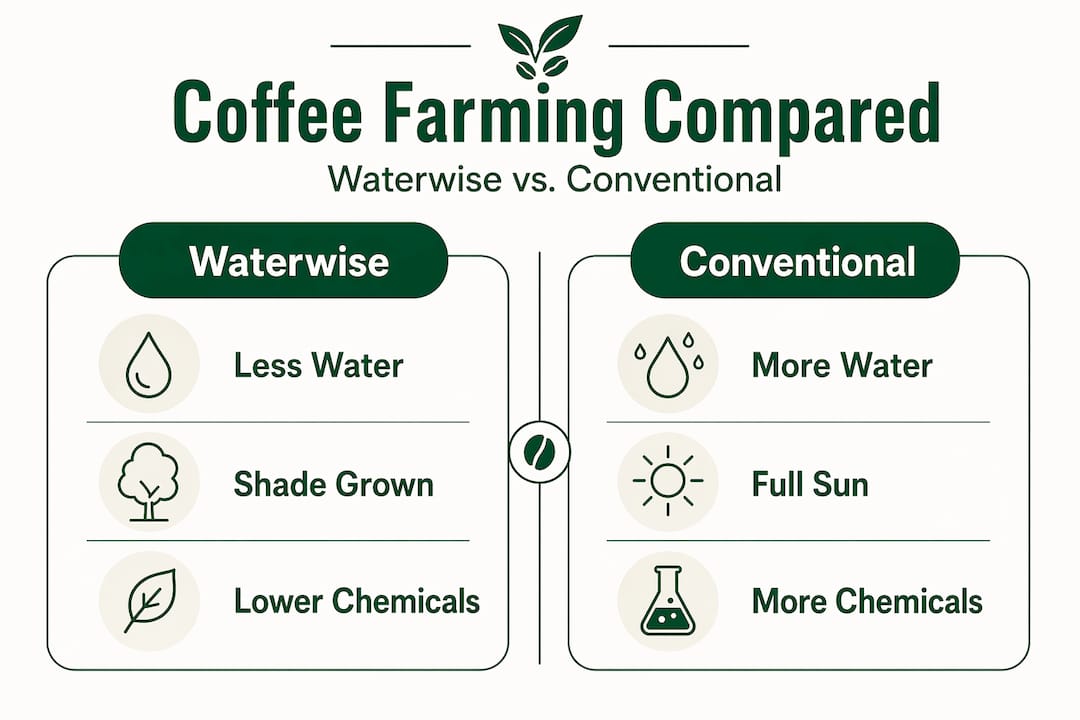
| Factor | Waterwise coffee | Conventional coffee |
|---|---|---|
| Water use per hectare | Reduced by up to 56% with drip irrigation | High, often using flood irrigation with significant runoff |
| Carbon footprint | Cut by nearly 60% with drip irrigation systems | Substantially higher due to energy-intensive irrigation and monoculture practices |
| Chemical input | 46% less per ton of beans produced | Heavy use of synthetic fertilizers and pesticides |
| Yield consistency | 10 to 50% higher, depending on method | Variable and declining with soil degradation over time |
| Soil health | Improved by agroforestry and composting practices | Degraded by continuous monoculture and chemical dependence |
| Biodiversity | Supported by shade trees and habitat corridors | Significantly reduced in open-sun monoculture systems |
The economic picture is worth addressing honestly. Waterwise and certified coffees typically cost more per bag at retail. That premium reflects real costs: certification audits, more labor-intensive farming, and the fair wages that ethical supply chains require. But sustainable brands using agroforestry open access to premium markets and build farmer resilience over the long term, which actually stabilizes supply and price over time.
There is also a common myth worth dispelling: that sustainable coffee is a niche product for a small audience. Consumer demand for eco-friendly coffee has grown steadily every year over the past decade, and that demand is reshaping supply chains at scale. When you choose waterwise coffee, you are participating in a market signal that reaches all the way back to how farmers allocate their land and water.
You can explore more on why eco-friendly coffee matters to see how purchasing decisions ripple through the supply chain.
My perspective on waterwise coffee’s real potential
I have spent a long time thinking about sustainable beverages, and I will say something plainly that most coverage of this topic softens: the gap between sustainability marketing and actual supply chain practice in coffee is still wide. A lot of brands use words like “responsible sourcing” without any certification, third-party audit, or farm-level transparency to back it up.
What I have learned is that waterwise coffee represents one of the clearest cases where the proof is measurable. A 56% reduction in water use is not a vague claim. A 46% reduction in chemical inputs has a direct, traceable effect on the ecosystems around those farms. When I see those numbers tied to verifiable certifications and named growing regions, I trust the product. When I see aspirational language with no supporting evidence, I do not.
The thing most consumers overlook about water conservation in coffee is that it is not a feel-good optional extra. It is a structural necessity. Water stress in key coffee-growing regions, from Central America to Ethiopia, is already affecting harvests. The farmers who adopted waterwise practices a decade ago are the ones with stable yields today. That should tell you something about the direction this has to go.
My encouragement is this: do not let perfect be the enemy of good. Start with one certified, shade-grown, or agroforestry-sourced bag. Notice whether the flavor is different. Read the sourcing page. That curiosity is what turns a casual buyer into a genuinely informed one.
— LaSaundra
Explore waterwise coffee with Ecoviberoast

At Ecoviberoast, every product on the shelf reflects a commitment to water conservation in coffee and sustainable sourcing you can actually verify. The brand works with farms that use drip irrigation and agroforestry systems, and every purchase supports real environmental action, including mangrove tree planting and ocean-bound plastic removal. That is not background noise. It is the reason the company exists.
If you are ready to make your daily brew a warm hug for both you and Mother Earth, start by exploring Ecoviberoast’s environmental impact initiatives to see exactly where your support goes. And if you want to expand your eco-conscious beverage ritual beyond coffee, the brand’s Hibiscus Berry Tea offers a vibrant, sustainably sourced herbal option that shares the same values. Thoughtful choices taste better, and at Ecoviberoast, that is the whole idea.
FAQ
What makes coffee “waterwise”?
Waterwise coffee is grown using methods like drip irrigation and agroforestry that significantly reduce water consumption compared to conventional farming. Drip irrigation alone cuts water use by up to 56% per hectare.
Is waterwise coffee eco-friendly in terms of carbon emissions?
Yes. Drip irrigation systems reduce the carbon footprint of coffee production by nearly 60%, and agroforestry further sequesters carbon through tree canopies and enriched soil.
How do I know if a coffee brand is genuinely waterwise?
Look for Rainforest Alliance, Fair Trade, or Bird Friendly certifications, which include audited water stewardship requirements. Transparent brands also publish farm-level sourcing data and processing details.
Does waterwise coffee taste different from conventional coffee?
Often, yes. Shade-grown and agroforestry-produced beans develop more slowly, concentrating aromatic compounds that result in more complex, satisfying flavor profiles compared to open-sun monoculture beans.
Why does waterwise coffee sometimes cost more?
The higher price reflects certification costs, more labor-intensive farming, and fair wages paid throughout the supply chain. It also signals that the brand has invested in practices that protect water resources and farmer livelihoods long term.


