

TL;DR:
- Coffee grounds are nitrogen-rich, near-neutral, and beneficial for composting and soil health.
- Proper ratios of 2-3 browns to 1 green prevent odors and promote aerobic decomposition.
- Following detailed composting guidelines enhances environmental impact and results in nutrient-rich compost.
Every morning, millions of coffee lovers brew a fresh cup and toss the grounds without a second thought. That small habit adds up to a staggering amount of organic waste heading straight to landfills, where it breaks down into methane, a greenhouse gas far more potent than carbon dioxide. But here’s the exciting part: those spent grounds are actually a gift for your compost pile. This guide walks you through everything you need, from tools and ratios to troubleshooting and finishing touches, so you can turn your daily coffee ritual into a genuine act of environmental care.
Table of Contents
- Why compost coffee grounds?
- What you need: Tools and materials checklist
- Step-by-step: Composting coffee grounds safely
- Solving common composting mistakes and FAQs
- How to tell your compost is ready and what to do next
- The uncomfortable truth about composting coffee grounds
- Compost more, waste less with EcoVibe Roast
- Frequently asked questions
Key Takeaways
| Point | Details |
|---|---|
| Balance your greens and browns | Use 2-3 parts brown material for every part of coffee grounds to create healthy compost. |
| Limit coffee grounds | Never let grounds exceed 25% of your compost’s volume to avoid odors and slowdowns. |
| Compost for a greener life | Composting coffee grounds cuts landfill waste and improves soil without making things more acidic. |
| Use unbleached filters | Add unbleached paper filters as a carbon-rich ‘brown’ in your compost for better results. |
| Check for dark, earthy compost | Finished compost should be crumbly with no visible grounds and an earthy smell. |
Why compost coffee grounds?
Your morning brew does more than wake you up. Once you understand what’s inside those spent grounds, you’ll never look at them the same way again.
Coffee grounds are classified as “green” compost material because of their high nitrogen content. Nitrogen is the nutrient that fuels microbial activity in your compost pile, helping organic matter break down faster and producing richer, more fertile finished compost. Think of grounds as a little energy boost for your pile, the same way a strong espresso jumpstarts your morning.
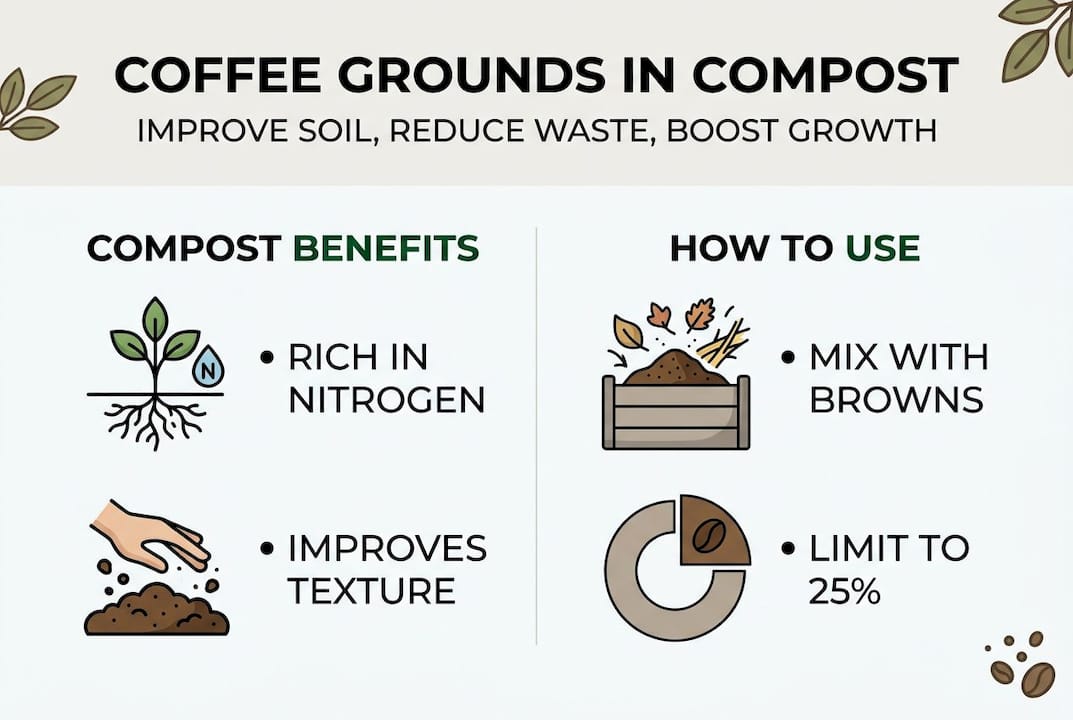
Beyond soil health, composting coffee grounds is a meaningful step toward reducing coffee waste at home. When organic material like coffee grounds ends up in a landfill, it decomposes without oxygen and releases methane. Keeping it out of the trash and into a compost bin is one of the simplest ways to cut your household’s carbon footprint.
One of the most persistent myths about coffee grounds is that they’re highly acidic and will throw off your compost or soil pH. Experts have debunked this clearly: spent grounds are near-neutral at a pH of 6.5 to 6.8, making them safe for virtually any compost system. The acidity is largely extracted into your brewed coffee, not left behind in the grounds.
Here’s a quick look at what coffee grounds bring to your compost:
| Property | Coffee grounds | Benefit to compost |
|---|---|---|
| Nitrogen content | High (~2%) | Fuels microbial breakdown |
| pH level | 6.5 to 6.8 (near-neutral) | Safe for most plants |
| Texture | Fine and granular | Improves aeration when mixed |
| Organic matter | Rich | Boosts finished compost quality |
The environmental case is just as strong as the soil science. Composting supports your broader low-waste coffee rituals and aligns with a lifestyle that takes sustainability seriously. Every batch of compost you make is a small but real act of stewardship for the planet.
Key benefits at a glance:
- Diverts organic waste from landfills
- Reduces methane emissions
- Adds nitrogen and organic matter to soil
- Supports a circular, zero-waste home routine
- Encourages healthy microbial life in your compost
With the need established, let’s cover what you should gather before you start composting.
What you need: Tools and materials checklist
Getting started with coffee ground composting doesn’t require fancy equipment. A few simple items are all you need to set yourself up for success.
Your core materials list:
- Used coffee grounds (any roast, any brew method)
- Compost bin or outdoor compost pile
- “Browns” such as dried leaves, cardboard, newspaper, or paper bags
- Unbleached paper coffee filters (if you use them)
- A turning tool like a pitchfork or compost aerator
- Optional: a worm bin for vermicomposting
The most important concept to understand before you add a single scoop of grounds is the brown-to-green ratio. You want 2 to 3 parts browns for every 1 part coffee grounds by volume. Browns are carbon-rich materials that balance the nitrogen in your grounds and keep the pile from getting soggy or smelly.
Pro Tip: Swap single-use plastic coffee packaging for compostable coffee packaging whenever you can. Compostable bags and pods can go straight into your pile along with the grounds, making your whole coffee routine more circular.
Here’s a handy comparison to help you sort your materials:
| Material | Brown or green? | Notes |
|---|---|---|
| Coffee grounds | Green | Add in measured amounts |
| Unbleached paper filters | Brown | Compostable and count as browns |
| Dried leaves | Brown | Excellent carbon source |
| Cardboard (torn up) | Brown | Remove tape and staples first |
| Fresh grass clippings | Green | Use sparingly |
| Vegetable scraps | Green | Great companion to grounds |
If you’re following eco-conscious coffee tips already, you may be using unbleached filters or compostable pods, which means you’re already halfway there. Bleached white filters can technically be composted too, but unbleached ones are the cleaner, more sustainable choice.
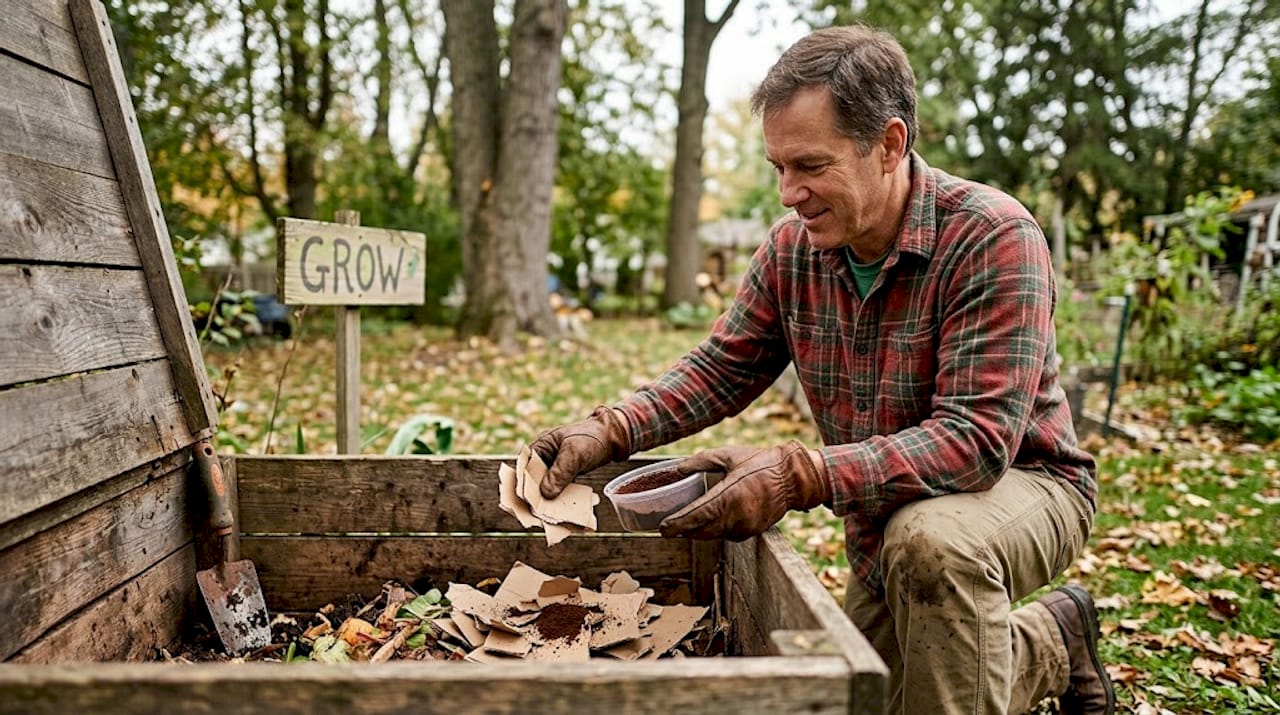
Having your browns ready before you start is the single best thing you can do to prevent problems down the line. Keep a small bin of dried leaves or torn cardboard near your compost so you can add them every time you toss in grounds. This simple habit keeps your pile balanced and odor-free.
Once you’ve gathered your supplies, you’re ready to get hands-on. The next section walks through each step.
Step-by-step: Composting coffee grounds safely
Following a clear process makes the difference between a thriving compost pile and a smelly, compacted mess. Here’s how to do it right.
- Collect your grounds and filters. After brewing, let grounds cool completely. Add them to a small countertop container until you’re ready to take them outside. Unbleached paper filters can go in too.
- Add grounds to your compost with the correct ratio. For every scoop of coffee grounds, add 2 to 3 scoops of browns. Experts recommend balancing with browns at this ratio to prevent compaction, odors, and anaerobic (oxygen-free) conditions that slow decomposition.
- Mix thoroughly. Don’t just layer grounds on top. Stir them into the pile so they’re evenly distributed. Coffee grounds clump together when wet, and clumps block airflow.
- Monitor moisture levels. Your pile should feel like a wrung-out sponge, damp but not dripping. If it’s too dry, add a little water. If it’s soggy, add more browns.
- Turn the pile weekly. Turning introduces oxygen, which speeds up decomposition and prevents odors. A simple pitchfork works perfectly.
Important: Keep coffee grounds to no more than 20 to 35% of your compost, with the EPA recommending a ceiling of 25%. Exceeding this limit causes odors, attracts pests, and can stunt the composting process.
Pro Tip: If you want faster results, consider vermicomposting. Worms absolutely love coffee grounds, and a worm bin can break down your organic material significantly faster than a traditional pile. Check out this sustainable coffee workflow for ideas on building a low-waste coffee routine around composting.
Knowing the process is key, but so is troubleshooting. Next, let’s address common problems and solutions.
Solving common composting mistakes and FAQs
Even with the best intentions, things can go sideways. Here’s how to recognize and fix the most common issues.
| Problem | Likely cause | Fix |
|---|---|---|
| Bad odor | Too many grounds, not enough browns | Add more carbon material and turn the pile |
| Compaction | Grounds clumping together | Mix thoroughly; break up clumps before adding |
| Mold on surface | Excess moisture | Add dry browns and turn to aerate |
| Slow decomposition | Pile too dry or unbalanced | Check moisture; rebalance ratio |
| Pests or wildlife | Fresh grounds used outdoors | Compost fully before outdoor use |
Common myths, busted:
- “Coffee grounds are too acidic for compost.” False. Spent grounds are near-neutral and won’t harm your pile or soil.
- “I can just sprinkle grounds directly on my garden.” Not ideal. Direct application can create a water-repellent crust on soil.
- “More grounds equal better compost.” Wrong. Exceeding 25% grounds can harm both compost and plants.
Wildlife is a real concern if you’re composting outdoors. Fresh coffee grounds may attract wildlife like bears when used as mulch or spread fresh in the garden. Always compost grounds fully before applying them outdoors, and never add dairy-based or flavored coffee drinks to your pile.
Decomposition timelines vary depending on your method. Hot piles take 3 to 5 months, cold piles take 6 to 12 months, and vermicomposting can be even faster. If you’re using a worm bin, you might have finished compost in as little as 6 to 8 weeks.
For those using single-serve brewers, learning about reducing waste with coffee pods can help you integrate pod composting into this same routine seamlessly.
With troubleshooting covered, let’s sum up what results you should expect and why composting coffee grounds is so rewarding.
How to tell your compost is ready and what to do next
Finished compost looks dark and crumbly, smells earthy like a forest floor, and shows no visible coffee grounds or other recognizable materials. That’s your green light to use it.
Here’s what to look for:
- Dark brown or black color throughout
- Crumbly, loose texture
- Rich, earthy smell (not sour or ammonia-like)
- No identifiable grounds or food scraps remaining
An Oregon State University study found that 25% coffee grounds in a hot compost pile can sustain temperatures between 135 and 155°F for two weeks, which is hot enough to kill pathogens and weed seeds more effectively than manure-based compost. That’s a powerful result from something you’d otherwise throw away.
Once your compost is ready, mix it into garden beds, use it as a top dressing for potted plants, or blend it into potting soil. Then start your next batch. The routine becomes second nature quickly.
The uncomfortable truth about composting coffee grounds
Most composting guides mention ratios briefly and move on. But in our experience, skipping the details on ratios is where most home composters go wrong, and where real eco-impact gets lost.
When you add too many grounds, the pile compacts, airflow stops, and anaerobic bacteria take over. The result? A smelly, slimy mess that discourages you from continuing. That’s the opposite of the environmental win you were going for.
The truth is that precise ratios aren’t a suggestion. They’re what keep your compost aerobic, active, and genuinely beneficial. There’s a temptation to think that because coffee grounds are “good” for compost, more must be better. It’s not. Exceeding 25% grounds can harm both the composting process and the plants you eventually feed.
True eco-impact comes from discipline: following the steps consistently, choosing unbleached and compostable products, and understanding the science behind what you’re doing. We also believe in the power of sharing. When you get it right, tell a friend, show a neighbor, or post about it. The benefits of compostable pods and composting practices multiply when more people adopt them. Small, precise actions done consistently beat big, careless gestures every time.
Compost more, waste less with EcoVibe Roast
Your composting journey pairs beautifully with the right coffee products. At EcoVibe Roast, we’ve built our entire line around making sustainable choices easy and enjoyable for you.

Our sustainable coffee pods are designed to fit right into your composting routine, so nothing goes to waste. Looking to branch out? Our organic hibiscus berry tea is another aromatic, eco-friendly option for your daily ritual. Every purchase you make supports our environmental commitment to planting mangrove trees and removing ocean-bound plastics. It’s a warm hug for both you and Mother Earth, one cup at a time.
Frequently asked questions
Can I compost flavored or instant coffee grounds?
It’s best to avoid flavored or instant coffee grounds since added sugars and dairy can attract pests and odors. Stick to plain, spent grounds for the cleanest compost results.
How much coffee grounds can I safely add to my compost pile?
Limit coffee grounds to no more than 20 to 35% of your total compost volume, with the EPA recommending 25% maximum to keep conditions balanced and aerobic.
Are coffee grounds acidic, and will they affect my soil’s pH?
Spent coffee grounds have a near-neutral pH of 6.5 to 6.8, so they won’t acidify your compost or garden soil. This is one of the most common myths about using grounds in the garden.
How long does it take for coffee grounds to compost?
Coffee grounds decompose in 3 to 5 months in hot piles, 6 to 12 months in cold piles, and even faster with vermicomposting depending on worm activity and pile conditions.
Do paper coffee filters belong in compost?
Yes! Unbleached paper filters are compostable and count as a brown material in your pile, making them a perfect companion to your coffee grounds.


