

TL;DR:
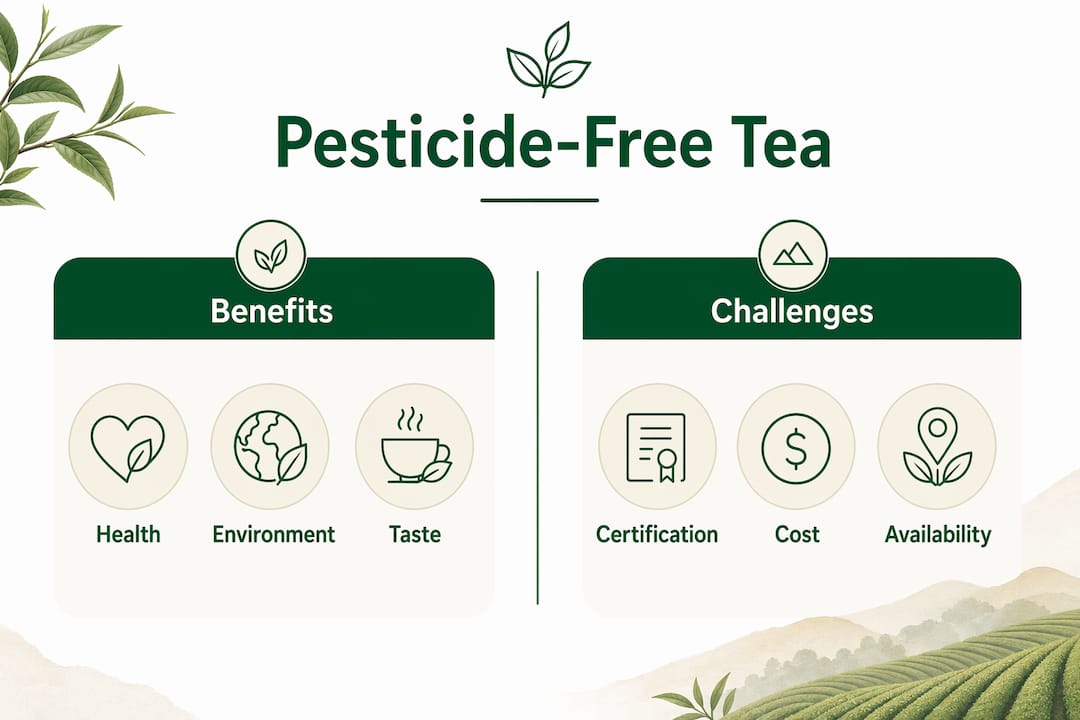
- Choosing pesticide-free tea reduces the risk of synthetic chemical residues and supports healthier ecosystems.
- Verification through third-party Certificates of Analysis is essential to confirm claims and ensure safety.
Pesticide-free tea lowers your likely exposure to synthetic chemical residues and supports farming practices that protect soil, water, and the people who grow your cup. That’s the short answer. The longer one involves understanding what labels actually mean, what the science shows about residue levels, and how to verify claims before you buy.
Here’s what matters most:
- Health risk reduction: Organic tea samples tend to show lower detection frequencies for pesticide residues than conventional samples.
- Environmental stewardship: Pesticide-free farming supports pollinator diversity, soil health, and cleaner waterways.
- Worker safety: Reducing synthetic pesticide use protects farmworkers and surrounding communities in tea-growing regions.
- Transparency: Certifications matter, but a published Certificate of Analysis (COA) from a third-party lab is the strongest verification tool you have.
Table of Contents
- What “pesticide-free,” “organic,” and “low-residue” labels actually mean
- What the science says about pesticide residues in tea
- How pesticide-free tea choices help the planet
- How to pick genuinely pesticide-free or low-residue tea
- Does “organic” guarantee zero pesticides? The honest answer
- Key Takeaways
- The label is only the beginning
- Pesticide-checked, eco-friendly tea from Ecoviberoast
- Useful sources and further reading
What “pesticide-free,” “organic,” and “low-residue” labels actually mean
These three terms sound similar but carry very different legal weight. Getting them straight helps you shop with confidence instead of guessing.
“Pesticide-free” is a chemical claim, not a legal certification. Any brand can print it on packaging. For it to mean anything, it needs to be backed by a third-party Certificate of Analysis showing residue testing results at clearly stated limits of detection. Without that document, the phrase is marketing.
USDA Organic is a legal certification. It means the producer followed a management system that prohibits synthetic pesticides and fertilizers, with documented chain-of-custody from farm to package. What it does not guarantee is zero residues. Atmospheric drift from neighboring farms, legacy soil contamination, and infrequent random testing all mean trace residues can appear even on certified organic products. As organic certification guidance makes clear, organic is a paperwork and management standard, not a chemical guarantee.
“Low-residue” is an informal descriptor tied to lab detection thresholds. Whether a sample tests as “not detected” (ND) depends entirely on the lab’s limit of quantification (LOQ) and limit of detection (LOD). A result of ND at a high LOQ is far less reassuring than ND at a very low LOQ. Always ask which methods and thresholds were used.
- USDA Organic: prohibits synthetic inputs, enforces chain-of-custody, does not guarantee zero residues
- “Pesticide-free”: requires a COA to be meaningful; no legal definition exists
- “Low-residue”: depends on the lab’s detection limits; always ask for LOQ/LOD values
- EU Organic and JAS (Japan Agricultural Standard): similar management-based frameworks with their own inspection regimes
What the science says about pesticide residues in tea
The evidence is nuanced, and that’s worth sitting with for a moment. Residues showing up in a lab test don’t automatically mean harm. But patterns across studies do suggest that choosing organic or pesticide-free tea reduces your exposure in meaningful ways.
A study of 103 Japanese tea leaf samples found neonicotinoid insecticides in both organic and conventional leaves, but organic samples showed lower detection frequencies and lower concentrations overall. That gap matters, especially for people who drink multiple cups a day.
Tea is also a dried product, and drying concentrates what’s on the leaf. Dehydration during processing increases residue concentrations per unit weight compared with fresh plant material, so residues that seem minor on a fresh leaf can be more significant in your finished cup.
The concept of “mixture effects” adds another layer. Regulatory maximum residue limits (MRLs) are set for individual compounds, not combinations. A tea with five residues each below its individual MRL may still present a combined exposure that hasn’t been fully evaluated.
Who benefits most from choosing pesticide-free tea:
- Frequent drinkers (three or more cups daily), where cumulative exposure adds up
- Pregnant people and young children, who are generally more sensitive to chemical exposures
- People with compromised immune systems or heightened chemical sensitivities
- Farmworkers and communities near tea-growing regions, where occupational exposure to synthetic pesticides is a documented concern
Residue context: Detectable does not always equal harmful. The question is frequency, concentration, and cumulative load over time, not a single cup.
How pesticide-free tea choices help the planet
Choosing tea grown without synthetic pesticides isn’t just good for your body. It’s a quiet vote for healthier ecosystems, and the research backs that up.

Organic farming systems show higher soil organic matter, greater pollinator abundance, and reduced nutrient runoff compared with conventional farming. Pollinators like bees and butterflies are especially sensitive to neonicotinoid insecticides, the same class of compounds found at lower levels in organic tea samples. Protecting them isn’t a side benefit; it’s foundational to food system stability.
Soil carbon sequestration is another real gain. Organic systems tend to build rather than deplete soil organic matter, which helps lock carbon into the ground rather than releasing it as CO₂. Reduced synthetic fertilizer use also means less nitrous oxide, a potent greenhouse gas, escaping from farm soils.
Water quality improves too. Synthetic pesticide and fertilizer runoff contaminates streams and groundwater in tea-growing regions, affecting communities that depend on those water sources. Pesticide-free farming reduces that downstream burden.
Ecological ripple: When you choose eco-friendly teas, you’re supporting the entire web of life around a tea garden, not just the leaf in your cup.
Pro Tip: When a brand makes environmental claims on packaging, look for a named third-party standard (Rainforest Alliance, Fair Trade, USDA Organic) alongside a transparency statement about sourcing. Vague phrases like “sustainably grown” with no certification or audit trail are marketing, not verification. If you want to understand the organic pest-control methods that make pesticide-free farming work, this overview of organic pest control is a solid starting point.
How to pick genuinely pesticide-free or low-residue tea
Here’s a practical checklist you can use right now, whether you’re browsing online or emailing a seller.
- Prioritize single-origin, traceable sourcing. Teas with a named farm or estate are easier to verify than blends. Traceability is the foundation of any transparency claim.
- Request a third-party COA. Ask the seller for a Certificate of Analysis from an independent lab. A reputable producer will have one. If they don’t, that’s your answer.
- Check the lab’s detection limits. A COA showing “ND” is only meaningful if the LOQ is stated and is genuinely low. Ask: What pesticides were tested? What lab performed the analysis? What were the limits of detection? When was the sample taken?
- Look for USDA Organic, EU Organic, or JAS certification. These don’t guarantee zero residues, but they do enforce management practices and chain-of-custody documentation. Combine certification with a COA for the strongest assurance.
- Consider additional seals for broader accountability. Fair Trade certification adds worker welfare standards. Rainforest Alliance adds biodiversity and community criteria. Neither replaces residue testing, but both signal a producer who accepts external scrutiny.
- Ask about geographic isolation. Remote or wild-harvest origins can produce non-detectable residue results even without organic certification, because physical distance limits drift and contamination. A published COA showing ND results is the proof.
- Watch for red flags. Vague “pesticide-free” claims with no COA, “made with organic ingredients” wording (which doesn’t mean the whole product is organic), lack of farm-level traceability, and unusually low prices for single-estate specialty teas all warrant skepticism.
On price: Genuinely transparent, low-residue teas from small producers with published COAs cost more than commodity tea bags. That premium reflects real testing, certification overhead, and often better growing conditions. For eco-conscious tea selection, treating price as a quality signal is reasonable, though it’s never a substitute for documentation.
One quality note worth knowing: organic green teas tend to show higher flavonol and tannin concentrations than conventional counterparts, though total antioxidant activity is broadly similar. If you’re drawn to the flavor complexity of a well-grown single-origin green tea, organic sourcing may offer a subtle edge.

Does “organic” guarantee zero pesticides? The honest answer
No. And understanding why helps you make smarter choices rather than feeling misled.
Organic certification enforces management practices and prohibits synthetic inputs. It does not eliminate all routes of contamination. Three main failure points explain why:
- Atmospheric drift: Pesticides sprayed on neighboring conventional farms can travel hundreds of meters and deposit on organic fields. Buffer zones help but don’t eliminate the risk entirely.
- Legacy soil contamination: Some persistent compounds remain in soil for years after use stops. A newly certified organic farm may still carry residues from its pre-certification history.
- Infrequent testing: Only a minority of certified organic farms receive regular random residue testing. Compliance is largely documentation-based, not chemistry-based.
Wild-harvested teas from geographically isolated regions offer an interesting alternative. Remote Yunnan teas, for example, have tested ND across broad pesticide panels because physical isolation minimizes drift. These teas often lack organic certification because wild systems don’t fit the documentation requirements organic standards demand. A published COA is the only way to verify their cleanliness.
Pro Tip: The most reliable approach combines three things: organic or equivalent certification (for management accountability) + a published third-party COA showing ND or very low residue results (for chemical verification) + geographic isolation or single-estate sourcing (for contamination risk reduction). No single factor is enough on its own. If you’re curious about growing your own low-pesticide herbs and teas at home, this guide to herbal teas from your garden walks you through the basics.
Key Takeaways
Choosing pesticide-free tea reduces your likely exposure to synthetic residues, supports healthier ecosystems, and protects farmworkers, but verification through third-party COAs matters as much as any label.
| Point | Details |
|---|---|
| Organic reduces but doesn’t eliminate residues | Drift, legacy contamination, and infrequent testing mean COAs are still needed for full confidence. |
| Drying concentrates residues | Dehydration increases residue concentration per weight in finished dry tea compared with fresh leaf. |
| Organic samples show lower residue levels | A study of 103 Japanese tea samples found lower neonicotinoid detection frequencies in organic versus conventional leaves. |
| Verification requires more than a label | Ask sellers for third-party COAs with stated LOQ/LOD values; certification alone is a management standard, not a chemical guarantee. |
| Ecoviberoast offers eco-verified tea options | Ecoviberoast sources teas with sustainability and transparency commitments, supporting both your health goals and environmental stewardship. |
The label is only the beginning
Most tea drinkers, even careful ones, stop at the organic seal and call it done. That’s understandable. The seal is visible, familiar, and feels like enough. But after reading the research behind residue testing and certification limits, I’d argue the seal is where the conversation starts, not where it ends.
What actually moves the needle is transparency at the producer level: a named farm, a dated COA from a credible third-party lab, and a brand willing to answer specific questions about testing protocols. That combination is rare, which is exactly why it’s worth seeking out. A brand that can tell you which lab tested their tea, what compounds were screened, and what the detection limits were is a brand that has done the work.
The environmental side of this equation deserves equal weight. Organic and pesticide-free farming practices genuinely support pollinator populations, soil health, and water quality in tea-growing regions. Every purchase is a small but real signal to producers about what the market values. That’s not idealism; it’s how supply chains shift over time.
The ecological benefits of organic tea farming extend well beyond your cup, and choosing producers who can document their practices is the most direct way to support that shift.
Pesticide-checked, eco-friendly tea from Ecoviberoast
If you’ve read this far, you already know what to look for. Ecoviberoast sources teas with sustainability and transparency at the center, not as an afterthought. Every purchase also plants mangrove trees and helps remove ocean-bound plastics, so your cup does something good beyond the last sip.

Ecoviberoast’s environmental impact commitments are publicly documented, and the brand’s sourcing philosophy prioritizes responsible supply chains. If you have questions about specific lab reports or sourcing details for any tea product, reach out to Ecoviberoast’s customer support directly. They’re there to help you make a confident, informed choice. Browse the full collection at ecoviberoast.com and find a tea that feels as good as it tastes.
Useful sources and further reading
These are the primary sources and research references used throughout this article. Each one adds a specific layer to the picture.
- Neonicotinoid residues in Japanese tea leaves (PubMed): A study of 103 tea leaf samples comparing organic and conventional farming; the core residue-frequency evidence cited in the health section.
- The Benefits of Organic Spices, Herbs, and Teas (Organic Center): Covers environmental benefits of organic farming, residue concentration effects from drying, and worker safety data.
- The Truth About Organic Tea (TeaTrade): Explains the limits of organic certification, the role of COAs, and the case for wild-harvest teas with published lab results.
- Polyphenols and antioxidant activity in organic vs. non-organic green teas (Cambridge Core): Peer-reviewed comparison of flavonol, tannin, and antioxidant levels between organic and conventional green teas.
For product-specific verification, always request a COA directly from the seller and check that it includes the lab name, test date, compounds screened, and limits of detection.


