

Choose whole beans if flavor, control, and long-term cost matter to you; choose pods if you need one-button speed and near-zero cleanup. The right call depends on three things: how much you care about taste, how much time you actually have at 6:45 a.m., and how much weight you put on environmental impact. Everything below breaks those trade-offs down so you can match the format to your actual life, not an idealized version of it.
TL;DR:
- Pods save time with brewing under two minutes and produce consistent extraction but are generally more expensive per cup and less flexible than beans.
- Whole beans provide fresher, more aromatic coffee when ground just before brewing, but require a grinder and additional preparation time.
- Environmental claims for pods, including recyclability and compostability, often depend on infrastructure that most households lack access to, limiting their sustainability advantage.
- Budget and volume determine cost-effectiveness: pods suit low-volume drinkers and those who already own a machine, while beans are cheaper and better suited for frequent coffee consumers.
- A hybrid approach, using pods for busy mornings and beans for leisure brewing, offers a practical balance aligned with most households’ routines.
Table of Contents
- Coffee Pods vs Beans: How Taste and Freshness Compare
- How Much Time Do Pods Actually Save You?
- What Does Each Format Actually Cost You Per Cup?
- Coffee Pods Environmental Impact: What the Data Actually Shows
- Which Brewing Method Fits Which Format?
- Pods or Beans: A Quick Decision Checklist
- Who’s Behind This Comparison and Where Ecoviberoast Stands on Sustainability
- A Practical Take: Why This Doesn’t Have to Be an Either/Or Decision
- Ready to Brew Sustainably? Here’s Where to Start
- Sources
Coffee Pods vs Beans: How Taste and Freshness Compare
Freshness is really about aroma retention, and aroma starts leaving the moment coffee gets ground. Grinding shreds the bean’s surface area, and those newly exposed oils and volatile compounds begin degrading almost immediately once they hit open air. That’s the whole reason a bag of pre-ground coffee smells “fine” but never quite matches the punch of beans ground right before brewing.
Sealed single-serve pods sidestep some of this by locking in ground coffee at the moment of packaging, which keeps it more stable in storage than an open bag of pre-ground grounds sitting in your pantry. But sealed and stable isn’t the same as fresh. Whole beans ground immediately before brewing capture aromatic complexity that pods, by design, can’t replicate once that seal is broken days or weeks earlier.
A few habits protect flavor no matter which format you lean on:
- Buy whole beans in amounts you’ll finish within a few weeks, not a bulk bag that sits for months.
- Store beans in an airtight container away from light, heat, and moisture.
- Grind with a burr grinder rather than a blade grinder. Burr grinders produce uniform particle size, which means more even extraction and a cleaner cup.
- If you’re using pods, note the roast date on the box. Pods sitting in a warehouse for months still lose some character before they ever reach your machine.
Pro Tip: Grind only what you’ll brew in the next 15 to 30 minutes. Ground coffee left exposed to air starts losing its aromatic edge fast, so grinding a whole week’s worth on Sunday defeats the purpose of owning a grinder at all.
If you want a deeper breakdown of how preparation method changes the cup, Ecoviberoast’s comparison of whole bean and ground coffee walks through it in more detail.
How Much Time Do Pods Actually Save You?
This is where pods win outright, and it’s worth being honest about that. A pod machine gets you from “half asleep” to “cup in hand” in under two minutes, with cleanup that amounts to tossing the used pod. A pour-over or drip setup from whole beans adds grinding, measuring, and a rinse cycle for your gear afterward.
The consistency gap matters just as much as the speed gap. Because each pod is pre-measured and system-controlled, you get nearly identical extraction every single time, regardless of who’s making the coffee or how rushed they are. Beans depend on your grind size, your water temperature, and your technique staying consistent, which is great for a coffee nerd chasing the perfect cup and mildly annoying for anyone in a hurry.
A workable middle ground for most households looks like this:
- Use pods on weekday mornings when you’re commuting or juggling a household before 7 a.m.
- Reserve whole beans for weekends, when you have ten extra minutes to actually enjoy the process.
- Pre-portion bean doses into small airtight containers the night before if weekday grinding still appeals to you.
- Keep your grinder and machine within arm’s reach. The setups that get skipped are almost always the ones tucked away in a cabinet.
What Does Each Format Actually Cost You Per Cup?
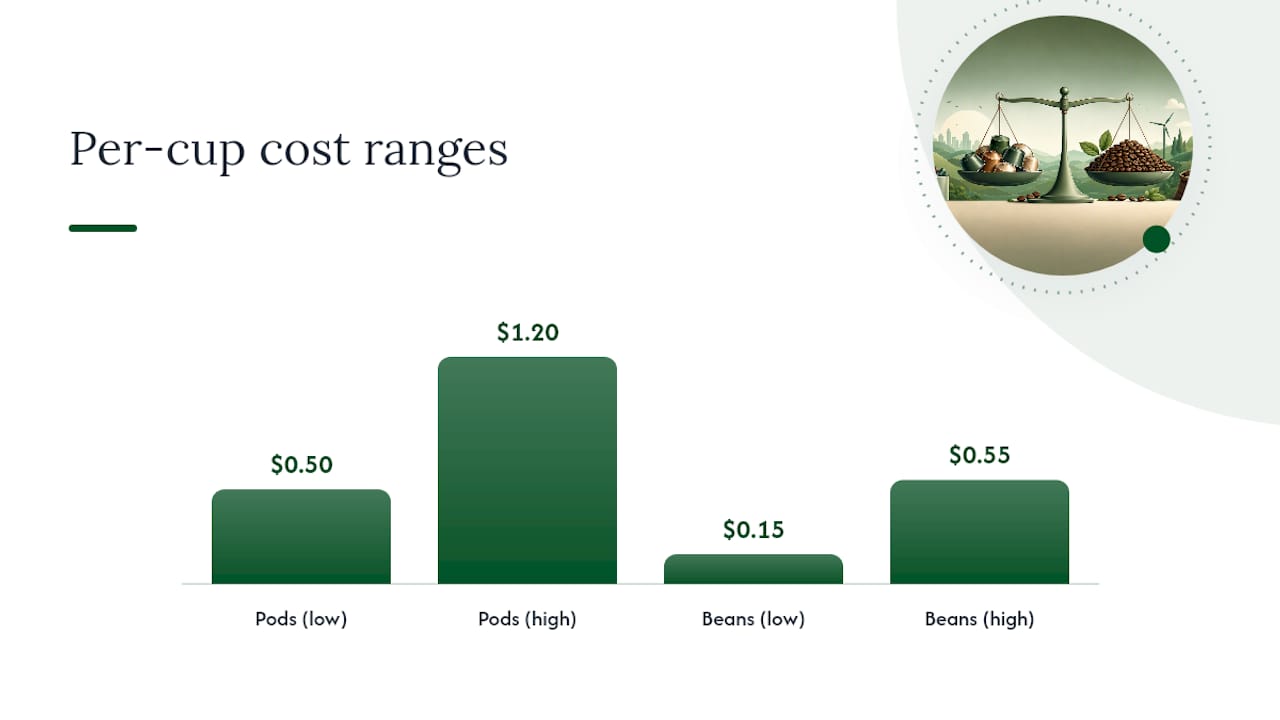
Pods cost more per cup, full stop, but the gap is smaller than people assume and the calculus changes with volume. Typical per-cup pricing runs $0.50 to $1.20 for pods versus $0.15 to $0.55 for ground or whole-bean coffee, depending on bean quality and how generously you portion your grounds.
By the numbers: a daily two-cup pod habit at $0.85 average runs roughly $50 a month, while the same two cups brewed from beans at $0.35 average lands closer to $21. That’s nearly $350 a year in savings once you’re drinking multiple cups daily.
Equipment costs flip the script for occasional drinkers, though. A single-serve pod machine typically runs less upfront than a quality burr grinder plus a drip or pour-over setup. If you’re making one cup every couple of days, that lower entry cost combined with pod convenience often wins out, because you’ll never brew enough volume to earn back the grinder investment.
A few rules of thumb for figuring out where you land:
- Light drinkers (1 cup every day or less): Pods usually make more financial sense once you factor in equipment costs.
- Moderate drinkers (2 to 3 cups daily): Beans typically break even on equipment within a few months and save real money after that.
- Heavy drinkers or households with multiple coffee people: Beans almost always win on cost, often significantly.
- Anyone who already owns a grinder: Beans are close to always the better value from day one.
Coffee Pods Environmental Impact: What the Data Actually Shows
This is the part where marketing claims and reality tend to part ways. Investigative reporting found that Keurig’s claims about pod recyclability didn’t hold up. The company agreed to pay $1.5 million in penalties in 2024 after regulators found its recyclability statements were overstated. Part of the problem is structural: pods are small and made of mixed materials, which leads many municipal sorting facilities to treat them as contamination rather than recyclable material, no matter what the packaging says. Separate coverage confirmed that large recycling operators have pushed back publicly on manufacturer recyclability claims.
Compostable pods carry a real but conditional benefit. A life-cycle study found that certain compostable pods fully degraded within 46 days at an industrial composting facility. Notice the qualifier: industrial. If a compostable pod ends up in a landfill instead, it can break down anaerobically and release methane, which erases much of the environmental upside it was supposed to deliver.
The uncomfortable truth about “compostable” and “recyclable” labels on coffee pods is that both promises depend entirely on infrastructure the average household doesn’t have access to. A label is only as good as the disposal system standing behind it.
None of this means pods are automatically the villain and beans are automatically clean. Whole beans still generate spent grounds and packaging waste, just in a form that’s far easier to compost at home. Practical steps that actually move the needle:
- Compost spent coffee grounds from beans directly in a home compost bin or garden.
- Check whether your municipality actually accepts pods before assuming curbside recycling works. Most don’t.
- If you use compostable pods, confirm you have access to industrial composting, not just a backyard bin.
- Consider a reusable pod insert that lets you fill it with your own grounds, cutting single-use waste entirely.
Ecoviberoast’s guide on reducing waste with coffee pods covers disposal options in more depth if you’re trying to make pods work sustainably.
Which Brewing Method Fits Which Format?
Matching your format to the right equipment prevents a lot of disappointment. Pod machines are closed systems built for one thing: they accept manufacturer-sized pods and nothing else, which is exactly why they’re fast but inflexible. Whole beans and ground coffee open up drip machines, pour-over cones, French press, and espresso machines, each of which calls for a different grind size.
Grind size is not a minor detail. Espresso needs a fine, almost powder-like grind to build the pressure and resistance the machine depends on. Drip coffee wants a medium grind. French press needs a coarse grind, or you’ll end up with sediment in every sip. A burr grinder handles all three with adjustable settings, while a blade grinder chops unevenly and gives you a muddier cup regardless of method.
Here’s how the gear typically lines up with priorities:
- Fastest possible setup: A single-serve pod machine, no grinder required.
- Best everyday value from beans: A mid-range drip machine paired with an entry-level burr grinder.
- Best flavor ceiling: An espresso machine with a fine-grind burr setting and beans ground fresh per shot.
- Best hybrid option: A dual-format machine that accepts both pods and ground coffee, letting one household cover both bases without buying two systems.
Pods or Beans: A Quick Decision Checklist
Pods, in short: fast, consistent, zero cleanup, but pricier per cup and heavier on packaging waste unless you’re diligent about disposal.
Beans, in short: better flavor ceiling, cheaper per cup at real volume, and easier to compost, but they demand a grinder, a few extra minutes, and some technique to get right.
Run through these three questions before you decide:
- What do I value most this week: flavor, time, or footprint? Pick the format that serves your top priority, not all three equally.
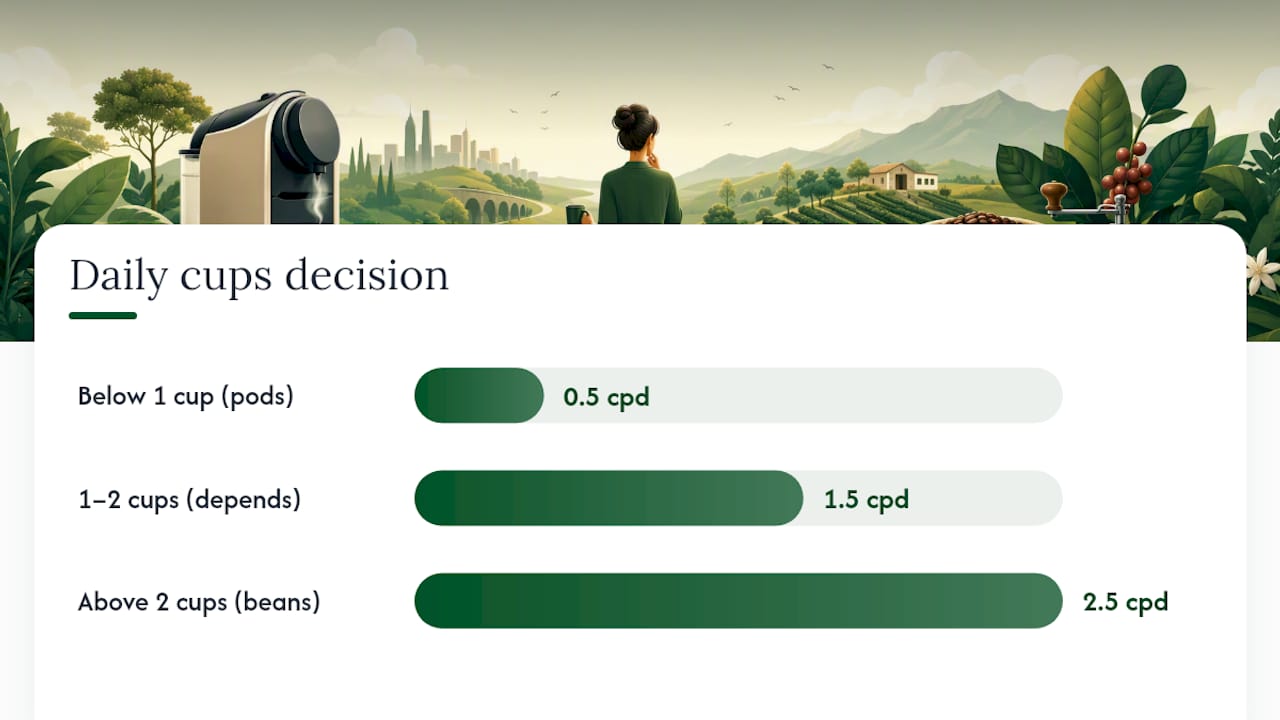
- How many cups am I actually drinking daily? Below one cup, pods often make sense financially. Above two, beans usually pay for themselves.
- Do I have (or want) a burr grinder? If yes, beans are close to a default win. If no, and you’re not planning to buy one, pods remove that barrier entirely.
A few quick archetypes to sanity-check your answer:
- The busy commuter: Pods on weekdays, full stop. The two minutes saved every morning adds up over a year.
- The flavor-first brewer: Whole beans, a burr grinder, and the patience to grind fresh each time.
- The sustainability-minded low-volume drinker: A reusable pod filled with your own grounds, or beans in small batches with grounds composted at home.
For readers leaning pod, Ecoviberoast’s guide to picking pods that still taste fresh is worth a look before you commit to a subscription.
Who’s Behind This Comparison and Where Ecoviberoast Stands on Sustainability
This comparison was written by LaSaundra for Ecoviberoast, drawing on published research into recyclability claims, composting outcomes, and per-cup cost data rather than anecdote. If you want more detail on the trade-offs between formats, Ecoviberoast has covered both sides in depth: whole bean versus ground coffee and the real-world impact of compostable pods.
Ecoviberoast’s own sustainability commitments go beyond compostable packaging. Every purchase supports mangrove tree planting and the removal of ocean-bound plastics, which is part of why the brand takes disposal claims seriously rather than slapping a vague “eco-friendly” label on a box.
Recyclability and compostability claims only mean something when the infrastructure behind them actually exists. That’s the standard worth holding every coffee brand to, including us.
A Practical Take: Why This Doesn’t Have to Be an Either/Or Decision
Most coffee drinkers I talk to frame this as a permanent allegiance, and that’s the wrong lens entirely. The realistic solution for most households is hybrid: pods for the mornings when two minutes actually matters, whole beans for the weekend cup you’re not rushing through.
Where I’d push back on conventional advice is the assumption that compostable pods are a clean solution just because the label says so. They’re only better if you can actually get them to an industrial composting facility. If you can’t, a reusable pod filled with your own beans does more good than a “compostable” one that ends up in a landfill anyway. Ecoviberoast’s compostable pods make sense for readers with access to that infrastructure; the whole-bean lineup makes more sense for everyone else who wants the sustainability win guaranteed rather than conditional.
— LaSaundra
Ready to Brew Sustainably? Here’s Where to Start
If you’ve landed on “hybrid” after reading all this, you’re not alone, and Ecoviberoast built its lineup around exactly that reality. Instead of forcing you into pods or beans, Ecoviberoast offers compostable single-serve pods for the mornings you need speed, alongside sustainably sourced whole beans for the sessions where flavor is the whole point.

Reach for the compostable pods when convenience wins the morning, and switch to the whole-bean lineup when you’ve got the ten minutes to grind fresh and actually taste the difference. Every order also plants mangrove trees and helps remove ocean-bound plastic, so your choice supports something bigger than your own cup either way. Ready to see which option fits your routine? Shop Ecoviberoast’s coffee and pods and build a rotation that matches how you actually drink coffee, not how you wish you did.
Sources
This comparison draws on NPR’s reporting on Keurig’s SEC settlement, a PubMed-indexed composting feasibility study, and per-cup cost analysis from MyHomeCoffee. For more on disposal and product choices, see Ecoviberoast’s guides to reducing pod waste and choosing biodegradable pod types.
- Keurig K-Cup pods are not as recyclable as company claims, SEC says : NPR
- Composting study demonstrating feasibility of industrial composting for certain biobased products - PubMed
- Coffee Pods vs. Ground Coffee: Breaking Down Cost, Flavor, and Environmental Trade-Offs


