

The main ways coffee loses its caffeine are solvent-based decaffeination (direct or indirect), water-based processing like the Swiss Water and Mountain Water methods, supercritical CO2, and the lesser-known triglyceride (oil) method. Solvent methods are the cheapest, water processes are the go-to for chemical-free decaf, and CO2 tends to preserve flavor best at commercial scale. Nearly every process in the United States has to hit the same baseline: roughly a 97% caffeine reduction.
TL;DR:
- Solvent-based decaffeination typically removes around 97% or more of caffeine but can cause more flavor loss compared to water or CO2 methods.
- Water processing like Swiss Water or Mountain Water relies on activated carbon filters to extract caffeine without chemicals, protecting the beans’ natural flavor.
- Supercritical CO2 is highly selective for caffeine, preserves flavor better, but involves expensive equipment, making it less common among small-scale producers.
- The industry standard for decaf compliance requires a minimum of 97% caffeine removal, with residual solvent levels usually safely evaporated during roasting.
- Always check for specific decaffeination process labels, as water and CO2 methods are more transparent and often priced higher than solvent-based options.
Table of Contents
- What Happens Before Any Decaf Coffee Methods Kick In
- Solvent-Based Decaf: The Direct and Indirect Methods
- Swiss Water and Mountain Water: Decaf Without the Chemicals
- Supercritical CO2: The High-Tech Route To Decaf
- Triglyceride Processing and Other Niche Decaf Variants
- What the Numbers Actually Tell You About Flavor and Safety
- How To Choose Decaf Coffee: A Practical Checklist
- EcoVibe Roast’s Approach To Sourcing Decaf
- The Real Trade-Off Nobody Talks About Enough
- Shop Sustainably Sourced Decaf With Ecoviberoast
- Sources
What Happens Before Any Decaf Coffee Methods Kick In
Every decaffeination technique, no matter how fancy the marketing sounds, starts in the exact same place: with green, unroasted coffee beans. That’s not a random choice. Roasting rearranges the bean’s internal chemistry and locks in the aromatic oils that give coffee its personality, and decaffeination has to happen before that transformation or the extraction becomes uncontrollable and unpredictable.
Here’s the general sequence every method follows before it branches off into its own specialty:
- Moisten the beans. Steam or hot water swells the green beans and opens their pores, creating a pathway for caffeine to travel.
- Create a concentration gradient. Caffeine is far more concentrated inside the bean than in the surrounding solvent or water, so it naturally migrates outward, chasing equilibrium the same way sugar dissolves into unsweetened tea.
- Separate caffeine from the solvent. Whether that solvent is a chemical, water, or pressurized CO2 depends on the method, but the caffeine has to be pulled out and disposed of separately.
- Dry the beans back down to their normal moisture content so they can be roasted like any other coffee.
The method a producer chooses at step three is pivotal, affecting cost, flavor, and how the label’s ‘cleanliness’ can be represented.
Solvent-Based Decaf: The Direct and Indirect Methods
Solvent-based decaffeination is the oldest and most widely used approach in the industry, mostly because it’s fast and cheap to run at scale. It splits into two workflows that share a chemical toolkit but differ in how the beans interact with it.
The direct method steams the green beans to open their structure, then soaks them straight in a solvent that bonds with caffeine molecules and carries them out. After extraction, the beans are steamed again to drive off leftover solvent, then dried and readied for roasting. The indirect method takes a longer road: beans soak in hot water first, that water (now loaded with caffeine and flavor compounds) gets treated with solvent to strip out the caffeine, and the flavor-rich water is returned to the beans so they reabsorb what makes coffee taste like coffee.
The two solvents doing the heavy lifting are methylene chloride and ethyl acetate. Solvent-based decaffeination remains the most common and cost-effective method in the industry, largely because both chemicals bond selectively with caffeine without demanding the specialized equipment that CO2 or water processing require.
Reported caffeine removal across solvent, water, and proprietary methods generally runs from the mid-90s percent up to 99%+, with US regulations requiring roughly a 97% reduction as the baseline standard.
A few things worth knowing before you judge a bag by its process label:
- The FDA sets strict parts-per-million limits on residual solvent, and roasting plus the final drying stage evaporates the overwhelming majority of any trace amounts left behind.
- “Ethyl acetate processed” often gets marketed as “naturally decaffeinated” because the compound occurs naturally in some fruits, even though it’s synthetically applied here.
- “Chemical-free” on a label almost always signals water or CO2 processing, not solvent, since neither of the solvent methods can honestly claim that.
Pro Tip: If a bag doesn’t specify a decaffeination method anywhere on the packaging or product page, assume it’s solvent-processed. Producers using water or CO2 methods almost always advertise it front and center because it costs them more to do.
Swiss Water and Mountain Water: Decaf Without the Chemicals
If you’re hunting for chemical-free decaf coffee, this is the category to know by name. Water-based decaffeination skips synthetic solvents entirely and relies on something called green coffee extract, or GCE, which is essentially water that’s already saturated with every soluble compound found in coffee except caffeine.
Here’s the elegant part: because the GCE is already full of everything but caffeine, when green beans are soaked in it, caffeine is the only thing with room to migrate out. The GCE then passes through activated carbon filters that trap caffeine molecules while letting flavor compounds pass through, and that filtered extract gets reused for the next batch of beans. The Swiss Water Process relies on this activated carbon filtration cycle to strip caffeine while protecting the beans’ natural character.
Mountain Water Process, a regional variant most associated with Mexican-grown coffee, follows the same basic principle using local mountain spring water instead of a proprietary GCE system.
Why does specialty coffee lean so heavily on water processing despite the added cost?
- No synthetic chemicals ever touch the bean, which matters enormously to buyers hunting for the best organic decaf coffee or genuinely chemical-free labeling.
- The multi-hour monitoring process protects delicate soluble compounds that faster methods can strip away along with the caffeine.
- Roasters who care about cup quality tend to reach for water-processed beans first, since the flavor loss is generally milder than with basic solvent methods.
Supercritical CO2: The High-Tech Route To Decaf
Supercritical CO2 sounds like something out of a chemistry lab, and honestly, it kind of is. Under enough pressure and heat, carbon dioxide stops behaving like a gas or a liquid and becomes something in between: a supercritical fluid with the density of a liquid and the diffusive reach of a gas. That hybrid state lets it slip into moistened green beans and act like a solvent.
What makes CO2 special is selectivity. It bonds almost exclusively with caffeine molecules and leaves the larger flavor and aroma compounds mostly undisturbed. The pressurized CO2 acts on moistened beans, and once extraction is complete, the pressure is released and the CO2 simply evaporates away, leaving minimal residue behind.
- Precision extraction: because CO2 targets caffeine so specifically, flavor retention tends to beat basic solvent-direct processing.
- Infrastructure demands: the pressurized tanks and equipment needed represent serious capital investment, which is why this method is mostly run by large-scale processors rather than small roasters.
- Price and availability: that infrastructure cost trickles down to the shelf, making CO2-processed decaf a bit pricier and less common than solvent-based options, though usually more available than small-batch water processing.
Specialty roasters and coffee reviewers alike frequently point to CO2 and Swiss Water methods as delivering noticeably better flavor retention than basic direct-solvent decaf, and that reputation shapes a lot of purchasing decisions among people who actually taste-test their coffee before committing to a bag.
Triglyceride Processing and Other Niche Decaf Variants
The triglyceride method, sometimes called the oil method, takes a genuinely clever approach: it recycles coffee oils, or triglycerides, pulled from spent coffee grounds and uses them as the extraction medium. Green beans get steamed, then soaked in a hot bath containing these coffee oils, which draw caffeine out of the bean through the same fatty-compound affinity that makes coffee oils cling to caffeine in the first place.
- This method preserves flavor reasonably well since the extracting medium is derived from coffee itself, not an external chemical.
- It’s used far less commonly than solvent, water, or CO2 methods, mostly because it’s harder to scale commercially and less standardized across producers.
- You’ll occasionally see regional or proprietary variants on packaging, sometimes bundled under vague terms like “natural process” or a roaster’s own branded name for a tweaked version of an established method.
If a label uses unfamiliar language you can’t immediately place into one of the four major categories, it’s worth digging into the product page or reaching out to the roaster directly. Vague terminology is sometimes a marketing dodge, and sometimes it’s just a smaller producer using a legitimate niche process that hasn’t earned a household name yet.
What the Numbers Actually Tell You About Flavor and Safety
Here’s where the marketing claims meet the actual chemistry. Removal rates across the industry generally land somewhere between the mid-90s percent and 99%+, and the US regulatory standard requires roughly a 97% reduction for a coffee to legally carry the word “decaf.”
Some flavor loss is unavoidable no matter which method you choose, since caffeine extraction inevitably disturbs at least a few of the aromatic compounds sitting alongside it in the bean. Water processing and CO2 tend to preserve more of those compounds because they’re gentler or more selective; basic direct-solvent methods tend to strip a bit more character along with the caffeine.
| Method | Typical Caffeine Removal | Flavor Impact |
|---|---|---|
| Direct solvent | ~97%+ | Noticeable flavor loss |
| Indirect solvent | ~97%+ | Moderate, flavor partially restored via water reintroduction |
| Swiss Water / Mountain Water | extensive caffeine removal | Minimal, widely regarded as best-preserved |
| Supercritical CO2 | ~97%+ | Minimal to moderate, high selectivity |
On the safety side, residual solvent levels from methylene chloride are typically minimal by the time coffee reaches your cup, since both the initial drying stage and the roasting process itself evaporate the overwhelming majority of any trace amounts. The FDA sets specific parts-per-million limits, and producers verify compliance using two main testing methods: HPLC (high-performance liquid chromatography), which precisely measures caffeine and residual compounds in a lab setting, and NIR spectroscopy, a faster, emerging technique that producers increasingly use for quality checks without the wait time of a full lab analysis.
How To Choose Decaf Coffee: A Practical Checklist
Standing in front of a wall of decaf options doesn’t have to feel like guesswork. Run through this list before you buy:
- Check the method label. Look for specific wording like “Swiss Water Processed,” “CO2 decaffeinated,” or “ethyl acetate processed” rather than a vague “naturally decaffeinated” claim.
- Look for a roast date, not just a “best by” date, since freshness affects flavor more than people expect.
- Read the flavor descriptors on the bag. Water and CO2 processed decaf often list tasting notes just like regular coffee, since the character survives intact.
- Expect to pay more for water-processed or CO2 decaf; that premium reflects longer processing times and heavier equipment costs, not a markup for the sake of it.
- Ask the roaster directly if the process isn’t listed. A roaster proud of its method will answer quickly and specifically.
- Check for organic and fair trade certifications, which often (though not always) pair with more environmentally conscious decaffeination choices too.
Pro Tip: Water-processed and CO2-processed decaf brew beautifully in pour-over methods since those techniques highlight the subtle flavors these gentler processes preserve. If you want to see the difference for yourself, brew the same decaf bean two ways and taste side by side.
EcoVibe Roast’s Approach To Sourcing Decaf
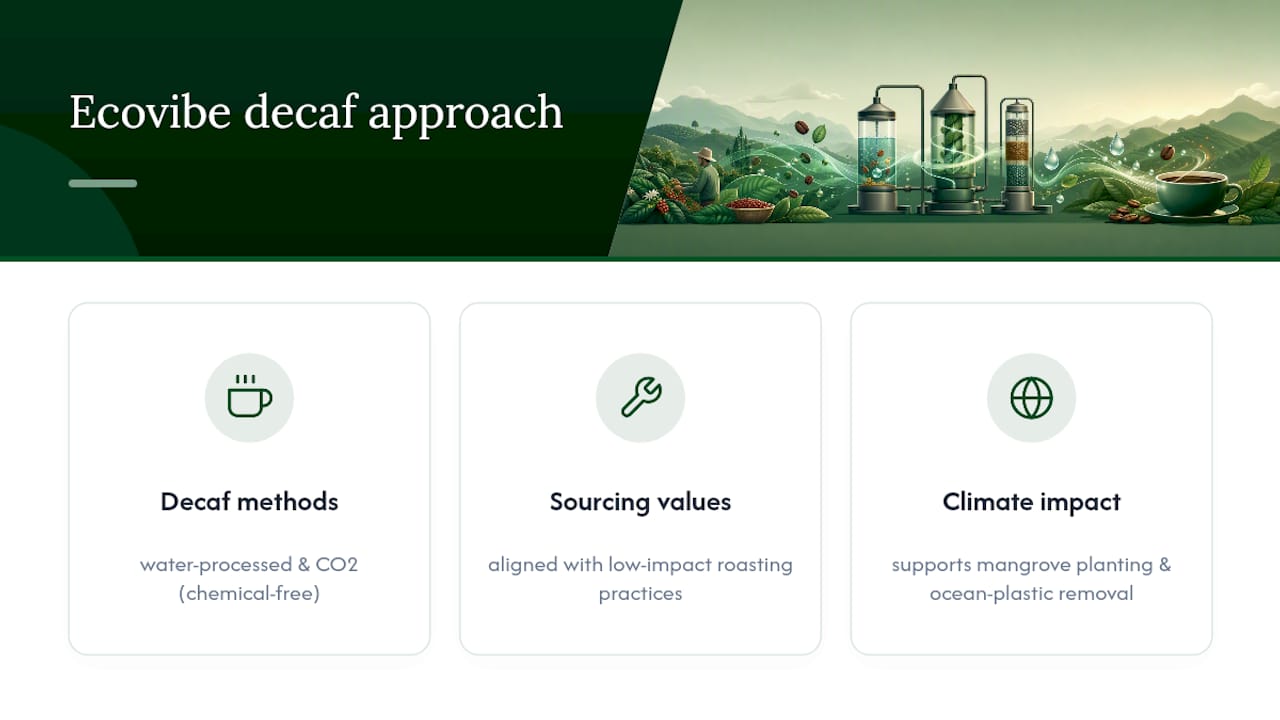
At Ecoviberoast, decaf isn’t an afterthought bolted onto the regular lineup. We prioritize chemical-free decaf coffee whenever possible, favoring water-processed and CO2 beans that align with the same sustainability values behind our low-impact roasting practices. Every purchase still supports mangrove planting and ocean-plastic removal, decaf included, because your ritual shouldn’t have to choose between great taste and a lighter footprint.
The Real Trade-Off Nobody Talks About Enough
Most decaf conversations get stuck arguing over which method is “safest,” and that framing misses the point entirely. Residual solvent levels across every regulated method sit well within FDA limits, and roasting burns off the overwhelming majority of any trace amounts regardless of which process a bean went through. Safety was mostly solved decades ago.
The trade-off that actually deserves your attention is flavor versus cost versus environmental footprint, and conventional coffee marketing dodges this conversation because it’s less flattering than “chemical-free!” printed in green letters. Water processing and CO2 both cost more because they demand more time, more monitoring, or more capital equipment, not because they’re inherently superior products dressed up in premium packaging.
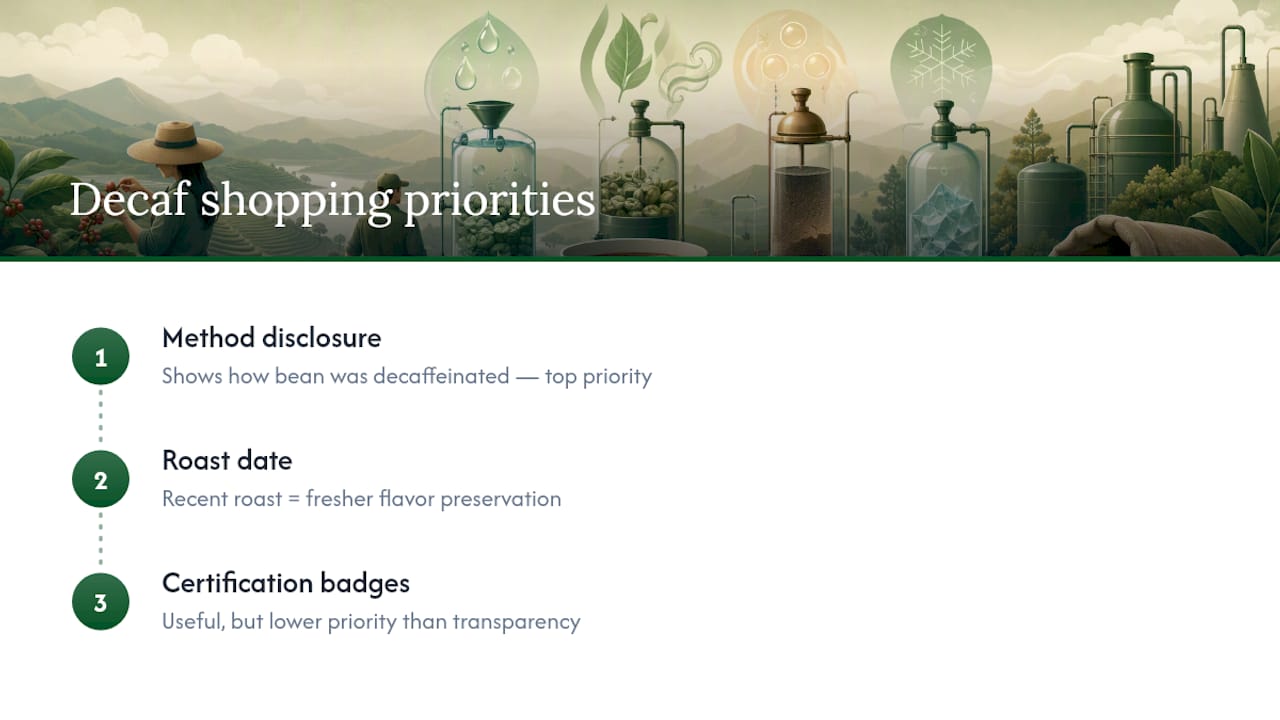
If you’re the kind of coffee drinker who reads labels and asks questions, prioritize the method disclosure first, the roast date second, and the certification badges third. A bag that tells you exactly how it was decaffeinated, and backs that claim with a recent roast date, is a bag from a producer who isn’t hiding anything. That transparency matters more than chasing whichever method happens to be trending in coffee media this year.
— LaSaundra
Shop Sustainably Sourced Decaf With Ecoviberoast
Ecoviberoast gives you a way to skip the guesswork entirely: every decaf offering is chosen with chemical-free and flavor-preserving methods front of mind, so you’re not stuck cross-referencing labels against a checklist every time you shop.

Whether you brew pour-over, drip, or reach for a single-serve pod on a busy morning, our lineup is built for coffee drinkers who want a cup that tastes like it wasn’t decaffeinated at all. Pair that with sustainable packaging and a portion of every purchase going toward mangrove restoration and ocean-plastic removal, and your evening cup starts pulling real weight beyond just keeping you cozy. Browse the current decaf selection at Ecoviberoast and find a bag that matches both your taste and your values, or explore our eco-conscious brewing guide to get the most flavor out of whichever process you choose.
Sources
- How is decaf coffee made? And is it really caffeine-free? | The Conversation
- How is coffee decaffeinated, and is it safe to drink? | Chemical & Engineering News (C&EN) / ACS
- Decaffeination — Wikipedia


