

TL;DR:
- Traceability in coffee involves documenting every stage from farm to retailer, ensuring transparency. Novel technologies like blockchain, satellite imagery, and geo-mapping enhance verification, meeting stricter regulations and consumer demands. Building truly inclusive systems remains challenging but is essential for ethical and sustainable coffee sourcing.
That aromatic cup of coffee sitting in your hands traveled through a surprisingly complex web of hands, countries, and decisions before it reached you. Most people assume “origin” just means the country printed on the bag, but to truly explain traceable coffee supply chains, you have to go much deeper. Traceability means documenting every link in the chain from the farm where those beans were grown, through processing, export, and roasting, all the way to the shelf. And right now, new regulations and rising consumer expectations are making that documentation not just meaningful but mandatory.
Table of Contents
- Key takeaways
- The coffee supply chain explained, stage by stage
- Technology tools driving coffee traceability
- Why traceability is the backbone of ethical coffee sourcing
- Real challenges in building traceable supply chains
- How brands and consumers can choose traceable coffee
- My take on why traceability is more than a data problem
- Ecoviberoast walks the talk on sustainable sourcing
- FAQ
Key takeaways
| Point | Details |
|---|---|
| Traceability spans every stage | Transparent coffee production tracks beans from cultivation through retail, not just country of origin. |
| Technology powers the chain | Blockchain, satellite imagery, and geo-mapping tools create verifiable, tamper-proof records at every step. |
| Regulations are raising the bar | The EU Deforestation Regulation now requires polygon-level farm mapping to prove no deforestation after 2020. |
| Smallholder inclusion is the hard part | Many farmers lack digital tools, and excluding them from traceability systems creates serious equity risks. |
| Consumers can drive change | Choosing certified, single-origin, and traceable coffees actively rewards farms that invest in ethical practices. |
The coffee supply chain explained, stage by stage
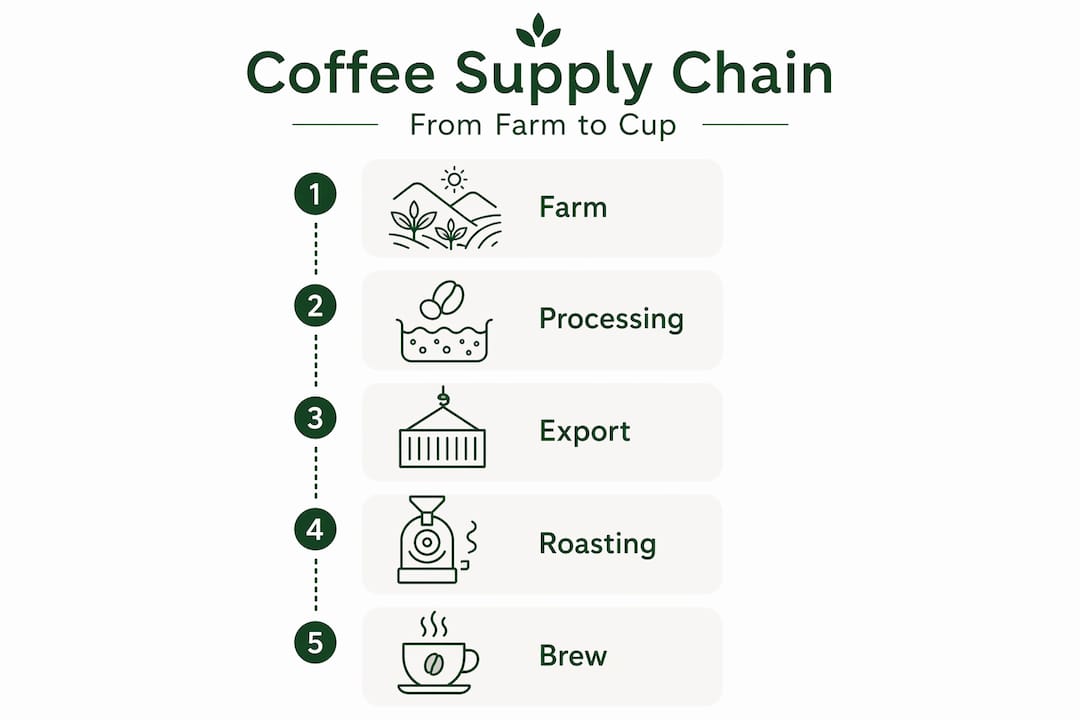
Understanding the role of traceability in coffee starts with knowing what the supply chain actually looks like. There are more handoffs than most people realize, and each one is a potential gap in the record.
- Cultivation — Farmers plant and grow coffee trees, often on small plots of land. This is where soil health, shade cover, and farming practices like agroforestry begin to shape both quality and environmental impact.
- Harvesting — Ripe cherries are picked, either by hand or machine. The method affects both quality and the accuracy of any weight or lot records.
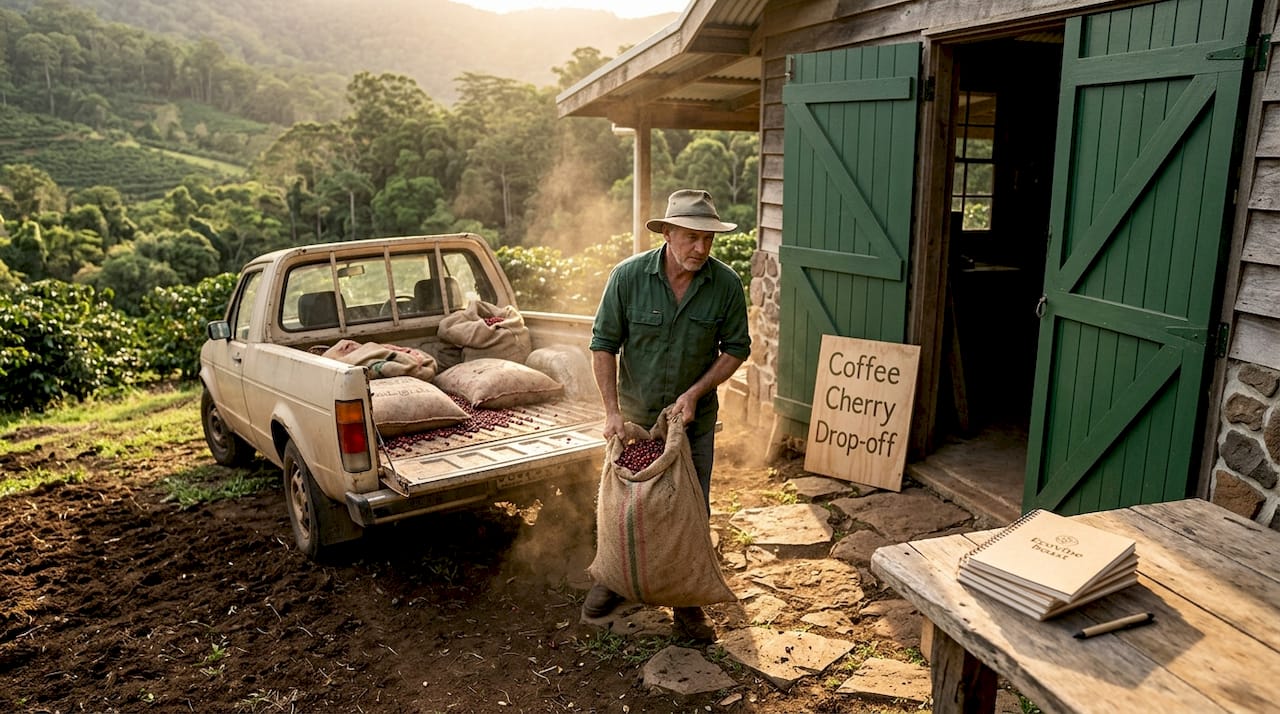
- Processing — Cherries are pulped, fermented, washed, or dried. At cooperative wet mills, hundreds of smallholders may deliver cherries that get mixed into shared lots, which is one of the biggest traceability challenges in the entire chain.
- Exporting — Processed green coffee is bagged and shipped. Export documentation is where many traceability records either solidify or fall apart.
- Roasting — Roasters apply heat profiles that transform green beans into the aromatic product you recognize. Roasters are increasingly the ones demanding traceability data from their supply partners.
- Distribution and retail — Coffee moves to warehouses, online platforms, and store shelves. Without a documented chain of custody, origin claims at this point are largely unverifiable.
- Consumption — You brew and enjoy the final cup, ideally with full confidence in where it came from and who was paid fairly to grow it.
Pro Tip: When a coffee label says “single-origin,” ask what that actually means. Is it traceable to a specific farm or cooperative? Or just a country? That distinction tells you a lot about how serious a brand is about transparent coffee production.
Traceability is most difficult in the middle stages, especially where smallholder farmers deliver cherries to shared processing stations. When dozens or hundreds of farmers pool their harvests, individual farm identity can disappear. Solving that problem is where technology comes in.
Technology tools driving coffee traceability
The good news is that a growing set of technologies makes it genuinely possible to trace coffee origins across every stage of a complex supply chain.
Here is what the best traceability systems actually use:
- Blockchain-based chain of custody — Blockchain’s immutability creates a tamper-proof audit trail across multi-tier supply chains, protecting against fraud and greenwashing claims. Once a record is written, no single party can quietly alter it.
- Polygon-level geo-mapping — Older systems used a single GPS point to represent an entire farm. Modern traceability draws the full boundary of each plot, which is now required by law in the EU. This shift from centroid to polygon dramatically increases precision.
- High-resolution satellite imagery — Satellite imagery up to 30cm resolution can distinguish between managed agroforestry systems and natural forest, making it possible to verify deforestation claims remotely and at scale.
- Offline-capable mobile apps — Digitizing cooperative operations using mobile apps that work without internet connectivity lets field agents onboard smallholders in remote areas and collect farm polygons on the ground.
- Digital traceability platforms — Integrated platforms connect farmers, cooperatives, exporters, and roasters in a single data ecosystem, so every party can see and verify records in real time.
| Technology | Primary use | Key benefit |
|---|---|---|
| Blockchain | Chain of custody records | Tamper-proof, fraud-resistant audit trail |
| Satellite imagery | Deforestation verification | Remote monitoring at farm level |
| Polygon geo-mapping | Farm boundary documentation | Regulatory compliance with EUDR |
| Mobile apps (offline) | Farmer onboarding | Reaches remote, low-connectivity areas |
| Digital platforms | Multi-stakeholder data sharing | Connects the full supply chain |
The regulatory push is real and accelerating. The EU Deforestation Regulation mandates polygon-level geo-coordinates for every coffee farm plot and requires a documented Due Diligence System to verify no deforestation occurred after 2020. And the scope just got bigger. The expanded regulation now covers soluble coffee, meaning instant coffee brands face the same compliance demands as roasted bean sellers.
Pro Tip: If you source or import coffee for a business, look for digital platforms that generate audit-ready documentation automatically, including geo-mapping, risk assessments, and due diligence statements. Manual record-keeping will not hold up under regulatory scrutiny.
Kenyan coffee exporters are already navigating this reality, replacing manual workflows with blockchain-enabled traceability that connects thousands of smallholders to a single verifiable system.
Why traceability is the backbone of ethical coffee sourcing
Traceability is not just a compliance exercise. It is the foundation that makes ethical coffee supply chains actually functional rather than just aspirational.
When you can trace a coffee lot back to a specific farm or cooperative, several powerful things become possible:
- Fair compensation verification — You can confirm that fair trade premiums actually reached the farmers who grew the coffee, not just the exporters who shipped it.
- Sustainable practice validation — Regenerative agriculture methods like agroforestry produce carbon data and polygon maps as a natural byproduct, so traceability and sustainability reinforce each other.
- Consumer trust — 4 in 10 consumers are actively drawn to coffee with ethical or origin claims. Verified traceability turns those claims into credible facts rather than marketing language.
- Market access — Single-origin traceable coffees command real price premiums. In Canada, for example, single-origin commands CAD 1 to 3 more per unit at retail compared to blends.
- Environmental accountability — With over 60% of global coffee supply exposed to deforestation risks, digital traceability is what allows brands to verify their sourcing claims with actual data.
“Transparency is a long-term commitment and alliance with producers, not a one-time marketing claim.” — Sofia Cuadros, specialty coffee sourcing expert
Certification programs like Rainforest Alliance, Fair Trade, and Direct Trade all lean on traceability systems to verify their standards. Without the underlying data infrastructure, a certification label is only as trustworthy as the last audit, which may have been two years ago. Traceable coffee practices keep accountability continuous rather than periodic.
You can learn more about how ethical sourcing actually works in practice to see what meaningful commitments look like versus surface-level claims.
Real challenges in building traceable supply chains
Here is the honest part that many traceable coffee articles skip over. Building a truly traceable system is hard, and the barriers are not just technical.
- Batch mixing at wet mills — When smallholder farmers deliver cherries to a shared cooperative processing station, individual farm identity often disappears into a communal lot. Recovering that identity requires collecting data before the cherries leave the farm gate.
- Missing GPS tools and formal boundaries — Many smallholder farmers in places like Kenya, Ethiopia, and Colombia do not have smartphones or formal surveyed plot boundaries. Collecting polygon-level maps requires field agents and equipment the farmers themselves cannot supply.
- Informal land tenure — A significant share of coffee farmers worldwide work land without formal legal title. Without documentation, even a perfectly mapped polygon cannot be definitively linked to a verified legal landowner, which creates gaps in regulatory compliance.
- Risk of exclusion — Data infrastructure gaps leave smallholder farmers behind when traceability systems are designed primarily for larger, better-resourced operations. If the bar for compliance is set too high without support, marginalized farmers get cut from premium markets entirely.
- Cost and capacity — Implementing digital traceability requires upfront investment in training, devices, and connectivity. Many cooperatives and small exporters simply do not have those resources without support from buyers or development programs.
The solution is not to lower standards but to build systems that meet farmers where they are. Offline-capable mobile apps, funded onboarding programs, and long-term buyer commitments all help close the gap between what traceability demands and what small farmers can realistically provide.
How brands and consumers can choose traceable coffee
Both sides of the supply chain have real power here. Brands and individual buyers each have practical moves they can make starting today.
For coffee brands and roasters:
- Invest in digital traceability platforms that link your suppliers across every tier, not just the exporter you deal with directly.
- Build long-term relationships with producers. Long-term roaster and producer relationships produce more honest transparency than transactional sourcing ever will.
- Use third-party certifications and independent audits as a supplement to your own data, not a substitute for it.
- Tell the story behind your coffee publicly and specifically. Farm names, farmer photos, processing methods, and harvest dates give consumers something real to connect with.
For consumers who care about what they are drinking:
- Look for single-origin coffees that name a specific farm, cooperative, or region, not just a country. Check out guidance on choosing responsible coffee beans to sharpen your label-reading skills.
- Support brands that publish their sourcing information openly, including the names of their farming partners.
- Prioritize certifications that require ongoing traceability verification rather than one-time audits.
Pro Tip: Ask your favorite coffee brand where their beans come from and what they can actually prove. A brand that walks the talk on traceability will have a real answer ready, not just a flag emoji on the packaging.
Traceability is ultimately what connects your morning ritual to the land and the people that made it possible. The more you support traceable, sustainably sourced coffee, the more the market rewards the farms doing it right.
My take on why traceability is more than a data problem
I’ve spent years working at the intersection of coffee sourcing and sustainability storytelling, and the thing I keep coming back to is this: the most meaningful traceability I’ve ever seen is built on relationships, not just records.
In my experience, the brands that truly understand the role of traceability in coffee are the ones who know their producers by name, visit farms regularly, and treat transparency as a two-way conversation. Data matters enormously, especially as regulations tighten and consumer scrutiny grows. But a blockchain record without genuine human investment behind it is still just paperwork.
What excites me about the direction the industry is moving is that technology and relationship-building are starting to reinforce each other. Satellite imagery flags deforestation risk. Mobile apps help smallholders document their land. But the reason those tools actually get implemented in remote Ethiopian or Colombian villages is because a roaster or brand committed enough to fund the process and show up in person.
The challenge I see ahead is keeping inclusion at the center of every traceability conversation. If the systems we build only work for large, well-resourced farms, we will end up with a traceable coffee market that ironically pushes the most vulnerable farmers out of it. That is the opposite of what sustainability should mean. The future I want to see is one where a smallholder with two acres in rural Kenya has just as much access to premium, traceable markets as a large estate in Brazil.
— LaSaundra
Ecoviberoast walks the talk on sustainable sourcing
If all of this has you thinking more carefully about what goes into your cup, that is exactly the point. And it is also exactly why Ecoviberoast exists.

Ecoviberoast is built around the same principles this article covers: verified sourcing, honest transparency, and real environmental accountability. Every purchase supports tree planting and ocean-bound plastic removal, because sustainability should show up in actions, not just messaging. The team works with ethical farming partners who share a genuine commitment to traceable and responsible practices, not just the ones that look good on a label. If you want to see what putting those values into practice actually looks like, explore Ecoviberoast’s environmental impact page. Your next cup of coffee can be a warm hug for both you and Mother Earth.
FAQ
What does traceable coffee actually mean?
Traceable coffee means every step of the supply chain, from farm to roaster to retailer, is documented and verifiable. It goes well beyond a country of origin label to include specific farm locations, processing records, and chain of custody data.
How does the EU Deforestation Regulation affect coffee traceability?
The EU Deforestation Regulation requires coffee importers to provide polygon-level GPS mapping of every farm plot and a documented due diligence system proving no deforestation occurred after 2020. It now applies to both roasted and soluble (instant) coffee.
Why is it hard to trace coffee from smallholder farmers?
Smallholder farmers often lack formal land titles, GPS equipment, and digital infrastructure. When their harvests are pooled at shared processing stations, individual farm identity can be lost unless data is collected before the cherries leave the farm gate.
How can consumers identify genuinely traceable coffee?
Look for single-origin coffees that name a specific farm or cooperative, certifications with ongoing verification requirements, and brands that publish sourcing details openly. Brands committed to transparent coffee production will have verifiable answers ready when you ask.
Does traceability make coffee more expensive?
Traceable, single-origin coffee often commands a price premium, and for good reason. That premium reflects fair compensation for farmers, investment in traceability systems, and verified sustainability practices. It is one of the most direct ways your purchase supports ethical coffee supply chains.


