

TL;DR:
- Young activists are shaping sustainable coffee practices through agroforestry, waste upcycling, and digital advocacy today. They promote biodiversity, transparency, and industry accountability, transforming communities from seed to cup. However, economic and systemic barriers remain, requiring combined grassroots efforts and industry reforms for lasting change.
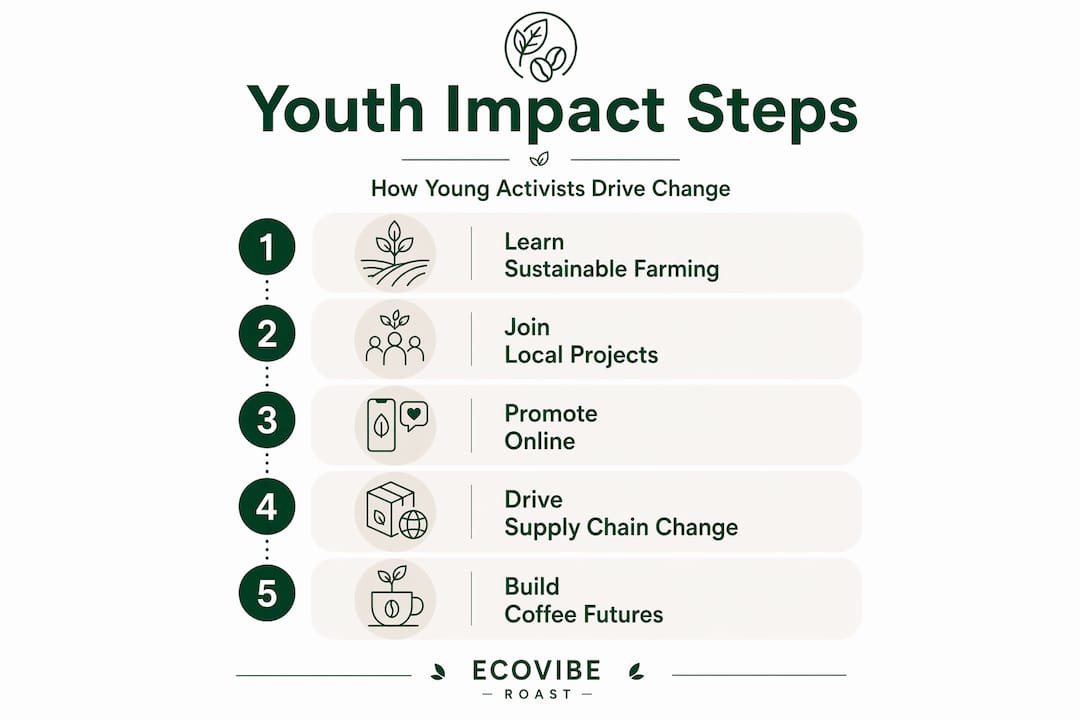
You might assume youth are just waiting in the wings, ready to take over sustainable coffee movements someday. They’re not waiting. The role of youth activism in sustainable coffee is happening right now, and it’s reshaping everything from how beans are grown on steep hillsides in Burundi to how your morning cup is sourced and sold online. Young people are farming with agroforestry techniques, turning coffee grounds into design materials, and using social media to hold brands accountable. This article breaks down exactly how that’s unfolding and what you can do to be part of it.
Table of Contents
- Key takeaways
- The role of youth activism in sustainable coffee farming
- Youth and the coffee waste circular economy
- How digital activism shapes coffee supply chains
- Barriers youth face and ways to break through them
- My honest take on youth and coffee sustainability
- Sip sustainably with Ecoviberoast
- FAQ
Key takeaways
| Point | Details |
|---|---|
| Youth are present changemakers | Young activists are driving real sustainability outcomes in coffee farming and supply chains today, not just in the future. |
| Farming innovation leads the way | Youth-led agroforestry and shade-grown methods protect biodiversity while improving coffee quality and economic returns. |
| Waste becomes opportunity | Youth projects convert coffee grounds into biomaterials, compost, and seed paper, supporting circular economy goals. |
| Digital advocacy creates pressure | Young consumers use social media fluency to push brands toward transparency and traceable sourcing. |
| Structural change still needed | Youth activism is most powerful when it combines grassroots energy with demands for industry-wide accountability. |
The role of youth activism in sustainable coffee farming
When young farmers in Kahaya Village, Indonesia, decided to stay in their rural community instead of migrating to cities, they didn’t just choose farming. They chose a whole new way of farming. Guided by agroforestry principles, youth in Kahaya planted coffee trees under forest canopies, protecting soil health, sequestering carbon, and producing richer, more aromatic beans. Their story is not an exception. It’s a growing model.
Across coffee-growing regions, young farmers are adopting practices that the previous generation often couldn’t afford to prioritize. These include:
- Agroforestry systems that layer coffee plants with native trees, protecting watersheds and bird habitats
- Organic fertilization using composted coffee pulp to replace synthetic inputs and reduce soil degradation
- Shade-grown cultivation that slows bean development for deeper flavor while preserving the tree canopy that supports biodiversity
- Water management techniques that reduce waste during the wet milling process
The Long Miles Coffee Scout program in Burundi takes this further. Youth coffee scouts are trained as agricultural leaders who visit farms, educate neighbors, monitor fermentation, and apply modern sustainable practices at scale. The result is higher yields, better incomes, and measurable environmental improvement. That’s youth impact on coffee sustainability you can trace from seed to cup.
What motivates young farmers to take this path? Economics, honestly. Young farmers adopting shade-grown coffee see improved marketability, better prices from specialty buyers, and stronger community reputations. When sustainability becomes financially smart, more youth stay on the land rather than leaving for cities. That’s one of the most powerful forces behind these sustainable coffee movements.
Pro Tip: If you want to support youth-led farming directly, look for coffee labeled with traceability information, including the farm name and region. That transparency usually signals a direct trade relationship that rewards young farmers fairly.
Youth and the coffee waste circular economy
Here’s something that might surprise you. The grounds left over from your morning brew are quietly becoming one of the most exciting materials in youth-led sustainability projects. Coffee waste, often dismissed as trash, is being transformed by young activists into something genuinely useful.
In South Korea, a youth team converted coffee grounds into filaments for 3D printing and eco-design objects, proving that local creativity can produce industrial materials without corporate budgets. In Japan, similar youth-led projects have pressed used grounds into seed paper and biodegradable packaging. These aren’t science fair experiments. They’re production-scale initiatives aligned directly with the UN Sustainable Development Goals around responsible consumption and climate action.
Here are four ways youth are turning coffee waste into meaningful impact:
- Biomaterial production. Coffee grounds mixed with binding agents create durable, sustainable materials for product design, architecture, and printing. These replace plastics derived from fossil fuels.
- Compost and soil amendment. Used grounds are nitrogen-rich and slightly acidic, making them excellent for community garden compost. Youth groups distribute collected café grounds to urban farms.
- Seed paper and packaging. Ground pulp pressed into sheets embeds seeds that grow when the paper is planted. Youth organizations gift these as awareness tools at events and in schools.
- Hunger alleviation partnerships. Some youth collectives combine coffee waste recycling programs with food security work, using the compost to grow produce in underserved communities.
The deeper achievement here is cultural. Upcycling coffee waste into design and industrial materials leverages local creativity and can shift entire communities toward circular thinking without waiting for corporate leadership. That shift matters enormously for long-term sustainability.
Pro Tip: You can join this movement at home by saving your coffee grounds for garden compost or partnering with a local café to collect theirs. Check out reducing coffee waste for a practical step-by-step approach.
How digital activism shapes coffee supply chains
Young people have a superpower that older generations in the coffee industry did not grow up with: the ability to reach millions of people instantly and authentically. That skill is being applied directly to activism and coffee production accountability in ways that are changing purchasing behavior and pressuring brands to act.

Gen Z’s digital fluency allows young people to serve as climate influencers, connecting consumers in Los Angeles or London directly with the realities of farmers in Ethiopia or Colombia. A single well-produced short video showing a coffee farmer explaining why shade-grown practices matter can move product and shift perception faster than any traditional marketing campaign.
The coffee sustainability and youth engagement happening online looks like this:
- Demand campaigns. Youth-led social media campaigns push roasters and retailers to publish sourcing information, including farm names, country of origin, and whether farmers received fair wages.
- Boycott and praise cycles. Young consumers publicly reward transparent brands and call out those whose supply chains are murky. This creates real commercial pressure.
- Community education. Youth creators publish content explaining the difference between commodity and specialty coffee, what “direct trade” actually means, and why certification labels vary in rigor.
- Farmer amplification. Some youth activists travel to origin or collaborate remotely to give farmers social media platforms of their own, creating direct connections with end consumers.
The challenge is that advocacy must focus on transparency and industry accountability, not just individual purchasing choices. Buying a “sustainable” bag of coffee is meaningful, but it does not fix centuries-old inequities baked into coffee supply chains. Youth activists who combine consumer education with systemic pressure on traceability are doing the most durable work. You can explore what that supply chain transparency looks like in practice and why it matters for every cup you drink.
Barriers youth face and ways to break through them
Youth activism in the coffee sector is genuinely exciting, but it is also genuinely hard. Knowing the obstacles makes you a more effective advocate, not a discouraged one.
| Challenge | Why it exists | Practical path forward |
|---|---|---|
| Economic barriers in farming | Low coffee prices make sustainable practices feel financially risky for young farmers | Link youth farmers to specialty buyers and premium markets that reward quality |
| Rural migration pressure | Young people leave coffee regions for perceived better opportunities in cities | Build agripreneurship models that make farming entrepreneurially appealing |
| Consumer activism ceiling | Individual purchasing choices alone cannot change systemic supply chain issues | Combine consumer pressure with advocacy for policy and industry reforms |
| Lack of training and mentorship | Young activists lack technical knowledge in both farming and advocacy | Invest in youth-led programs like coffee scouts that pair training with leadership |
| Greenwashing confusion | Misleading sustainability claims undermine trust in ethical brands | Support certification standards and demand traceability at point of purchase |
The economic barrier deserves special attention. Economic viability is consistently the biggest reason young people in coffee-growing regions leave farming. Successful models like Kahaya Village and the Long Miles program succeed because they treat youth as entrepreneurs, not charity recipients. They offer training, market access, and pricing that make sustainability financially sustainable too.
There is also the systemic issue. Supply chain practices like fertilizer reduction and coffee waste recycling can cut sector emissions by around 30%, but those gains require industry adoption, not just individual effort. Youth activism pushes that adoption by making the cost of inaction reputationally expensive for big brands. That combination of grassroots energy and industry pressure is where real change lives. You can learn more about supporting sustainable farms in ways that go beyond the cup.
My honest take on youth and coffee sustainability
I’ve spent a lot of time thinking about how change actually happens in the coffee industry, and here is what I keep coming back to: the “youth as future leaders” framing is one of the most quietly damaging ideas in sustainability circles.
When we say young people are the future of sustainable coffee, we accidentally give everyone else permission to keep doing what they’re doing in the present. But the evidence tells a different story. Youth in Burundi are training farmers right now. Youth in Korea are building circular manufacturing models today. Young consumers are reshaping brand behavior this season.
What strikes me most is that youth activism channels eco-anxiety into community engagement and real resilience. This is not a soft benefit. When young activists work on concrete projects like building compost programs or running origin transparency campaigns, they replace helplessness with capability. That psychological shift sustains long-term commitment in ways that awareness-only movements rarely do.
My take: the most powerful thing you can do is stop separating activism from consumption. Every purchase, every share, every demand for traceability is part of the same system. Youth who understand that are not just advocates for sustainable coffee. They are the architecture of the coffee industry’s better version.
— LaSaundra
Sip sustainably with Ecoviberoast
If everything in this article has you ready to put your values into your coffee routine, Ecoviberoast makes that genuinely easy. Every product on the platform is sourced with environmental and social impact in mind, from the farms that grow the beans to the packaging that holds them.

Ecoviberoast’s eco-friendly coffee pods bring together the rich, aromatic experience you want from your daily brew with the responsible sourcing that aligns with everything this community stands for. Each purchase contributes to planting mangrove trees and removing ocean-bound plastics, making every cup a small act of activism. Want to explore more options? Browse the single-serve collection and find your perfect sustainable match. Your morning ritual can be a warm hug for both you and Mother Earth.
FAQ
What is the role of youth activism in sustainable coffee?
Youth activism drives sustainable coffee by combining eco-friendly farming practices, waste recycling initiatives, and digital advocacy that pressures brands toward greater transparency and ethical sourcing. Young people are active contributors to sustainable coffee movements today, not just future participants.
How do young farmers help coffee sustainability?
Young farmers adopt practices like agroforestry, shade-grown cultivation, and organic composting that protect biodiversity, improve soil health, and produce higher-quality beans. Programs like the Long Miles Coffee Scout model show that youth-led agricultural training creates measurable gains in yield, income, and environmental outcomes.
Can buying sustainable coffee actually make a difference?
Purchasing from transparent, ethically sourced brands creates commercial incentives for better farming practices, but it works best when combined with advocacy for traceability and industry reform. Individual consumption choices alone cannot fix structural supply chain inequities, but they are a meaningful part of a larger push for change.
How are youth using social media for coffee sustainability?
Young activists use short-form video, community campaigns, and platform amplification to connect consumers with origin stories, expose unsustainable sourcing, and reward brands that prioritize transparency. This digital fluency makes youth powerful climate influencers in the global coffee conversation.
What are the biggest barriers for youth in coffee activism?
Economic pressure is the top barrier, especially for young farmers in coffee-growing regions where low commodity prices make sustainable practices feel financially risky. Successful models address this by connecting youth with specialty markets, entrepreneurship training, and mentorship programs that make sustainability both viable and rewarding.


