

Transparency in eco labels means one specific thing: clear, verifiable disclosure of what a product actually does for the environment, backed by credible third-party evidence. Not vague promises. Not a leaf logo with no explanation. When a label tells you exactly where your coffee was grown, how farmers were paid, and which independent body confirmed those claims, it functions as a genuine trust signal rather than marketing decoration. Certifications like Fair Trade, USDA Organic, Energy Star, and the Forest Stewardship Council (FSC) have earned consumer confidence precisely because they attach specific, audited criteria to their seals. Research confirms that argument specificity matters more than label source alone, especially for everyday purchases like coffee and tea. Here is what that means for you as a shopper:
- Specific claims build more trust than broad “eco-friendly” labels, because they give you something concrete to evaluate.
- Third-party verification removes the conflict of interest that comes with self-declared green claims.
- Strategic transparency can take two forms: full disclosure for high-performing products, and focused partial disclosure when trade-offs exist, both designed to maintain credibility without overwhelming you.
- Trusted certifications like USDA Organic and FSC operate through documented standards, independent audits, and public criteria you can look up.
Table of Contents
- What are eco-labels, and how do they actually work?
- How transparency in eco labels shapes what you buy
- Benefits of transparency for you and for the brands you support
- Future trends in eco-label transparency and verification
- What the research actually says about trust drivers in eco-label transparency
- How transparency builds green trust over time
- U.S. regulatory standards governing eco-label transparency
- Real-world examples of transparency building consumer trust
- How eco-label transparency claims get verified and audited
- Key Takeaways
- Sip Something You Can Feel Good About
What are eco-labels, and how do they actually work?
Eco-labels are voluntary sustainability certifications that signal a product’s environmental or social performance. They are not government mandates in most cases. Instead, they represent a brand’s commitment to meeting a defined set of criteria, verified by an independent body, and communicated to you through a recognizable seal or mark. Think of them as a shorthand for a much longer conversation about sourcing, production, and impact.
In the U.S. market, four certifications dominate the conversation:
- Fair Trade: Certifies that farmers and workers received fair wages and safe working conditions. For coffee and tea, this often means a guaranteed minimum price that protects growers from volatile commodity markets.
- USDA Organic: Administered by the U.S. Department of Agriculture’s National Organic Program, this label confirms that agricultural products were grown without synthetic pesticides, herbicides, or genetically modified organisms. It carries one of the most rigorous verification processes of any U.S. eco-label.
- Energy Star: A joint program of the U.S. Environmental Protection Agency and the Department of Energy, it certifies that appliances and electronics meet specific energy-efficiency benchmarks, helping you cut both your electricity bill and your carbon footprint.
- Forest Stewardship Council (FSC): Certifies that wood, paper, and packaging products come from responsibly managed forests. For eco-conscious shoppers, seeing FSC on a coffee bag’s packaging is a signal that the supply chain respects biodiversity and forest communities.
How does the certification process actually work? A brand applies to the certifying body, submits documentation about its supply chain and production practices, and then undergoes an on-site audit by an accredited third-party inspector. If the brand passes, it earns the right to display the label. Ongoing compliance requires periodic re-audits, which keeps the label honest over time. The EPA’s introduction to ecolabels describes this ecosystem as a communication tool connecting product performance to consumer decision-making through verified environmental claims. That verification layer is what separates a meaningful eco-label from a self-applied sticker.
How transparency in eco labels shapes what you buy
When you pick up a bag of shade-grown coffee and see a Fair Trade seal, something psychological happens: your skepticism drops. Transparency reduces what economists call information asymmetry, the gap between what a brand knows about its product and what you know as a buyer. The narrower that gap, the more confident you feel making a purchase.
Consumer trust functions as the critical link between a transparent eco-label and your actual decision to buy. Research on sustainable label effectiveness shows that green trust moderates consumer skepticism, turning doubt into assurance when eco-label claims are authentic and reliable. Without that trust, even a well-designed label can feel like noise.
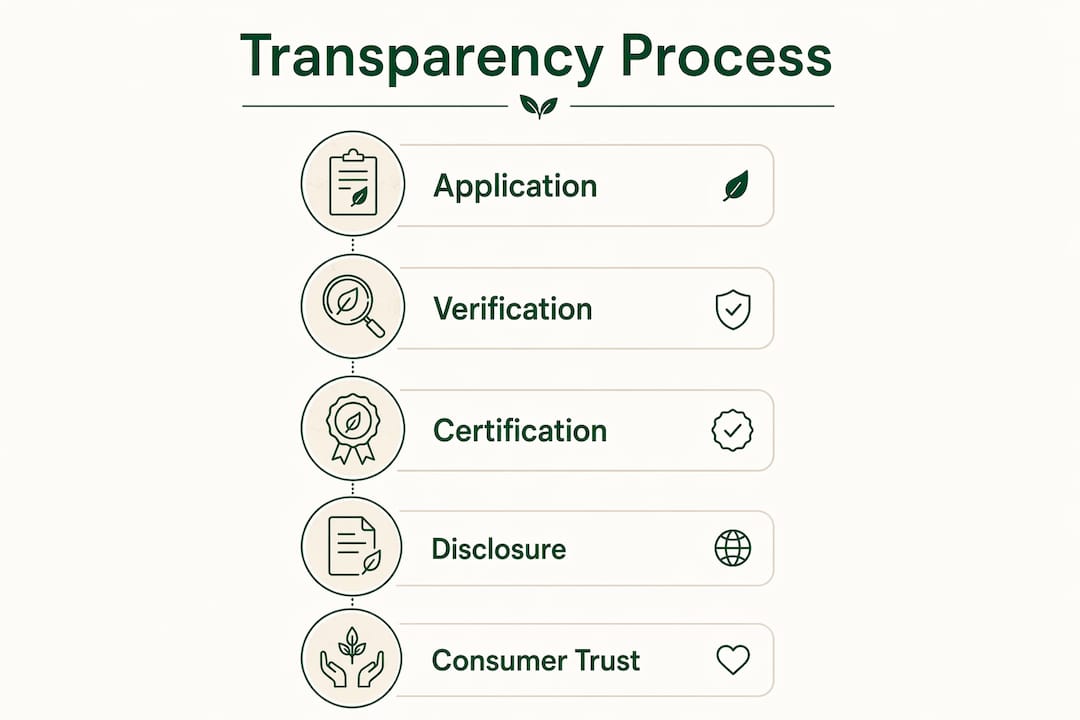
The FTC’s Green Guides (16 CFR Part 260) set the regulatory floor for what transparency must look like in the U.S. market. They require that environmental claims be clear, prominent, and specific enough that a reasonable consumer can understand them without a law degree. Vague terms like “eco-friendly” or “green” are explicitly flagged as problematic because they convey far-reaching benefits that most brands cannot substantiate.
Here is how clarity and specificity play out in practice:
| Transparency Factor | Weak Example | Strong Example |
|---|---|---|
| Claim specificity | “Eco-friendly packaging” | “Packaging made from 80% post-consumer recycled fiber” |
| Verification source | Self-declared seal | FSC-certified by Rainforest Alliance auditors |
| Scope of claim | “Sustainable product” | “Carbon-neutral shipping, certified by Green-e” |
| Accessibility of evidence | No supporting info | QR code linking to full supply chain audit report |
One challenge worth naming: full disclosure does not always land the way brands intend. Overloading you with complex environmental data can actually reduce trust, because it feels overwhelming rather than reassuring. The FTC Green Guides specifically recommend plain language and a focus on the most significant impacts, not an exhaustive inventory of every environmental attribute. Clarity beats comprehensiveness every time.
Benefits of transparency for you and for the brands you support
Transparency in eco-labels creates a two-way win. You get the information you need to shop with confidence. Brands that invest in honest disclosure build something far more durable than a one-time sale.
What transparency does for you as a consumer:
- Reduces greenwashing risk. When a label is backed by third-party audits and specific criteria, you are far less likely to be misled by a brand that simply slapped a leaf on its packaging.
- Supports informed purchasing. Knowing that your coffee is Fair Trade certified means you can connect your morning cup to real outcomes: fair wages for farmers, community investment, and biodiversity protection.
- Builds confidence in product impact. Specific claims, like “every purchase plants a mangrove tree,” give you a tangible reason to feel good about where your money goes.
- Empowers comparison shopping. When labels speak plainly, you can actually compare two products on environmental merit rather than guessing which “green” claim is more meaningful.
What transparency delivers for brands:
- Enhanced credibility. A brand that discloses its supply chain origins and holds third-party certifications signals that it has nothing to hide. That openness attracts loyal customers who return precisely because they trust the brand.
- Differentiation in a crowded market. Eco-labels like “Climate Pledge Friendly” have been shown to boost consumer demand by 13%–14% after adoption, demonstrating that verified transparency translates directly into sales.
- Justification for green premiums. When you can see exactly what a brand does differently, paying a few extra dollars for sustainably sourced coffee pods feels like a fair exchange rather than a marketing tax.
- Regulatory compliance. Brands that align with FTC Green Guides requirements avoid the legal and reputational risk of deceptive environmental claims.
Ecoviberoast puts this into practice by being upfront about where its coffee and tea come from, what certifications its products carry, and what environmental actions each purchase triggers. That kind of eco-labeling transparency in beverages is not just a marketing choice. It is the foundation of a relationship built on shared values.
Future trends in eco-label transparency and verification
The next wave of eco-label transparency is not just about adding more information. It is about making that information verifiable in ways that were impossible five years ago.
Blockchain is the most talked-about technology in this space, and for good reason. By recording each step of a supply chain on an immutable digital ledger, blockchain allows you to trace your coffee beans from a specific farm in Colombia to the roaster to your doorstep, with every transaction timestamped and tamper-proof. A survey of 200 consumers found that blockchain eco-labels generated higher trust and knowledge scores among Generation Y consumers compared to traditional labels. That gap matters as millennials and Gen Z become the dominant purchasing demographic.
Strategic disclosure is another trend reshaping how brands approach transparency. Rather than a binary choice between “tell everything” or “say nothing,” research points toward a more nuanced approach: full disclosure for products with strong environmental performance across the board, and focused partial disclosure for products where trade-offs exist. A brand that honestly says “our packaging is 90% recycled but our shipping is not yet carbon-neutral” builds more credibility than one that either hides the gap or buries you in caveats.
Regulatory momentum is also accelerating. The FTC is actively reviewing the Green Guides, and there is growing pressure from consumer advocacy groups for standardized digital disclosure requirements, including QR codes that link directly to third-party audit reports at the point of sale.
Pro Tip: If you are a brand deciding how much to disclose, start by mapping your product’s strongest environmental attributes and lead with those. Then add context for areas where you are still improving. Consumers respond far better to honest progress than to either silence or perfection claims.
What the research actually says about trust drivers in eco-label transparency
The science behind eco-label trust is more specific than most brands realize, and the findings are worth knowing if you want to shop smarter.
A study with 233 participants found that specific, detailed arguments in eco-label claims increased consumer trust and positive attitude more than the label’s source alone, particularly for low-involvement products like coffee and tea. In other words, a label that explains why a product is sustainable outperforms one that simply displays a recognizable seal. For your morning brew, that means a certification explaining shade-grown practices and biodiversity protection lands harder than a generic “certified sustainable” badge.
Green trust functions as a psychological buffer against skepticism. When eco-label claims are authentic and consistently backed by evidence, green trust reduces consumer doubt and strengthens purchase intention. Think of it as the difference between a friend recommending a product and a stranger doing the same. The more a brand has earned your trust through honest disclosure, the less mental energy you spend second-guessing its claims.
Chemical transparency in product labeling also plays a measurable role. A study with 420 young consumers found that perceived chemical transparency strongly predicted label trust (β=0.611, p<0.001), which in turn shaped green purchase attitude. While that study focused on packaged goods broadly, the principle applies directly to food and beverage: when you know what is in your tea and where it came from, you trust the label more and feel better about buying it.
The FTC’s compliance guidance adds one more layer: brands must disclose material connections to certifying organizations. If a company funds or controls the body that certifies its products, that relationship must be disclosed. Failing to do so is not just an ethical problem. It is a deceptive practice under Section 5 of the FTC Act.
How transparency builds green trust over time
Green trust is not a one-time transaction. It accumulates through repeated, consistent honesty between a brand and its customers. Every time you see a label claim confirmed by an independent audit, every time a brand updates its sustainability report with real numbers, and every time a certification body publishes its criteria publicly, that trust deepens.
The mechanism works in both directions. Brands that maintain transparent eco-labels attract consumers who are already inclined toward sustainable purchasing, and those consumers become advocates who spread the message organically. Brands that cut corners on disclosure, even once, face a disproportionate trust penalty because eco-conscious shoppers tend to research carefully and share what they find.
For products like coffee and tea, where the supply chain spans multiple countries and involves farming communities, processing facilities, and logistics networks, transparency is especially powerful. Knowing that your green certification for coffee and tea covers the full journey from farm to cup gives you a level of confidence that no amount of attractive packaging can replicate. Ecoviberoast’s commitment to disclosing its environmental impact, including mangrove tree planting and ocean-bound plastic removal, is a practical example of how green trust gets built purchase by purchase.
U.S. regulatory standards governing eco-label transparency
The United States does not have a single federal eco-label law, but several overlapping frameworks govern what brands can and cannot claim.
The FTC Green Guides (16 CFR Part 260) are the primary regulatory reference. They do not carry the force of law independently, but the FTC can take enforcement action under Section 5 of the FTC Act against brands whose environmental claims are unfair or deceptive. The Guides cover everything from carbon offset claims to recyclability, compostability, and certifications. Key requirements include:
- Claims must be clear, prominent, and specific.
- Unqualified general claims like “green” or “eco-friendly” are discouraged because they imply benefits that cannot be substantiated.
- Third-party certifications must disclose any material connection between the brand and the certifying body.
- Disclosures cannot be buried in fine print or relegated to a website that consumers are unlikely to visit before purchase.
The USDA National Organic Program (NOP) governs organic claims for agricultural products with a comprehensive regulatory framework. If a product carries the USDA Organic seal, it has met specific production and handling requirements verified by an accredited certifying agent. The FTC explicitly defers to the NOP on organic claims to avoid duplicative or inconsistent guidance.
ISO 14021 provides international standards for self-declared environmental marketing claims. While not legally binding in the U.S., the FTC has harmonized the Green Guides with ISO 14021 where possible, particularly on free-of claims and recyclability. Brands selling in both U.S. and international markets often align with ISO standards as a baseline.
Energy Star operates under a formal partnership between the EPA and the Department of Energy, with product certification requirements that include third-party testing by EPA-recognized laboratories. It is one of the few U.S. eco-labels with a fully public database of certified products and their performance data.
Real-world examples of transparency building consumer trust
Abstract principles become real when you look at what specific certifications have actually accomplished.
Fair Trade USA has documented how its certification model, which requires brands to pay a Fair Trade Premium on top of the commodity price, has directed funds toward community development projects in coffee-growing regions. When a brand displays the Fair Trade seal on its coffee packaging, it is not just making a claim. It is pointing to an audited financial mechanism that you can research independently.
USDA Organic certification for coffee means the beans were grown without synthetic pesticides on land that has been managed organically for at least three years. That specificity matters because it rules out a common greenwashing tactic: calling a product “natural” or “clean” without any enforceable standard behind the claim.
Amazon’s “Climate Pledge Friendly” label offers a more recent data point. After its introduction, products carrying the label saw demand increase by 13%–14%, according to sales data analysis. That figure illustrates something important: transparency does not just feel good. It moves product. Consumers respond to verified claims with their wallets.
Ecoviberoast’s approach to transparency follows a similar logic. By disclosing the specific environmental actions tied to each purchase, including tree planting and plastic removal, and by sourcing from certified suppliers, the brand gives you a concrete story to connect to rather than a vague promise. You can explore how coffee certifications influence purchasing decisions to see how that specificity plays out in practice.

How eco-label transparency claims get verified and audited
Verification is what separates a credible eco-label from a well-designed sticker. The process typically involves three layers.
First-party declarations are the brand’s own claims about its environmental performance. These are the starting point but carry the least weight on their own, because the brand has an obvious interest in presenting itself favorably.
Second-party audits involve a customer, trade association, or industry body reviewing a supplier’s claims. These add some accountability but still involve parties with a shared interest in the outcome.
Third-party certification is the gold standard. An independent, accredited organization with no financial stake in the outcome evaluates the brand against published criteria and issues a certification only if the brand passes. Fair Trade, USDA Organic, FSC, and Energy Star all operate on this model. The certifying bodies themselves are often accredited by national or international accreditation bodies, adding another layer of oversight.

For ongoing compliance, most certification programs require annual or biennial re-audits. FSC, for example, requires annual surveillance audits and a full recertification every five years. USDA Organic certifiers conduct at least one unannounced inspection per year. These requirements mean that a brand cannot simply earn a certification and coast. It has to maintain the practices that earned the label in the first place.
Digital tools are making verification more accessible to you as a consumer. QR codes on packaging can link directly to audit reports, certification databases, and supply chain maps. The FTC has noted, however, that disclosures requiring a consumer to visit a website are not sufficient on their own if the label claim is otherwise misleading. The core disclosure still needs to be clear and prominent at the point of sale. Pairing a transparent label with a digital deep-dive option gives you both the quick signal and the full story, which is exactly the kind of layered transparency that builds lasting green trust. If you want to see what that looks like for sustainable hydration products, sustainable product transparency offers a useful comparison from another eco-conscious category.
Key Takeaways
Transparency in eco labels builds consumer trust by providing specific, verified environmental claims that reduce skepticism and directly increase purchase intention.
| Point | Details |
|---|---|
| Specificity beats source | Detailed eco-label arguments build more trust than a recognizable seal alone, especially for everyday products like coffee and tea. |
| Third-party verification matters | Independent audits from bodies like Fair Trade, USDA Organic, and FSC give eco-label claims the credibility self-declarations cannot. |
| Demand responds to transparency | Products with verified eco-labels like “Climate Pledge Friendly” saw consumer demand rise by 13%–14% after adoption. |
| FTC Green Guides set the floor | U.S. brands must make environmental claims that are clear, prominent, and specific, or risk enforcement action under Section 5 of the FTC Act. |
| Blockchain is reshaping verification | Generation Y consumers rated blockchain eco-labels higher in trust and knowledge than traditional labels in a survey of 200 participants. |
Sip Something You Can Feel Good About

Every cup of coffee or tea you brew is a small decision with a real ripple effect. When you choose products with honest, verified eco-labels, you are not just enjoying an aromatic morning ritual. You are supporting farmers who earn fair wages, forests that stay standing, and oceans that stay cleaner.
Ecoviberoast makes that choice easy. From single-serve coffee pods crafted from responsibly sourced beans to herbal teas like Hibiscus Berry Tea made with organic ingredients, every product comes with the transparency you deserve and the environmental impact you can track. Explore Ecoviberoast’s environmental impact page to see exactly what your purchase does for the planet.


