

TL;DR:
- Eco initiatives in retail focus on reducing environmental footprints while enhancing operational and financial outcomes. They are now vital to supply chain management, store practices, and regulatory compliance, driving long-term profitability and consumer trust. Implementing systemic sustainability strategies creates measurable benefits and positions retailers for future growth.
Eco initiatives in retail are defined as strategic environmental practices that reduce a business’s ecological footprint while delivering measurable operational and financial benefits. The role of eco initiatives in retail has shifted from a feel-good add-on to a core business driver, shaping supply chains, store operations, and consumer loyalty all at once. Retailers who treat sustainability as a system-wide commitment, not a branding exercise, consistently outperform those who treat it as a side project. This guide breaks down exactly how green initiatives work across retail operations, what regulations are reshaping the industry, and why the business case for environmental responsibility has never been stronger.
How do eco initiatives shape retail supply chains?
Sustainable supply chain management is the backbone of effective retail eco initiatives. When retailers embed environmental responsibility into procurement, logistics, and packaging decisions, they reduce costs and carbon emissions at the same time. Green procurement capabilities, both technology-driven and relationship-oriented, give retailers a durable competitive edge that pure price competition cannot replicate.

Circular logistics is one of the most underused tools in retail sustainability. Reverse logistics networks, where returned or end-of-life products flow back through the supply chain for reuse or recycling, cut landfill waste and recover material value. Retailers who use local suppliers also shorten transport routes, which reduces fuel consumption and delivery emissions without sacrificing product quality.
Sustainable sourcing goes beyond choosing recycled packaging. It means setting supplier codes of conduct, auditing for fair wages and biodiversity protection, and building long-term relationships with growers who practice shade-grown or regenerative agriculture. These relationships create supply chain resilience, because ethical suppliers are less likely to face sudden regulatory shutdowns or reputational crises.
Key supply chain eco practices that deliver real results include:
- Route optimization to cut fuel use and delivery emissions
- Packaging weight reduction to lower material costs and shipping weight
- Supplier environmental audits to manage upstream risk
- Reverse logistics programs to recover and reuse returned goods
- Consolidated shipments to reduce the number of trips per delivery cycle
Pro Tip: Map your supply chain’s carbon hotspots before investing in new technology. Most retailers find that 70–80% of their supply chain emissions come from just two or three sourcing or logistics decisions, making targeted action far more cost-effective than broad programs.
What eco-friendly store practices most influence consumer purchasing behavior?
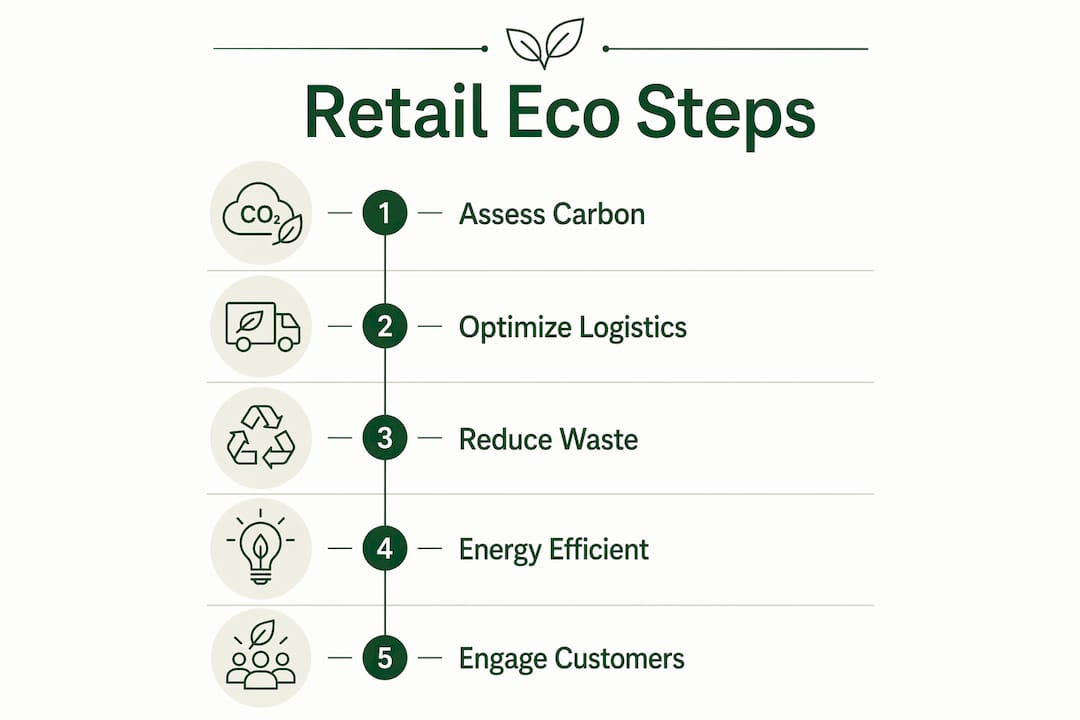
Store-level sustainability practices directly shape how consumers feel about a brand and whether they return. Sustainability drives long-term profitability by improving both customer engagement and tenant retention, which means the benefits compound over time. Consumers who see visible eco commitments in-store, such as recycling stations, energy-efficient lighting, and compostable packaging, are more likely to trust the brand and spend more per visit.
Energy-efficient store design is one of the highest-impact changes a retailer can make. Retail is the largest energy-using sub-sector in Europe’s wholesale and retail trade, which means even modest efficiency gains translate into significant cost savings and emissions reductions. LED lighting, smart HVAC systems, and solar panels on store rooftops are no longer premium investments. They are standard tools for staying competitive.
Certification programs like EMAS (Eco-Management and Audit Scheme) give retailers a structured way to verify and communicate their sustainability progress. EMAS enables retailers to customize environmental targets, coordinate multi-site compliance, and publish verified sustainability statements that build genuine consumer trust. That third-party verification matters because consumers are increasingly skeptical of unverified green claims.
Store practices that most influence eco-conscious consumer decisions include:
- Transparent sustainability labeling on products and packaging
- In-store recycling and take-back programs for packaging and products
- Compostable or minimal packaging at point of sale
- EMAS or equivalent certification displayed prominently
- Renewable energy use communicated clearly in-store and online
What regulatory frameworks are driving retail sustainability?
Regulation is the single most powerful accelerator of retail sustainability investment. The EU’s Circular Economy Action Plan and Retail Transition Pathway will invest up to €600 billion by 2030, targeting packaging, food waste, energy efficiency, and textiles across the retail sector. That level of public and private capital commitment signals a structural shift, not a temporary trend.
Extended Producer Responsibility (EPR) schemes are reshaping how retailers think about packaging. Under EPR, retailers bear financial responsibility for the end-of-life management of the packaging they put on the market. This creates a direct financial incentive to reduce packaging weight, switch to recyclable materials, and design for disassembly from the start.
| Regulatory Framework | Primary Target | Retail Impact |
|---|---|---|
| EU Circular Economy Action Plan | Packaging, food waste, textiles | Mandatory waste reduction and reporting |
| Extended Producer Responsibility | Packaging end-of-life costs | Financial incentive to minimize packaging |
| EMAS Certification | Environmental management systems | Verified sustainability reporting |
| EU Packaging Waste Regulation | Single-use plastics and recyclability | Material substitution requirements |
Corporate ESG adoption has also proven its environmental effectiveness at scale. A study across 15 OECD countries over 20 years confirmed a causal link between ESG adoption and improved national environmental outcomes. Retailers who build ESG frameworks now are positioning themselves ahead of mandatory reporting requirements that are expanding across major markets.
Pro Tip: Treat regulatory requirements as innovation signals, not compliance burdens. Retailers who redesign packaging or logistics ahead of a regulation deadline consistently find cost savings that more than offset their early investment.
How does economic uncertainty affect green investment in retail?
Economic policy uncertainty is the most underappreciated obstacle to retail sustainability. Green finance positively influences corporate environmental performance, but that positive effect weakens significantly when economic policy is unstable. Firms facing uncertain policy environments delay sustainability investments, which creates a gap between stated commitments and actual progress.
Environmental investments are capital intensive and long-term by nature. A new solar installation, a fleet of electric delivery vehicles, or a full packaging redesign all require upfront capital with payback periods measured in years, not quarters. That time horizon makes these investments sensitive to interest rate changes, subsidy availability, and regulatory stability.
Retailers can use several adaptive strategies to manage this uncertainty:
- Phased investment plans that spread capital outlay over multiple budget cycles
- Green bond financing to access dedicated sustainability capital at favorable rates
- Pilot programs that test eco initiatives at small scale before full rollout
- Policy monitoring teams that track regulatory changes and adjust investment timing accordingly
- Supplier co-investment agreements that share the cost of sustainability upgrades across the value chain
The retailers who maintain momentum through economic uncertainty are those who treat sustainability as a cost-reduction strategy, not just an environmental one. When a packaging redesign saves material costs, or a route optimization cuts fuel spend, the investment pays back regardless of policy conditions. Framing eco initiatives in financial terms protects them from budget cuts when conditions tighten.
Key Takeaways
Retailers who embed eco initiatives across supply chains, store operations, and procurement consistently achieve better financial and environmental outcomes than those who treat sustainability as a standalone project.
| Point | Details |
|---|---|
| System-wide integration wins | Embedding circularity across logistics, waste, and procurement delivers results that siloed projects cannot match. |
| Store practices build loyalty | Energy efficiency, EMAS certification, and transparent labeling directly improve consumer trust and repeat purchases. |
| Regulation accelerates investment | EU frameworks like the Circular Economy Action Plan and EPR schemes create financial incentives to act before deadlines. |
| Policy uncertainty delays progress | Stable policy environments maximize the effectiveness of green finance and long-term sustainability investment. |
| Financial framing protects budgets | Eco initiatives framed as cost-reduction tools survive economic downturns better than those framed as purely environmental. |
Why I think most retailers are still thinking too small about sustainability
I’ve watched retail sustainability programs come and go for years, and the pattern is almost always the same. A retailer launches a recycling program, gets some good press, and calls it a day. The real opportunity, the one most teams miss, is system-wide integration.
El Corte Inglés is the example I keep coming back to. By embedding circularity across logistics and waste management, they recovered over 100,000 tonnes of material and prevented 61,000 tonnes of CO2 emissions. That is not the result of a recycling bin in the break room. That is the result of treating sustainability as an operational discipline, the same way you would treat inventory management or quality control.
The other thing I’d push back on is the idea that eco initiatives are a luxury for large retailers. The circular economy guide for coffee and tea shows that even small beverage retailers can apply packaging optimization and responsible sourcing at meaningful scale. The tools exist. The regulatory signals are clear. What’s missing for most retailers is the willingness to commit to incremental, consistent progress rather than waiting for a perfect moment that never arrives.
My honest advice: pick one supply chain node, measure its environmental impact, fix it, and document the cost savings. Then use that proof to fund the next project. Sustainability built on financial evidence is far more durable than sustainability built on good intentions.
— LaSaundra
Ecoviberoast: sustainability you can taste in every cup
Ecoviberoast puts the principles in this article into practice with every order. Each product is responsibly sourced, and every purchase contributes to planting mangrove trees and removing ocean-bound plastics from coastlines.

If you want to experience what environmental responsibility tastes like, the Hibiscus Berry Tea is a rich, aromatic place to start. It is organic, ethically sourced, and packaged with sustainability in mind. You can also read more about Ecoviberoast’s environmental impact efforts, including tree planting and plastic pollution reduction, to see exactly where your purchase goes. Choosing Ecoviberoast is a warm hug for both you and Mother Earth, one sip at a time.
FAQ
What is the role of eco initiatives in retail?
Eco initiatives in retail are strategic environmental practices that reduce waste, lower carbon emissions, and improve operational efficiency. They also build consumer trust and support regulatory compliance, making them a core business strategy rather than an optional add-on.
How do eco initiatives affect consumer purchasing decisions?
Consumers are more likely to buy from retailers who demonstrate visible sustainability commitments, such as EMAS certification, eco-friendly packaging, and in-store recycling programs. Sustainability drives long-term customer loyalty and repeat purchases.
What regulations are shaping retail sustainability in 2026?
The EU Circular Economy Action Plan, Extended Producer Responsibility schemes, and the EU Packaging Waste Regulation are the primary frameworks shaping retail sustainability. Together, they target packaging reduction, food waste, energy efficiency, and textiles across the retail sector.
How do eco-friendly retail strategies reduce costs?
Sustainable practices like route optimization, packaging weight reduction, and energy-efficient store design cut operational costs directly. Retailers who frame eco initiatives as cost-reduction tools protect those investments even during economic downturns.
What is EMAS and why does it matter for retailers?
EMAS is the EU’s Eco-Management and Audit Scheme, a voluntary environmental management system that helps retailers set targets, verify progress, and publish credible sustainability statements. It builds consumer trust by providing third-party verification of environmental claims.


