

TL;DR:
- Women make up a significant portion of the supply chain workforce, but their leadership remains underrepresented. When women hold senior sourcing roles, they prioritize sustainability and social responsibility, positively influencing supplier standards. Overcoming structural barriers requires deliberate policies, grassroots investments, and inclusion of women in decision-making to improve ethical sourcing outcomes.
The role of women in ethical sourcing defines how supply chains become more sustainable, equitable, and accountable. Women make up 40% of the global supply chain workforce and up to 80% of workers in labor-intensive sectors like garment production. Yet their leadership, land rights, and voices in governance remain severely underrepresented. Understanding where women stand today, what barriers hold them back, and how organizations can close that gap is the foundation of any serious ethical sourcing initiative. This guide covers all three, drawing on 2026 research and feminist ethics frameworks to give you a complete picture.
How women shape ethical and sustainable supply chain decisions
Women in supply chain leadership do not just fill seats. They change how decisions get made. A study of 612 supply chain professionals found that female managers prioritize sustainable products more consistently than their male counterparts and show higher risk-taking in ambiguous procurement situations. That combination matters because ethical sourcing requires both a commitment to sustainability goals and the willingness to act under uncertainty.

Female leaders in supply chains also integrate corporate social responsibility (CSR) into sourcing decisions at a higher rate. Where male-dominated procurement teams often treat CSR as a compliance checkbox, women in sourcing roles tend to treat it as a core evaluation criterion. This shows up in supplier selection, contract terms, and audit priorities.
The impact of women in ethics extends beyond individual decisions. When women hold senior procurement roles, they model a culture where social and environmental standards are non-negotiable. That cultural shift ripples through entire supplier networks, raising baseline expectations for fair wages, safe conditions, and environmental care.
- Women in senior sourcing roles push suppliers toward stronger labor protections.
- Female procurement managers are more likely to flag social risks early in supplier assessments.
- Gender-diverse sourcing teams produce more thorough due diligence because they bring different lived experiences to risk evaluation.
- Women’s empowerment in sourcing correlates with better supplier relationship management and longer-term partnerships.
Pro Tip: If your organization wants to improve ethical sourcing outcomes, audit who sits on your procurement decision panels. Adding women at the evaluation stage, not just in support roles, directly improves the quality of social and environmental risk assessments.
What barriers do women in ethical sourcing roles face?
Women’s contribution to ethical trade is enormous, but the structural conditions they work within often erase that contribution. Women own less than 1% of land in key agricultural supply regions despite doing the majority of harvesting work. That legal invisibility means they rarely appear in ESG reporting, supplier databases, or certification audits. Companies that rely on documentation alone miss the women doing the actual work.
The challenges faced by women in sourcing go well beyond land ownership. Here are the four most persistent structural barriers:
- Wage and role disparities. Women cluster in lower-paid, lower-skilled positions even in sectors where they form the majority of the workforce. Representation does not equal equity when the pay gap and role ceiling remain intact.
- Invisible labor. Women working informally without contracts or land rights do not show up in standard supply chain mapping. Certifications like Fair Trade or Rainforest Alliance help but do not fully capture informal female labor.
- Male-centric grievance systems. Gender-neutral reporting policies fail women because women are significantly less likely to report harassment or wage theft through committees dominated by men. The mechanism itself creates a barrier.
- Leadership pipeline gaps. Organizational culture in procurement and trading often rewards long hours, geographic mobility, and aggressive negotiation styles. Those norms disadvantage women with caregiving responsibilities and push talented candidates out of the pipeline.
“Women’s lived experiences in supply chains are not edge cases. They are the data that most ethical sourcing frameworks are currently missing. Until grievance systems, land rights, and labor visibility are redesigned with women at the center, gender-neutral policies will keep producing gender-unequal outcomes.”
The feminist ethics framework offers a useful lens here. It argues that corporate governance must shift from hierarchical, profit-first models to relational, care-based ones. That shift does not happen through policy statements. It requires structural redesign at the governance level, including who sits on sourcing committees, who conducts field assessments, and whose testimony counts in audits.
Practical strategies to strengthen women’s leadership in sourcing
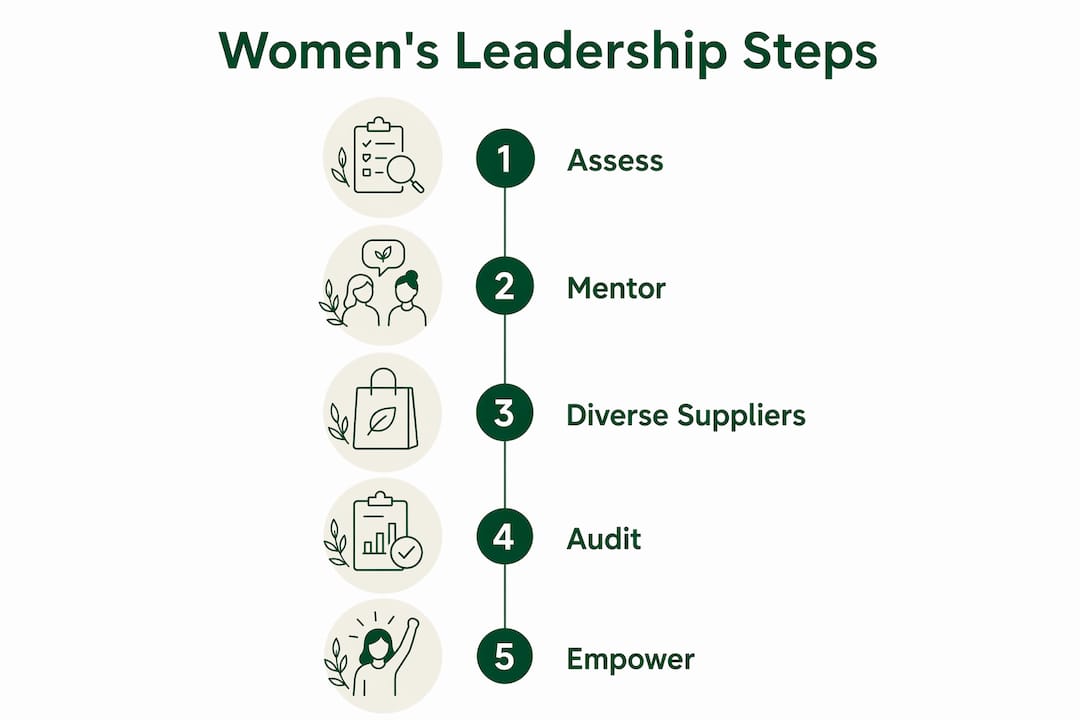
Organizations serious about gender equality in sourcing need concrete programs, not aspirational language. The strategies below are evidence-backed and applicable across industries, from coffee and tea supply chains to garment and food production.
| Strategy | What it involves | Why it works |
|---|---|---|
| Supplier diversity programs | Actively source from women-owned businesses | Improves supply chain resilience and creates economic pathways for women entrepreneurs |
| Women-only grievance channels | Separate reporting lines assessed by female auditors | Women report issues at significantly higher rates when male gatekeepers are removed |
| Peer mentorship networks | Structured internal mobility programs connecting women across sourcing, tech, and trading roles | Reduces burnout and accelerates career growth into leadership |
| Grassroots self-help groups | Community-level investment in women’s economic collectives | Reaches informal workers invisible to standard audits |
| Gender-sensitive field assessments | On-site evaluations conducted by female assessors | Surfaces labor conditions that male-led audits routinely miss |
Supplier diversity programs deserve special attention. Including women-owned businesses in your sourcing mix is not just a social good. It actively diversifies your supply base, which reduces single-source risk and improves resilience when disruptions hit. You can read more about how women drive coffee production at the farm level to see how this plays out in practice.
Peer mentorship networks are equally powerful. Women in sourcing careers often face isolation, especially when they are the only woman in a trading or procurement team. Structured networks that connect women across departments, including moves from sustainability roles into technical procurement or AI-driven supply chain management, speed up career growth and keep talented women in the industry. The local sourcing movement also creates natural entry points for women-led suppliers, particularly in food and beverage.
Pro Tip: When designing a mentorship program for women in sourcing, prioritize cross-functional pairings. A woman in a sustainability role paired with a senior trading director gains visibility and skills that a same-function mentor cannot provide.
Why gender-inclusive sourcing leadership produces better business outcomes
The business case for women’s empowerment in sourcing is not soft. It is measurable. Female CEOs produce about 95% higher CSR scores than male CEOs. That gap reflects moral and cultural imprints shaped by lived experience, including exposure to disasters, traditional community values, and caregiving roles that build relational accountability. Those same qualities translate directly into stronger ethical sourcing governance.
The risks of excluding women from sourcing leadership are equally concrete:
- Algorithmic blind spots. Homogeneous, male-dominated procurement teams produce AI and data systems with embedded gender and racial bias. Women’s involvement in technical procurement roles improves ethical design and catches bias before it scales.
- Weaker due diligence. Teams without gender diversity miss the social risks that female workers are most likely to experience, including harassment, wage theft, and unsafe conditions.
- Lower supplier trust. Women-majority workforces in supplier facilities respond better to female-led assessments, producing more accurate and honest reporting.
- Missed innovation. Gender-diverse sourcing teams generate more varied supplier relationships and sourcing strategies, which improves both resilience and creativity.
The feminist ethics of care framework, applied to boardroom governance, argues that relational and care-based decision-making produces more sustainable outcomes than hierarchical profit-first models. That is not a philosophical abstraction. It shows up in how female-led organizations handle supplier disputes, environmental commitments, and community investment. The 2026 sustainability trends in coffee reflect exactly this shift, with women’s leadership emerging as a key driver of ethical sourcing decisions across the industry.
Key Takeaways
Women’s leadership in ethical sourcing produces measurably better CSR outcomes, stronger due diligence, and more resilient supply chains when structural barriers are actively removed.
| Point | Details |
|---|---|
| Women dominate supply chain labor | Women make up 40% of the global workforce and up to 80% in labor-intensive sectors, yet remain in lower-paid roles. |
| Female leaders prioritize sustainability | Studies show female supply chain managers consistently prioritize sustainable products and flag social risks earlier. |
| Invisible labor is a real gap | Women own less than 1% of land in key agricultural regions, making their labor invisible to standard ESG audits. |
| Grievance systems need redesign | Gender-neutral reporting policies fail women; dedicated female-only channels produce significantly higher reporting rates. |
| Gender diversity improves business outcomes | Female CEOs score about 95% higher on CSR metrics, and diverse teams reduce algorithmic bias in procurement AI. |
What I’ve learned watching women reshape ethical sourcing
By LaSaundra
The data on women in sustainable sourcing is striking, but the part that stays with me is the invisibility problem. We have entire certification systems built on documentation, and the women doing the most physically demanding work in coffee and tea supply chains often hold no documents at all. No land title, no formal contract, no name in a supplier database. The audit passes. The woman is not counted.
What I find genuinely encouraging in 2026 is the shift toward grassroots investment. Organizations that fund women’s self-help groups at the community level are reaching workers that no certification body ever will. That is not a workaround. That is the actual solution.
The feminist ethics of care framework is also gaining traction in boardrooms, and I think that matters more than most people realize. When governance shifts from “what is the most profitable decision” to “who does this decision affect and how,” sourcing practices change at the root. Female leaders are not just better at CSR scores. They ask different questions from the start.
My honest observation is that the organizations making the most progress are not the ones with the best gender diversity policies on paper. They are the ones where women hold real decision-making authority in procurement, not just advisory or sustainability roles. That distinction is everything.
— LaSaundra
Ecoviberoast’s commitment to women-led ethical sourcing
Ecoviberoast sources its coffee with women farmers and ethical supply chains at the center of every decision. Every bag and pod connects you to producers who receive fair wages, work in safe conditions, and are supported by community investment programs that reach informal workers too.

When you choose Ecoviberoast’s single-serve coffee pods, you are supporting a supply chain that plants mangrove trees, removes ocean-bound plastics, and actively works to make women’s labor visible and valued. That aromatic cup in your hand is a warm hug for both you and the women who grew it. You can also learn more about supporting sustainable farms to deepen your impact beyond the purchase.
FAQ
What is the role of women in ethical sourcing?
Women in ethical sourcing contribute as frontline agricultural workers, procurement managers, and executive leaders who prioritize sustainability and social responsibility. Their involvement at every level improves labor standards, CSR outcomes, and supply chain resilience.
Why are women underrepresented in sourcing leadership?
Women face wage gaps, male-centric grievance systems, and organizational cultures that reward mobility and aggressive negotiation styles. These structural barriers push women out of leadership pipelines despite their strong presence in the broader workforce.
How does gender diversity improve ethical sourcing outcomes?
Female CEOs score about 95% higher on CSR metrics than male CEOs, and gender-diverse procurement teams produce stronger due diligence by catching social risks that homogeneous teams miss.
What is the invisible labor problem in supply chains?
Women do most of the harvesting in key agricultural regions but own less than 1% of the land, making them invisible in ESG reports and supplier audits. Addressing this requires grassroots investment beyond standard certification programs.
What practical steps can organizations take to support women in sourcing?
Organizations can implement supplier diversity programs, create women-only grievance channels, fund peer mentorship networks, and invest in grassroots self-help groups to reach informal workers who fall outside standard audit frameworks.


