

TL;DR:
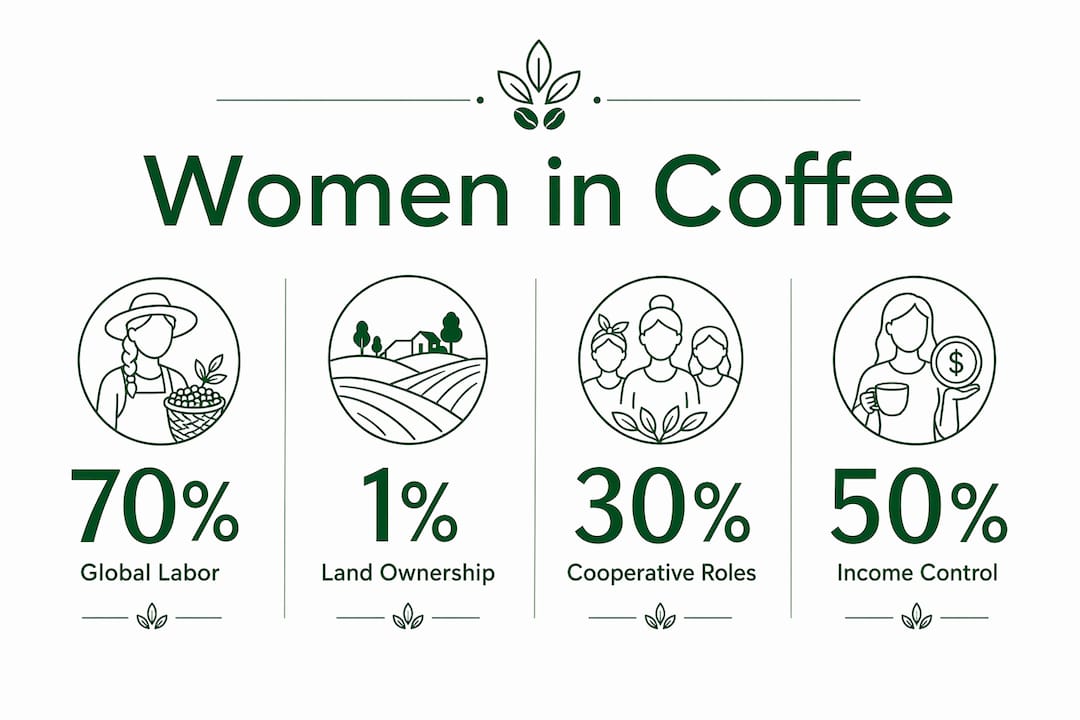
- Women perform approximately 70% of global coffee labor but own as little as 1% of land, highlighting the need for structural reform. Targeted programs and consumer support can help close the ownership and decision-making gaps, empowering women and benefiting communities. Genuine change requires measuring profit share and board participation, not just participation metrics.
Women are the backbone of global coffee production, performing around 70% of labor across farms in Africa, Latin America, and Asia, yet they own a fraction of the land they work and control even less of the profit. This gap between labor contribution and economic reward is the defining tension in gender roles in coffee today. Understanding it means looking beyond harvest season photos and into the structural systems that shape who benefits from your morning cup. From the International Coffee Organization’s data to on-the-ground studies in Rwanda and Uganda, the evidence is clear: female coffee farmers are the industry’s most undervalued asset.
What is the role of women in coffee production?
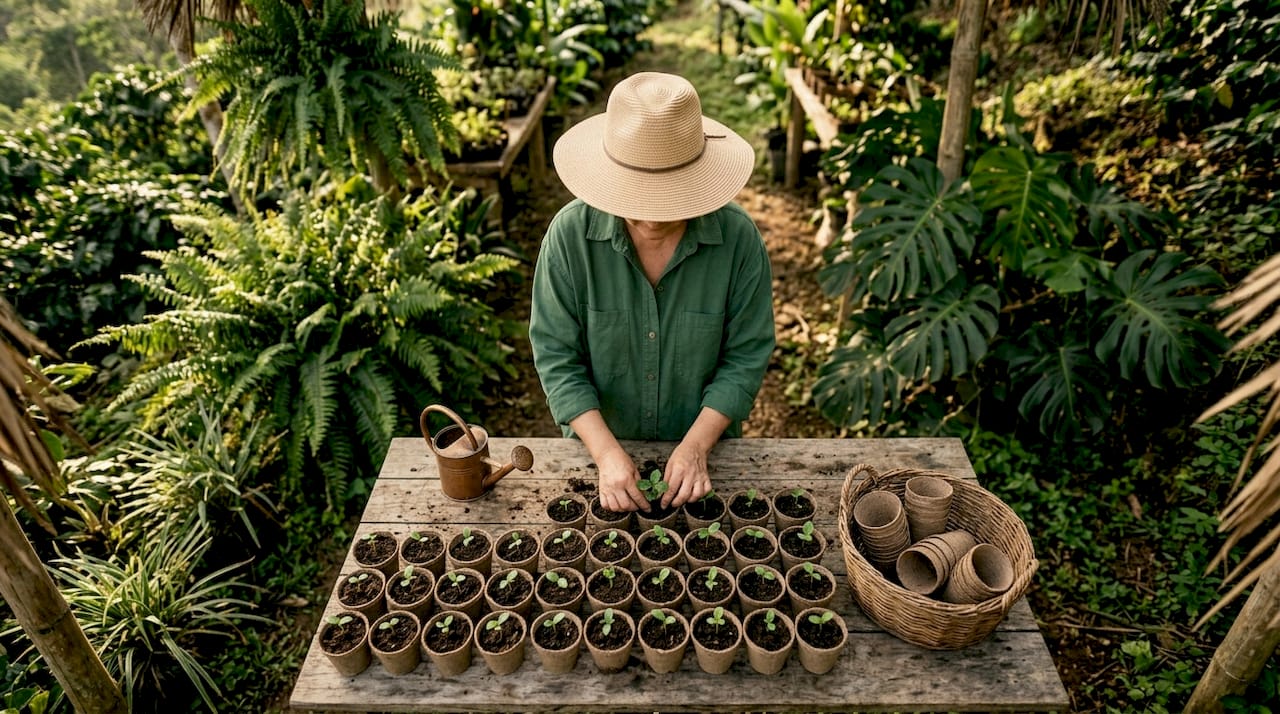
Women in coffee production are the primary labor force across every physical stage of growing and processing coffee, from seedling to export-ready bag. The International Labour Organization and researchers at Soroptimist International both confirm that women perform most tasks in smallholder coffee farming globally. That means the aromatic, rich coffee you brew each morning almost certainly passed through a woman’s hands multiple times before reaching you. Yet despite this central role, women’s contributions to coffee are rarely reflected in ownership records, cooperative leadership rosters, or income statements.
The coffee value chain is long, and women show up at nearly every link. In Colombia, women manage nurseries and apply fertilizers while men handle transport and sales. In Rwanda, female household heads coordinate harvest teams and oversee drying beds. The division of labor is real and significant, but it is not matched by an equal division of decision-making power or financial reward. Recognizing this gap is the first step toward changing it.
What tasks do women perform across the coffee value chain?
Women’s contributions to coffee span a wider range of tasks than most consumers realize. Here is where female coffee farmers show up most consistently:
- Planting and nursery management: Women prepare seedbeds, transplant seedlings, and monitor early plant health, often handling the most time-intensive early-stage work.
- Weeding and pest control: Regular maintenance of coffee plots falls heavily on women, including manual weeding and applying organic or chemical treatments where available.
- Harvesting ripe cherries: Selective hand-picking of ripe cherries is one of the most labor-intensive tasks in specialty coffee, and women perform the majority of this work across East Africa and Central America.
- Sorting and processing: Post-harvest sorting, washing, and drying are predominantly women’s work. In Rwanda and Ethiopia, women sort cherries by hand at washing stations, directly affecting cup quality.
- Cooperative participation: Women attend cooperative meetings and contribute labor to collective farms, though their formal leadership roles remain limited in most regions.
The variation by region matters. In Uganda, women on larger estates often specialize in processing, while on smallholder plots they manage the entire production cycle. In Colombia, women-led cooperatives like those supported by programs tied to the Specialty Coffee Association have demonstrated that when women control processing decisions, quality scores improve. That is not a coincidence. It reflects the depth of knowledge women accumulate through years of hands-on work.
Pro Tip: When you buy a bag of coffee labeled “women-produced” or sourced from a women-led cooperative, check whether the certification covers processing and governance, not just harvest labor. That distinction tells you whether women are truly in control of the value chain.
What structural barriers limit women’s leadership in coffee?
The most striking fact in gender analysis of coffee is this: women own as little as 1% of land in some coffee-producing regions, despite performing the majority of farm labor. In Kenya, Margaret Nyamumbo’s observations confirm that women contribute extensively to production but rarely hold title to the land they cultivate. This ownership gap is not a cultural footnote. It is the root cause of nearly every other disparity in the coffee sector.
| Barrier | Impact on women coffee farmers |
|---|---|
| Limited land ownership | Prevents use of land as collateral for loans or investment |
| Restricted credit access | Blocks purchase of inputs, tools, and improved seedlings |
| Exclusion from training | Reduces access to agronomic knowledge and yield improvements |
| Cultural norms in governance | Limits women’s votes and leadership roles in cooperatives |
| Profit distribution gaps | Men often receive cooperative payments even when women do the work |
Research from the University of Illinois found that female household heads in Rwanda face compounding barriers: limited access to land, labor, inputs, and finance, often forcing them to prioritize immediate food security over long-term coffee investment. This is not a failure of ambition. It is a rational response to constrained resources and unreliable cash flow timing.
An Oxfam gender analysis of Uganda’s coffee sector found that certification programs may favor men unless gender considerations are built into every stage of production and monitoring. Fair Trade and organic certifications are valuable tools, but they do not automatically redistribute power. A cooperative can earn a Fair Trade premium and still route all payments through male household heads.
“Meaningful empowerment requires measuring land ownership, credit access, board representation, and profit share, not just labor participation.” — Soroptimist International, 2026
This distinction between participation and power is the most important concept in coffee production and gender equality today. Counting women at meetings is not the same as counting women in governance. The industry needs both metrics, and it needs to act on both.
How are empowerment initiatives addressing gender inequality in coffee?
The good news is that targeted programs are producing measurable results. Here are the most effective approaches currently reshaping gender roles in coffee:
-
Women-led cooperative sourcing commitments: Pact Coffee announced in March 2026 that it sources 100% of its core range from women or gender-equity groups, partnering with Waitrose to bring women-led coffee to mainstream retail. This model proves that sourcing commitments can scale without sacrificing quality.
-
Targeted training programs: Agronomic training designed specifically for women, delivered at times and locations that fit around household responsibilities, increases both yield and confidence. Generic training sessions scheduled during school hours or harvest peaks exclude the women who need them most.
-
Cooperative leadership development: Programs in Rwanda and Ethiopia that reserve board seats for women have shown that female leadership correlates with more equitable profit distribution across the cooperative. Leadership is not just symbolic. It changes who controls the money.
-
Access to finance and inputs: Microfinance products tailored to women coffee farmers, with repayment schedules aligned to harvest cycles, address the cash flow timing problem that prevents women from investing in pesticides and quality inputs. World Coffee Research supports on-ground R&D that addresses agronomic constraints directly relevant to smallholder women farmers.
-
Gender integration across the value chain: An Oxfam study confirms that gender equality must be integrated at every stage of production and value chain governance, not added as an afterthought to existing certification frameworks. This aligns directly with the United Nations Sustainable Development Goal 5 on gender equality and SDG 8 on decent work.
Pro Tip: Look for coffee brands that publish gender equity data alongside environmental certifications. A brand that tracks women’s board representation and profit share in its supply chain is doing the real work, not just the marketing.
The impact of women in coffee extends well beyond the farm gate. When women control their income, research consistently shows that more of it flows into household nutrition, children’s education, and community health. Empowering female farmers creates a multiplier effect that benefits entire communities, not just individual households.
How can you support women in coffee production?
Your purchasing decisions carry real weight in the coffee supply chain. Here is how to put that weight behind women farmers:
- Choose women-led or gender-equity certified coffees. Look for labels from organizations that verify women’s governance roles, not just labor participation. Brands sourcing from cooperatives with documented female leadership are your best signal.
- Support ethical and fair-trade sourcing practices. Ethical sourcing in coffee means tracing where premiums go and whether they reach women. Ask brands directly if you cannot find the answer on their website.
- Back programs focused on land, credit, and education. Organizations like Oxfam, the International Women’s Coffee Alliance, and World Coffee Research fund programs that address the root causes of women’s exclusion. Donating or amplifying their work matters.
- Promote women’s agency in cooperatives. When you share content about coffee cooperatives and their role in ethical sourcing, you help normalize the idea that women belong in leadership, not just in the field.
- Ask your favorite coffee brand about its gender equity practices. Consumer pressure is one of the fastest ways to shift sourcing priorities. Brands that hear this question repeatedly start building the answer into their supply chain strategy.
Supporting sustainable coffee farms run by or benefiting women is one of the most direct ways to connect your daily ritual to positive social change. The coffee in your cup has a story. You get to choose which stories you amplify.
Key takeaways
Women perform approximately 70% of coffee labor globally but own as little as 1% of land in some regions, making structural reform, not just participation metrics, the true measure of gender equity in coffee.
| Point | Details |
|---|---|
| Women dominate coffee labor | Female farmers perform around 70% of global coffee production tasks, from planting to processing. |
| Ownership gap is the core problem | Women own as little as 1% of land in some regions, blocking credit access and profit control. |
| Certification alone is not enough | Fair Trade and organic programs can unintentionally favor men without explicit gender integration. |
| Targeted initiatives work | Pact Coffee’s 100% women-sourced range and cooperative leadership programs show scalable models. |
| Consumer choices matter | Buying from women-led cooperatives and asking brands about gender equity data drives real change. |
Why the numbers alone won’t fix this
I have spent years reading supply chain reports and talking to people who work in ethical sourcing, and here is what I keep coming back to: the coffee industry is very good at counting women and very bad at empowering them. Participation numbers go up, press releases get written, and the land ownership figures barely move.
The programs I find most credible are the ones that start with household realities, not industry targets. A training program that ignores the fact that a woman is also managing childcare, food preparation, and water collection is not a gender program. It is a scheduling problem dressed up as empowerment. The Rwanda research from the University of Illinois captures this perfectly: investment hesitancy among women farmers is linked to risk assessment and cash flow timing, not lack of initiative. That reframe matters enormously.
What gives me genuine optimism is the shift toward measuring profit share and board representation alongside labor participation. When Pact Coffee commits to sourcing entirely from women or gender-equity groups, that is a structural commitment, not a marketing line. It changes the incentive structure for every cooperative in their supply chain. More brands need to follow that model, and more consumers need to demand it.
— LaSaundra
Sip with purpose: Ecoviberoast’s commitment to women in coffee
Every cup you brew is a small vote for the kind of coffee industry you want to exist. At Ecoviberoast, that vote is cast for farmers who deserve fair wages, land rights, and a real seat at the table.

Ecoviberoast sources its coffee with sustainability and social impact at the center, connecting you to cooperatives where women’s contributions are recognized and rewarded. The 60-pack single-serve coffee pods make it easy to enjoy rich, aromatic coffee every morning while supporting ethical sourcing practices that benefit female farmers. Explore the full single-serve collection and find a coffee that feels as good as it tastes, for you and for the women who grew it.
FAQ
What percentage of coffee labor do women perform globally?
Women perform around 70% of labor in coffee production globally, covering tasks from planting and harvesting to sorting and processing, yet they control a small fraction of land and income.
Why do female coffee farmers have less income despite doing most of the work?
Women typically lack land ownership, which prevents them from accessing credit or receiving cooperative payments directly. Cultural norms and governance structures in many cooperatives route profits through male household heads even when women perform the labor.
Do Fair Trade certifications help women in coffee production?
Fair Trade certification improves overall farm conditions but can unintentionally favor men unless gender equity is explicitly built into production monitoring and profit distribution practices.
What does a genuinely women-empowering coffee brand look like?
A genuinely empowering brand tracks women’s board representation, land ownership, and profit share in its supply chain. Pact Coffee’s commitment to sourcing its entire core range from women or gender-equity groups is a concrete example of this standard in practice.
How does empowering women in coffee benefit communities?
Empowering women in coffee generates multiplier effects across households, improving nutrition, children’s education, and economic resilience when women control their own income.


