

TL;DR:
- Coffee cooperatives are farmer-owned organizations that enhance bargaining power, improve quality, and support community development through shared resources and certifications. They boost farmers’ incomes, fund social projects, and promote sustainable practices, making ethical sourcing deeply impactful. However, their effectiveness depends on strong governance, transparency, and proper management, which consumers can help influence through informed purchasing decisions.
That premium you pay for your morning cup isn’t just a feel-good label or a clever marketing badge. It’s often the direct result of local farmers banding together, negotiating as a united front, and building systems that protect their livelihoods and the land they depend on. Most coffee lovers associate ethical sourcing with a certification seal, but the engine driving that seal is frequently a coffee cooperative working quietly in the background. Let’s pull back the curtain on how these remarkable organizations work, what they genuinely deliver, and how you can use that knowledge to make every sip count even more.
Table of Contents
- What are coffee cooperatives and how do they function?
- Economic and social impact: Rising incomes and stronger communities
- Sustainability, certifications, and environmental practices
- Challenges and limitations: What every conscious buyer should know
- What most guides miss: Traceability, governance, and your power as a consumer
- Easily connect with sustainable coffee options
- Frequently asked questions
Key Takeaways
| Point | Details |
|---|---|
| Cooperatives boost farmer income | Co-ops help small farmers earn more by bargaining for better prices and pooling resources. |
| Community and sustainability gains | Many co-ops invest in local projects, certification training, and eco-friendly farming for broader impact. |
| Not all co-ops are equal | Strong governance and transparency are vital; some co-ops struggle with debt or leadership problems. |
| Your choice matters | Buyers can drive positive change by choosing products with traceable, well-managed cooperative origins. |
What are coffee cooperatives and how do they function?
To understand the real impact of co-ops, we first need to clarify what they are and how they work. A coffee cooperative is a business collectively owned and democratically managed by the farmers who belong to it. Think of it as a team approach to an industry where small individual players are often at a huge disadvantage. When a single farmer tries to sell cherries to a large exporter, they have almost no bargaining power. A cooperative changes that equation completely.
Co-ops pool the harvests of dozens, hundreds, or even thousands of small farmers, creating a volume of supply that commands attention and respect in the market. That collective strength shows up in very real numbers. For example, cooperative bargaining in Kirinyaga achieved farm-gate prices of Ksh155 to 157 per kg of coffee cherry, a payout level individual farmers selling alone could rarely secure. That difference in cents per kilogram adds up to meaningful income across a full harvest season.
The core functions of a well-run cooperative go well beyond price negotiation. Here’s what they typically manage on behalf of their members:
- Aggregation: Collecting and combining each farmer’s harvest into a larger, marketable lot.
- Price negotiation: Bargaining with exporters, roasters, and international buyers from a position of collective strength.
- Shared facilities: Operating wet mills, drying stations, and warehouses that individual farmers couldn’t afford alone.
- Quality control: Standardizing processing methods so the coffee consistently meets specialty or export grade requirements.
- Certification support: Covering the costs and paperwork for Fairtrade, organic, or Rainforest Alliance certifications that open doors to premium markets.
When you start exploring ethical sourcing in coffee, cooperatives appear at the center of almost every authentic story. They are also the backbone of coffee traceability and impact, because a co-op maintains records of which farmers contributed to a specific lot, making it possible to trace your cup all the way back to the hillside where it was grown.
Economic and social impact: Rising incomes and stronger communities
With a foundational understanding of what co-ops do, we can now examine the real economic and social changes they bring to farming communities. The impact goes far beyond a slightly better price per kilogram. It reshapes what’s possible for families and entire villages.

Shared cooperative infrastructure gives farmers access to wet mills and processing equipment, training programs, and certifications that are simply out of reach when a farmer works alone. These resources raise the quality of the coffee, which in turn qualifies it for specialty markets where prices are significantly higher. A farmer who once sold commodity-grade coffee suddenly has a pathway to specialty buyers who will pay two or three times as much for the same beans, simply because they’ve been processed correctly and consistently.
The numbers from Fairtrade programs illustrate just how powerful this can be at scale.
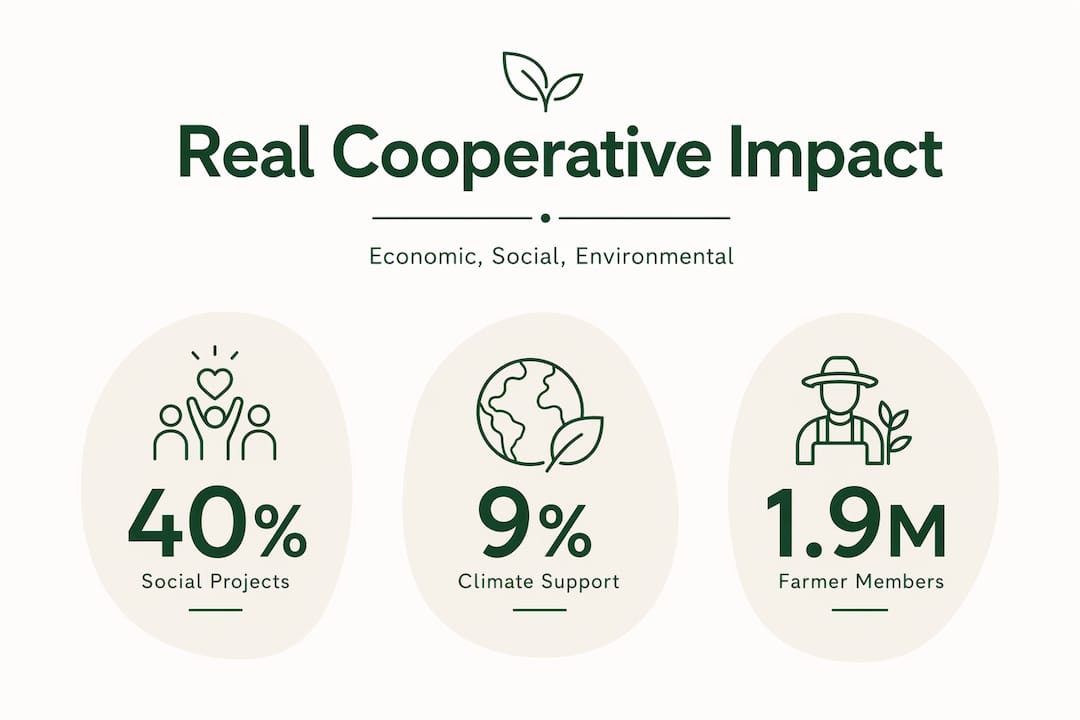
Fairtrade Premium investments direct 40% of funds to social projects like education and health, and 9% to productivity and climate adaptation. The Oromia Union in Ethiopia, supported by Fairtrade, works with more than 200,000 farmers, providing training and infrastructure that transforms entire communities.
Here’s a quick look at how cooperative membership typically compares to direct sales in terms of tangible economic outcomes:
| Factor | Individual direct sale | Cooperative member |
|---|---|---|
| Farm-gate price | Lowest (set by middlemen) | Higher (collective negotiation) |
| Market access | Local buyers only | Specialty and export markets |
| Premium eligibility | Rare | Common (Fairtrade, organic) |
| Infrastructure access | None | Wet mills, storage, transport |
| Social premium use | None | 40% to education, health, etc. |
There are also three concrete ways that strong cooperatives strengthen the communities surrounding them:
- Education initiatives: Premium funds frequently go toward school fees, scholarships, and local school construction, keeping kids in classrooms and giving the next generation better options.
- Health services: Some cooperatives fund local clinics, maternal health programs, and clean water access, directly improving quality of life for farming families.
- Climate adaptation projects: With weather patterns becoming less predictable, co-ops fund shade-growing programs, reforestation, and drought-resistant crop training so farmers can continue producing quality coffee even as the climate shifts.
Understanding these benefits of ethical sourcing makes it clear that your coffee purchase can ripple outward in ways you might never have imagined. This is also why community support in sustainable sourcing isn’t just a talking point for marketers. It’s a documented, measurable outcome when the right cooperative structures are in place.
Sustainability, certifications, and environmental practices
Economic and community impact often go hand in hand with environmental advances, and here’s where cooperatives lead on the sustainability front in ways that are both practical and inspiring.
Small farmers generally can’t afford the certification fees, auditing costs, or the technical expertise needed to pursue organic or Fairtrade status on their own. A cooperative absorbs those costs collectively and shares the knowledge across its membership. That’s a game changer. Suddenly, a farmer cultivating two acres of coffee in the highlands of Guatemala or Rwanda has access to the same certification pathway as a large corporate farm.
Training and cooperative knowledge transfer also supports better environmental practices like agroforestry and shade-grown coffee cultivation, reducing chemical inputs and building biodiversity around coffee plots. These are the practices that protect soil health, support bird populations, and sequester carbon, all while producing more aromatic, complex-flavored coffee that specialty buyers love.
Here are the core sustainability practices that well-functioning cooperatives actively support among their members:
- Shade-growing: Planting coffee under a canopy of native trees, which supports biodiversity, reduces soil erosion, and produces beans with richer flavor profiles.
- Agroforestry integration: Combining coffee with fruit trees, timber, and native species to create diverse, resilient farming systems.
- Chemical reduction: Providing access to organic inputs and training on natural pest management to reduce herbicide and pesticide use.
- Climate adaptation: Introducing drought-resistant varieties, water conservation techniques, and erosion prevention strategies.
- Waste management: Teaching proper wet mill wastewater management to protect local water sources.
40% of Fairtrade Premiums are directed to social projects, with another 9% specifically supporting productivity and climate adaptation programs. That means every time you choose a Fairtrade cooperative coffee, a meaningful portion of your purchase directly funds farmers learning how to grow more sustainably in a changing climate.
Pro Tip: When shopping for certified coffee, don’t stop at the seal. Ask whether the certification connects back to an identifiable cooperative with a traceable community program. Look for brands that can name the co-op, the region, and describe specific projects the premium has funded. You can also explore what different certifications actually mean and read up on the role certifications play in sustainability to sharpen your instincts as a buyer.
If you want to go deeper into why this matters, reading about how to support sustainable farms and why Fairtrade deserves your consideration will give you a richer picture of the broader impact your choices create.
Challenges and limitations: What every conscious buyer should know
Despite the many upsides, not all coffee cooperatives are equally effective, and here’s where potential pitfalls can emerge. Knowing this doesn’t mean you should give up on cooperative coffee. It means you can be a smarter, more impactful buyer.
Governance is everything. A cooperative is only as strong as the leadership managing it and the transparency it maintains with its members. When leadership is weak, unaccountable, or self-serving, the entire structure can unravel. The collapse of Kaserem SACCO in Uganda is a sobering example of how payment delays, accumulated debt, and years of poor leadership destroyed a cooperative and left member farmers without their promised payouts. This isn’t a unique story. It happens more than the industry likes to admit.
Other real risks include:
- Delayed payments: Farmers wait months for payment after harvest, creating serious cash flow problems for families.
- Side-selling: When co-op prices lag behind market prices, farmers sell to private buyers instead, weakening the co-op’s volume and stability.
- Debt cycles: Cooperatives that borrow heavily for infrastructure without strong repayment plans can trap members in financial instability.
- External shocks: Political conflicts, climate disasters, and global price crashes can devastate even well-managed cooperatives.
Empirical research on certification programs reveals a more nuanced picture than many advocates present. While Fairtrade cooperatives in Costa Rica showed a price advantage of roughly 5 cents per pound over non-certified coffee, the overall livelihood improvements were mixed and sometimes modest. Higher farm prices don’t automatically translate into dramatically better living standards if other costs, governance issues, or market access problems persist.
Here’s a side-by-side look at what separates a healthy cooperative from a troubled one:
| Trait | Healthy cooperative | Troubled cooperative |
|---|---|---|
| Transparency | Open financial reporting to members | Limited or no financial disclosure |
| Leadership quality | Elected, accountable, community-focused | Weak oversight, potential corruption |
| Payment timing | Consistent, on-schedule payouts | Frequent delays or partial payments |
| Member services | Training, inputs, market access | Minimal or declining services |
| Market resilience | Diversified buyers, contracts secured | Dependent on single buyer or price |
| Debt management | Manageable, planned | Over-leveraged, destabilizing |
Pro Tip: Before buying a brand that claims cooperative support, check if it publishes the cooperative’s name, location, governance structure, and member services. Brands committed to responsible coffee sourcing will share that level of detail because they’ve verified it themselves.
What most guides miss: Traceability, governance, and your power as a consumer
Here’s what we’ve noticed that most guides gloss over: the ethical coffee conversation focuses too much on the label and not enough on the story behind it. A beautiful bag with three certification logos tells you almost nothing about whether the cooperative producing that coffee is genuinely functioning well for its farmers. Certifications set a floor. Governance determines whether co-ops actually reach their potential.
Traceability is the real test. When a roaster or retailer can tell you the cooperative’s name, describe specific projects funded by premiums, and explain how member farmers benefit season after season, that’s meaningful transparency. When they can only point to a logo, that’s a starting point at best. Verifying cooperative governance is something every conscious buyer should build into their purchasing habits, because the difference between a thriving co-op and a struggling one can mean the difference between a farmer building a better life and a farmer waiting months to be paid for work already done.
You have more power here than you might realize. Every time you choose a brand that publishes cooperative names and community impact stories, you signal to the industry that this level of transparency is the standard. And every time you ask your favorite coffee company “Which cooperative grew this? What has the premium funded?” you push the entire supply chain toward accountability. Understanding how certifications genuinely drive sustainability helps you ask the right questions and spot the difference between surface-level ethics and the real thing.
Supporting cooperatives isn’t just about feeling good about your purchase. It’s about directing your dollars toward systems that work and demanding improvement from those that don’t. That’s a genuinely powerful position to be in.
Easily connect with sustainable coffee options
Once you know what to look for in ethical coffee, it’s time to take action and here’s where to start your journey. At EcoVibe Roast, we take the guesswork out of ethical sourcing by curating sustainably produced options that align with the cooperative and environmental principles we’ve explored together in this article.

Whether you’re drawn to the convenience of single-serve coffee pods or want to explore our full sustainable coffee collection, every product we offer reflects a commitment to traceable sourcing, eco-friendly practices, and community support. We also plant mangrove trees and remove ocean-bound plastics with every purchase, so your morning ritual becomes a warm hug for both you and Mother Earth. Explore our environmental impact page to see exactly what your purchase supports, because we believe you deserve to know the full story behind every aromatic cup.
Frequently asked questions
What is a coffee cooperative and how does it help small farmers?
A coffee cooperative is a group owned by coffee farmers themselves, working together to negotiate better prices, access shared infrastructure, and combine resources. By pooling their harvests, members benefit from collective bargaining power that individual farmers simply can’t achieve on their own.
Does buying from a cooperative guarantee ethical or sustainable coffee?
Not always. While many cooperatives deliver real sustainability and ethical benefits, buyers should look for robust governance and transparency, because as research shows, poor leadership causes cooperative failures that hurt the very farmers they’re meant to support.
How do coffee cooperatives invest back into the community?
Cooperatives typically direct premiums toward social programs, and data shows that 40% of Fairtrade Premiums fund social goods like health care and education, while another portion supports climate adaptation and productivity improvements.
Are there risks in supporting coffee cooperatives?
Yes. Some cooperatives struggle with mismanagement, payment delays, or debt, and in serious cases, these challenges lead to collapses that leave farmers without their earned income. Researching a cooperative’s governance and track record before buying reduces this risk significantly.
Do all certifications mean a coffee comes from a cooperative?
No. Certifications like organic or Fairtrade can apply to estate-grown or corporate-farm coffee as well as cooperatives. Always look for specific traceability information to confirm the source and understand who truly benefits from your purchase.
Recommended
- How Community Support Transforms Sustainable Coffee Sourcing – EcoVibe Roast
- Top benefits of ethical sourcing for coffee & tea lovers – EcoVibe Roast
- Ethical sourcing in coffee and tea: real examples & how to choose – EcoVibe Roast
- How to Support Sustainable Coffee Farms Step-by-Step – EcoVibe Roast


