

TL;DR:
- Renewable energy in coffee production can significantly reduce emissions, but its true impact depends on the supply chain stage and technologies used. Key reductions occur at processing and roasting, where renewable electricity can replace fossil fuels, especially with verified data and third-party audits. However, limitations like seasonal availability and regional infrastructure mean renewable claims need careful scrutiny to ensure genuine environmental benefits.
Your morning cup of coffee feels simple, comforting, like a warm hug to start the day. But behind that rich, aromatic brew is an energy story most eco-marketing glosses right over. Renewable energy in coffee production sounds straightforwardly good, and often it is, yet the real benefits depend heavily on where in the supply chain it’s applied, which technologies are used, and whether fossil fuels are actually being displaced. If you care about the true sustainability of every sip, understanding this nuance puts you way ahead of the average green-label shopper.
Table of Contents
- Why energy matters from bean to cup
- Renewable energy solutions at origin: Farms and processing
- From roasting to retail: Where renewables make the biggest dent
- Not all renewables are created equal: Limitations and nuances
- Perspective: What most eco coffee guides get wrong about renewables
- How EcoVibe Roast advances eco-friendly coffee solutions
- Frequently asked questions
Key Takeaways
| Point | Details |
|---|---|
| Energy use drives impact | How coffee is powered from farm to cup is a major factor in its environmental footprint. |
| Renewable solutions vary | The best renewable energy option for coffee depends on local context and supply chain stage. |
| Not always carbon-neutral | Renewable energy in coffee only lowers emissions when it displaces fossil-based power and is reliably implemented. |
| Ask for transparency | Eco claims matter most when they’re backed by data, certifications, and process-specific reporting. |
| Informed choices matter | Eco-conscious consumers can make the biggest positive impact by supporting coffee brands with genuine sustainability commitments. |
Why energy matters from bean to cup
Now that you know coffee’s sustainability isn’t just about the farming method, let’s examine why energy, specifically, takes center stage in its environmental story.
Coffee travels a long road from a mountain farm to your mug, and at every stage, energy is consumed in ways that quietly shape coffee’s carbon footprint. Farming uses fuel for machinery and irrigation. Processing facilities need power to run pulping machines, wash stations, and drying equipment. Roasting is one of the most energy-intensive steps, requiring sustained high heat. Retail cafes and e-commerce warehouses burn electricity around the clock for HVAC, lighting, and equipment.
Here’s a quick look at how energy demand breaks down across the supply chain:
| Supply chain stage | Primary energy use | Typical fuel source | Emissions potential |
|---|---|---|---|
| Farming | Irrigation, machinery | Diesel, grid electricity | Moderate |
| Processing | Pulping, washing, drying | Diesel, biomass, grid | High |
| Roasting | Heat generation | Natural gas, electricity | High |
| Retail/cafes | HVAC, lighting, espresso machines | Grid electricity | Moderate to high |
| Packaging/shipping | Manufacturing, transport | Fossil fuels | Variable |
As you can see, the heaviest energy loads cluster around processing and roasting. That’s exactly where renewable energy swaps can deliver the most measurable reductions. Renewable electricity can decarbonize coffee processing and roasting by replacing fossil-powered energy used for equipment, lighting, and HVAC, and can also reduce emissions for retailers and cafes.
Key reasons why energy is such a powerful sustainability lever:
- Fossil fuels still dominate grid electricity in many coffee-growing and consuming regions
- Roasting alone can account for a significant slice of a roaster’s total emissions budget
- Processing facilities in off-grid rural areas often rely on diesel generators, which are among the most carbon-intensive options available
- Switching to solar, wind, or certified renewable grid power produces reductions that are measurable in kilowatt-hours and metric tons of CO2
“The transition to renewables in coffee isn’t a side story—it’s central to whether the industry can genuinely reduce its climate impact or just rebrand it.” — EcoVibe Roast
Staying up to date with the latest sustainability trends in coffee shows just how fast this conversation is evolving, and why now is the right time to get fluent in what these claims actually mean.
Renewable energy solutions at origin: Farms and processing
Understanding the why behind renewable energy in coffee, let’s see how these solutions are actually being deployed on the ground where coffee starts its journey.
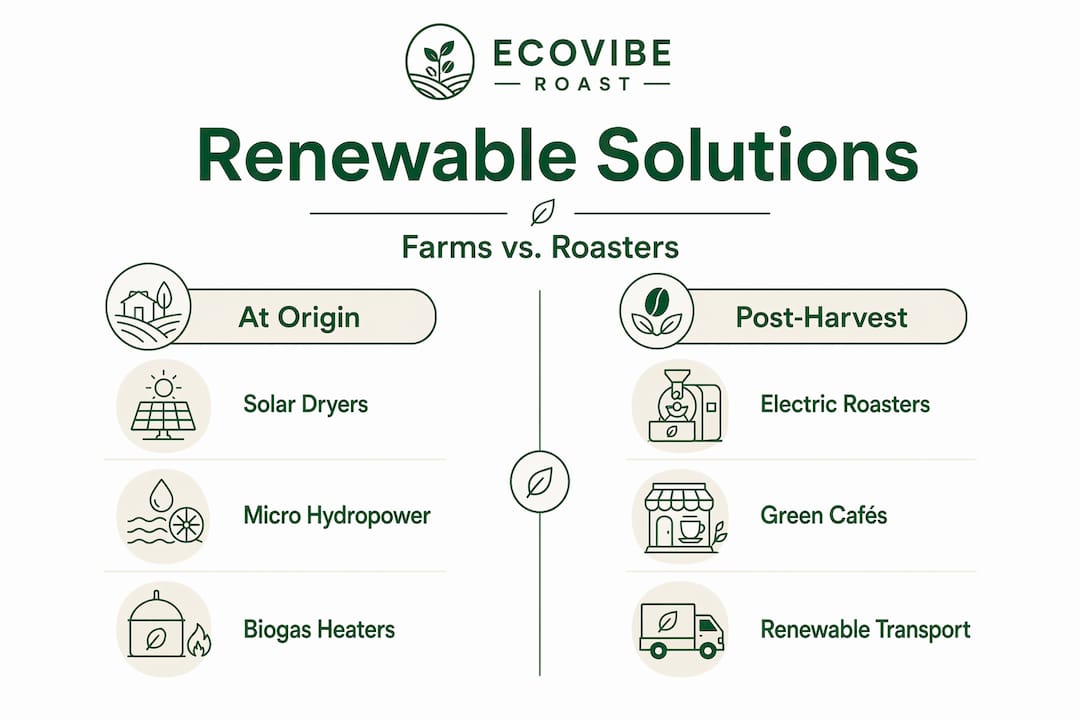
The most exciting developments are happening at origin, right where coffee cherries are picked and processed. Solar panels, hybrid energy systems, and biomass technologies are showing up on farms and processing stations across Africa, Southeast Asia, and Latin America, and the results are genuinely promising.
Here are four real-world examples of renewable energy making a difference at origin:
- Pilot solar farms in East Africa have demonstrated that solar photovoltaic panels can power washing stations and small mills, replacing diesel generators that previously ran processing equipment for hours each day.
- Hybrid solar-biomass dryers in Uganda combine sunlight with locally sourced biomass fuel to dry coffee cherries faster and more evenly. Solar-powered drying systems cut drying time and reduce reliance on non-renewable energy inputs, which directly improves both environmental outcomes and bean quality.
- Solar-powered community hubs in Timor-Leste have helped smallholder farmers access reliable electricity for the first time, enabling more controlled and cleaner processing methods that were previously unavailable.
- Agriphotovoltaic systems, where solar panels are installed alongside or above crops, are being explored for shade-grown coffee farms, offering dual benefits of energy generation and crop protection.
How do these approaches compare?
| Technology | Best suited for | Key benefit | Main challenge |
|---|---|---|---|
| Rooftop solar PV | Wet mills, dry mills | Off-grid power, no fuel cost | High upfront cost |
| Hybrid solar-biomass | Remote drying stations | Continuous operation | Requires biomass supply |
| Agriphotovoltaics | Shade-grown farms | Dual crop/energy use | Requires technical setup |
| Grid-tied renewables | Urban processing hubs | Scalable, low maintenance | Grid availability |
That said, the path to implementation isn’t always smooth. On-site solar can be feasible for coffee farming and processing, including off-grid and energy-constrained contexts, but implementation requires site-specific techno-economic and operational assessment. In plain terms, what works brilliantly in one region may not translate well to another without proper analysis of sunlight availability, load requirements, and local support infrastructure.
Pro Tip: When a coffee brand says it supports “renewable energy at origin,” ask which specific stage it applies to and whether it’s backed by a third-party energy audit or certification. A solar panel photo on Instagram is lovely, but verified kilowatt-hour data is what actually tells the story.
Practical steps like these connect directly to broader efforts for reducing coffee waste with renewables, since efficient energy use often reduces spoilage and processing byproducts at the same time.
From roasting to retail: Where renewables make the biggest dent
But the journey doesn’t stop at the farm. Energy choices in roasting and retail define the rest of the sustainability equation.
Roasting is a hot topic, literally. A commercial roaster can reach temperatures above 400°F and run for hours each day. Most roasters traditionally relied on natural gas or propane, both of which produce significant CO2 emissions. Switching those systems to electricity powered by solar or wind, or purchasing certified renewable energy credits tied to actual generation, produces a measurable and verifiable reduction in emissions.
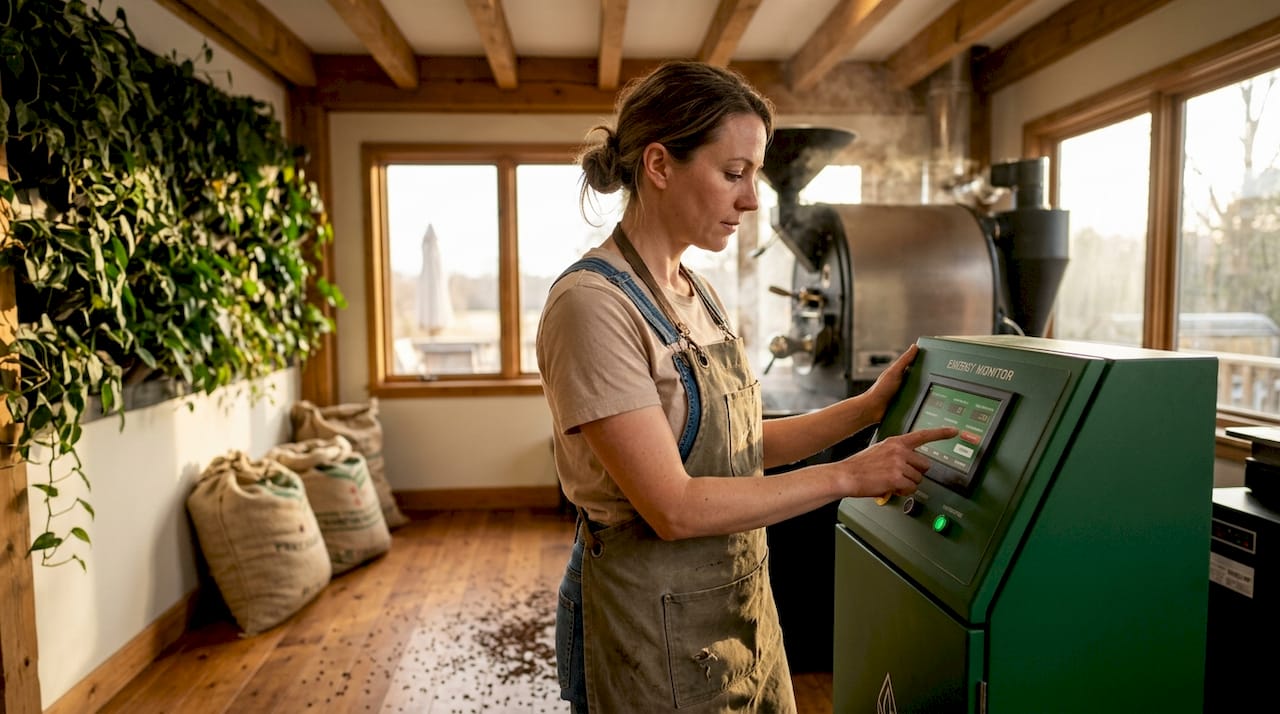
Cafes and retail operations face a similar opportunity. Between espresso machines, grinders, refrigerators, lighting, and climate control, a busy café can consume a surprising amount of electricity. The “green café” model that’s gaining traction in cities across the U.S. and Europe involves solar installations, energy-efficient equipment, and renewable energy procurement tied to verified sources.
Here’s what makes this stage particularly impactful:
- Emissions at roasting and retail are relatively easy to measure using standard utility billing and emissions factors
- Renewable energy certificates (RECs) and power purchase agreements (PPAs) allow roasters and cafes in areas without direct solar access to still support renewable generation
- Energy-efficient equipment combined with renewable sourcing can reduce a roaster’s operational emissions by 40% or more in favorable grid scenarios
- Renewable electricity can decarbonize coffee roasting and retail by systematically replacing fossil-fueled processes with clean alternatives
Emissions avoided at the roasting stage are among the most transparently trackable in the entire coffee supply chain.
The key phrase there is “transparently trackable.” Because roasters operate in regulated electricity markets with standardized emissions accounting, their claims are easier to verify than those made at origin. That makes scrutiny even more worthwhile.
Pro Tip: Not all “renewable energy” claims are equal. Look for brands that publish specific numbers, such as kilowatt-hours of renewable electricity used per year or tons of CO2 avoided, rather than vague green language. The CDP’s guidance on transparent reporting provides a solid benchmark for what good disclosure looks like.
Exploring green coffee initiatives gives you a clearer sense of what genuine commitments look like versus surface-level branding. And if you want to assess whether a brand’s claims hold up, checking into climate positive coffee claims is a great next step.
Not all renewables are created equal: Limitations and nuances
With all the promise, it’s just as important to explore where renewable energy in coffee falls short or isn’t as straightforward as it seems.
Here’s the honest reality: renewable energy in coffee is not automatically carbon-neutral or always beneficial, because energy use varies by process such as drying method and roasting technology, and because availability including seasonality, grid reliability, and off-grid constraints affects whether renewables can reliably cover demand.
Let’s walk through the main limitations:
- Seasonal solar availability means that farms relying solely on solar panels in regions with pronounced wet seasons or heavy cloud cover may face significant gaps in supply. A solar dryer in a region with six months of clouds needs a reliable backup that may still be fossil-based.
- Off-grid economic realities make upfront renewable installations unaffordable for smallholder farmers without financing support, subsidies, or cooperative structures. The farms most in need of clean energy solutions are often the ones least able to afford them independently.
- Process variation matters enormously. A natural-process (dry-processed) coffee that simply dries in the sun requires very little energy input at all, renewable or otherwise. Comparing it to a washed coffee that uses electric pumps, water heating, and mechanical drying is like comparing apples to oranges in terms of energy impact.
- Grid reliability issues in some coffee-growing countries mean that even when renewable installations exist, unreliable infrastructure can force fallback on diesel backup generators, undermining the overall carbon savings.
- Accounting gaps are real. When a brand claims “our coffee is roasted with renewable energy,” it might mean 100% solar-powered roasting, or it might mean they purchase renewable energy credits that don’t directly fund new clean energy capacity. The difference matters.
“Context matters more than the label. A ‘renewable energy’ claim without supply chain specifics is a starting point for questions, not a final answer.”
This is why sustainable agriculture for coffee always needs to be viewed holistically. Renewables are one piece of a complex puzzle that also includes water use, deforestation impact from coffee, labor conditions, and waste management. You can dig deeper into the full picture through a sustainable coffee sourcing workflow that accounts for all of these variables together.
Perspective: What most eco coffee guides get wrong about renewables
After covering the facts, let’s zoom out for a frank look at how to navigate green claims as a conscientious coffee lover.
Here’s what we see far too often: a brand slaps a solar panel image on their packaging, calls their roastery “powered by renewables,” and calls it a day. And well-meaning coffee drinkers feel good about their choice without ever asking the harder questions. We don’t think that’s good enough, and honestly, we don’t think you do either.
The inconvenient truth is that renewable energy as a marketing claim has outpaced renewable energy as a verified practice. It’s easy to purchase a renewable energy certificate at a low cost and technically claim “green energy” without making any physical change to your operations or supply chain. That’s not fraud exactly, but it’s not transparency either.
What you should actually be looking for when evaluating a coffee brand’s renewable energy claims:
- Stage-specific disclosure: Does the claim cover farming, processing, roasting, or all three? Each stage has very different energy profiles and emissions implications.
- Third-party verification: Is there a certifying body, an energy auditor, or a credible standard (like B Corp or CDP reporting) that validates the claim independently?
- Real numbers, not logos: Tons of CO2 avoided, kWh of renewable electricity consumed, percentage of energy needs covered. These are the details that separate genuine progress from green wallpaper.
- What was replaced: If a roaster switches from natural gas to electric roasting powered by wind energy, that’s a significant, real reduction. If they add solar panels to their office roof but still run their roasters on grid electricity from a coal-heavy region, the impact is modest.
The best question you can ask any coffee brand is this: what energy source are you replacing, and how much carbon are you actually avoiding as a result? If they can answer that clearly and with data, that’s a brand worth trusting. If they respond with a mission statement and a green logo, keep digging.
Understanding what real climate claims require is one of the most empowering things you can do as an eco-conscious coffee drinker. It shifts your purchasing power from passive to purposeful.
How EcoVibe Roast advances eco-friendly coffee solutions
Ready to put your values into practice? See how EcoVibe Roast brings these principles to your cup.
At EcoVibe Roast, we believe that every purchase should do more than just taste great. It should move the needle. That’s why we’re committed to traceable sourcing, transparent sustainability reporting, and products that align with your values at every stage of the supply chain.

Every order from EcoVibe Roast contributes to planting mangrove trees and removing ocean-bound plastics, and our sustainable coffee pods are designed with minimal environmental footprint in mind. If single-serve convenience matters to you without the guilt, browse EcoVibe’s single-serve options to find your perfect match. Want to see the full picture of what we’re doing for the planet? Explore our environmental impact page for the real numbers behind our commitments. This is coffee that works as hard for the Earth as you do.
Frequently asked questions
Does using renewable energy make coffee carbon-neutral?
Not always. Actual carbon impact depends on the stage, prior energy mix, and how much fossil fuel is displaced, since energy use varies by process and renewable availability is constrained by seasonality and grid reliability.
What’s an example of renewable energy in coffee processing?
Hybrid solar-biomass dryers are a strong real-world example, because solar-powered drying systems cut drying time and reduce reliance on fossil fuels by combining sunlight with locally available biomass materials.
Are all renewable energy claims in coffee equal?
No. Benefits vary significantly by process, region, and whether the renewable source is actually replacing carbon-intensive energy, since renewables in coffee are not automatically beneficial in every context.
How can consumers support renewable energy in their coffee?
Choose brands that publish transparent, stage-specific reporting with third-party certification and concrete data, such as kilowatt-hours or emissions avoided, rather than relying on generic green labels.
Recommended
- Sustainability Trends in Coffee 2026: Impact on Ethical Choices – EcoVibe Roast
- Eco-Conscious Coffee Brewing Process for Sustainable Enjoyment – EcoVibe Roast
- 7 Steps to Build Your Sustainable Coffee Checklist – EcoVibe Roast
- Master Eco-Conscious Coffee Making Workflow for Sustainability – EcoVibe Roast


