

TL;DR:
- Most carbon claims in coffee are marketing hype, lacking transparency, verifiable data, and clear boundaries.
- Genuine carbon intelligence involves traceability, primary data, continuous improvement, and third-party verification throughout the supply chain.
You’ve seen the labels: “carbon neutral,” “climate positive,” “net zero.” They sound reassuring while you’re sipping your morning brew, but something feels off. Where’s the proof? What do those words actually mean for the farmers, the soil, and the atmosphere? If you’ve ever felt like these claims are more marketing poetry than measurable progress, you’re not wrong to be skeptical. This guide cuts through the noise and shows you exactly what genuine carbon intelligence looks like in coffee, so your next purchase can be a truly informed one.
Table of Contents
- What does ‘carbon intelligent’ coffee actually mean?
- How is carbon intelligence measured? The science behind the label
- From data to action: How evidence drives smarter coffee farming
- Why regenerative practices matter in carbon-intelligent coffee
- How to spot genuine vs. marketing-driven carbon coffee claims
- Why most ‘carbon’ coffee claims miss the mark—and what ethical drinkers really need
- Discover carbon-intelligent, transparent coffee with EcoVibe Roast
- Frequently asked questions
Key Takeaways
| Point | Details |
|---|---|
| Data defines intelligence | Carbon-intelligent coffee uses transparent, rigorous measurement and reporting—never just claims or offsets. |
| Improvement loop matters | Look for brands that measure, report, improve, and verify emission reductions over time. |
| Regenerative farming is key | When tracked with credible data, regenerative and agroforestry practices can significantly cut emissions and build resilience. |
| Marketing vs. science | Don’t trust labels alone—ask for evidence of boundaries, numbers, and verified progress. |
What does ‘carbon intelligent’ coffee actually mean?
With the confusion around generic carbon claims established, let’s break down what “carbon intelligent” really means for your morning brew.
Most coffee brands slap a “carbon neutral” badge on their packaging and call it a day. But that label alone tells you almost nothing. It doesn’t tell you which parts of the supply chain were measured, how the numbers were calculated, or whether the brand is actually reducing emissions over time versus just buying cheap offsets to cover the gap.
True carbon intelligence is a fundamentally different approach. As efico explains, carbon-intelligent coffee means you can trace and quantify greenhouse gas impacts across the entire coffee value chain, then reduce them using evidence-based farm and processing practices rather than relying only on vague sustainability claims. That’s the key distinction: tracing, quantifying, and improving, not just labeling.
Here are the traits that genuinely carbon-intelligent coffee will always have:
- Traceability: Emissions are tracked from specific farms, not estimated from regional averages.
- Primary data use: Real on-farm measurements are used, not generic industry numbers.
- Clear system boundaries: The brand specifies exactly which stages of the supply chain are included in the calculation.
- Improvement over time: There’s a feedback loop where data drives actual changes in farming or processing practices.
- Transparent reporting: Results are published, not just claimed.
“Calculating coffee’s carbon footprint is genuinely complex, and inconsistent methods across the industry make it easy for brands to cherry-pick favorable numbers without providing meaningful accountability.” — Carbon footprint research, Efico
Pro Tip: When you see a “carbon neutral” claim, ask two questions immediately. First, what’s included in the boundary? Second, how has the brand’s footprint changed year over year? If they can’t answer both, the label is decoration, not data. You can also learn more about carbon neutral coffee impact to understand what genuine accountability looks like in practice.
How is carbon intelligence measured? The science behind the label
Knowing what “carbon intelligent” coffee aims for, the next step is understanding how it’s scientifically measured for credibility.
The gold-standard tool is life-cycle assessment, or LCA. Think of LCA as a full-body scan for your coffee’s environmental health. It traces greenhouse gas emissions at every stage of a product’s existence, from the seeds planted in a farm’s soil all the way to the cup you’re holding (and even the used grounds going into your compost bin).
A practical LCA methodology requires explicit system boundaries, a defined functional unit (like one kilogram of roasted coffee), and clear carbon-accounting rules. Without these anchors, results become incomparable and easy to manipulate.
Here are the essential steps in a credible LCA for coffee:
- Define the boundaries. Decide which stages are included: farming, processing, transportation, roasting, packaging, brewing, and disposal.
- Collect primary data. Gather real measurements from actual farms and facilities, not industry averages.
- Analyze the hotspots. Identify which stages produce the most emissions (hint: farming and fertilizer use are often the biggest culprits).
- Report transparently. Publish the methodology, the functional unit, and the full results, not just a single number.
- Improve and repeat. Use the findings to drive targeted practice changes, then measure again.
Why does this rigor matter so much? Because the variability in real-world results is staggering. Studies on coffee production’s environmental impact show footprints ranging from 0.15 to 14.5 kg CO2e per kilogram of green coffee, depending on how the study was conducted. That’s a nearly hundredfold difference. When you compare that to beverage carbon footprint comparisons, it becomes clear that the method of measurement shapes the story as much as the actual farming practices do.
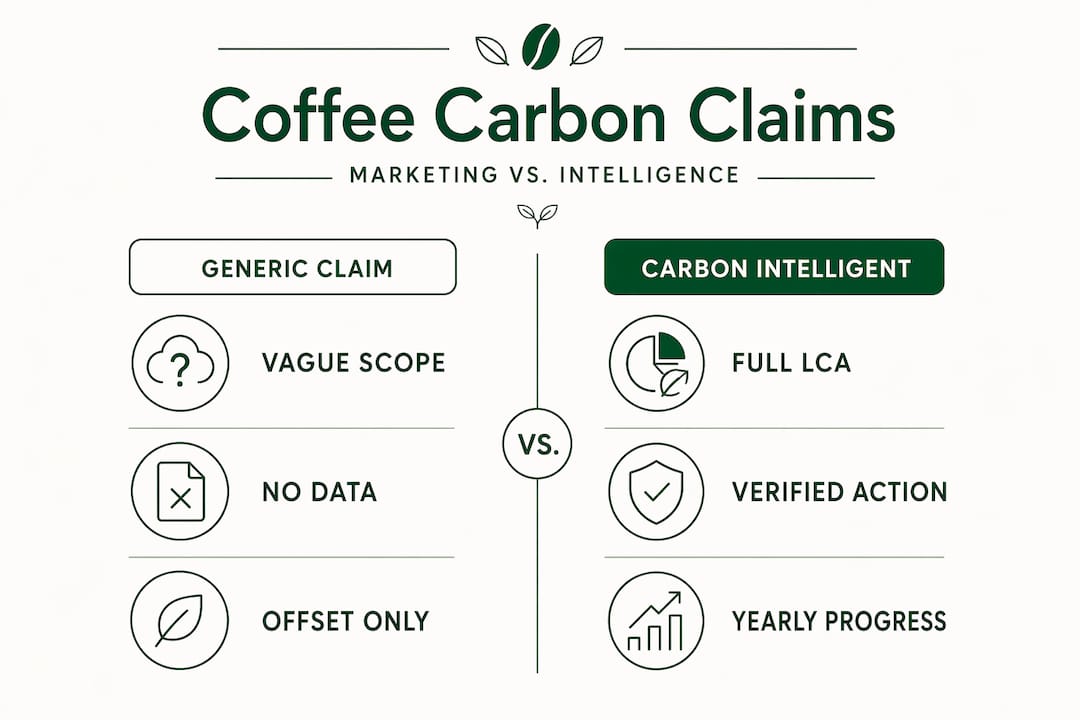
| Feature | Generic “carbon neutral” claim | Carbon-intelligent coffee |
|---|---|---|
| System boundaries | Not disclosed or vague | Explicitly defined and published |
| Data source | Industry averages or estimates | Primary farm-level data |
| Improvement loop | Absent | Built into ongoing measurement |
| Third-party verification | Rare or unspecified | Standard practice |
| Footprint range communicated | Single round number | Range with context and methodology |
This table makes one thing very clear: the difference between a marketing claim and a meaningful commitment comes down to specificity and accountability.
From data to action: How evidence drives smarter coffee farming
Scientific rigor is valuable, but what turns data into genuine progress for the climate, especially on coffee farms?
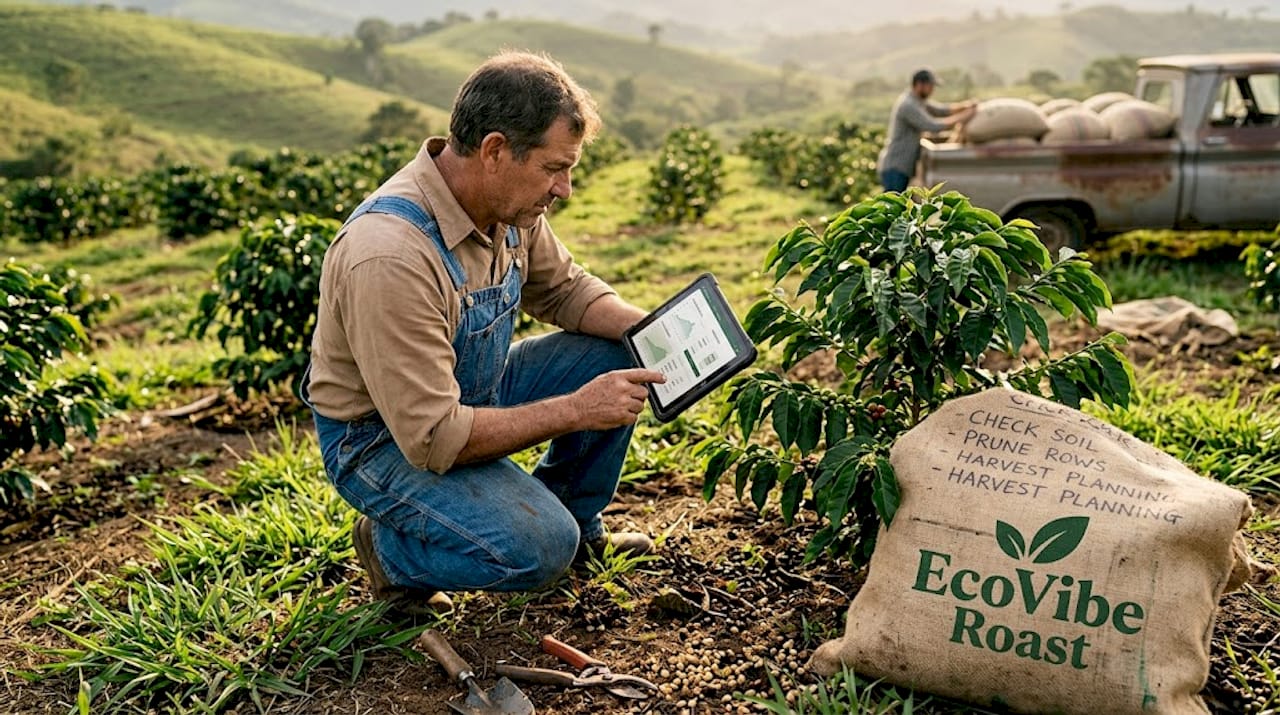
This is where carbon intelligence gets exciting. Data by itself doesn’t cool the planet. Action does. And the most promising development in sustainable coffee right now is the feedback loop between on-farm measurement and targeted practice changes.
Programs focused on climate and social goals for coffee supply chains increasingly use digital footprint calculators and primary data to manage Scope 3 emissions and drive targeted practice changes at the farm level. In plain language: brands are giving farmers real-time tools to see where their emissions come from and then adjust accordingly.
The results are concrete and encouraging:
| Country | Practice change | Emissions reduction |
|---|---|---|
| Brazil | Optimized nitrogen fertilizer application | ~19% reduction in farm-level emissions |
| Peru | Smarter fertilizer timing and soil management | ~30% reduction in nitrous oxide emissions |
| Colombia | Shade-grown and multicropping adoption | Increased soil carbon sequestration |
These numbers aren’t abstract. They represent real farmers making measurable changes that ripple out to every bag of coffee you buy. Want to understand how this connects to broader soil health strategies? The impact of regenerative agriculture in coffee offers a deeper look at how these practices build resilience from the roots up.
Here’s what evidence-driven carbon intelligence looks like on the ground:
- Digital carbon calculators that give farmers real-time feedback on their emissions per kilogram of coffee produced.
- Improved fertilizer management that reduces nitrous oxide, one of the most potent agricultural greenhouse gases.
- LCA feedback loops that highlight which farm processes need the most urgent attention.
- Measurable year-over-year improvements that brands can honestly report to conscious consumers like you.
Pro Tip: When evaluating a coffee brand’s sustainability story, look for programs that report specific farm-level changes, not just total global offsets purchased. Offsets can mask emissions rather than reduce them. Certified improvement is far more powerful than compensated inaction. You can also explore practical ways to reduce coffee waste throughout your own routine.
Why regenerative practices matter in carbon-intelligent coffee
With technology and data setting the baseline, let’s see why carbon intelligence often leads coffee brands to boost regenerative, soil-focused strategies.
Here’s something that might shift your perspective: the soil under a coffee farm is potentially one of the most powerful carbon storage tools on Earth. When managed well, it doesn’t just reduce emissions, it actively pulls carbon from the atmosphere and locks it underground. That’s a genuine climate win, not a marketing one.
Many carbon-intelligent offerings combine quantitative carbon accounting with regenerative and agroforestry-type practices to improve soil carbon and resilience, though the quality of conclusions always depends on rigorous measurement, reporting, and verification (MRV) and consistent system boundaries.
Regenerative practices that have demonstrated real carbon and resilience benefits include:
- Agroforestry: Growing coffee under a diverse canopy of shade trees, which adds organic matter to soil and sequesters carbon above and below ground.
- Multicropping: Planting companion crops alongside coffee to reduce bare soil, improve biodiversity, and stabilize soil carbon.
- Composting and organic matter management: Returning coffee pulp and organic waste to the soil to feed microbes and build carbon-rich humus.
- Reduced tillage: Minimizing soil disturbance to protect existing carbon stores and microbial networks.
- Cover cropping: Keeping living plant roots in the soil year-round to prevent erosion and promote continuous carbon capture.
“When regenerative practices are combined with rigorous carbon accounting and verification, coffee farming systems can shift from being net emitters to functioning as meaningful carbon sinks, while also improving farmer income stability and ecosystem health.” — Global Coffee Platform, RegenCoffee
The critical word in all of this is verified. Regenerative practices without measurement are just good intentions. The connection between mangrove planting and sustainable coffee is a great example of how verified, place-specific conservation efforts add real, trackable carbon impact beyond the farm itself. It’s also worth exploring additional regenerative practices in coffee to see how these strategies build on each other at scale.
How to spot genuine vs. marketing-driven carbon coffee claims
After understanding both the measurement and impact side, let’s get practical. How can you separate true carbon intelligence from clever marketing?
The good news is that once you know what to look for, greenwashing becomes pretty obvious. The not-so-great news is that many brands are still getting away with vague claims because most consumers haven’t been handed the right tools to push back. Until now.
Some consumer-facing “carbon negative” products rely on simple ratios rather than disclosing full LCA and MRV methods. Industry and academic sources consistently stress that boundaries, harmonized methods, and farm-level data quality are essential for any claim to be taken seriously.
Here’s your practical checklist for evaluating any coffee carbon claim:
- Ask for the system boundary. Does the footprint include farming, transportation, roasting, packaging, and brewing? Or just one convenient segment?
- Look for specific numbers. A real footprint figure (like “2.3 kg CO2e per kg roasted coffee”) is a good sign. A vague “we’re carbon neutral” without any number is a red flag.
- Check for improvement reports. Has the brand’s footprint decreased compared to a previous year? Real intelligence improves over time.
- Favor LCA over offsets alone. Brands that prioritize actual emission reductions through better farming are doing more than brands that simply buy credits to balance out unchanged practices.
- Look for third-party verification. Independent auditing adds a layer of accountability that self-reported claims can’t provide.
- Ask the brand directly. Reach out and ask about their methodology. A brand committed to transparency will welcome the question. One hiding behind marketing will deflect.
Pro Tip: If a coffee brand can’t tell you their functional unit, their system boundary, or their year-over-year improvement data, treat the claim as a marketing tactic rather than a genuine sustainability practice. Real climate positive coffee claims come with receipts.
Why most ‘carbon’ coffee claims miss the mark—and what ethical drinkers really need
Here’s an uncomfortable truth we think is worth saying plainly: most carbon claims in the coffee industry are built on a foundation that hasn’t been properly poured yet. Brands race to announce “carbon neutral by 2025” or “net negative by 2030” before they’ve even established consistent baseline measurements, defined their system boundaries, or created any real improvement loop on the farms that grow their coffee.
It’s a bit like declaring your home “energy independent” before checking whether your solar panels are actually connected to anything. The ambition is admirable. The execution is often hollow.
What eco-conscious drinkers like you genuinely need isn’t a perfect headline. It’s a brand that’s honest about where it started, clear about what it’s measuring, and committed to improving every single year. That’s a far more meaningful relationship than a flashy label on a bag.
We also think there’s something important in shifting from “neutral” as a destination to “intelligent” as a practice. Neutral implies you’ve arrived somewhere. Intelligent implies you keep learning, measuring, and getting better. The coffee brands doing this work right are treating carbon accounting as an ongoing conversation with their farmers and their customers, not as a marketing checkbox.
For you, the most powerful thing you can do is support brands that publish their methodology, report improvements transparently, and engage directly with the farming communities producing their beans. That support sends a signal to the entire industry that opacity isn’t acceptable and that you’re paying attention to green initiatives for coffee lovers that go beyond surface-level storytelling.
Discover carbon-intelligent, transparent coffee with EcoVibe Roast
If this article has lit a spark of clarity in how you think about your morning cup, we’d love to be your next step. At EcoVibe Roast, transparency isn’t a talking point. It’s built into how we source, how we report, and how we keep improving.

Every purchase you make with us plants mangrove trees and removes ocean-bound plastics, with the impact tracked and reported so you can see exactly where your money goes. Explore our single serve coffee pods for a convenient, responsibly sourced option that doesn’t compromise on flavor or accountability. And when you’re ready to see the full picture of what your purchase supports, visit our environmental impact page for the details that matter. Your cup can be a force for real, measurable good.
Frequently asked questions
Is carbon-neutral coffee always carbon intelligent?
No. Unless a brand shows how it measures emissions, where it starts and stops counting, and focuses on real reductions over time, “carbon neutral” is often just a label rather than a verified, methodologically sound commitment to climate action.
How much can regenerative coffee practices reduce emissions?
Regenerative adoption can cut millions of tons of CO2e per year when implemented at scale, while also improving farmer income and soil health in ways that compound over time.
What system boundary should you look for when assessing coffee’s carbon claims?
Check whether the brand’s footprint covers all stages from farm to cup, not just production. Credible LCAs standardize system boundaries and functional units, and more stages included means higher credibility.
Can coffee actually remove more carbon than it emits?
Yes. When integrated agroforestry systems are verified with full carbon accounting and rigorous measurement, coffee farming can function as a net carbon sink rather than a net emitter.
Recommended
- Carbon Neutral Coffee – Impact on Sustainable Living – EcoVibe Roast
- Spotting greenwashing in coffee: how to choose truly sustainable brews – EcoVibe Roast
- Green initiatives for coffee lovers: make every sip count – EcoVibe Roast
- Climate positive coffee: Claims, proof, and real impact – EcoVibe Roast


