

You might not immediately connect mangrove forests with your morning coffee, but these coastal ecosystems play a surprising role in sustainable coffee production. While traditional agroforestry focuses on shade trees within coffee plantations, mangrove restoration enhances water quality and provides natural barriers against erosion and storms that protect entire watersheds. This relationship extends beyond direct planting on coffee farms. By supporting climate resilience, carbon sequestration, and community livelihoods, mangrove planting initiatives complement coffee sustainability efforts in ways that benefit both ecosystems and farmers. This guide explores how these two environmental priorities intersect to create more resilient agricultural systems.
Table of Contents
- Understanding Agroforestry And Its Role In Coffee Production
- The Ecosystem Benefits Of Mangrove Planting Linked To Coffee Production
- Case Studies Linking Mangrove Restoration And Coffee Sustainability Efforts
- Applying Mangrove Planting To Enhance Coffee Production Sustainability
- Discover Eco-Friendly Products That Support Sustainable Coffee And The Environment
- Frequently Asked Questions
Key takeaways
| Point | Details |
|---|---|
| Ecosystem synergy | Mangrove planting enhances water quality, coastal protection, and carbon storage that indirectly supports coffee farming resilience. |
| Agroforestry benefits | Agroforestry reduces evaporation, cools air, and protects coffee crops from pests and diseases while improving yields. |
| Real world impact | Projects like Gorongosa combine native tree restoration with sustainable coffee production to benefit 1,000+ farmers. |
| Carbon sequestration | Mangroves sequester up to 10 times more carbon than terrestrial trees while supporting coastal communities. |
| Community integration | Local participation and stakeholder engagement drive successful combined mangrove and coffee sustainability systems. |
Understanding agroforestry and its role in coffee production
Agroforestry represents a farming approach that integrates trees and shrubs with crops to create mutually beneficial ecosystems. In coffee production, this means growing coffee plants alongside diverse tree species that provide shade, improve soil health, and support biodiversity. Syntropic agriculture takes this concept further by designing systems where every plant species contributes to ecosystem balance through strategic layering and succession planning.
These practices deliver measurable benefits for coffee farmers. Agroforestry reduces evaporation, cools air, and protects coffee crops from pests and diseases, enhancing resilience against climate variability. Trees create microclimates that buffer temperature extremes, reducing stress on coffee plants during heat waves or unexpected cold snaps. The shade canopy also suppresses weed growth naturally, cutting down on labor costs and chemical herbicide use.
Diverse tree species attract beneficial insects that prey on coffee pests, creating natural pest management systems. Nitrogen-fixing trees enrich soil without synthetic fertilizers, while deep-rooted species prevent erosion and improve water infiltration. This biodiversity creates resilient farms that maintain productivity even when climate conditions fluctuate.
Key agroforestry benefits for coffee production include:
- Enhanced soil fertility through organic matter accumulation and nitrogen fixation
- Natural pest control via increased biodiversity and habitat for beneficial species
- Climate regulation through shade provision and microclimate stabilization
- Water conservation by reducing evaporation and improving soil water retention
- Carbon sequestration in both trees and enriched soil
The quality improvements extend beyond yield protection. Shade-grown coffee typically develops more complex flavor profiles because slower cherry maturation allows sugars and acids to develop fully. Many specialty coffee buyers actively seek out agroforestry-grown beans for their superior cup quality and environmental credentials. This creates market incentives that make regenerative agriculture in coffee economically viable for farmers.
Pro Tip: Transitioning from monoculture to agroforestry requires patience and local knowledge. Start by consulting with agricultural extension services or experienced agroforestry practitioners in your region to identify native tree species that complement coffee production while providing economic co-benefits like fruit, timber, or medicinal plants.
The ecosystem benefits of mangrove planting linked to coffee production
Mangrove ecosystems deliver critical environmental services that support agricultural sustainability across entire regions, including areas where coffee grows. These coastal forests act as natural water treatment systems, filtering pollutants and sediments before they reach marine environments. This purification process maintains water quality in rivers and aquifers that coffee farms depend on for irrigation and processing.
The carbon storage capacity of mangroves stands out dramatically. Mangroves sequester up to 10 times more carbon than terrestrial trees and support coastal protection, storing carbon in both biomass and deep soil layers called blue carbon. This makes mangrove restoration one of the most effective nature-based climate solutions available, directly addressing the climate challenges that threaten coffee production worldwide.
| Ecosystem Type | Carbon Sequestration Rate | Primary Storage Location | Lifespan of Storage |
|---|---|---|---|
| Mangrove Forests | 1,000-1,500 tons CO2/hectare | Soil and biomass | Centuries to millennia |
| Terrestrial Forests | 100-300 tons CO2/hectare | Primarily biomass | Decades to centuries |
| Coffee Agroforestry | 150-400 tons CO2/hectare | Mixed biomass and soil | Decades with management |
Coastal protection from mangroves prevents erosion that would otherwise degrade water quality and increase sedimentation in waterways. Storm surge barriers created by mangrove root systems protect low-lying agricultural areas from saltwater intrusion during extreme weather events. These protective functions become increasingly valuable as climate change intensifies storm frequency and severity.
The connection to coffee sustainability operates through watershed-level benefits. Mangrove ecosystems offer diverse services beyond carbon storage including nutrient cycling, soil formation, and socio-economic benefits that support rural communities. Coffee-growing regions often share watersheds with coastal areas where mangroves thrive, creating interdependence between these ecosystems.
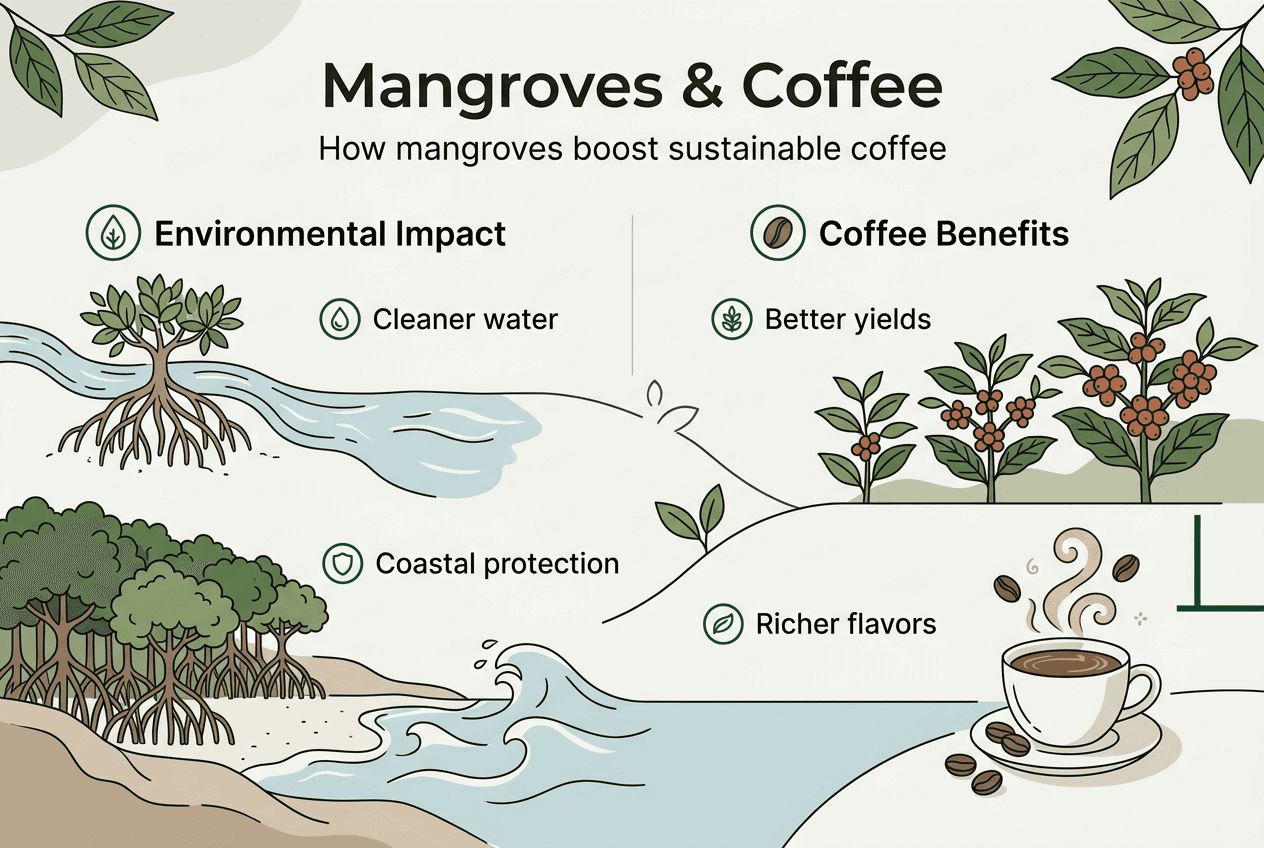
Communities that depend on both coffee farming and coastal resources gain resilience when mangrove restoration succeeds. Fisheries supported by healthy mangroves provide alternative income sources for coffee farmers during off-seasons or crop failures. This economic diversification reduces vulnerability to coffee price volatility and climate-related yield losses.
Key mangrove ecosystem services supporting coffee sustainability:
- Water quality maintenance through natural filtration and sediment capture
- Climate regulation via exceptional carbon sequestration in soil and biomass
- Coastal erosion prevention protecting agricultural lands and water sources
- Storm surge buffering that reduces saltwater intrusion risks
- Biodiversity habitat supporting fisheries and pollinator populations
Pro Tip: Coffee cooperatives can partner with coastal restoration organizations to support mangrove planting projects within their watershed. This creates measurable environmental impact that strengthens sustainability certifications and appeals to eco-conscious consumers willing to pay premium prices for sustainably farmed coffee.
Case studies linking mangrove restoration and coffee sustainability efforts
Real-world projects demonstrate how tree restoration and coffee production advance together when communities prioritize integrated environmental management. The Gorongosa Coffee Project combines native tree restoration with shade-grown coffee, scaling sustainable income for 1,000+ farmers in Mozambique. This initiative shows that environmental restoration and agricultural development need not compete for resources or attention.
The project operates through cooperative structures that empower farmers while protecting ecosystems. AMOCAFE unifies Mozambican coffee stakeholders promoting sustainable growth linked to restoration projects, creating market access for smallholder farmers who adopt conservation practices. This organizational model ensures that environmental benefits translate into economic opportunities for participating communities.
Successful integration of restoration and coffee production typically follows these steps:
- Assess watershed ecology to identify priority areas for native tree planting and ecosystem restoration
- Engage local communities through participatory planning that addresses both conservation and livelihood needs
- Establish nurseries for native species including those suitable for coffee agroforestry systems
- Train farmers in sustainable coffee production techniques that complement restoration goals
- Develop market linkages that reward environmental stewardship with premium prices
- Monitor both ecological outcomes and farmer income to ensure mutual benefits
- Scale successful approaches through farmer-to-farmer knowledge sharing and cooperative expansion
These projects create measurable benefits beyond carbon storage. Reforestation improves water availability during dry seasons by enhancing groundwater recharge. Native tree corridors support pollinator populations that increase coffee yields. Diversified farm income from fruit trees or timber reduces economic pressure to expand coffee cultivation into remaining forest areas.
| Farming Approach | Tree Diversity | Chemical Input Use | Carbon Storage | Community Economic Benefits |
|---|---|---|---|---|
| Traditional Monoculture | Low (0-5 species) | High dependence | Minimal | Single income stream |
| Restoration-Integrated Agroforestry | High (15-40 species) | Reduced by 60-80% | High (multi-layered) | Diversified income sources |
The economic transformation proves particularly significant. Farmers participating in restoration-linked coffee projects typically earn 30-50% higher incomes through combination of better coffee prices, payments for ecosystem services, and alternative products from restored areas. This economic security encourages long-term environmental stewardship rather than short-term resource extraction.
Youth engagement represents another crucial outcome. Projects that combine conservation with viable agricultural livelihoods attract younger generations who might otherwise migrate to cities. This generational continuity ensures that both coffee farming knowledge and environmental management practices persist over time. Community support for coffee sustainability strengthens when economic benefits reach multiple household members.
Applying mangrove planting to enhance coffee production sustainability
Eco-conscious coffee enthusiasts can actively support the intersection of mangrove restoration and sustainable coffee through informed purchasing and advocacy. Understanding blue carbon approaches helps consumers recognize how coastal ecosystem restoration contributes to climate-resilient agriculture. Blue carbon refers to carbon captured by ocean and coastal ecosystems, making mangrove planting a powerful complement to terrestrial carbon sequestration in coffee agroforestry.

Agroforestry interventions, including mangrove planting, reduce climate-related yield loss and improve coffee quality and pest resistance. This research confirms that integrated approaches deliver superior outcomes compared to isolated interventions. Coffee farms benefit from watershed-level improvements even when mangroves grow kilometers away from plantation boundaries.
Practical actions for supporting this integration include:
- Purchase certified sustainable coffee from cooperatives that invest in ecosystem restoration projects
- Support brands that transparently link product sales to mangrove planting or watershed conservation
- Advocate for agricultural policies that incentivize integrated landscape management
- Engage with community-based organizations working at the intersection of coastal and agricultural sustainability
- Share information about blue carbon and agroforestry benefits within your social networks
- Choose coffee from regions where restoration projects demonstrate measurable environmental and social outcomes
The connection between consumer choices and environmental outcomes becomes clearer when brands provide traceability. Look for coffee companies that specify which restoration projects they support, how many trees they plant per purchase, and what monitoring systems verify impact. This transparency allows you to assess whether marketing claims translate into genuine environmental benefits.
Collaboration between farmers, conservation organizations, and coffee buyers creates the foundation for successful integrated systems. Farmers need technical support to transition toward more sustainable practices. Conservation groups provide expertise in ecosystem restoration and monitoring. Buyers create market demand that makes sustainability economically viable. When these stakeholders align around shared goals, both coffee quality and environmental outcomes improve.
Yield and quality benefits provide powerful motivation for farmer adoption. Research shows that well-designed agroforestry systems maintain or increase coffee yields while dramatically improving bean quality. The premium prices that specialty coffee commands for shade-grown, sustainably produced beans often exceed the income from higher-yielding but lower-quality monoculture production. This economic reality drives adoption more effectively than environmental arguments alone.
Pro Tip: When selecting coffee, prioritize brands that fund or practice ecosystem restoration within coffee-growing regions. Look for specific commitments like “plants X mangrove trees per bag sold” with verification through third-party monitoring. This ensures your purchase directly supports the integrated environmental management that strengthens coffee production sustainability. Explore sustainability trends in coffee for 2026 to understand emerging best practices.
Consumer education plays a vital role in scaling these approaches. As more coffee drinkers understand the connection between healthy ecosystems and quality coffee, market demand shifts toward products that deliver both. This creates business incentives for companies to invest in restoration and sustainable sourcing. Your purchasing decisions and conversations with others contribute to this market transformation. Learn how to support green coffee initiatives that prioritize environmental stewardship alongside quality.
Discover eco-friendly products that support sustainable coffee and the environment
EcoVibe Roast demonstrates how e-commerce can advance environmental goals while delivering quality products. Every purchase supports mangrove tree planting and ocean plastic removal, creating tangible impact beyond the coffee cup. This commitment reflects the integrated thinking that connects coastal ecosystem health with agricultural sustainability.

Explore products like Hibiscus Berry Tea that complement your coffee routine while supporting eco-friendly farming practices. The same principles that guide sustainable coffee production apply to tea cultivation, creating opportunities for diversified support of regenerative agriculture. Learn more about the company’s environmental impact and tree planting initiatives to see how your purchases translate into measurable conservation outcomes. When you choose products from companies that prioritize ecosystem restoration, you participate in the market transformation that makes sustainable agriculture economically viable for farmers worldwide.
Frequently asked questions
What is the role of mangrove planting in coffee production?
Mangrove ecosystems provide indirect but significant support for coffee production through watershed-level benefits. They improve water quality by filtering pollutants and sediments, protect against coastal erosion that would degrade water sources, and sequester carbon at rates up to 10 times higher than terrestrial forests. These functions enhance climate resilience for agricultural regions that share watersheds with coastal areas where mangroves thrive.
How does agroforestry integrate with mangrove restoration for coffee sustainability?
Agroforestry and mangrove restoration represent complementary strategies within integrated landscape management approaches. While agroforestry focuses on tree integration within coffee farms, mangrove restoration addresses watershed and coastal ecosystem health that benefits entire regions. Both strategies sequester carbon, improve water management, and support biodiversity, creating synergistic effects when implemented together across a landscape.
What economic benefits do communities gain from combined coffee and mangrove projects?
Communities depending on both coffee farming and coastal resources achieve greater economic resilience through diversified income sources. Mangrove restoration supports fisheries that provide alternative livelihoods during coffee off-seasons or crop failures. Coffee projects linked to restoration often command premium prices, while payments for ecosystem services create additional revenue streams. This diversification reduces vulnerability to price volatility and climate-related losses.
Why should coffee consumers care about mangrove planting?
Consumer support for mangrove planting through coffee purchases creates market incentives for integrated environmental management. Brands that link sales to restoration projects demonstrate how consumer choices drive measurable conservation outcomes. Understanding these connections helps you make purchasing decisions that support both quality coffee production and ecosystem health, contributing to the market transformation needed for long-term agricultural sustainability.
What research gaps exist in linking mangrove restoration to coffee production?
Current research focuses primarily on direct agroforestry benefits within coffee farms, with limited studies examining watershed-level interactions between coastal ecosystem restoration and agricultural outcomes. More research is needed on how mangrove restoration affects water quality in coffee-growing regions, optimal spatial planning for integrated landscape management, and economic modeling of combined conservation and agricultural investments. Stakeholder engagement studies would help identify barriers and opportunities for scaling integrated approaches.


