

TL;DR:
- Local community sourcing involves procuring goods from nearby suppliers to reduce costs and environmental impact. Effective programs embed this approach into organizational infrastructure through clear criteria, feedback loops, and measurement. Starting small, organizations can build resilient, sustainable supply chains that support local economies and social equity.
Local community sourcing is defined as the strategic procurement of goods and services from suppliers within close geographic proximity to reduce transportation costs, lower carbon emissions, and support regional economic stability. This practice goes by a related industry term, community procurement, which emphasizes the social and governance dimensions alongside the logistical ones. Whether you are a conscious consumer, a small business owner, or simply curious about where your morning coffee comes from, understanding local community sourcing gives you a clearer picture of how purchasing decisions ripple through entire communities and ecosystems.
What is local community sourcing and what are its core benefits?
Local community sourcing is a procurement approach that prioritizes suppliers in close geographical proximity, reducing transportation distances and the costs and emissions that come with them. The benefits reach far beyond the supply chain. They touch employment, food quality, environmental health, and long-term community resilience.
Here is what community-driven sourcing delivers in practice:
- Lower logistics costs. Shorter transportation routes cut freight expenses and reduce the risk of delays caused by long-haul shipping disruptions.
- Stronger quality control. Buyers can visit suppliers in person, inspect products directly, and communicate faster. That ease of access translates to fewer defects and faster problem resolution.
- Local job creation. Spending with nearby businesses keeps wages circulating within the community, building economic stability over time.
- Reduced carbon footprint. Fewer miles traveled means fewer emissions per unit. This is one of the most direct ways a purchasing decision can reduce environmental impact.
- Social equity. Community-based procurement prioritizes businesses that employ marginalized groups, placing long-term community well-being above the lowest possible price.
“Local sourcing drives sustainability and social equity when embedded in organizational values and procurement infrastructure, not just purchasing policy.”
The distinction between policy and infrastructure matters. A one-time decision to buy local does not create lasting impact. Organizations that build local sourcing into their supplier selection criteria, contracts, and review cycles see compounding benefits over time.
Pro Tip: Start by mapping your current supplier locations. Identifying which purchases already come from nearby vendors gives you a baseline and reveals the easiest wins for shifting more spend to local sources.

How does local sourcing compare to global sourcing models?
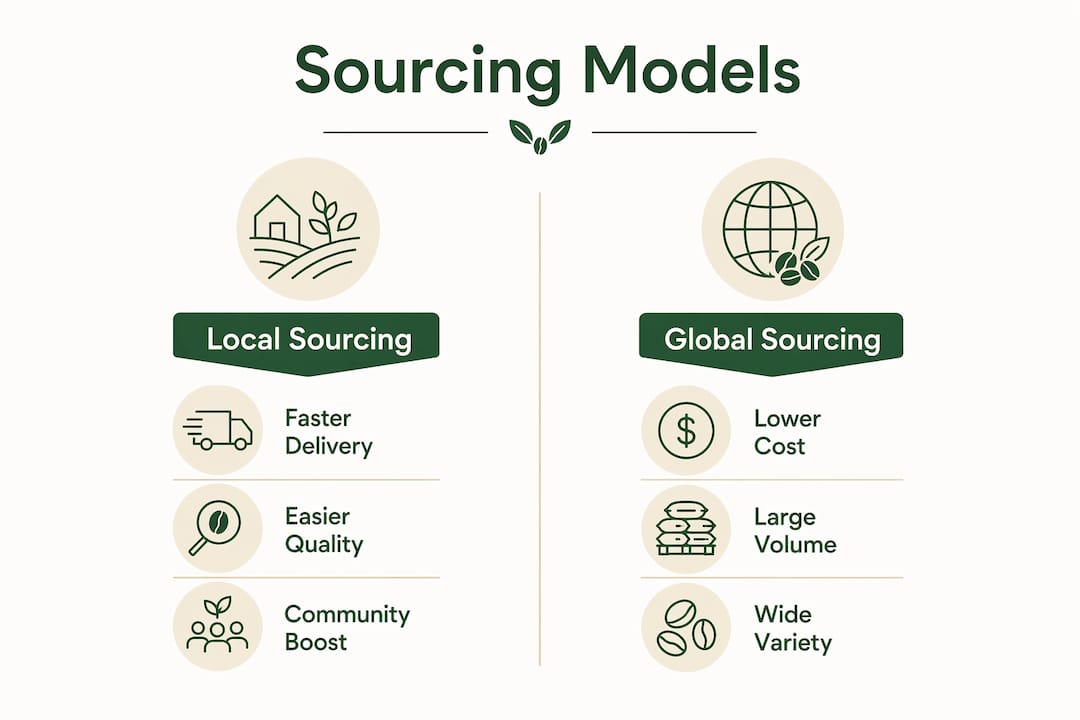
Local and global sourcing each have genuine strengths. The right choice depends on the product category, the organization’s scale, and its risk tolerance.
| Factor | Local sourcing | Global sourcing |
|---|---|---|
| Delivery speed | Faster, fewer transit stages | Slower, more logistics handoffs |
| Quality oversight | Easier in-person inspections | Harder to monitor remotely |
| Cost per unit | Higher for specialized goods | Lower at large volumes |
| Carbon footprint | Lower due to shorter distances | Higher due to long-haul transport |
| Supply chain risk | Lower geopolitical exposure | Higher exposure to disruptions |
| Social impact | Directly supports local economy | Impact is diffuse and indirect |
Local sourcing offers faster delivery and improved quality control compared to global sourcing, largely because in-person communication and inspections become practical. That advantage is significant for perishable goods, artisan products, and anything where freshness or craftsmanship defines value.
Global sourcing still wins on unit cost for standardized, high-volume goods. A small roastery cannot match the price of a multinational commodity supplier. That reality is why hybrid procurement models are recommended by supply chain experts. A hybrid approach combines local agility for high-touch or time-sensitive products with global efficiency for commodities where cost is the primary driver.
Pro Tip: Segment your product catalog before committing to a sourcing strategy. Perishables, specialty items, and community-branded products are ideal candidates for local sourcing. Standardized inputs with stable global supply chains may stay global without sacrificing your sustainability goals.
What are effective community sourcing models and examples in practice?
The most successful community sourcing programs share four structural features: clear governance, dual validation gates, meaningful incentives, and integration into the organization’s core strategy. Here are proven models that demonstrate each principle.
-
The LEGO Ideas program. LEGO Ideas transforms customers into collaborators by offering design royalties and requiring community voting thresholds before a product concept advances to internal review. This dual gating mechanism, community validation followed by internal review, protects brand standards while harnessing genuine community creativity. The result is reduced product launch risk and stronger brand advocacy because buyers feel ownership over what they helped create.
-
The Ceres Community Project. The Ceres Community Project exemplifies values-driven local sourcing focused on health, equity, and sustainability. Rather than chasing the lowest price, Ceres builds supplier relationships with local organic farms and food producers whose values align with its mission. This approach creates a supply chain that is both nutritionally rich and economically fair, a warm hug for both the organization and the communities it serves.
-
Community-based procurement for marginalized groups. Some municipalities and nonprofits structure their procurement to actively direct spending toward businesses owned by or employing underrepresented populations. This is not charity. It is a deliberate economic development tool that builds wealth in communities that have historically been excluded from supply chains.
-
Structured community-led product development. Brands that implement clear guardrails and stakeholder alignment in their community R&D programs avoid the design-by-committee trap. Transparency about decision rights, meaning who has input versus who makes the final call, maximizes the quality and usability of community input.
“Transforming a community from a passive audience into a strategic partner creates competitive advantage through long-term brand loyalty and advocacy that paid marketing cannot replicate.”
The lesson across all four models is consistency. Community sourcing works when it is treated as infrastructure, not a campaign. Organizations that build feedback loops, publish sourcing criteria, and report outcomes publicly earn the trust that makes these programs self-reinforcing.
How can organizations implement local community sourcing effectively?
Putting community procurement into practice requires more than good intentions. It requires structure. These steps give you a foundation that holds up over time.
- Define your sourcing criteria upfront. Specify what “local” means for your organization. Is it within 50 miles? Within the same state? Within a regional food shed? Clear geographic parameters prevent ambiguity and make supplier evaluation consistent.
- Create a supplier discovery process. Local suppliers are often invisible to large buyers because they lack the marketing budgets of global vendors. Attend regional trade events, partner with local chambers of commerce, and publish open calls for local suppliers.
- Build structured feedback loops. Careful curation of community input prevents dilution of quality and keeps decision-making grounded. Schedule regular supplier reviews and create a clear channel for suppliers to flag issues or opportunities.
- Measure your social and environmental impact. Track metrics like local spend as a percentage of total procurement, jobs supported, and estimated carbon savings from reduced transport. These numbers tell a story that resonates with customers and stakeholders alike.
- Balance local and global needs honestly. Not every product category suits local sourcing. Acknowledge that openly and focus your local sourcing energy where it delivers the most value, both economically and environmentally.
Pro Tip: Publish your local sourcing criteria and progress publicly, even if the numbers are modest at first. Transparency builds credibility with conscious consumers and creates accountability that keeps your program on track.
You can learn more about why local sourcing matters and how it strengthens communities through Ecoviberoast’s own sourcing philosophy. For a broader look at the economic and quality advantages of local sourcing across food and hospitality sectors, local sourcing insights from food industry practitioners offer useful real-world context.
Key Takeaways
Local community sourcing delivers its strongest results when it is built into organizational infrastructure, not treated as an occasional purchasing preference.
| Point | Details |
|---|---|
| Core definition | Local community sourcing means buying from geographically close suppliers to cut costs and emissions. |
| Top benefit | Quality control improves because in-person supplier visits and faster communication become practical. |
| Best model structure | Effective programs use dual validation gates, clear criteria, incentives, and regular feedback loops. |
| Hybrid approach | Combine local sourcing for specialty goods with global sourcing for high-volume commodities. |
| Measure impact | Track local spend percentage, jobs supported, and carbon savings to prove and improve program value. |
Why community sourcing is more than a feel-good trend
I have spent years watching organizations treat local sourcing as a marketing checkbox. They announce a commitment, feature a few supplier photos on their website, and then quietly revert to the cheapest global option when margins tighten. That pattern is not community sourcing. It is tokenism with good photography.
What actually works looks different. The organizations I have seen build lasting community sourcing programs treat their local suppliers the way they treat their best employees: with clear expectations, regular communication, and genuine investment in their growth. The Ceres Community Project did not become a model by accident. It built relationships with local organic producers over years, paid fair prices, and made those relationships central to its identity.
The uncomfortable truth is that community sourcing requires you to accept some inefficiency in the short term. Local suppliers may cost more per unit. They may have smaller production capacity. They may need more hand-holding in the early stages. But the resilience you build, the goodwill you earn, and the quality you gain are worth more than the margin you sacrifice.
My advice: start with one product category where local sourcing is genuinely feasible and build from there. Do not announce a sweeping commitment you cannot keep. Prove the model at small scale, measure the results honestly, and let the outcomes make the case for expansion. Community sourcing as a strategic infrastructure, not a one-off tactic, is what separates the brands that earn lasting loyalty from those that chase it.
— LaSaundra
Ecoviberoast puts community sourcing in your cup
Ecoviberoast was built on the belief that your daily coffee ritual can do more than wake you up. Every product in the Ecoviberoast line reflects a commitment to responsible sourcing, fair wages for growers, and a measurable reduction in environmental harm, including mangrove tree planting and ocean-bound plastic removal with every purchase.

If you want to put community sourcing principles into practice in the most delicious way possible, the 60-pack single-serve coffee pods are a great place to start. Rich, aromatic, and produced with the kind of supply chain transparency that actually means something. You can also explore the full single-serve collection to find the roast that fits your morning. Every sip supports the kind of sourcing this article is all about.
FAQ
What is local community sourcing in simple terms?
Local community sourcing is the practice of buying goods and services from suppliers located close to your organization or community. It reduces transportation costs, supports local jobs, and lowers carbon emissions compared to sourcing from distant suppliers.
What is community procurement and how does it differ?
Community procurement is the formal term for purchasing strategies that prioritize social impact alongside cost and quality. It often focuses on directing spending toward local businesses that employ marginalized or underrepresented groups, making economic development an explicit goal of the buying process.
What are the main advantages of local sourcing?
The main advantages of local sourcing include faster delivery, easier quality control through in-person inspections, lower carbon emissions from shorter transport distances, and direct support for local employment and economic stability.
Can local sourcing work alongside global sourcing?
Yes. Hybrid procurement models combine local sourcing for specialty, perishable, or community-branded products with global sourcing for standardized, high-volume inputs. Supply chain experts recommend this approach for balancing cost efficiency with social and environmental impact.
How do I start a local community sourcing program?
Define your geographic sourcing criteria, identify local suppliers through trade events and chambers of commerce, set measurable goals for local spend, and build regular feedback loops with your suppliers. Starting with one product category and scaling from proven results is the most reliable path.


