

TL;DR:
- Local sourcing in coffee often focuses only on roasting location, not farm practices or transportation.
- Farming and processing stages contribute more to coffee’s environmental footprint than shipping miles alone.
- Consumers should prioritize traceability, farm-level practices, and transportation modes to support truly sustainable coffee.
You pour your morning cup and feel good knowing you chose a “locally sourced” coffee. It sounds like the right call, right? But here’s something worth sitting with: the connection between local sourcing and environmental benefit is far more nuanced than most labels let on. Science shows that where coffee is grown, how it’s farmed, and how it’s processed often matter far more than the miles it traveled to reach your mug. This guide will help you cut through the noise, understand what local sourcing really means, and walk away with smarter tools to support truly sustainable coffee.
Table of Contents
- What does local sourcing in coffee actually mean?
- The environmental reality: What does the science say?
- When is local really greener? Key variables to consider
- How eco-conscious consumers can buy smarter coffee
- A fresh perspective: Why “local” isn’t a shortcut for sustainability
- Discover truly sustainable coffee choices
- Frequently asked questions
Key Takeaways
| Point | Details |
|---|---|
| Local isn’t always greener | The location alone doesn’t determine the true footprint—farming, processing, and transport type matter most. |
| Look beyond distance | Ask for details about how the coffee is grown, processed, and shipped to assess real eco impact. |
| Verify sustainability claims | Seek traceability, certifications, and evidence over buzzwords like ‘local’ for responsible coffee choices. |
| Practical steps matter | Eco-conscious buying works best with informed questions about sourcing, packaging, and producer practices. |
What does local sourcing in coffee actually mean?
With the common assumption challenged, let’s define what local sourcing actually means for your coffee cup.
The word “local” sounds simple, but in the world of coffee, it’s genuinely complicated. Coffee is a tropical crop, grown in equatorial regions like Ethiopia, Colombia, Brazil, Guatemala, and Vietnam. Unless you live near one of these regions, the beans in your bag have already traveled thousands of miles before they even arrive at a roaster. So when a brand calls its coffee “locally sourced,” it’s usually referring to one step in a much longer journey.
Here are the main stages in the coffee supply chain worth knowing:
- Farming: Coffee cherries are grown and harvested, often by smallholder farmers in tropical countries
- Processing: Cherries are pulped, fermented, washed, or dried to reveal the green bean
- Export and shipping: Green beans travel by sea freight to importing countries
- Roasting: Beans are roasted, often in the country where they’ll be sold
- Packaging: Roasted coffee is packaged, often in single-use or specialty bags
- Retail and delivery: Coffee reaches stores, cafes, or your doorstep
When a roaster markets “locally roasted” coffee, they usually mean the roasting step happens nearby. The farming, processing, and overseas transport have already occurred. When a brand says “locally grown,” it might mean coffee from a domestic producer, such as Hawaiian Kona or Puerto Rican coffee, though these are rare exceptions for most North American consumers.
Distance alone doesn’t determine environmental benefit. The scale of the operation, the farming practices used, the energy source powering the roaster, and even the packaging type all shape the total footprint. In fact, a Taiwan LCA case study comparing locally sourced versus imported raw ingredients found that “the ‘local is greener’ assumption does not reliably hold across environmental impact categories; origin can shift results depending on production intensity and resource constraints.”
Learning to spot the difference between a genuine sustainability claim and a marketing shortcut is a skill worth building. Check out these ethical sourcing examples for a practical look at what responsible practices actually look like in action.
The environmental reality: What does the science say?
Understanding what “local” means sets the stage for digging into the scientific reality behind coffee’s environmental footprint.
If you’ve ever assumed that shipping coffee across the ocean must be the biggest climate problem, you’re not alone. It feels logical. But the data tells a different story.
Life Cycle Assessment, or LCA, is the scientific method researchers use to measure every stage of a product’s environmental impact, from seed to cup. Multiple LCA studies on coffee have consistently found that farming and processing dominate the footprint, not transport.
Here’s a simplified look at how different stages compare across major studies:
| Supply chain stage | Typical share of global warming potential |
|---|---|
| Cultivation and farming | 40%–70% |
| Processing (wet/dry mill) | 5%–20% |
| Import transport (by sea) | 1%–12% |
| Roasting | 5%–15% |
| Packaging | 3%–10% |
| Retail/consumer preparation | 5%–20% |
The numbers shift based on the study’s methodology, the country of origin, and whether researchers include land-use change (clearing forests for coffee farms). But the pattern holds: transport by sea is a minor contributor.
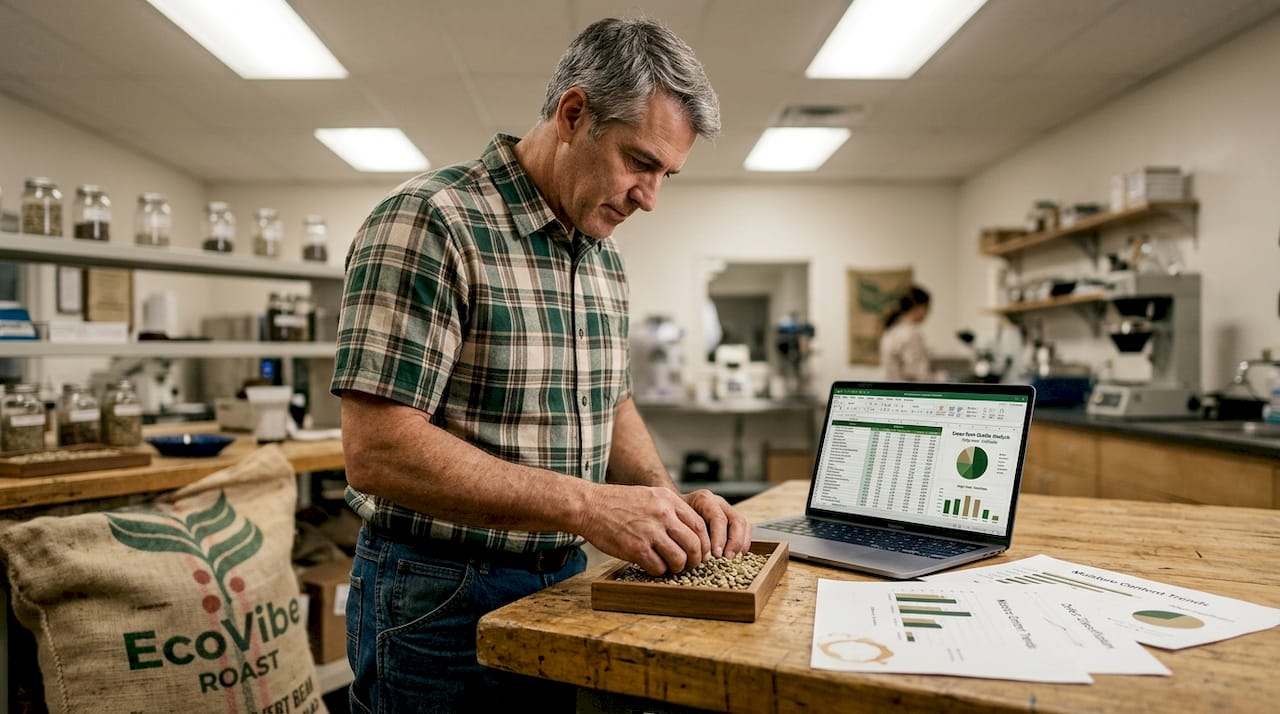
A systematic review of 34 coffee LCA studies covering 234 systems found that “in coffee LCAs, transport is often a minority contributor versus upstream cultivation/processing, but its magnitude can vary widely by system boundary and whether studies include factors like land-use change (LUC).”
The one major exception? Air freight. If coffee is rushed across continents by airplane rather than shipped by sea, emissions from transport can jump dramatically. The same systematic review noted that import transport ranged from negligible when shipped by sea to over 73% of total transport impact when air freight was involved. That’s a staggering difference, and it’s a powerful reminder that how something is transported matters as much as how far it goes.
The biggest climate levers in coffee aren’t at your local roaster. They’re in the soil, the shade trees, the fertilizer, and the forest cover of the farm thousands of miles away.
You can explore more about this shift in thinking through current sustainability trends in coffee and learn why conscious buyers are looking upstream. Understanding this evidence also connects directly to the benefits of ethical sourcing that reach far beyond emissions data alone.
When is local really greener? Key variables to consider
With the science established, let’s examine when buying local actually benefits the planet, and when it might not.
This isn’t about dismissing the idea of local. It’s about being honest about what conditions make local sourcing genuinely impactful. The answer depends on a handful of specific variables.
Variables that determine whether local is greener:
- Transport mode: Sea freight is low-emission. Air freight is not. If a “local” roaster is air-freighting green beans, the footprint can be worse.
- Farm practices: Shade-grown, agroforestry, and organic farming methods dramatically reduce environmental impact at the source.
- Processing energy: If a processing facility in the country of origin uses renewable energy, its footprint is much lower than one relying on diesel generators.
- Packaging type: Compostable, recycled, or minimal packaging matters, regardless of where the coffee comes from.
- Land-use change: Farms carved out of rainforest carry a massive carbon debt that no amount of short transport distance can offset.
Here’s a practical comparison of transport modes:
| Transport mode | CO₂ emissions (kg per tonne-km) | Relative climate impact |
|---|---|---|
| Sea freight | 0.01–0.04 | Very low |
| Road freight (truck) | 0.06–0.15 | Low to moderate |
| Air freight | 0.50–1.00+ | Very high |
An LCA of smallholder specialty coffee in Yemen found that “local sourcing in coffee can matter environmentally when it changes what is actually happening upstream (e.g., farming practices, agroforestry) or downstream (processing energy, packaging, transport mode and distance), but it is not automatically beneficial just because it reduces distance.” In that study, cultivation dominated many impact categories, reinforcing that farm-level decisions set the tone for everything else.
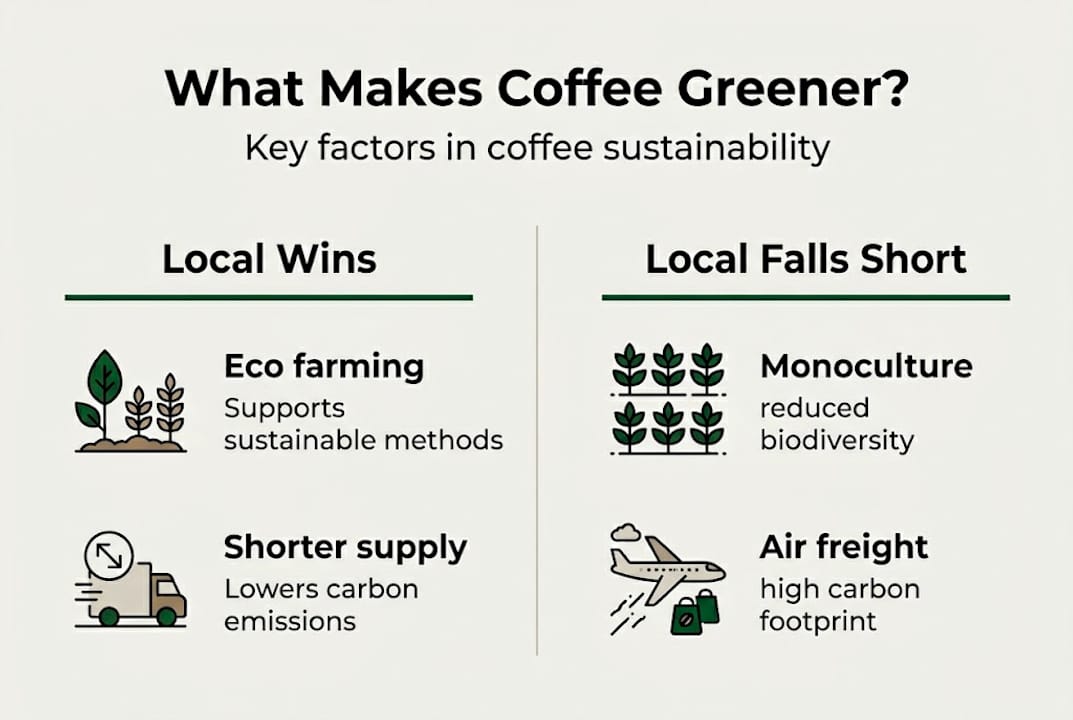
Scenario where local wins: A roaster sources green beans from a nearby organic, shade-grown, small-scale cooperative that uses renewable energy for processing, ships via road freight, and packages in compostable bags. Even if the beans technically traveled from Central America by sea, the low-emission transport and excellent upstream practices make this a genuinely strong choice.
Scenario where local falls short: A roaster promotes beans as “locally roasted” but sources from a monoculture farm that uses heavy synthetic fertilizers, relies on diesel for processing, and air-freights beans for freshness. The “local” roasting step saves almost nothing compared to the upstream harm.
Pro Tip: When you’re evaluating a coffee brand’s sustainability story, look past the origin label. Ask whether they share farm-level practices, certifications like Rainforest Alliance or organic status, and details about how the green beans were transported. A sustainable sourcing workflow can help you understand what a genuinely responsible supply chain looks like from start to finish.
How eco-conscious consumers can buy smarter coffee
To bridge knowledge and action, here’s how you can make credible, impact-driven coffee decisions.
Knowledge without action is just interesting trivia. The good news? Translating this science into your actual shopping habits is very doable. Here’s a step-by-step guide to buying coffee that reflects real sustainability, not just a feel-good label.
-
Look for traceability down to the farm or lot. Brands that publish the name of the farm, the cooperative, or the specific growing region are showing you they know their supply chain. Generic “sourced from Colombia” labels tell you very little.
-
Check for recognized certifications. Look for Fair Trade, Rainforest Alliance, USDA Organic, or Direct Trade claims. These aren’t perfect, but they signal that at least some third-party accountability exists. Certifications tie into fair wages, biodiversity protection, and reduced chemical inputs.
-
Ask about farming methods. Shade-grown and agroforestry practices preserve tree cover, support bird habitats, reduce the need for synthetic fertilizers, and often produce more complex, aromatic flavor. If a brand mentions shade-grown, that’s a genuinely good sign.
-
Understand the packaging. Even beautifully sourced coffee loses some of its eco-credibility if it arrives in layers of non-recyclable plastic. Look for brands that use compostable, recycled, or minimal packaging.
-
Watch out for greenwashing. Phrases like “eco-friendly,” “sustainable,” and “green” without any supporting evidence are red flags. Real sustainability comes with specifics, not slogans.
-
Ask about carbon footprint data or methodology. Some leading roasters now publish carbon calculations for their supply chains. While harmonized farm-level carbon accounting is still limited in practice, brands that try to quantify and communicate their footprint are ahead of the curve. As one consumer insight source notes, eco-conscious buyers should “ask for evidence beyond origin claims, e.g., traceability down to lot/farm, stated practices (shade/agroforestry, fertilizer management), and any quantified footprint method used.”
Pro Tip: When in doubt, look for brands that publish their sourcing story in detail, not just on a landing page, but in verifiable reports or supply chain maps. Exploring responsible sourcing benefits and taking time to understand responsible sourcing gives you the vocabulary to ask better questions and spot the difference between substance and spin.
A fresh perspective: Why “local” isn’t a shortcut for sustainability
Here’s something we genuinely believe after looking closely at the science: using “local” as a proxy for “sustainable” is a well-meaning shortcut that can actually lead you away from the brands doing the real work.
The reason this matters so much is that LCA studies are sensitive to the assumptions researchers make. As one major systematic review points out, “LCA comparability hinges on methodological choices: system boundaries, inclusion/exclusion of LUC, treatment of packaging/cup washing/waste, and how transport modes are modeled.” That’s why “local sourcing” can actually flip outcomes depending on assumptions. Two studies of the same supply chain, using different boundaries, can reach opposite conclusions.
What this tells us is that sustainability in coffee can’t be boiled down to a single label or a short supply chain. It lives in the full system, from the soil biology on a hillside farm in Ethiopia to the compostable bag sitting in your recycling bin. Demanding deeper traceability isn’t nitpicking. It’s the most powerful thing you can do as a consumer to push the industry toward genuine accountability. And learning to reduce coffee waste at the consumption stage is another layer of your own environmental impact that’s fully within your control.
Discover truly sustainable coffee choices
If you’re ready to support coffee choices that reflect real sustainability, explore what’s possible.
At EcoVibe Roast, we believe that your morning ritual can feel like a warm hug for both you and Mother Earth. Every purchase plants mangrove trees and helps remove ocean-bound plastics, connecting your daily cup to something much bigger. We source with intention, and we’re transparent about why that matters.

Whether you’re after the convenience of single-serve options or you want to explore a broader range, our 60 pack single serve pods and 12 pack single serve pods make it easy to sip responsibly every day. Browse the full single serve collection and discover coffee that tantalizes your taste buds while honoring the planet. Your next cup can stand for something real.
Frequently asked questions
Does buying locally roasted coffee reduce my carbon footprint?
Not always. Transport often plays a small role compared to how and where the coffee is grown and processed. A systematic review of 34 coffee LCA studies consistently shows upstream cultivation as the dominant impact category.
When is local coffee actually greener?
Local coffee is greener mainly when it also involves eco-friendly farming practices and avoids high-emission air freight. An LCA of smallholder specialty coffee in Yemen confirmed that cultivation stage practices set the environmental tone far more than transport distance alone.
How can I verify if my coffee is genuinely eco-friendly?
Look for traceability, details on farm practices, and evidence like certifications or carbon footprint data, not just “local” or “sustainable” claims. Eco-conscious buyers are encouraged to ask for evidence beyond origin labels and seek lot-level or farm-level sourcing information.
Is air freight really that bad for coffee’s climate impact?
Yes, significantly so. In a systematic review of 34 coffee LCA studies, import transport ranged from negligible when shipped by sea to over 73% of total shipping impact when air freight was used, making transport mode one of the most critical variables to consider.


