

TL;DR:
- Eco-friendly flavoring is produced through sustainable farming, green extraction, and transparent supply chains that promote biodiversity. It benefits the environment by reducing deforestation, lowering carbon emissions, and supporting fair trade practices, while offering consumers cleaner, more authentic flavors. Regulated and certified sourcing ensures that eco-conscious claims are verified, fostering trust and transparency in sustainable beverage choices.
Eco-friendly flavoring refers to flavor ingredients sourced and produced through sustainable, environmentally responsible methods that preserve natural resources and reduce ecological harm. When you reach for a cup of coffee or tea, the flavoring behind that aromatic richness carries a story. Choosing to prioritize eco-friendly flavoring means that story includes healthy soil, fair wages for farmers, and a smaller carbon footprint. This guide breaks down exactly why sustainable flavoring matters, how it benefits both you and the planet, and what to look for when making smarter beverage choices.
Why prioritize eco-friendly flavoring: what it really means
Eco-friendly flavoring, also called sustainable natural flavoring in the industry, goes well beyond slapping a “natural” label on a bottle. It covers the entire lifecycle of a flavor ingredient, from how it is grown and harvested to how it is extracted, stabilized, and delivered to your cup.
Here is what genuinely sets sustainable flavoring apart from conventional alternatives:
- Responsible farming and biodiversity preservation. Over 75% of global food currently comes from a small number of plant and animal species. Sustainable flavoring actively diversifies those sources, building food system resilience and protecting ecosystems that conventional monoculture farming erodes.
- Organic and regenerative agriculture. Certified organic flavor ingredients must come from sources that meet strict USDA NOP standards, with no synthetic solvents used during extraction. This raises consumer trust and meets rising demand for clean labels.
- Green extraction methods. Preferred techniques include steam distillation and cold-pressing, both of which maintain flavor integrity without leaving chemical residues. These methods avoid the petroleum-based solvents common in conventional flavoring.
- Renewable energy in processing. Sustainable production methods such as solar drying and renewable packaging significantly lower carbon footprints in flavor ingredient processing, replacing energy-intensive industrial methods.
- Precision fermentation. This biotechnology approach uses microorganisms to produce flavor compounds that are molecularly identical to those found in nature, without requiring large-scale land use or chemical synthesis.
- Third-party certifications. Look for USDA Organic, Rainforest Alliance, and Fair Trade certifications as verified indicators that sourcing and production meet documented sustainability standards.
Pro Tip: When reading a beverage label, “natural flavor” alone tells you almost nothing about sustainability. Look for specific certifications like USDA Organic or Rainforest Alliance to confirm that eco-conscious practices are actually in place.
How eco-friendly flavoring benefits the planet and you
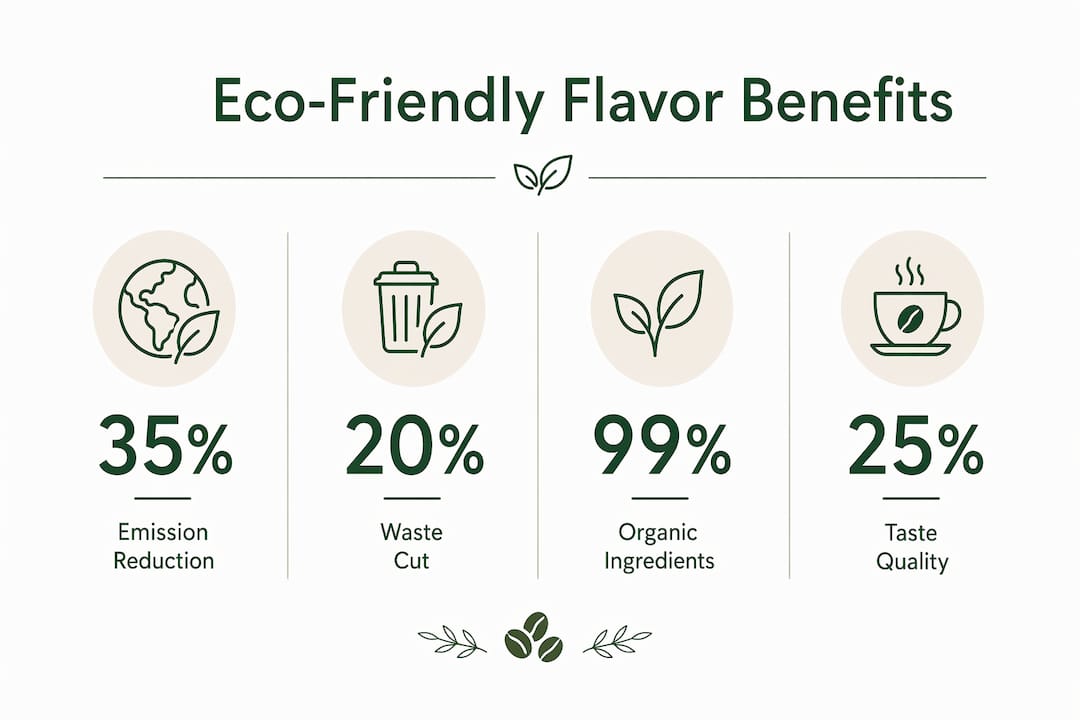
The benefits of eco-friendly flavoring are not abstract. They show up in your health, in the quality of your drink, and in the long-term health of the ecosystems that produce the ingredients you love.
Here are the most meaningful benefits, ranked from planetary to personal:
- Reduced deforestation and resource depletion. Sustainable sourcing practices prioritize ingredients grown on existing farmland using regenerative methods, rather than clearing new land. This directly protects forests and the biodiversity they support.
- Lower carbon footprint. Shorter, more transparent supply chains combined with green processing technologies reduce transportation emissions and energy use at every stage of production.
- Preserved soil health. Regenerative agriculture builds organic matter in soil, which improves water retention and long-term crop yields. Healthy soil means more consistent, aromatic ingredients season after season.
- Minimized chemical exposure for you. Organic flavor ingredients carry no synthetic pesticide residues, which is especially relevant for beverages you consume daily. Your morning cup of shade-grown coffee or hibiscus berry tea becomes a genuinely cleaner experience.
- Support for small-scale farmers. Sustainable supply chains often prioritize direct trade relationships with local growers, ensuring fair wages and community investment rather than funneling profits through layers of intermediaries.
- Enhanced flavor authenticity. The concept of molecular authenticity through minimal processing represents the future of sustainable flavoring. When ingredients are handled gently and honestly, the resulting flavor is richer and truer to the source.
“Transparency and precise traceability are essential for consumers to verify sustainability claims beyond generic ‘natural’ labels.” — Biotech and sustainability in flavoring
That quote captures something worth sitting with. A beverage brand that cannot tell you where its flavor ingredients come from, how they were grown, and how they were processed is not truly eco-conscious. It is just eco-adjacent.
Can sustainable flavoring actually taste as good?

This is the question most eco-conscious consumers quietly wonder about, and the answer is yes, with some nuance worth understanding. Climate change directly challenges flavor consistency, and unpredictable weather affects sugars, acids, and aromatic compounds in flavor ingredients, making batch-to-batch consistency a real technical challenge.
Here is how the industry is solving that problem:
| Challenge | Sustainable Solution |
|---|---|
| Climate-driven variability in ingredient profiles | Controlled environment agriculture (CEA) stabilizes growing conditions year-round |
| Heat and light sensitivity of natural flavors | Microencapsulation protects flavor compounds without synthetic additives |
| Supply chain unpredictability | AI-driven demand forecasting reduces sourcing gaps and waste |
| Batch inconsistency from natural ingredient variation | Biomolecular data analysis aligns flavor profiles across harvests |
Controlled environment agriculture, or CEA, uses indoor growing systems with precise light, humidity, and temperature control to produce flavor ingredients that are consistent regardless of what is happening outdoors. This is particularly valuable for delicate botanicals like jasmine blossoms or hibiscus, where even slight climate shifts alter the aromatic profile.
Microencapsulation wraps natural flavor compounds in a protective coating, shielding them from heat, light, and oxidation during storage and transport. This technology is essential because natural flavors are far more sensitive than synthetic ones, and it allows brands to maintain shelf life and quality without reaching for artificial stabilizers.
AI-integrated flavor development enables manufacturers to reduce production waste by over 20%. Early adopters use these tools to optimize ingredient sourcing and forecast demand more accurately, which means less waste and more reliable product quality for you as a consumer. In fact, AI-driven inventory forecasting can reach waste reductions of 15 to 25% for flavor ingredients, which also reduces transportation emissions and speeds up market readiness of sustainable products.
Pro Tip: When a brand publishes batch-specific flavor notes or harvest origin details, that is a strong signal they are using traceability tools and taking consistency seriously. It is the beverage equivalent of a wine vintage label.
What regulations and consumer demand are changing
The regulatory environment around sustainable flavoring is tightening, and that is genuinely good news for you as a consumer. Since 2025, EU regulations demand supply chain transparency and auditable records to validate sustainability claims for flavor ingredients. Compliance with frameworks like the Green Claims Directive is now mandatory in the EU to avoid penalties and maintain market access.
What this means in practice:
- Verified sustainability claims. Brands can no longer make vague environmental claims without documented evidence. Every “eco-friendly” or “sustainable” label must be backed by auditable supply chain records.
- Organic certification standards. USDA NOP in the United States and equivalent bodies in other markets set strict agricultural and processing requirements that certified organic flavors must meet, giving you a reliable benchmark.
- Anti-greenwashing enforcement. Regulators are actively pursuing brands that use misleading environmental language. This creates real accountability and rewards brands that invest in genuine sustainability.
- Consumer demand for clean labels. Shoppers increasingly want to see exactly what is in their beverage and where it came from. Brands that provide this transparency build stronger loyalty and command premium pricing.
- Traceability as a baseline expectation. Supply chain documentation is shifting from a competitive advantage to a baseline requirement. Brands that cannot trace their flavor ingredients from farm to cup are falling behind both regulators and consumers.
The importance of sustainable flavoring is no longer a niche concern. It is a market-wide shift, and the brands investing in genuine traceability and certified sourcing today are the ones you will trust most tomorrow.
Key takeaways
Eco-friendly flavoring delivers better taste, cleaner ingredients, and real environmental benefits when it is backed by certified sourcing, green extraction methods, and transparent supply chains.
| Point | Details |
|---|---|
| Certification is your best filter | Look for USDA Organic, Rainforest Alliance, or Fair Trade labels to confirm genuine sustainability. |
| Technology solves the consistency problem | Microencapsulation and CEA allow natural flavors to match synthetic ones in shelf life and reliability. |
| AI reduces waste across the supply chain | AI-driven forecasting cuts flavor ingredient waste by 15 to 25%, benefiting both brands and the environment. |
| Regulations now enforce transparency | EU Green Claims Directive and USDA NOP standards mean sustainability claims must be auditable and verified. |
| Biodiversity depends on diversified sourcing | With over 75% of global food from a narrow species base, sustainable flavoring actively protects ecological variety. |
My honest take on where sustainable flavoring is headed
I have spent years watching the beverage industry make promises about sustainability that rarely survived close inspection. “Natural” was the word that covered a multitude of sins. Brands would source a single organic ingredient, feature it prominently on the label, and quietly use conventional everything else.
What has changed recently is the technology. Precision fermentation and biomolecular analysis are not marketing concepts anymore. They are production realities, and they are making it genuinely possible to deliver consistent, aromatic, rich flavor from sustainably sourced ingredients at scale. That was not true five years ago.
My advice to you is simple: stop trusting the word “natural” and start trusting documentation. Ask whether a brand publishes its sourcing origins. Check whether certifications are current and third-party verified. Look for brands that talk about specific farms, specific harvests, and specific extraction methods, because that level of detail is only possible when the supply chain is actually transparent.
The eco-friendly tea brewing space is one of the most exciting areas right now, because botanical flavors like hibiscus and jasmine are extraordinarily sensitive to how they are grown and processed. When a brand gets that right, you taste the difference immediately. It is not subtle.
The future of sustainable flavoring is what researchers call molecular authenticity: flavor compounds that are minimally processed, traceable to their source, and genuinely representative of the plant they came from. That is a warm hug for both your taste buds and Mother Earth, and it is closer than most people realize.
— LaSaundra
Taste the difference with Ecoviberoast

Ecoviberoast sources every beverage with the same principles this article describes: certified organic ingredients, transparent supply chains, and a genuine commitment to the planet. Each purchase plants mangrove trees and removes ocean-bound plastics, so your daily cup does real environmental work.
If you want to experience what eco-conscious flavoring actually tastes like, the Hibiscus Berry Tea is a perfect starting point. It is refreshing, organically sourced, and bursting with the kind of authentic floral-fruit flavor that only comes from responsibly grown botanicals. For something more delicate, the Jasmine Tea delivers a floral green tea experience that reflects exactly the kind of careful, sustainable sourcing this article champions. Your next cup can be both delicious and meaningful.
FAQ
What is eco-friendly flavoring?
Eco-friendly flavoring refers to flavor ingredients sourced and produced using sustainable methods, including organic farming, green extraction techniques like steam distillation, and supply chains that prioritize biodiversity and fair labor practices.
Why does sustainable flavoring matter for my health?
Organic flavor ingredients contain no synthetic pesticide residues, meaning your daily beverages carry a cleaner chemical profile. Certified organic standards from bodies like USDA NOP prohibit synthetic solvents during extraction, which directly reduces your exposure to chemical residues.
Does eco-friendly flavoring taste as good as conventional flavoring?
Yes. Technologies like microencapsulation and controlled environment agriculture now allow natural flavors to match conventional ones in consistency and shelf life, while delivering richer, more authentic taste profiles rooted in the actual source ingredient.
How can I tell if a brand’s flavoring is genuinely sustainable?
Look beyond “natural” labels and check for third-party certifications like USDA Organic or Rainforest Alliance. Brands that publish harvest origins, batch-specific flavor notes, and auditable supply chain records are demonstrating the kind of verified sustainability claims that regulations now require.
What role does AI play in sustainable flavoring?
AI-driven supply chain modeling helps brands reduce flavor ingredient waste by 15 to 25%, optimize sourcing decisions, and forecast demand more accurately. This reduces transportation emissions and makes sustainably sourced flavors more consistently available to consumers.
Recommended
- Flavored coffee sustainability tips: brew greener, enjoy better – EcoVibe Roast
- Sustainable packaging in beverages: eco-conscious guide 2026 – EcoVibe Roast
- Flavored Coffee Sustainability – How It Impacts Our World – EcoVibe Roast
- 7 Flavored Coffee Advantages Every Eco Drinker Should Know – EcoVibe Roast


