

Supply chain transparency is the deliberate disclosure and contextual sharing of sourcing, labor, and environmental data so that buyers, regulators, and everyday customers can hold a business accountable. It is not a marketing slogan. It is a working business capability, and it does three specific jobs for the companies that build it well.
- Builds stakeholder trust by giving customers, investors, and partners real evidence instead of a promise.
- Enables strategic risk management by surfacing problems (forced labor, deforestation, quality failures) before they become headlines or recalls.
- Unlocks operational and commercial value, from better supplier negotiations to premium pricing for verified, ethically sourced goods.
The rest of this guide walks through how transparency differs from visibility, what it actually buys you, and how to build a program that works whether you’re managing a coffee cooperative relationship or a global electronics supply base.
Key Takeaways
Supply chain transparency works when disclosure objectives, supplier incentives, and verifiable data infrastructure are all built together, not layered on after the fact.
| Point | Details |
|---|---|
| Transparency needs visibility and disclosure | Internal data alone doesn’t build trust; you have to share context externally too. |
| Second-tier disclosure reduces risk | Getting critical tier-2 suppliers to disclose data lowers ESG risk exposure measurably. |
| Pilot before scaling | Test transparency efforts on one product line for two to three months before a full rollout. |
| Match tools to objectives | Choose ERPs, traceability platforms, or blockchain based on the specific problem, not the hype. |
| Track concrete KPIs | Measure spend mapped by tier, verified disclosures, and time-to-trace, not vague sustainability language. |
| Ecoviberoast models it at small scale | Disclosed farmer relationships, published certifications, and purchase-linked impact show the approach working. |
Table of Contents
- What Is the Role of Transparency in Supply Chains, Really?
- What Business and Ethical Benefits Does Transparency Deliver?
- How Do You Actually Improve Supply Chain Transparency?
- Which Technologies Actually Enable Transparency?
- What Challenges Come With Being More Transparent?
- How Should You Measure and Report Transparency Progress?
- What Does Transparent Sourcing Look Like in Practice?
- Why We Built Transparency Into Every Bag
- See Transparent Sourcing for Yourself
- Frequently Asked Questions
- Sources
What Is the Role of Transparency in Supply Chains, Really?
Transparency gets confused with two neighboring concepts, and that confusion causes a lot of wasted budget. Visibility is the real-time operational data you use internally: where a shipment sits right now, what a supplier’s current capacity looks like. Traceability is the historical, product-level record: which farm grew this batch, which factory stitched this garment. Transparency is the outward-facing layer built on top of both. It’s the disclosure and contextualizing of that data for people outside your four walls who need to trust your claims.
According to MIT Sloan, transparency requires both visibility and disclosure working together. You can have excellent internal visibility and still be opaque to the public if you never share what you know. Full disclosure isn’t always the right call, either. A consumer-facing sustainability report might warrant broad public disclosure, while a competitive sourcing detail might only go to auditors or certifying bodies under a confidentiality agreement.
- Visibility: internal, real-time, operational (where’s my shipment today?)
- Traceability: internal or shared, historical, product-specific (where did this batch originate?)
- Transparency: external-facing, contextual, accountability-driven (can we prove our claims to the public?)
A scholarly review of supply chain transparency research warns that treating these three as interchangeable is exactly how companies end up with expensive tracking systems and still no public trust to show for it.
What Business and Ethical Benefits Does Transparency Deliver?
The case for transparency isn’t just moral. It shows up in trust metrics, risk exposure, and market access, and each stakeholder group cares about a different slice of it.
Customers respond to disclosure in measurable ways. Research highlighted by MIT Sloan Management Review finds that transparency can strengthen customer trust and, among socially minded and skeptical shoppers in particular, increase the likelihood they’ll actually buy. That second group matters more than people assume. Skeptical consumers don’t need a nicer story. They need something they can verify, and transparency is what pushes past their doubt.
Investors and boards increasingly treat disclosure as an ESG signal, not an optional nicety. A company that can show verified supplier data has an easier time in due diligence conversations than one relying on unverifiable claims.
Partners and suppliers benefit too, though it’s less obvious. Clear disclosure expectations create accountability on both sides of a contract, which tends to reduce disputes over quality and compliance later.
Operations teams get the most underrated benefit: earlier risk detection. When you can see two or three tiers deep into your supply base, you catch a labor violation or a quality slip before it becomes a recall. A study of 428 buyer firms found that disclosure from critical second-tier suppliers, the ones sitting just behind your direct vendors, meaningfully reduces a buyer’s ESG risk exposure. The effect gets stronger when the buyer’s own network is easier to navigate, which is one more argument for mapping your supply base before you try to fix it.
Compliance is its own driver. The California Transparency in Supply Chains Act already requires large retailers and manufacturers to disclose their anti-slavery and anti-trafficking efforts. Regulations like this are only going to multiply, so building the disclosure muscle now beats scrambling later.
One honest caveat: ROI here is often indirect and slow. You won’t always get a clean revenue line tied to a transparency initiative. What you get is fewer surprises, stronger renewal conversations with retail partners, and a defensible story when a journalist or regulator comes asking.
Pro Tip: Frame your transparency program internally as risk management with upside, not as a cost center. Executives fund risk mitigation far more readily than they fund “doing the right thing” alone, even when the actions are identical.
How Do You Actually Improve Supply Chain Transparency?
Most transparency programs fail for one reason: they try to disclose everything before they’ve mapped anything. Work through this in order.
- Run a materiality and risk assessment. Identify which parts of your supply chain carry the highest ethical, environmental, or reputational risk. A coffee roaster’s biggest exposure is usually at the farm and cooperative level, not in packaging or logistics.
- Map your supplier tiers. Most companies know their direct (tier-1) suppliers well and know almost nothing past that. Nexus supplier disclosure, meaning transparency from those critical tier-2 vendors, is where a lot of hidden risk lives.
- Set disclosure objectives before you collect data. Decide what you’re disclosing, to whom, and why. Skipping this step is how companies end up buried in supplier data they never use.
- Engage suppliers as partners, not auditees. MIT Sloan notes that audits alone rarely surface upper-tier risks; you need shared ownership and genuine collaboration with the people closest to the sourcing.
- Standardize disclosure formats across suppliers so you’re not reconciling five spreadsheet formats every quarter.
- Pilot before scaling. Pick one product line or one region, run it for two to three months, and fix the process before rolling it out company-wide.
A realistic pilot needs a few things locked down early: which data elements you’re collecting (certifications, labor practices, emissions, origin), who governs the data internally, and how you’ll verify what suppliers tell you.
Cost scales with ambition. A single-category pilot using existing procurement software might cost little beyond staff time. Enterprise-wide blockchain traceability is a different order of investment entirely, and most companies should not start there.
- Assign procurement to own supplier relationships and data collection.
- Assign legal to update contracts with disclosure clauses and audit rights.
- Assign sustainability to define what “good” looks like against recognized standards.
- Assign marketing to translate verified data into honest, non-inflated customer claims.
Align supplier incentives too. A supplier who sees transparency as a compliance burden will give you low-quality data. A supplier who sees it as a path to a longer contract or premium pricing will give you good data voluntarily.
Which Technologies Actually Enable Transparency?
Tool selection should follow your objective, not the other way around. Here’s how the major categories map to actual use cases.
| Technology | Best Use Case | Watch-Out |
|---|---|---|
| ERP and integrated procurement systems | Centralizing supplier data you already collect | Often lacks tier-2+ visibility out of the box |
| Traceability platforms | Product-level origin tracking (farm, factory, batch) | Data quality depends entirely on supplier input |
| Blockchain/ledger solutions | Immutable, shareable proof across many parties | High cost and complexity for smaller supply bases |
| IoT and sensors | Real-time condition monitoring (temperature, location) | Solves visibility, not disclosure, on its own |
| Supplier portals | Standardizing how suppliers submit disclosures | Adoption depends on ease-of-use for the supplier |
| Data-exchange APIs | Connecting your systems to certifiers or partners | Requires ongoing integration maintenance |
Before you sign a contract, run through a short checklist: Does the platform’s data model match what you actually need to disclose? What’s the real integration cost, including staff time? Can it support third-party audits, not just internal reporting? Is it simple enough that a small supplier will actually use it? And does it protect confidential business information while still enabling public-facing claims?
Business platforms increasingly recommend an incremental approach: build visibility first, pilot with a handful of suppliers, then scale using procurement technology you already have before adding anything new.
Pro Tip: Don’t buy an enterprise blockchain platform to solve a problem a supplier portal and a spreadsheet-cleanup project could fix for a fraction of the cost. Prove ROI on a small pilot before you scale the tech spend.
What Challenges Come With Being More Transparent?
Every real transparency program runs into friction, and the trick is anticipating it rather than being surprised by it.
Cost and data quality top the list. Suppliers without existing data infrastructure will hand you incomplete or inconsistent information at first. Staged disclosure, meaning you start with a few required fields and expand over time, beats demanding everything at once.
Supplier resistance is common, especially from smaller vendors who see disclosure as extra work with no clear benefit to them. Contractual incentives, like longer terms or priority ordering tied to verified disclosure, tend to work better than mandates alone.

Confidentiality concerns are legitimate, not just an excuse. Full disclosure of sourcing details can occasionally expose competitive information or, in rare cases, make it easier for suppliers to coordinate pricing. Anonymized, aggregated reporting solves most of this: you can report “80% of our tier-1 suppliers are certified” without naming every vendor and every rate.
Red flags worth watching for include suppliers who repeatedly miss data deadlines, provide numbers that don’t reconcile with shipment records, or resist any third-party verification. Those patterns usually mean deeper problems, not just administrative sloppiness.
Pro Tip: If a supplier pushes back hard on basic disclosure requests, that resistance is information in itself. Treat it as a risk signal worth investigating, not an inconvenience to smooth over.
How Should You Measure and Report Transparency Progress?
Vague sustainability language doesn’t survive scrutiny anymore. Concrete KPIs do.
- Percent of spend mapped to tier-2 and beyond. Most companies start near zero here; even 30 to 40% is a meaningful milestone.
- Number of verified supplier disclosures, not just self-reported ones.
- Time-to-trace for a recall or incident. Days matter far more than weeks.
- ESG incident rate across your supplier base, tracked over time.
Report differently depending on audience. Public sustainability reports can stay high-level and annual. Partner and auditor reporting should be granular and available more frequently, sometimes quarterly. Third-party verification, whether through Fair Trade, recognized coffee certifications, GRI-aligned reporting, or independent audits, adds credibility that self-reported data simply can’t match on its own. The data-centric framework separating visibility, traceability, and transparency is a useful reference point when deciding exactly which KPI belongs to which capability.
What Does Transparent Sourcing Look Like in Practice?
Here’s a concrete example rather than a theory. Ecoviberoast builds its sourcing around disclosed relationships with coffee farms and cooperatives, published certifications, and public commitments tied to environmental impact, including mangrove planting and ocean-bound plastic removal tied to purchases.
What that looks like in measurable terms:
- Origin and farmer relationship information shared on product pages, not buried in a footnote.
- Certifications disclosed clearly rather than implied through vague “eco-friendly” language.
- Environmental impact actions tied directly and publicly to individual purchases.
This is a small-scale, replicable model. A local roaster or a regional distributor can apply the same logic: disclose what you actually know, verify what you claim, and resist the urge to say more than you can back up. You can see this approach worked through in more depth in Ecoviberoast’s coffee supply transparency guide.
Why We Built Transparency Into Every Bag
Transparency isn’t a compliance checkbox for us; understanding local sourcing benefits and challenges is central to making credible supply chain claims. It’s the reason we can tell you exactly whose farm your coffee came from and what that purchase funded. Every sourcing decision starts with a simple question: can we actually prove this claim to a customer who asks?
See Transparent Sourcing for Yourself
Everything covered above, tier mapping, certifications, disclosed farmer relationships, is easier to trust when you can see it applied to an actual product instead of a policy document. That’s the gap Ecoviberoast tries to close: our environmental impact page lays out exactly what each purchase funds, from mangrove planting to ocean-bound plastic removal, with specifics instead of vague claims.

If you want to see disclosure applied to a real product, start with something simple. Our 60-pack single-serve coffee pods carry the same sourcing transparency as our whole-bean line, and the jasmine tea page shows how we handle disclosure for a smaller-batch product. Browse the single-serve collection to see how sustainable packaging and disclosed sourcing show up across a full product line, then decide for yourself whether the proof holds up.
Frequently Asked Questions
What is the role of transparency in supply chains for a small business? For a small business, transparency mainly builds trust with customers and reduces the risk of undetected supplier problems. You don’t need enterprise tools; a supplier questionnaire and honest, verified product-page claims cover most of the ground.
How is supply chain transparency different from supply chain visibility? Visibility is internal, operational data you use to run your business day to day. Transparency is the external disclosure of contextualized information so outside stakeholders can hold you accountable.
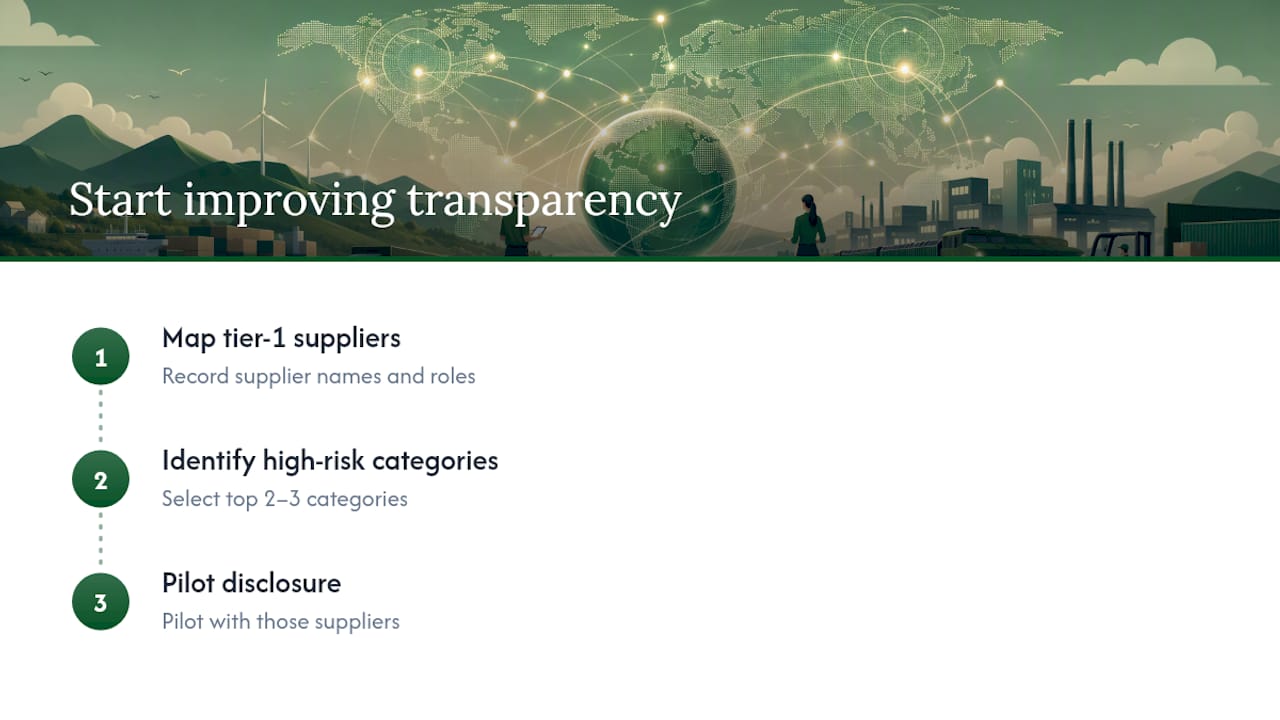
What’s the fastest way to start improving transparency? Map your tier-1 suppliers first, identify your two or three highest-risk categories, and pilot disclosure with just those suppliers before expanding.
Do consumers actually care about supply chain transparency? Yes, particularly skeptical and socially minded shoppers, who are more likely to purchase when they can verify sourcing claims rather than just take a brand’s word for it.
Is blockchain necessary for supply chain transparency? No. Blockchain suits specific cases involving many parties needing shared, tamper-proof records. Most companies get more immediate value from a supplier portal or better ERP integration first.
Sources
- Supply chain transparency, explained | MIT Sloan
- How Supply Chain Transparency Boosts Business Value
- A review of supply chain transparency research: Antecedents, technologies, types, and outcomes
- The role of nexus supplier transparency and buyer supply network accessibility (IJOPM)
- Data-centric framework clarifying visibility, traceability, and transparency (transport research/operations management literature)


