

Biodiversity in farming is the variety and variability of animals, plants, and microorganisms across three levels — genetic, species, and ecosystem — that together sustain the functions a farm needs to produce food. Think of it as the living web beneath, around, and within every field: the heirloom tomato variety, the bumblebee visiting a coffee flower, the fungal threads threading through the soil. According to the FAO’s agricultural biodiversity framework, this variety is not a bonus feature of healthy farms — it is the engine that keeps them running.
- Farm resilience depends on genetic diversity: when one variety fails, others survive.
- Ecosystem services — pollination, pest control, nutrient cycling — flow from species richness, reducing the need for synthetic inputs.
- Food security is at risk when biodiversity erodes; the Convention on Biological Diversity frames biodiversity as the very basis of agriculture itself.
Key Takeaways
Biodiversity in farming operates across genetic, species, and ecosystem levels, and protecting it is one of the most practical things a farmer can do for long-term yield stability and reduced input costs.
| Point | Details |
|---|---|
| Three-level definition | Agricultural biodiversity spans genetic, species, and ecosystem diversity — all three levels matter for farm function. |
| Ecosystem services are the payoff | Pollination, pest control, nutrient cycling, and water regulation flow from biodiversity and reduce dependence on synthetic inputs. |
| Threats are accelerating | Monoculture, genetic erosion, pesticide use, habitat loss, and climate change are each eroding the biodiversity farms depend on. |
| Practices build over time | Crop rotation, cover crops, agroforestry, hedgerows, and seed saving all increase biodiversity — but benefits typically build across multiple seasons, not one harvest. |
| Start with one low-effort step | Walk a field-margin transect and count pollinator types for 10 minutes — it costs nothing and starts your monitoring baseline today. |
Table of Contents
- What is biodiversity in farming, exactly — the three levels explained
- How does biodiversity affect farming outcomes and ecosystem services?
- What are the biggest threats to biodiversity on farms?
- Practical ways farmers can increase biodiversity on their land
- How can you measure and monitor biodiversity on a farm?
- Why farmers, traditional knowledge, and policy all shape agricultural biodiversity
- Why biodiversity in farming feels personal to me
- Sources
What is biodiversity in farming, exactly — the three levels explained
When people ask what agricultural biodiversity means in practice, the answer has three layers, and each one shows up differently on a real farm.
Genetic diversity is the variation within a single species. A coffee farmer growing three distinct Arabica varieties — say, Typica, Gesha, and Bourbon — holds genetic diversity even though all three plants look similar at a glance. That variation is what lets one variety shrug off a fungal outbreak that wipes out another. Seed-saving traditions and on-farm genebanks are the main way farmers preserve this layer.
Species diversity is the count and mix of different organisms sharing the farm. This includes the crops and livestock a farmer intentionally manages (called planned biodiversity) and the organisms that arrive on their own: wild pollinators, predatory beetles, earthworms, soil fungi, hedgerow birds. The FAO’s State of the World’s Biodiversity for Food and Agriculture explicitly includes domesticated species, their wild relatives, and all these associated organisms as part of the biodiversity that supports food systems.
Ecosystem diversity refers to the variety of habitats and landscapes within and around the farm: the crop field itself, a riparian buffer, a woodlot, a flower strip along the field margin. Each habitat type hosts different communities and provides different services.
A quick way to see all three levels on a single farm:
- Genetic: multiple coffee or tea cultivars planted side by side
- Species (planned): coffee trees, shade trees, cover crops, livestock
- Species (associated): native bees, parasitic wasps, mycorrhizal fungi, earthworms
- Ecosystem: shaded agroforestry plots, open pasture, hedgerows, stream margins
The distinction between planned and associated biodiversity matters because farmers often focus only on what they plant. The associated organisms — the ones nobody sows — are frequently the ones delivering the most valuable services for free.
How does biodiversity affect farming outcomes and ecosystem services?
Biodiversity is not just a conservation ideal. It translates directly into farm economics and yield stability through a set of processes ecologists call ecosystem services.
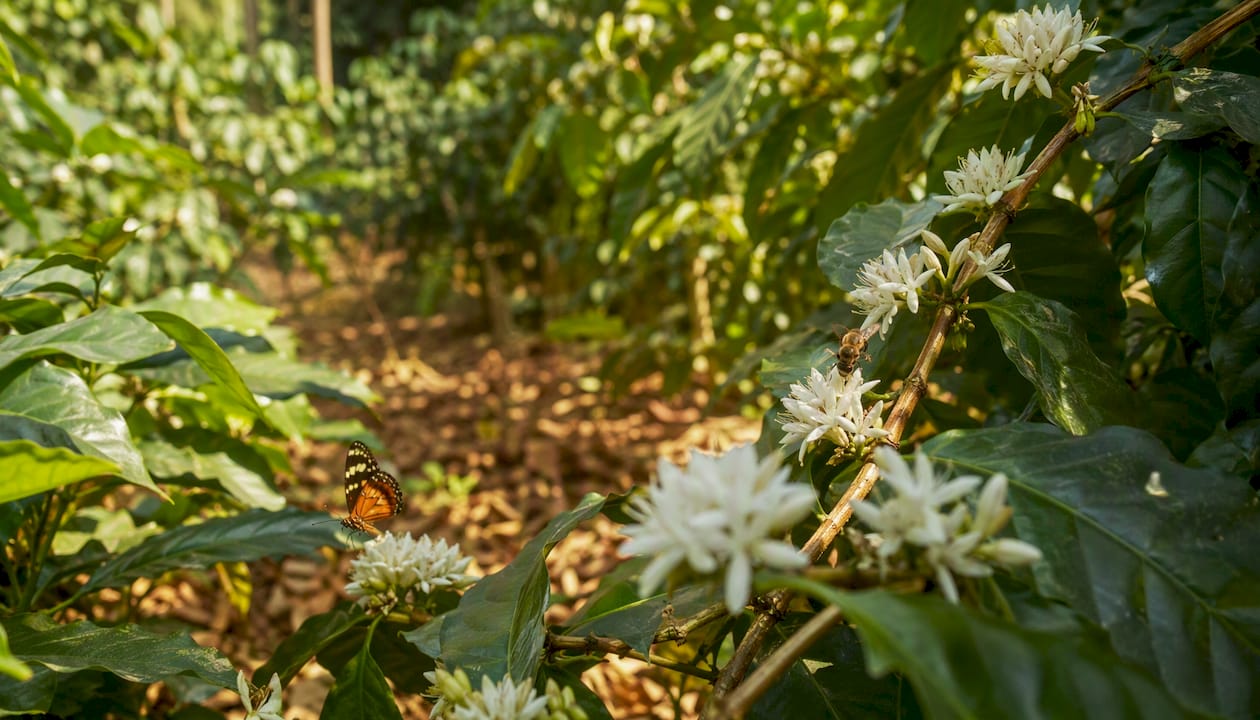
Pollination is the most visible example. A large majority of the world’s flowering crops depend on animal pollinators, and wild bee diversity strongly predicts pollination reliability. A farm with only managed honeybees is one disease outbreak away from a pollination gap; a farm that also hosts solitary bees, hoverflies, and butterflies has built-in redundancy.
Natural pest control works through predator-prey relationships. Ladybugs, ground beetles, parasitic wasps, and spiders suppress aphids, caterpillars, and other pests when the farm provides habitat for them. Research published in Ecology & Society shows that integrating non-crop habitats such as hedgerows and flower strips measurably increases both pollinator populations and natural enemy populations on adjacent crops — reducing the need for pesticide applications.
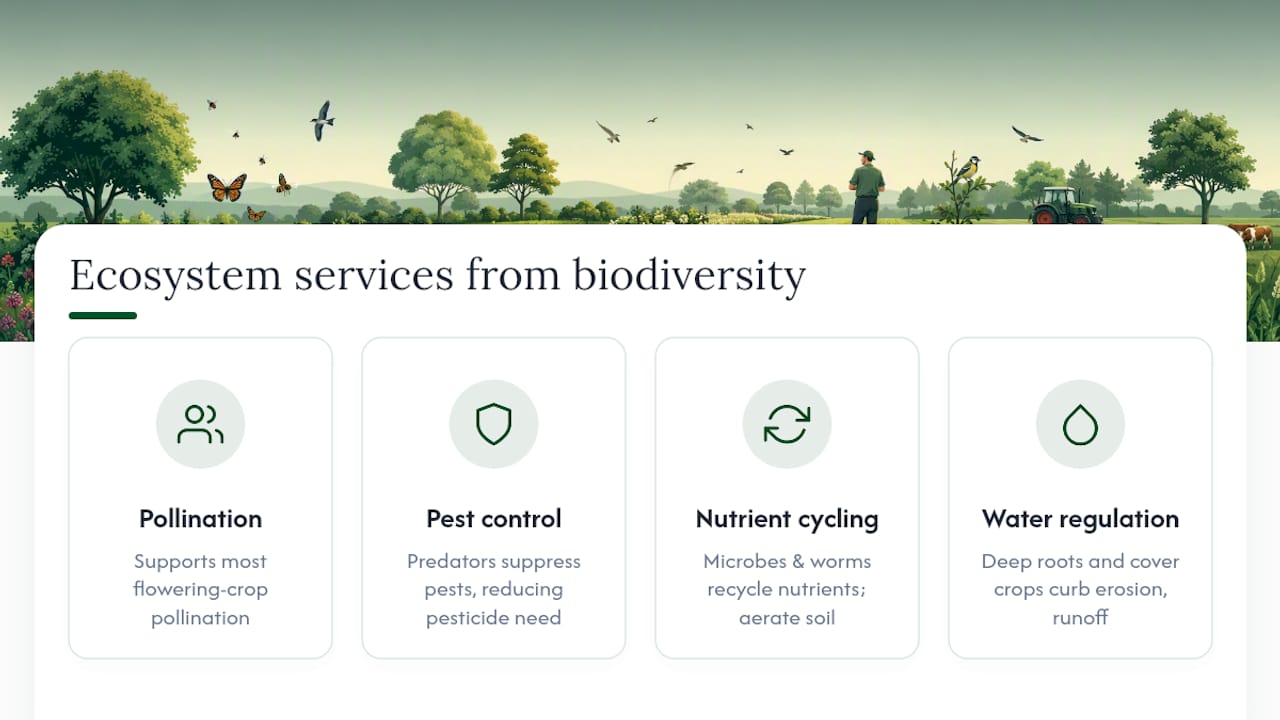
Nutrient cycling happens underground. Soil bacteria break down organic matter and release nitrogen; mycorrhizal fungi extend root systems and improve phosphorus uptake; earthworms aerate and structure the soil. A review in Science Advances underscores that soil biodiversity is a hidden but critical component of farm resilience, and that prioritizing soil health through organic amendments and reduced tillage is one of the highest-leverage moves a farmer can make.
Water regulation and erosion control follow from plant diversity. Deep-rooted perennials and cover crops hold soil in place, slow runoff, and recharge groundwater — services that become more valuable as rainfall patterns grow less predictable.
The Science review on why biodiversity matters in agriculture makes the economic case plainly: biodiversity loss threatens these services, and replacing them with synthetic inputs is both costly and often incomplete. Farms with higher biodiversity tend to show greater yield stability across years, not necessarily higher peak yields, but far fewer catastrophic failures.
What are the biggest threats to biodiversity on farms?
The pressures are real, and several of them have been building for decades.
Monoculture and genetic erosion sit at the top of the list. The 20th century’s Green Revolution dramatically increased yields but concentrated production around a handful of high-performing varieties. The Science review warns of major reductions in crop genetic diversity over that period, with global food supply now dominated by a surprisingly small number of species. When a new pathogen or climate shift targets those few crops, the consequences can be severe and widespread.
Pesticide and synthetic fertilizer use suppresses the associated biodiversity that farms depend on. Broad-spectrum insecticides kill beneficial insects alongside pests. Herbicides reduce the plant diversity in field margins. Synthetic nitrogen, applied heavily, can shift soil microbial communities away from the diverse assemblages that cycle nutrients most efficiently.
Habitat loss removes the refuges that non-crop species need. When hedgerows are grubbed out to enlarge fields, when wetlands are drained, when woodlots are cleared, the species that lived there do not simply relocate — they disappear from the local farming system.
Climate change amplifies all of these pressures. Shifting temperature and rainfall patterns alter which pests and pathogens thrive, push crop-growing zones poleward, and stress varieties that were bred for stable conditions. The genetic diversity held in traditional varieties and wild relatives is the raw material breeders need to develop climate-adapted crops — which makes its loss especially costly right now.
The stakes are high: scientific reviews now describe biodiversity loss in agricultural landscapes as a critical threat to food security, not a distant ecological concern.
Practical ways farmers can increase biodiversity on their land
The good news is that a wide range of evidence-backed practices can rebuild biodiversity at the farm scale. A Wiley Global Change Biology review found that agricultural diversification through intercropping, crop rotation, and agroforestry delivers long-term benefits including increased biodiversity, better pollination, pest and disease control, and improved water quality.
- Crop rotation breaks pest and disease cycles by denying any single organism a permanent host. Rotating legumes into the sequence also fixes atmospheric nitrogen, reducing fertilizer needs.
- Intercropping and mixed-species planting increase species diversity immediately. Planting a cereal alongside a legume, or coffee under shade trees, creates structural complexity that supports more organisms.
- Cover crops protect bare soil between cash-crop seasons, feed soil microbes, and provide forage for pollinators when they flower. Combined with reduced tillage, they accelerate soil biodiversity recovery.
- Agroforestry integrates trees into crop or livestock systems, adding a vertical habitat layer. Shade-grown coffee is a classic example: the canopy supports birds, insects, and soil organisms while moderating temperature stress on the coffee plants. Ecoviberoast’s mangrove-planting work illustrates how tree-planting initiatives extend this logic beyond the farm gate.
- Hedgerows and field margins provide corridors and refuges for pollinators and predatory insects. Even a strip of grass along a field edge can meaningfully increase beneficial insect populations.
- Reduced tillage protects soil structure and the organisms living in it. Frequent deep plowing disrupts fungal networks and kills soil fauna; cutting tillage frequency gives those communities time to recover.
- Integrated pest management (IPM) uses biological controls, habitat management, and targeted pesticide applications as a last resort rather than a first response.
- Seed saving and on-farm genebanks preserve genetic diversity that commercial seed markets often do not carry. Farmers who save seed from their best-performing plants are actively selecting for local adaptation.
Pro Tip: Don’t try to implement every practice at once. Start with cover crops and reduced tillage together — they reinforce each other, improve soil health faster than either alone, and create a foundation that makes every other practice more effective. A Nature study on diversification outcomes confirms that benefits build over multiple seasons, so patience and consistency matter more than scale.
How can you measure and monitor biodiversity on a farm?
You don’t need a laboratory to start tracking biodiversity. Simple, consistent observation builds a picture over time that is genuinely useful for management decisions.
Start with these low-effort indicators:
- Count the number of crop varieties and livestock breeds on the farm each season.
- Walk field margins in early morning and record pollinator species or morphotypes (bumblebees, honeybees, hoverflies, butterflies) for 10 minutes per transect.
- Do a visual soil health check: dig a small hole and look for earthworms, smell for a rich earthy scent (a sign of active microbial life), and assess aggregate structure.
- Track cover crop biomass before termination — higher biomass generally signals a more active soil food web.
A simple periodic monitoring checklist:
- Monthly (growing season): Walk two field-margin transects and note pollinator activity; record any new pest or beneficial insect sightings.
- Each season: Count crop varieties in production; assess soil structure and earthworm counts in three locations per field.
- Annually: Review pesticide and fertilizer inputs against the previous year; photograph the same hedgerow or margin locations to track vegetation change.
- Every 2–3 years: Consider a professional soil health panel (microbial biomass, respiration rate) or a formal pollinator survey to ground-truth your field observations.
For more advanced monitoring, soil DNA metabarcoding can identify thousands of microbial species from a single sample, and formal transect counts using standardized protocols give statistically comparable data across years. These are worth the investment when you are applying for agri-environment payments or trying to document ecosystem service delivery to buyers. Ecoviberoast’s guide on soil health in coffee farming walks through why these indicators matter for beverage-crop quality specifically.
Why farmers, traditional knowledge, and policy all shape agricultural biodiversity
Farmers are not just producers — they are custodians of genetic resources. Over millennia, farming communities selected, saved, and exchanged seeds, developing the thousands of crop varieties that still exist today. That local knowledge is often the only medium through which adaptive traits survive; when a farming community abandons a traditional variety, the knowledge of how to grow and use it usually disappears with the seed.
The economic picture is shifting in ways that reward diversity. Consumer demand for heritage grains, heirloom vegetables, and single-origin specialty coffees creates market incentives for farmers to maintain rare varieties. Food-service operators are increasingly seeking diverse, seasonal sourcing as both a culinary and a sustainability signal. Payments for ecosystem services — where farmers are compensated for the pollination or water-quality benefits their land provides — are expanding in several countries, though coverage remains uneven.
At the international level, the International Treaty on Plant Genetic Resources for Food and Agriculture (the Plant Treaty) governs access to and benefit-sharing from crop genetic resources. The Convention on Biological Diversity sets the broader framework. CGIAR genebank networks conserve hundreds of thousands of crop accessions and supply germplasm to breeders developing climate- and disease-resistant varieties — a backstop that depends on the genetic diversity farmers have maintained on-farm for generations.
The connection between biodiversity and sustainable agriculture in coffee and tea supply chains is direct: the flavor complexity, disease resistance, and climate adaptability of specialty crops trace back to the genetic and ecological diversity maintained by farming communities around the world.
Why biodiversity in farming feels personal to me
When I think about what ends up in your morning cup, I keep coming back to the farms where it all begins. The aromatic depth of a well-grown coffee or a carefully tended tea leaf is inseparable from the living ecosystem that produced it: the shade trees, the soil microbes, the pollinators working the flowers at dawn. Biodiversity is not an abstract environmental metric — it is the reason one cup tastes rich and complex while another tastes flat.
At Ecoviberoast, our sourcing choices are guided by exactly this understanding. We look for farms and cooperatives that maintain diverse growing systems, because the evidence is clear that those systems produce better, more resilient crops and support the communities that tend them. Every purchase you make with us contributes to tree-planting and ocean-plastic-removal initiatives that extend the circle of care from the farm to the wider ecosystem. That feels like the right kind of coffee ritual to me.
Sources
- Plant Production and Protection Division: What is agricultural biodiversity
- Why is it Important? - Convention on Biological Diversity (CBD)


