

TL;DR:
- Community trade tea is sourced under strict fair trade standards that ensure fair wages, sustainable farming, and community investment. Certification involves annual audits, minimum price floors, and community-controlled premiums, with transparency vital for genuine support. The most impactful benefits come from cooperatives that use premiums for infrastructure and capacity building, making certification and transparency key for ethical purchasing.
Community trade tea is defined as tea sourced under rigorous social, economic, and environmental standards that guarantee fair wages, sustainable farming, and direct investment in producer communities. The term is widely used by conscious consumers, though the recognized industry framework behind it is fair trade certification, governed by bodies like Fairtrade International and verified by auditors like FLOCERT. Whether you call it community trade tea or fair trade tea, the core promise is the same: every cup you drink connects to a farmer who was paid fairly and a community that grew stronger because of it. This guide breaks down exactly how that works, what certifications mean, and how you can shop with confidence.
What is community trade tea and how does certification define it?
Community trade tea is built on a foundation of enforceable standards, not just good intentions. Fair trade certification requires annual social audits conducted by accredited bodies like FLOCERT, verifying that farms prohibit child labor and forced labor, maintain safe working conditions, and respect collective bargaining rights. These audits give the certification real teeth.

Two financial mechanisms sit at the heart of the system. First, minimum price floors protect farmers from market crashes by requiring buyers to pay a set minimum regardless of global price swings. Second, the Fairtrade Premium adds a fixed amount on top of the purchase price, deposited into a community fund controlled by farmers or workers. Together, these tools create a financial safety net that no spot market can erode.
The certification framework also draws a meaningful line between two producer types. Smallholder cooperatives own their farms collectively, so premium funds flow directly to member families. Hired-labor plantations operate differently: premium funds are managed jointly by management and workers, and they do not automatically translate into individual wage increases. Knowing which model your tea comes from tells you a lot about where your money actually goes.
| Certification element | What it requires | Who verifies it |
|---|---|---|
| Minimum price floor | Buyer pays set minimum regardless of market | FLOCERT audit |
| Fairtrade Premium | Extra funds deposited into community account | FLOCERT audit |
| Labor standards | No child or forced labor, safe conditions | Annual social audit |
| Environmental criteria | Restricted pesticide use, sustainable farming | Third-party inspection |
| Democratic fund control | Farmers or workers vote on premium spending | Cooperative governance |
Pro Tip: Look for the official Fairtrade International mark, not just the word “fair trade” on packaging. The logo signals third-party verification, not a self-declared claim.
How sustainable farming practices shape ethical tea production
Sustainable tea production goes well beyond avoiding harmful chemicals. It requires a whole-farm approach that rebuilds soil, conserves water, and protects the biodiversity that keeps tea gardens productive for generations. Cooperatives play a central role here because they give smallholders access to training and credit that individual farmers rarely afford on their own.
One of the most exciting developments in sustainable tea cultivation is the use of plant growth-promoting bacteria, or PGPB, as a direct alternative to synthetic fertilizers. Field trials show that PGPB consortiums improve antioxidant activity in tea plants, increase microbial diversity in the soil, and boost enzyme activity compared to conventional fertilizer treatments. That means healthier plants and richer soil without the chemical runoff that harms local waterways.
A 2026 study of 745 households in Sri Lanka found that cooperative membership directly correlates with higher adoption of soil management, mulching, and water conservation practices among tea farmers. Cooperative participation is not just a social benefit. It is a practical driver of better farming. Farmers who share knowledge and resources simply do better.
The barriers to adoption are real, though. Research from Vietnam shows that smallholders often perceive environmental standards as burdensome without targeted technical training and cooperative support. Capacity building is the bridge between certification requirements and actual farm-level change. Certifications that invest in farmer education produce measurably better outcomes than those that only audit for compliance.
- Soil health: Mulching and composting reduce erosion and improve water retention.
- Water conservation: Drip irrigation and contour planting cut water use significantly.
- Biodiversity: Shade-grown tea gardens support bird populations and natural pest control.
- Biofertilizers: PGPB treatments replace synthetic inputs without sacrificing yield.
Pro Tip: When evaluating a tea brand’s sustainability claims, ask whether they fund farmer training programs. Certification compliance alone does not guarantee that farmers have the tools to maintain those standards long term.
Who benefits from community trade tea, and how deep does the impact go?
The most direct beneficiaries of community trade tea are the farming families who grow it. The Fairtrade Premium fund finances projects that individual families could never afford alone. A project in Capulí Grande, Colombia, used premium funds to build a water treatment plant that delivered safe drinking water to 70 families. That is the kind of infrastructure shift that changes daily life in a lasting way.
Premium funds are democratically controlled by the farmers or workers who earn them. Communities vote on how to spend the money, and projects often include schools, clinics, and shared vehicles. This collective decision-making model means the community itself defines what “benefit” looks like, rather than having priorities set by outside organizations.
The Fairtrade Premium is not a charity payment. It is a community investment fund controlled by the people who grew your tea. When farmers vote to build a school or a water system, they are exercising economic power that the market alone would never grant them.
The picture is more nuanced for plantation workers than for cooperative members. On hired-labor estates, premium funds are managed jointly by workers and management, and direct wage increases are not guaranteed. Workers benefit from community projects, but they may not see higher take-home pay. This distinction matters when you are choosing between a cooperative-sourced tea and a plantation-sourced one.
- Cooperative members receive direct financial and social benefits from premium funds.
- Plantation workers benefit from community projects but not necessarily from wage gains.
- Both models require democratic input on premium spending, protecting against misuse.
How does community trade tea compare to other ethical sourcing models?
Community trade tea, rooted in fair trade certification, is one of several ethical sourcing frameworks you will encounter. Each model makes different promises and uses different verification methods. Understanding the differences helps you shop with clarity.
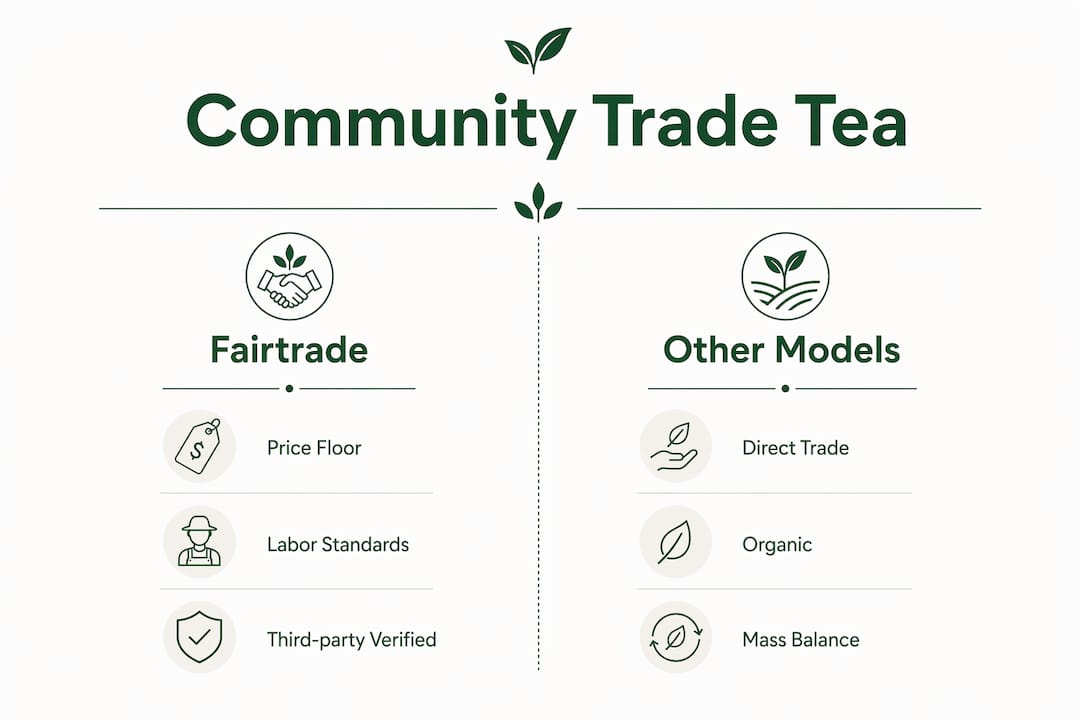
Fair trade sets a price floor and social standards enforced through third-party audits. Direct trade, by contrast, is relationship-based and quality-focused. Buyers work directly with farmers, often paying above fair trade minimums, but there is no formal certification or independent verification. Direct trade can result in excellent outcomes, but it depends entirely on the buyer’s integrity. You are trusting a relationship, not a standard.
Organic certification focuses exclusively on farming practices, specifically the absence of synthetic pesticides and fertilizers. It says nothing about wages, labor conditions, or community investment. A tea can be certified organic and still be produced under exploitative labor conditions. Organic and fair trade certifications address different problems, and the strongest products carry both.
One pitfall worth knowing: mass balance practices allow companies to sell tea labeled as certified by mixing uncertified tea with certified offsets. The logo appears on the package, but the tea in your cup may not be fully certified. This is a recognized greenwashing risk in the industry, and it is why third-party audits and transparent supply chains matter so much. You can learn more about local sourcing strategies that prioritize traceability and community connection.
| Sourcing model | Price guarantee | Labor standards | Environmental focus | Third-party verified |
|---|---|---|---|---|
| Fair trade / community trade | Yes, minimum floor | Yes, audited annually | Yes, restricted pesticides | Yes, FLOCERT |
| Direct trade | No formal floor | No formal standard | Varies by buyer | No |
| Organic certification | No | No | Yes, no synthetic inputs | Yes |
| Conventional | No | Varies by country law | Minimal | No |
How can you identify and support genuine community trade tea?
Spotting authentic community trade tea starts with the label. The Fairtrade International mark and similar logos from accredited certification bodies signal that an independent auditor has verified the supply chain. A brand simply writing “ethically sourced” or “community supported” on its packaging carries no enforceable meaning. Look for the logo, then look up the certifying body.
Transparency is your second tool. Brands committed to traceable tea sourcing publish information about which farms or cooperatives supply their tea, what premiums were paid, and how community funds were spent. If a brand cannot tell you where its tea comes from, that silence is informative.
Here is a practical checklist for making confident, ethical purchases:
- Check for a recognized certification logo. Fairtrade International, Fair Trade USA, and similar bodies all use distinct, searchable marks.
- Research the certifying body. Confirm it conducts annual audits and publishes compliance reports.
- Identify the producer model. Cooperative-sourced teas deliver more direct benefits to farming families than plantation-sourced teas.
- Read the brand’s sourcing page. Genuine transparency includes farm names, regions, and premium fund reports.
- Avoid mass balance claims. Prefer brands that use physical segregation, meaning your tea is certified from field to cup, not just offset on paper.
Pro Tip: Use the sustainable tea checklist from Ecoviberoast to evaluate any tea brand before you buy. It covers certifications, sourcing transparency, and environmental practices in one place.
Key Takeaways
Community trade tea delivers the most meaningful impact when it combines Fairtrade certification, cooperative sourcing, and transparent premium fund management.
| Point | Details |
|---|---|
| Certification is the foundation | Look for Fairtrade International or Fair Trade USA logos verified by FLOCERT audits. |
| Cooperatives deliver more direct benefits | Smallholder cooperative teas route premiums directly to farming families, unlike plantation models. |
| Premiums fund real infrastructure | Community funds have built water treatment plants, schools, and clinics in producer regions. |
| Sustainable farming requires training | Cooperative capacity building drives adoption of soil, water, and biodiversity practices. |
| Mass balance is a greenwashing risk | Choose brands using physical segregation to guarantee your tea is certified from farm to cup. |
Why I think the “community” in community trade tea is the whole point
People often focus on the price floor when they talk about fair trade tea, and the minimum price guarantee matters. But after spending years paying attention to how these supply chains actually work, I think the Fairtrade Premium fund is the more transformative mechanism. A price floor keeps farmers from going broke. A community fund builds the school their children attend and the water system their families drink from. Those are generational changes, not just quarterly income improvements.
What I have also come to appreciate is how much cooperatives do beyond certification compliance. The 2026 Sri Lanka research confirming that cooperative membership drives sustainable practice adoption resonates with what I have observed anecdotally. Farmers who share resources and knowledge simply farm better. Certification without cooperative infrastructure is like a rulebook without a coach.
My honest advice to any reader who cares about ethical tea practices: prioritize brands that source from cooperatives, publish premium fund reports, and invest in farmer training. The certification logo is the starting point, not the finish line. The brands worth supporting are the ones who treat transparency as a value, not a marketing tactic.
— LaSaundra
Ecoviberoast’s tea collection for conscious drinkers

Ecoviberoast sources its teas with the same values this article describes: fair wages, transparent supply chains, and a genuine commitment to the communities behind every harvest. The Mango Treat loose leaf tea is a great starting point, blending organic mango with fragrant notes in a tea that feels as good to drink as it does to buy. Every Ecoviberoast purchase also contributes to planting mangrove trees and removing ocean-bound plastics, so your cup does double duty for the planet. You can read more about Ecoviberoast’s environmental impact commitments and see exactly where those contributions go. Ethical sourcing and great flavor belong together, and Ecoviberoast proves it with every order.
FAQ
What is community trade tea in simple terms?
Community trade tea is tea sourced under fair trade principles that guarantee farmers a minimum price, fund community projects through premiums, and require annual audits of labor and environmental standards.
How does community trade tea differ from fair trade tea?
The terms describe the same core framework. “Community trade tea” emphasizes the social investment side of fair trade certification, while “fair trade tea” is the recognized industry label used by certifying bodies like Fairtrade International.
What does the Fairtrade Premium actually pay for?
The Fairtrade Premium funds community-chosen projects such as water treatment plants, schools, and clinics. In Capulí Grande, Colombia, premium funds provided safe drinking water to 70 families.
Are all fair trade teas equally beneficial to farmers?
No. Cooperative-sourced teas deliver more direct financial benefits to farming families than plantation-sourced teas, where premiums are managed jointly by workers and management without guaranteed wage increases.
How do I avoid greenwashing when buying ethical tea?
Look for a verified certification logo from Fairtrade International or Fair Trade USA, and choose brands that use physical segregation rather than mass balance, which can mix certified and uncertified tea under the same label.


