

Plant-based packaging is any container, wrapper, or protective material made from renewable plant-derived sources — think corn starch, sugarcane pulp, or seaweed — used in place of fossil-based plastics. The single most important thing to understand right away is this: where it ends up matters more than what it’s made from. A compostable cup that goes to landfill behaves almost exactly like a conventional plastic one.
Here’s what you need to know at a glance:
- Renewable feedstock means the raw material regrows, reducing dependence on petroleum.
- “Plant-based” does not automatically mean biodegradable in your backyard or curbside bin.
- Disposal depends entirely on local infrastructure — specifically, whether industrial composting is available near you.
End-of-life is the single biggest determinant of whether plant-based packaging delivers real environmental benefit. A consumer perception review found a persistent knowledge gap: many people expect these materials to be both renewable and fully biodegradable, when in reality most require specific conditions to break down properly.
Table of Contents
- What does “plant-based packaging” actually mean?
- What materials are used in plant-based packaging?
- Do the environmental benefits actually hold up?
- How does plant-based packaging perform for food and products?
- How can a business adopt plant-based packaging responsibly?
- What happens to plant-based packaging at end of life in the U.S.?
- Which certifications and labels can you actually trust?
- What market and regulatory trends should businesses watch?
- What does recent research actually say?
- Key Takeaways
- Why the “just switch the material” mindset misses the point
- Ecoviberoast’s approach to sustainable packaging
- Useful sources for deeper reading
What does “plant-based packaging” actually mean?
The term covers a lot of ground, and the labels on packaging can feel like alphabet soup. Breaking them into four clear categories makes reading any product claim much easier.
Bio-based means the material is derived from renewable biological sources (plants, algae, agricultural byproducts) rather than petroleum. It says nothing about how the material breaks down. A bio-based plastic can be just as persistent as a conventional one.
Biodegradable means microorganisms can break the material down under certain conditions. The catch: “certain conditions” can mean high heat, controlled moisture, and specific microbial populations — conditions that exist in industrial composting facilities, not in your kitchen compost bin or a landfill.
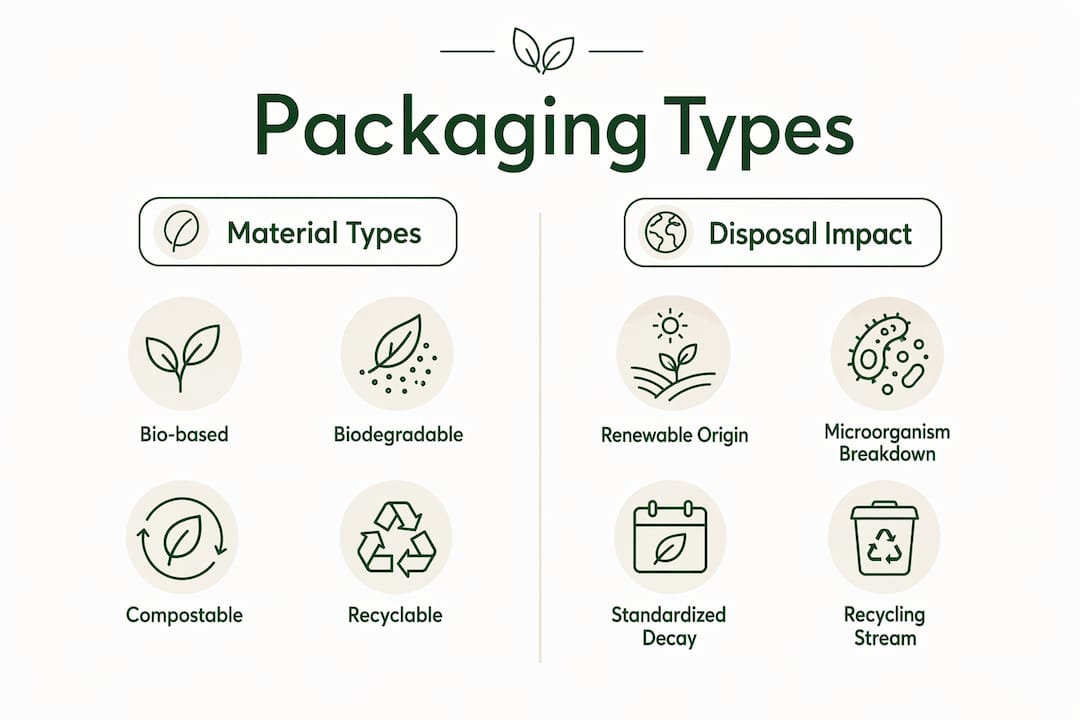
Compostable is a more precise claim. It means the material meets a defined standard for breakdown within a set timeframe, leaving no toxic residue. In the U.S., the relevant standards are ASTM D6400 (for plastics) and ASTM D6868 (for coatings and films). Industrial compostable and home compostable are two different things.
Recyclable means the material can re-enter a manufacturing stream. Some plant-based plastics like PLA can theoretically be recycled, but they contaminate conventional plastic recycling streams if mixed in, so most U.S. facilities reject them.
| Term | Material examples | What it means for disposal |
|---|---|---|
| Bio-based | PLA, PHA, bio-PE | Renewable origin; end-of-life varies widely |
| Biodegradable | Starch blends, PHA | Breaks down under specific conditions; not guaranteed in landfill |
| Compostable | PLA (certified), bagasse, molded fiber | Requires industrial or home composting per label |
| Recyclable | Cellulose paper, some bio-PE | Can enter recycling streams; check local rules |
What materials are used in plant-based packaging?
The material families vary widely in performance, cost, and best-fit applications. Here’s a practical breakdown of the main ones you’ll encounter.
PLA (polylactic acid)
PLA is made by fermenting plant sugars, typically from corn or sugarcane, into lactic acid and then polymerizing it. It looks and feels like conventional clear plastic, which makes it popular for cold cups, clamshells, and produce containers. The trade-off: PLA requires industrial composting conditions to break down. Without access to a facility running at 140°F+ with controlled moisture, PLA can persist in a landfill for a long time without breaking down effectively. It also has a low heat-distortion temperature, so it’s not suitable for hot beverages.

PHA (polyhydroxyalkanoates)
PHA is produced by bacteria that accumulate the polymer as an energy reserve when fed plant-based sugars or oils. Unlike PLA, PHA can biodegrade in soil and marine environments, which makes it genuinely more versatile for end-of-life. It’s more expensive to produce, so you’ll see it in premium or specialty applications rather than commodity packaging.
Starch-based plastics
Starch-based materials are cost-effective, have good film-forming ability, and biodegrade relatively quickly when industrial composting is available. They’re well-suited for single-use food packaging films, bags, and lightweight containers. Their weakness is moisture sensitivity — they can soften or lose structural integrity in humid conditions, which limits shelf-life applications.
Molded fiber (bagasse and pulp)
Bagasse is the fibrous residue left after sugarcane juice is extracted. Pressed into molds, it becomes plates, bowls, trays, and takeout containers. Molded fiber comes in two process types: wet-pressed yields a smoother, retail-grade finish, while dry-pressed is cheaper and better suited for protective transit inserts and bulk shipping. Both are home-compostable in most cases and widely accepted at industrial composting facilities.

Cellulose derivatives and cellophane
Cellulose-based films are derived from wood pulp or cotton. Cellophane, one of the oldest bio-based films, is transparent, grease-resistant, and compostable when uncoated. Coated versions (for moisture or oxygen barriers) may not be compostable, so checking the specific product spec matters. These materials work well for dry food wraps, tea bags, and coffee packaging.
Mycelium
Mycelium packaging grows fungal root networks around agricultural waste (like corn husks) to create rigid, foam-like protective inserts. It’s home-compostable, requires no synthetic inputs to grow, and is particularly well-suited for replacing expanded polystyrene in protective shipping applications.
Seaweed and alginate
Seaweed-derived packaging is still largely in the innovation phase but shows real promise for single-serve sachets, edible films, and flexible wraps. Alginate, extracted from brown seaweed, forms flexible, water-soluble films. The feedstock grows without freshwater or fertilizer, which gives it a compelling land-use profile.
Pro Tip: When evaluating a new plant-based material for your product, request the supplier’s compostability test data and food-contact certification before ordering samples. Many materials look identical but have very different end-of-life and safety profiles.
Do the environmental benefits actually hold up?
The honest answer is: often yes, but it depends on the full lifecycle. Life-cycle assessments show biopolymer-based packaging frequently has a lower carbon footprint than conventional plastics, but the results are sensitive to assumptions about feedstock, production energy, and especially end-of-life.
The real environmental benefits:
- Reduced fossil feedstock consumption — plant sugars replace petroleum as the carbon source.
- Lower greenhouse gas emissions during production for many bio-based materials.
- Reduced persistent plastic pollution when materials are properly composted or biodegraded.
- Agricultural byproducts (bagasse, rice husks) as feedstocks reduce waste from other industries.
The trade-offs you should know:
- Feedstock crops like corn require land, water, fertilizer, and pesticides — inputs that carry their own environmental costs.
- Production energy can be high, particularly for PHA fermentation processes.
- If plant-based packaging contaminates conventional recycling streams, it can make those streams less efficient, not more.
- Industrial composting infrastructure in the U.S. is limited. Without access, the composting benefit disappears.
When reading an LCA, pay close attention to two things: the end-of-life scenario assumed (industrial composting vs. landfill vs. recycling) and the system boundary (cradle-to-gate vs. cradle-to-grave). An LCA that assumes 100% industrial composting will look far more favorable than one modeling real-world U.S. disposal rates. The LCA methodology itself is the lens — and the assumptions inside it are what you’re really evaluating.
How does plant-based packaging perform for food and products?
Performance is where plant-based materials face their biggest practical challenge. Conventional plastics were engineered over decades for specific barrier and thermal properties. Plant-based alternatives are catching up, but gaps remain.
Key performance metrics to understand:
- Oxygen transmission rate (OTR): How much oxygen passes through the material. Low OTR is critical for coffee, snacks, and any oxidation-sensitive product.
- Water vapor transmission rate (WVTR): Moisture permeability. High WVTR means the package won’t protect against humidity — a real issue for starch-based films.
- Heat distortion temperature: The temperature at which the material softens. PLA softens around 140°F, making it unsuitable for hot-fill or microwave applications.
| Material | Oxygen barrier | Moisture barrier | Heat resistance | Best-fit use |
|---|---|---|---|---|
| PLA | Medium | Low–Medium | Low | Cold cups, clamshells, produce |
| PHA | Medium | Medium | Medium | Flexible films, coatings |
| Starch-based | Low | Low | Low | Single-use bags, light films |
| Molded fiber | N/A | Low–Medium | High | Trays, takeout, protective inserts |
| Cellulose/cellophane | Medium–High | Medium | Medium | Dry food wraps, tea packaging |
| Mycelium | N/A | Low | Medium | Protective shipping inserts |
Michigan State research confirms that current plant-based plastics show low toxicity and minimal chemical migration into food, making them safe for short-term, single-use food applications. For longer shelf-life needs, many plant-based options need coatings, blends, or multi-layer structures to meet performance requirements. Nature-inspired biomimetic designs — structures that mimic the layered architecture of natural materials like nacre or plant cell walls — are one promising route to improving barrier and mechanical properties without sacrificing compostability.
Smart packaging technologies (freshness indicators, antimicrobial films) are also being adapted for plant-based platforms, which could extend the shelf life of perishables without reverting to fossil plastics. For coffee and tea specifically, cellulose-based films and coated molded fiber are the most practical near-term options for maintaining aroma and freshness.
How can a business adopt plant-based packaging responsibly?
Switching packaging isn’t just a material swap — it’s a supply chain decision. Here’s a practical sequence that works for small businesses and larger procurement teams alike.
- Audit your current packaging. List every format you use (bags, boxes, films, inserts), its material, and its current end-of-life path. This baseline is what your LCA will compare against.
- Pilot one format first. Choose the highest-volume or highest-visibility item. Test the plant-based alternative for performance (seal integrity, moisture resistance, shelf life) before committing to a full switch.
- Request supplier documentation. Ask for compostability test results (ASTM D6400 or D6868), food-contact certifications (FDA compliance or equivalent), feedstock origin, and any available LCA data.
- Model the full cost. Plant-based materials often carry a price premium, especially at low volumes. Factor in redesign costs, minimum order quantities, and lead times. Some materials (bagasse, starch-based) are more cost-competitive than others (PHA).
- Plan your consumer communication. Clear disposal instructions on the package reduce contamination. “Compostable in industrial facilities only” is more useful than a generic leaf icon.
Questions to ask every supplier:
- What feedstock does this material use, and where is it sourced?
- What certifications does it hold (BPI, USDA Biobased, ASTM-compliant)?
- Is it certified for food contact under FDA guidelines?
- What end-of-life pathway does it support, and under what conditions?
- Can you provide an LCA or third-party environmental data?
For green coffee packaging specifically, the combination of a cellulose-based outer layer with a compostable inner liner tends to offer the best balance of barrier performance and end-of-life credibility.
Pro Tip: Start with molded fiber or bagasse for any dry, non-perishable product. These materials have the most mature supply chains, the most accessible composting pathways, and the lowest performance risk for a first pilot.
What happens to plant-based packaging at end of life in the U.S.?
This is the section that most guides skip over, and it’s the one that matters most. The U.S. composting infrastructure is genuinely limited. Industrial composting facilities that accept food-service compostables are limited in number, and many of those have restrictions on which certified materials they’ll take.
What consumers should do:
- Check findacomposter.com or your local municipal waste authority to confirm whether industrial composting is available in your area.
- If industrial composting isn’t accessible, certified home-compostable materials (look for the “OK compost HOME” label) can go in a backyard pile.
- Never put PLA or other certified-industrial-compostable items in curbside recycling. They contaminate the stream and will likely be landfilled anyway.
- Molded fiber and uncoated paper-based packaging can often go in curbside compost or yard waste bins — but confirm with your local program.
What brands should do:
- Print clear, specific disposal instructions on every package. “Industrial compost only” or “Home compostable” beats a generic green icon.
- Consider partnering with a composting hauler or take-back program if your customers are in areas without municipal composting.
- Avoid using compostable packaging in contexts where you know it will go to landfill — the environmental benefit evaporates, and the marketing claim becomes misleading.
- For compostable coffee packaging, pairing the package with a QR code linking to local composting resources is a practical, low-cost way to close the loop.
Pro Tip: The US Composting Council’s “Compostable Logo Program” and BPI certification both require that a material be accepted by real composting facilities. If a supplier’s product has neither, treat compostability claims with skepticism.
Which certifications and labels can you actually trust?
Labels matter, but they’re only as useful as your ability to read them correctly. Here are the major U.S.-relevant standards and what they actually tell you.
- ASTM D6400: The standard for compostable plastics in the U.S. A material meeting this standard will disintegrate and biodegrade in an industrial composting environment within a defined timeframe, leaving no toxic residue.
- ASTM D6868: Covers compostable coatings and films applied to paper or other substrates — relevant for coated cups, bags, and wrappers.
- BPI (Biodegradable Products Institute) certification: Third-party verification that a product meets ASTM D6400 or D6868 and is accepted by real composting facilities. BPI certification is one of the most credible signals in the U.S. market.
- USDA Certified Biobased Product: Verifies the percentage of bio-based carbon content using ASTM D6866 testing. Critically, this label says nothing about biodegradability or compostability — a 95% biobased product can still be designed for landfill.
- “OK compost HOME” (TÜV Austria): Certifies that a material will biodegrade in a home compost environment. This is a higher bar than industrial compostable certification and genuinely useful for consumers without facility access.
| Label | What it verifies | What it does NOT tell you |
|---|---|---|
| ASTM D6400/D6868 | Industrial compostability standard met | Whether local facilities accept it |
| BPI certified | Third-party verified, facility-accepted | Home compostability |
| USDA Certified Biobased | Bio-based carbon content % | Biodegradability or compostability |
| OK compost HOME | Home compostable | Industrial composting performance |
A common greenwashing trap: a product labeled “biobased” is often marketed as eco-friendly without any compostability or recyclability claim. Always ask which specific standard backs the claim, and request the test report from your supplier.
What market and regulatory trends should businesses watch?
The policy and market environment around plant-based packaging is shifting fast, particularly at the state level.
Regulatory signals to monitor:
- California, Colorado, and Washington have active single-use plastic reduction legislation that increasingly favors certified compostable alternatives in food-service settings.
- Several states are developing or updating “truth in labeling” rules for compostability claims, which will raise the bar for what can legally appear on packaging.
- The EPA’s Sustainable Materials Management program continues to publish guidance on organic waste diversion, which shapes municipal composting program funding and scope.
Market signals:
- Demand for plant-based packaging is rising across food service, e-commerce, and consumer goods. Food service operators are increasingly specifying certified compostable packaging as a baseline requirement rather than a premium option.
- Nanocomposites and agricultural byproduct-based fillers are improving barrier properties in biopolymers, which could close the performance gap with conventional plastics within the next few years.
- Cost parity for some materials (bagasse, starch-based films) is already within reach at scale. PHA remains expensive but is attracting significant investment.
How to stay current:
- Subscribe to BPI and the US Composting Council for certification updates and facility acceptance news.
- Monitor state environmental agency rulemaking portals for composting and single-use plastic legislation.
- Ask your packaging supplier to update your LCA data annually, since production energy mixes and composting infrastructure both change.
What does recent research actually say?
The evidence base for plant-based packaging is growing, and a few key findings should shape how businesses and consumers approach it.
Consumer perception research consistently shows that people view bioplastic packaging positively but significantly overestimate its biodegradability. Many assume that “plant-based” means it will break down in any environment. For brands, this gap is both a risk and an opportunity: if you don’t provide clear disposal guidance, customers will make incorrect assumptions that undermine the environmental benefit you’re trying to deliver.
Michigan State’s food safety analysis offers a reassuring finding for food businesses: current plant-based plastics show low toxicity and minimal migration into food under normal short-term use conditions. The practical implication is that you can confidently use PLA or starch-based materials for single-use food applications without food-safety concerns — but you should treat them as short-term solutions until performance improves for longer shelf-life needs.
“Biopolymer-based packaging often has a lower carbon footprint than conventional plastics, but results depend on feedstock, processing, and end-of-life assumptions — making the choice of LCA scenario as important as the choice of material itself.” — ScienceDirect LCA review
Practitioner experience reinforces the research. PLA composting in the real world is far less reliable than lab conditions suggest, because most U.S. facilities either don’t accept it or can’t process it consistently. Wet-pressed molded fiber, by contrast, has a mature, well-understood supply chain and broad facility acceptance, making it the lower-risk choice for businesses that want composting to actually happen.
Key Takeaways
Plant-based packaging delivers genuine environmental benefits only when the right material meets the right disposal infrastructure — end-of-life is the variable that determines whether the sustainability claim holds.
| Point | Details |
|---|---|
| End-of-life determines impact | A compostable package in a landfill performs no better than conventional plastic. |
| Labels require verification | “Biobased” confirms feedstock only; look for BPI or ASTM D6400 certification for composting claims. |
| Material choice must match use | PLA suits cold, short-use applications; molded fiber and cellulose work better for dry food and beverage packaging. |
| LCA assumptions drive results | Prioritize LCAs that model real-world U.S. disposal rates, not optimistic industrial composting scenarios. |
| Ecoviberoast models the approach | Ecoviberoast pairs certified sustainable packaging with clear disposal guidance and direct environmental commitments on every order. |
Why the “just switch the material” mindset misses the point
Most conversations about plant-based packaging focus almost entirely on what the material is made from. That framing is understandable — it’s the visible, marketable part. But the evidence points somewhere else. The carbon savings, the reduced pollution, the composting benefit: all of it hinges on what happens after the package leaves your hands.
The uncomfortable truth is that a significant portion of certified compostable packaging in the U.S. ends up in landfill, not because consumers don’t care, but because the infrastructure to handle it correctly simply isn’t there yet. Brands that switch to plant-based materials without addressing disposal are, at best, making a symbolic gesture. At worst, they’re creating a new contamination problem in recycling streams.
What actually moves the needle is the combination: a material that’s genuinely certified, paired with disposal instructions that are specific enough to be actionable, sold by a brand that has verified its supply chain. That’s a harder story to tell on a package, but it’s the one that produces real outcomes. Ecoviberoast’s approach of linking packaging choices to verifiable environmental commitments — mangrove planting, ocean-bound plastic removal — is exactly the kind of accountability structure that makes sustainability claims credible rather than decorative.
Ecoviberoast’s approach to sustainable packaging

Ecoviberoast takes packaging seriously because the cup, bag, or pod that holds your coffee is part of the product’s full environmental story. The brand’s single-serve coffee pods are designed with sustainability in mind, and every purchase contributes directly to mangrove tree planting and ocean-bound plastic removal — two of the most impactful environmental interventions available. For tea drinkers, the loose-leaf and specialty teas use packaging formats that minimize unnecessary material while keeping your brew fresh and aromatic.
Ecoviberoast also publishes practical guidance on eco-friendly packaging examples for coffee lovers who want to understand what’s actually in their hands. If you’re ready to make your daily ritual a little warmer for the planet, browse the full collection and see the packaging details firsthand.
Useful sources for deeper reading
These primary sources back the claims in this article and are worth bookmarking if you want to go deeper on standards, safety, or research.
- ASTM D6400 and D6868 standards — The foundational U.S. compostability standards for plastics and coatings. Use these to verify supplier claims.
- BPI Certification Program — The leading third-party certifier for compostable products in the U.S. Their certified products list is searchable by material and application.
- US Composting Council — Guidance on composting infrastructure, facility locators, and the “Compostable Logo Program.”
- USDA Certified Biobased Product label — The federal program verifying bio-based content. Useful for procurement teams sourcing bio-based materials.
- FDA Food Contact Substances guidance — The regulatory framework for food-contact packaging safety in the U.S.
- MDPI Sustainability review (2025) — Consumer perception and environmental impacts of bioplastics in food packaging; covers disposal knowledge gaps and LCA findings.
- ScienceDirect LCA review — Environmental impact of biopolymer-based packaging versus conventional plastics; essential for understanding how lifecycle assumptions drive conclusions.
- Michigan State CRIS — Plant-based plastics food safety analysis; the most accessible summary of food-contact safety evidence for non-specialists.


