

TL;DR:
- Forest-friendly farming integrates agroecology and canopy management to grow crops without clearing standing forests. Consumers can support it by choosing certified products and encouraging responsible sourcing and fair prices.
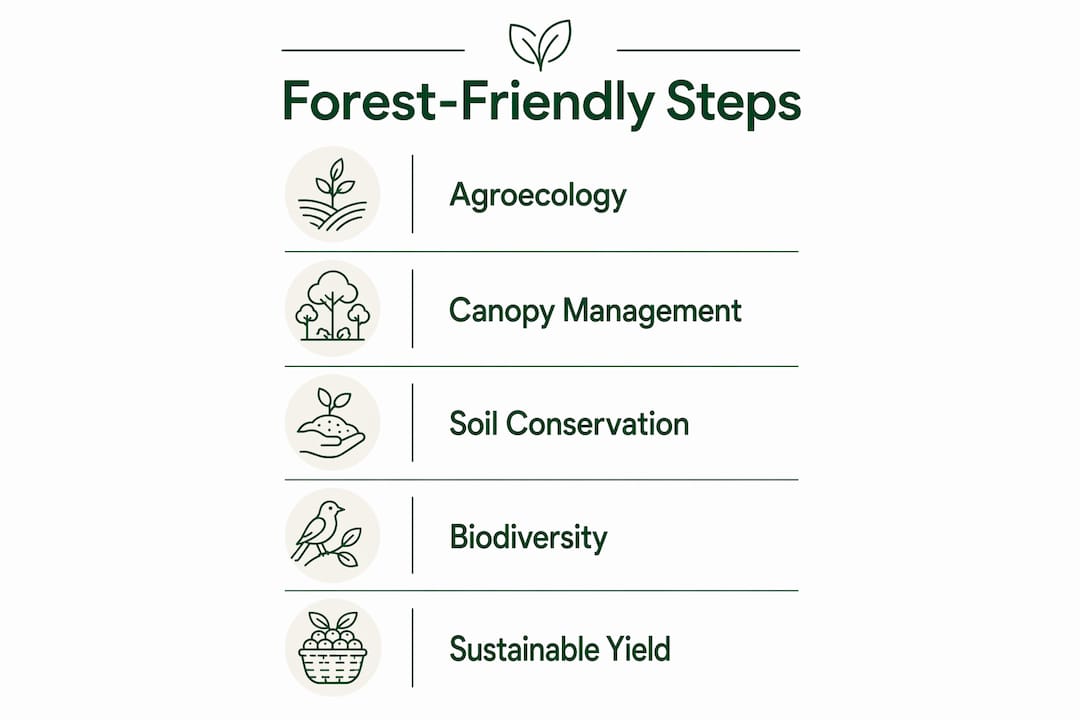
Forest-friendly farming is an agroecology-based approach that grows crops within or alongside standing forests by managing canopy layers, protecting native species, and preserving the ecological functions of the land. For your morning cup, that means the coffee or tea you’re sipping may have been grown beneath a living forest canopy rather than on cleared, sun-baked land.
Three things worth knowing right now:
- Look for these on the label: Rainforest Alliance, Bird Friendly (Smithsonian Migratory Bird Center), Fair Trade USA, or USDA Organic seals are your most reliable shelf signals.
- Why it matters: Ecosystem services from forest-friendly farms, including carbon sequestration and biodiversity habitat, depend on consumer demand to stay financially viable for farmers.
- Who’s doing it right: Brands like Ecoviberoast source with these principles in mind, pairing responsible sourcing with tangible commitments like mangrove planting and ocean-bound plastic removal.
Table of Contents
- What is forest-friendly farming, and how does it actually work?
- How shade-grown coffee and forest-friendly tea actually grow
- Common on-farm practices that qualify as forest-friendly
- How forest-friendly farming becomes financially viable for farmers
- How to spot genuinely forest-friendly coffee and tea on the shelf
- Concrete steps you can take to support forest-friendly farming
- How Ecoviberoast supports forest-friendly sourcing
- Limits and misconceptions worth knowing before you buy
- Key Takeaways
- Why this matters more than the label suggests
- Ecoviberoast’s forest-friendly coffee collection
- Useful sources and further reading
What is forest-friendly farming, and how does it actually work?
The core principles are agroecology, multistory cropping, soil and water conservation, and active biodiversity protection. Rather than clearing land for a single crop, forest-friendly systems intentionally use vertical space — tall canopy trees, mid-level shrubs, and ground-level crops all coexisting in layers that mimic a natural forest.
Canopy management is the heart of it. The USDA’s NRCS guidelines describe forest farming systems with mature tree canopy cover ranging from 5 to 40 percent, calibrated to let enough light reach understory crops without sacrificing the forest structure above. Farmers thin selectively, amend soil, and manage spacing rather than bulldozing and replanting from scratch.
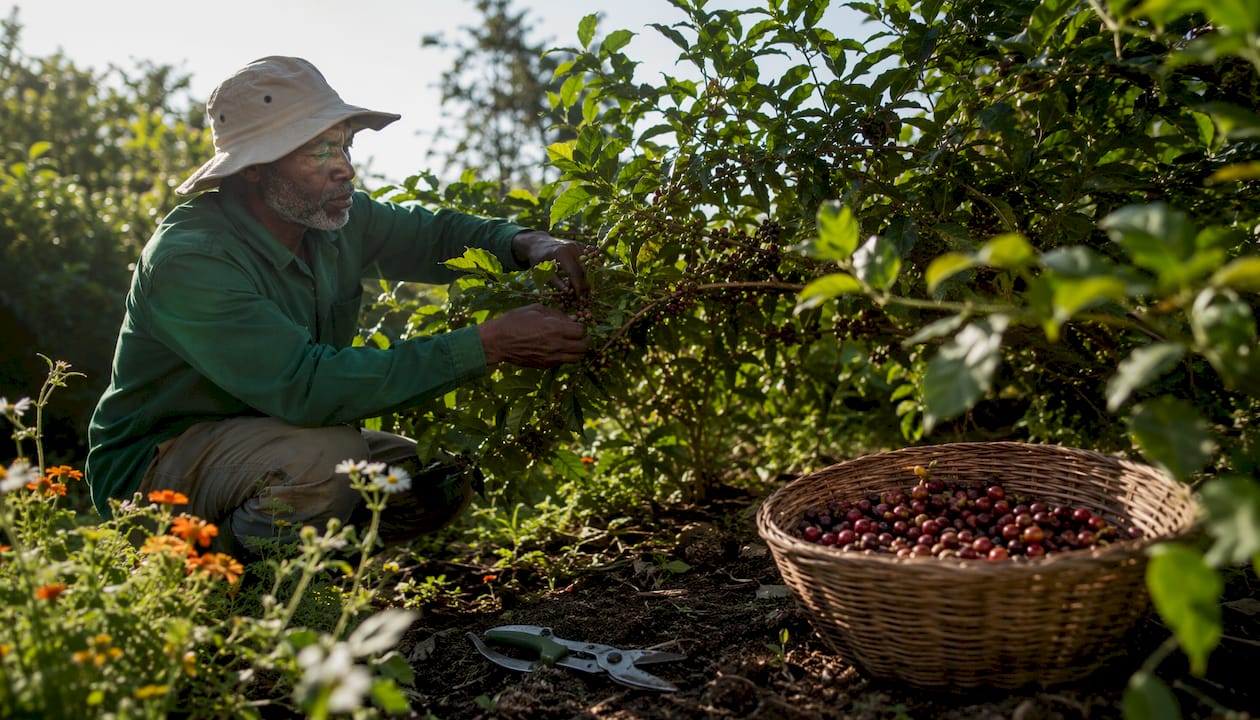
Soil health and native species retention are what make these systems resilient over time. Reduced tillage keeps microbial networks intact, root systems hold moisture during dry spells, and native trees attract the insects and birds that keep pest pressure low naturally.
Pro Tip: Shade patterns do more than protect plants from heat. Dappled light slows the ripening of coffee cherries, concentrating sugars and producing a denser, more aromatic bean — which is one reason shade-grown coffees often taste noticeably richer than sun-grown varieties.
How shade-grown coffee and forest-friendly tea actually grow
Shade-grown coffee and forest-friendly tea are the most direct expressions of agroforestry benefits for your cup. Both rely on multistory cropping: coffee plants or tea bushes grow in the understory beneath a canopy of native or planted trees, creating a layered system that supports biodiversity while producing a harvestable crop.
A few concrete examples of what this looks like on the ground:
- Shade-grown coffee with native-tree canopy: coffee plants grow beneath fruit, timber, or nitrogen-fixing trees, which feed the soil and shelter migratory birds.
- Tea with agroforestry windbreaks: tea gardens bordered or interspersed with taller trees that reduce erosion on hillside plots and moderate temperature swings.
- Cooperative forest protection: Farm Africa’s work in Ethiopia shows what happens when market access and forest protection are linked. By combining income from forest-based enterprises with anticipated carbon credit revenue, cooperatives protected 12,496 hectares of forest between 2012 and 2015 and avoided approximately 5.5 million tonnes of CO₂. That’s not a side benefit — it’s the economic engine that makes the whole system sustainable.
Common on-farm practices that qualify as forest-friendly
The most common qualifying practices are shade trees, intercropping, understory management, reduced tillage, cover cropping, contour planting, and water conservation measures. Together, they form a toolkit rather than a single technique.
Here’s what each practice actually accomplishes:
- Shade trees: Regulate temperature, fix nitrogen, support bird and insect habitat, and slow cherry ripening for better flavor.
- Intercropping: Planting complementary species together reduces pest pressure and diversifies farmer income.
- Understory management: Selective clearing keeps the forest floor productive without removing the canopy.
- Reduced tillage: Preserves soil structure, microbial life, and carbon stored in the ground.
- Cover cropping: Protects bare soil between harvests, adds organic matter, and reduces runoff.
- Contour planting: Rows planted along hillside contours slow water flow and prevent erosion on steep terrain.
Cornell research found that farmers already practicing cover cropping, intercropping, and reduced tillage often report lower labor burdens than non-adopters, which challenges the assumption that eco-friendly methods are always harder. The learning curve is real, but it tends to flatten quickly. Practices also vary by region and crop: what works in an Ethiopian highland coffee forest looks different from a Sri Lankan tea garden, and that local adaptation is a feature, not a flaw.
How forest-friendly farming becomes financially viable for farmers
Technical practices alone are fragile without economic incentives. FAO’s agroecology framework and Farm Africa’s field evidence both point to the same conclusion: farmers protect forests when doing so is more profitable than clearing them. Certifications, premiums, and direct-trade relationships are the mechanisms that close that gap.
| Mechanism | What it covers |
|---|---|
| Rainforest Alliance | Integrated social, environmental, and economic standards for farms and supply chains |
| Bird Friendly (Smithsonian) | Shade-grown standard specifically protecting migratory bird habitat and forest canopy |
| Fair Trade USA | Minimum price floors, social premiums, and community investment requirements |
| USDA Organic | Prohibits synthetic inputs; supports soil health but does not require forest canopy |
| Direct trade / cooperative premiums | Buyer-to-farmer relationships that reward quality and traceability above commodity prices |
| Voluntary carbon credits | Income from avoided deforestation; useful but fragile without stable market demand |
Farm Africa’s Ethiopia project shows that linking forest enterprises to carbon credit income helped protect 12,496 hectares and avoid approximately 5.5 million tonnes of CO₂ — proof that economic incentives and conservation outcomes can reinforce each other.
One honest caveat: voluntary carbon markets have been volatile, and carbon credit income alone is not a reliable foundation. The most durable systems pair carbon revenue with direct market access, premiums, and long-term buyer relationships. Certifications help, but they work best when they’re backed by real purchasing commitments, not just a badge on a bag.
How to spot genuinely forest-friendly coffee and tea on the shelf
Start with certifications. Rainforest Alliance, Bird Friendly, Fair Trade USA, and USDA Organic are the four most credible signals you’ll find on U.S. packaging. Bird Friendly certification from the Smithsonian Migratory Bird Center is particularly specific to shade-grown and forest-habitat protection — it’s one of the strongest single indicators of genuinely forest-friendly production.
Beyond the seal, look for:
- Named origin and cooperative transparency — a specific region, farm, or cooperative listed on the bag
- Traceability claims — lot numbers, harvest dates, or direct-trade relationships
- Processing and flavor notes — shade-grown coffees often carry tasting notes that reflect slower ripening (fruit-forward, complex, lower bitterness)
Red flags to watch for: vague phrases like “eco-friendly” or “sustainably sourced” with no certification or origin detail; unverified badges that don’t link to a certifying body; and brands that rely entirely on carbon offsets without any farm-level program. Offsets can complement a sourcing strategy, but they’re not a substitute for it. Ecoviberoast’s rainforest-friendly coffee content walks through what responsible sourcing actually looks like in practice, which is a useful benchmark when you’re evaluating other brands.
Concrete steps you can take to support forest-friendly farming
Your purchasing choices send a real signal to the supply chain. Here’s how to make them count:
- Check the certification and origin first. Look for Rainforest Alliance, Bird Friendly, Fair Trade USA, or USDA Organic on the label, then confirm the origin is named specifically — a country and region, not just “Central America.”
- Ask brands about farm-level programs. Does the brand pay premiums above commodity price? Do they have long-term contracts with cooperatives? These questions separate genuine commitment from marketing copy.
- Favor brands with direct-trade or cooperative relationships. Premiums that flow directly to farmers fund the conservation practices that certifications require.
- Support subscriptions and repeat purchases. Consistent demand is what makes forest protection economically rational for farmers. A one-time purchase helps; a recurring order helps more.
- Use brand educational pages as a filter. Brands that publish sourcing stories, farm photos, and impact data are showing their work. Those that don’t are asking you to take their word for it.
For more on how to support sustainable farms step by step, Ecoviberoast has a practical guide worth bookmarking. And if you’re curious about how your everyday choices connect to broader eco-conscious living, resources like eco-friendly lifestyle guides can help frame the bigger picture.
How Ecoviberoast supports forest-friendly sourcing
Ecoviberoast’s sourcing commitments center on responsible ingredient selection, environmental restoration, and consumer education. Here’s what the brand currently shares publicly:
- Responsible sourcing: Products are selected with sustainability criteria in mind, prioritizing suppliers who align with forest-friendly and eco-conscious practices.
- Mangrove planting: Every purchase contributes to mangrove restoration, a form of ecosystem investment that mirrors the conservation logic of forest-friendly farming.
- Ocean-bound plastic removal: Packaging impact is addressed through plastic removal partnerships, reducing the footprint beyond the farm.
- Educational content: Ecoviberoast publishes guides on topics like shade-grown coffee, soil health in coffee farming, and biodiversity in coffee farming — giving buyers the context to evaluate sourcing claims across the industry.
Where third-party certification data or farm-level audit results are not yet publicly listed, Ecoviberoast’s transparency would be strengthened by adding those details. That’s a fair standard to hold any brand to, including this one.
Limits and misconceptions worth knowing before you buy
Forest-friendly farming is not a single technique, a yield guarantee, or a promise of zero environmental impact. It’s a conservation-minded approach that only works when supported by economics, monitoring, and local adaptation.
A few myths worth correcting:
“Forest-friendly always means higher yield.” Not true. Shade-grown systems often produce lower volumes per hectare than full-sun monocrops, though they tend to produce higher-quality beans and more stable yields over time. The trade-off is real, and pretending otherwise misleads farmers and buyers alike.
“Certification guarantees full forest protection.” Certifications set standards and require audits, but they don’t eliminate all risk. Coverage gaps, audit frequency, and enforcement vary by certifying body and region. A Rainforest Alliance seal is meaningful, but it’s a floor, not a ceiling.
“Eco-friendly practices are always harder and more expensive.” Cornell’s research suggests the opposite is often true once farmers get past the initial learning curve. Also worth noting: “forest farming” as a formal agroforestry system and “forest-friendly farming” as a broader conservation strategy are related but distinct — the former is a technical production method, the latter is a mission-driven approach supported by certifiers, NGOs, and market programs.
Key Takeaways
Forest-friendly farming protects standing forests by integrating agroecology, canopy management, and biodiversity conservation into crop production — and it only stays viable when consumers and companies back it with real purchasing commitments.
| Point | Details |
|---|---|
| Core definition | Forest-friendly farming uses agroecology and canopy management to grow crops without clearing standing forest. |
| Top shelf signals | Look for Rainforest Alliance, Bird Friendly, Fair Trade USA, or USDA Organic on coffee and tea packaging. |
| Economic reality | Certifications and premiums are what make forest protection financially rational for farmers — demand matters. |
| Misconceptions | Higher yield and full certification coverage are not guaranteed; local adaptation and monitoring are always required. |
| Ecoviberoast | Sources responsibly, plants mangroves, and publishes educational content on shade-grown and forest-friendly practices. |
Why this matters more than the label suggests
The certification debate in sustainable coffee tends to get stuck on which seal is “best,” but that framing misses the deeper point. Forest-friendly farming isn’t primarily a labeling strategy — it’s a land-use decision made by a farmer who needs it to make economic sense. When buyers pay premiums, choose certified products, and stick with brands that show their sourcing work, they’re not just feeling good about their coffee. They’re funding the conditions that make conservation rational at the farm level. FAO’s agroecology research and Farm Africa’s field evidence both point to the same conclusion: the gap between clearing land and protecting it is often a market gap, not a values gap. Closing it is something consumers can actually do, one purchase at a time. The brands worth supporting are the ones that understand that and build their sourcing around it, not just their packaging.
Ecoviberoast’s forest-friendly coffee collection
If you’re ready to put these principles into practice, Ecoviberoast makes it straightforward. The brand’s single-serve sustainable coffee pods are sourced with forest-friendly and eco-conscious criteria in mind, so your daily brew does a little good beyond the mug. Every purchase contributes to mangrove planting and ocean-bound plastic removal — two commitments you can verify on the brand’s environmental impact page.

New to Ecoviberoast? The 12-pack sampler is a low-commitment way to taste what responsible sourcing actually produces. Browse the full collection, read the sourcing stories, and see how your next cup can be a small but real vote for the forests that grow it.
Useful sources and further reading
- FAO — Agroecology overview: Best starting point for the science behind forest-friendly and agroecological farming systems.
- Farm Africa — Forest-Friendly Farming in Ethiopia: Market and economic evidence for how income incentives reduce deforestation.
- USDA Forest Service — Forest farming: Technical definition and vertical-space management principles.
- USDA NRCS — Agroforestry systems: Canopy cover ranges and design elements for forest farming systems.
- USDA NIFA — Sustainable agriculture: Broad framework for sustainable agricultural practices and research programs.
- UNEP — Beginner’s guide to sustainable farming: Ecosystem services framing and the consumer/company role in supporting sustainable farms.
- Smithsonian Bird Friendly / Fairtrade lesson plan: Consumer-facing guidance on Bird Friendly certification and cooperative forest protection.
- Cornell News — Eco-friendly ag practices: Research on adoption barriers and the real labor experience of farmers using sustainable methods.
- SARE — What is sustainable agriculture?: Practical overview of cover cropping, intercropping, and soil health practices.


