

TL;DR:
- Shade trees in coffee farms act as active production components that improve microclimate, soil health, and bean quality. Proper management of canopy density and species selection enhances yield, flavor, and ecological benefits while providing income diversification opportunities.
Shade trees in coffee farms are defined as canopy species planted alongside coffee to regulate microclimate, enrich soil, and improve bean quality while supporting ecological sustainability. This is the core function behind what agronomists call coffee agroforestry, a system that treats shade trees as active production partners rather than passive overhead cover. The role of shade trees in coffee farms extends well beyond temperature control. Research from Ethiopia’s Jimma Zone, Nepal’s mid-hills, and Kenya all confirm that the right species at the right density improves cup quality, sequesters carbon, and supports biodiversity. This guide translates those 2026 findings into practical decisions you can apply on your farm today.
How do shade trees regulate coffee farm microclimates?
Shade trees regulate coffee farm microclimates by filtering direct sunlight, lowering soil surface temperature, reducing evapotranspiration, and acting as windbreaks. A study in Kenya highlights how species like Grevillea, Albizia, and Macadamia deliver all four of these benefits simultaneously. That combination reduces heat stress on coffee plants and extends the productive life of each tree.
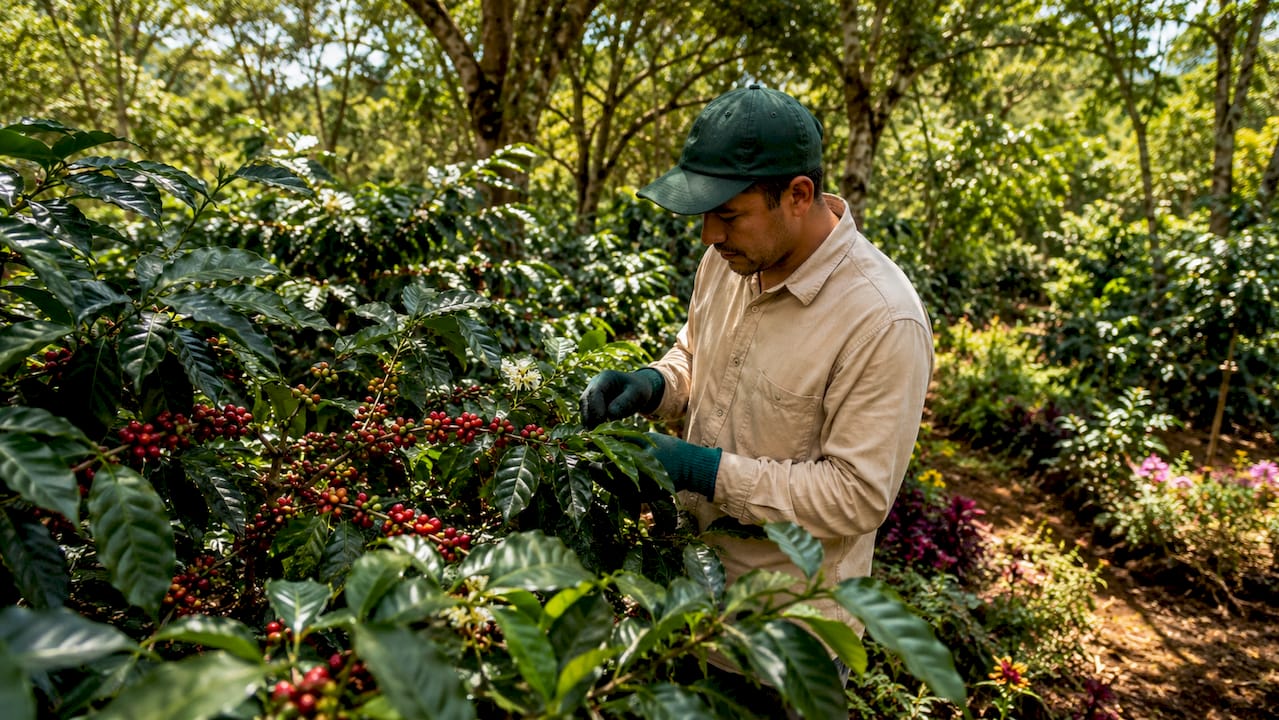
Soil moisture conservation is one of the most underappreciated outcomes of canopy cover. When shade trees reduce direct solar radiation, the soil loses less water through evaporation. That means coffee roots stay hydrated longer between rainfall events, which is critical during dry spells that are becoming more frequent across major coffee-growing regions.
Wind stress is a silent yield killer on exposed farms. Shade trees act as physical barriers that slow wind speed at the canopy level, reducing leaf damage and the desiccation of flowers during critical pollination windows. Protecting flowers directly protects your cherry set and, ultimately, your harvest volume.
Coffee plants under well-managed canopy also show greater longevity. Reduced temperature swings and consistent soil moisture mean less physiological stress per growing cycle. Farms using multi-species canopies in Kenya report that coffee trees maintain productive yields for more years before requiring renovation.
- Sunlight filtering: Canopy species reduce direct radiation, preventing leaf scorch and slowing soil moisture loss.
- Wind protection: Tree rows oriented perpendicular to prevailing winds cut wind speed at the coffee canopy level.
- Soil temperature: Canopy cover keeps soil surface temperatures lower, protecting shallow feeder roots.
- Evapotranspiration: Reduced direct sun and wind exposure lowers water demand from both soil and coffee leaves.
Pro Tip: Place taller windbreak species like Grevillea on the windward edge of your farm and use nitrogen-fixing Albizia within rows to combine wind protection with soil fertility benefits in a single planting design.
What is the impact of shade tree species on coffee yield and quality?
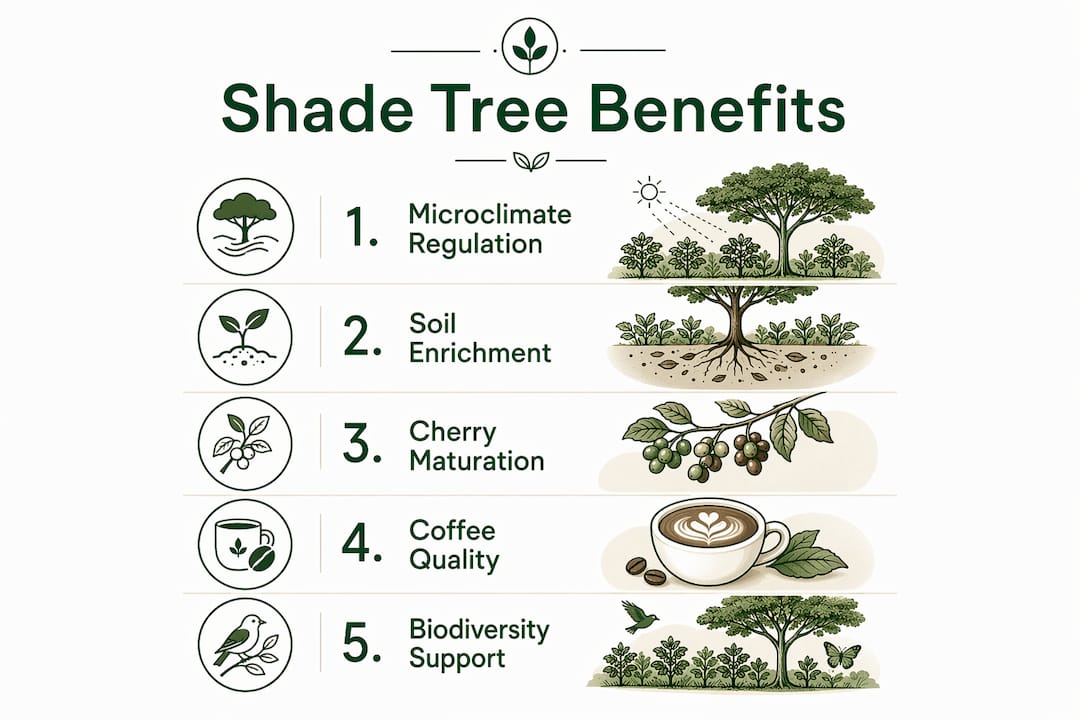
Shade tree species selection is the single most controllable variable in coffee agroforestry systems. Not all canopy trees deliver equal results. Research from Ethiopia’s Jimma Zone shows that Albizia gummifera and Vachellia abyssinica positively affect both organoleptic and biochemical traits in Arabica coffee. These species improve bean quality through two distinct pathways: soil enrichment via litter and root decomposition, and canopy shade that slows cherry maturation.
Slower cherry maturation is a quality driver that many farmers overlook. When cherries develop over a longer period, they accumulate more sugars, chlorogenic acids, trigonelline, and caffeine. These compounds directly shape the cup profile you deliver to buyers. Farms under Albizia gummifera canopies in southwestern Ethiopia consistently score higher on cup cleanness, acidity, and body compared to full-sun plots.
Canopy density matters as much as species choice. A Nepal mid-hills study reports that coffee yields peak at medium canopy cover of 25–70%. Yields drop at both extremes: below 25% cover, plants face heat and moisture stress; above 70%, light competition suppresses photosynthesis and cherry development. This non-linear relationship means more shade is not automatically better.
| Shade tree species | Primary soil benefit | Effect on cherry maturation | Cup quality impact |
|---|---|---|---|
| Albizia gummifera | High nitrogen via litter | Significantly slowed | Higher acidity, cleaner cup |
| Vachellia abyssinica | Moderate nitrogen, good litter quality | Moderately slowed | Improved body and flavor |
| Grevillea robusta | Low nitrogen, good canopy structure | Moderate effect | Consistent quality, good windbreak |
| Macadamia integrifolia | Low nitrogen, dense canopy | Strong slowing effect | Rich body, risk of over-shading |
The choice of shade species also shapes the biochemical profile of your beans. Litter quality from nitrogen-fixing species feeds soil microbes that release nutrients slowly and steadily. That steady nutrient supply supports the synthesis of chlorogenic acids and trigonelline, two compounds strongly linked to specialty-grade cup scores.
Pro Tip: When selecting shade species, prioritize nitrogen-fixing trees with high-quality leaf litter over fast-growing species with woody, slow-decomposing leaves. The litter quality directly feeds the soil biology that drives bean biochemistry.
What ecological and economic benefits do shade trees provide?
Shade trees deliver ecological and economic benefits that extend well beyond the coffee crop itself. Shade-grown coffee farms provide critical habitat for migratory birds, insect-eating species, and nectar feeders that act as natural pest controllers and pollinators. That biodiversity reduces your dependence on chemical inputs and builds long-term farm resilience.
Carbon sequestration is a measurable financial asset, not just an environmental talking point. Research from Nepal reports that above-ground biomass in coffee agroforestry systems averages 43.5 Mg/ha, with total carbon stocks including soil reaching up to 138.8 Mg/ha. Farms with verified carbon stocks can access carbon credit markets, creating an income stream that runs parallel to coffee sales.
“Farmers primarily value shade trees for microclimate regulation but also for diversified income and long-term soil fertility, underscoring their multifunctional importance.” — Ethiopian household survey findings on coffee-based agroforestry
The economic diversification argument is strong. Shade trees on your farm can produce timber, fuelwood, fodder for livestock, and medicinal products. Each of these outputs represents income or cost savings that buffer you against coffee price volatility. A farm that earns from timber, carbon credits, and coffee simultaneously is far more financially stable than one dependent on a single crop.
- Biodiversity support: Canopy trees attract pest-predating birds and beneficial insects, reducing the need for pesticides.
- Carbon income: Verified carbon stocks in agroforestry systems open access to carbon credit programs.
- Timber and fuelwood: Shade species like Grevillea produce valuable timber that can be harvested on rotation.
- Soil fertility: Litter and root decomposition cycle nutrients continuously, reducing fertilizer costs over time.
A survey of Ethiopian households found that 100% of respondents identified microclimate regulation as the primary role of shade trees, with significant recognition of income diversification and soil fertility as secondary benefits. That near-universal agreement reflects how deeply farmers already understand the multifunctional value of their canopy trees.
How should farmers manage shade trees for optimal productivity?
Shade management in coffee cultivation works best when you treat canopy cover as an adjustable variable rather than a fixed condition. A Nepal agroforestry study frames this directly: farmers should treat shade as an adjustable knob, actively pruning or thinning trees to hit the 25–70% cover range that maximizes yield. Pruning timing matters as much as pruning intensity.
Reduce canopy density before the flowering phase. Coffee flowers need adequate light to set properly, and excessive shade during this window suppresses cherry development. After fruit set, you can allow canopy to recover slightly to slow cherry maturation and build cup quality. This two-phase approach gives you control over both yield volume and bean quality within the same growing cycle.
Companion crop selection requires matching shade tolerance to actual light levels under your canopy. A screenhouse study on African smallholder systems confirms that Arabica coffee seedlings maintain stable growth across typical agroforestry shade levels, but companion crops like beans and cover crops vary significantly in their shade tolerance. Planting shade-sensitive crops under dense canopy wastes both seed and labor.
| Management strategy | Best timing | Primary benefit | Trade-off |
|---|---|---|---|
| Heavy pruning (open canopy) | Pre-flowering | Maximizes light for cherry set | Reduces carbon storage, increases heat risk |
| Light thinning (medium canopy) | Post-flowering | Balances yield and quality | Requires annual monitoring |
| Multi-strata intercropping | Year-round | Diversifies income, improves soil | Requires shade-tolerant companion selection |
| Native species integration | Establishment phase | Ecosystem compatibility, resilience | Slower canopy establishment |
Native species deserve priority during farm establishment. They carry existing relationships with local soil microbes, insects, and birds that exotic species cannot replicate quickly. Farms that integrate native canopy species alongside proven nitrogen-fixers like Albizia report stronger ecosystem services and lower long-term management costs. The biodiversity benefits of native species compound over time in ways that exotic monocultures cannot match.
Key Takeaways
Shade trees in coffee agroforestry systems regulate microclimate, improve bean biochemistry, support biodiversity, and generate diversified income when managed at medium canopy density with the right species.
| Point | Details |
|---|---|
| Optimal shade density | Keep canopy cover between 25–70% to maximize coffee yield without suppressing photosynthesis. |
| Species selection drives quality | Nitrogen-fixing species like Albizia gummifera improve soil fertility and slow cherry maturation for better cup scores. |
| Dynamic pruning is required | Prune before flowering to boost cherry set, then allow canopy recovery to slow maturation and build flavor. |
| Ecological benefits are measurable | Carbon stocks in agroforestry systems can reach 138.8 Mg/ha, opening access to carbon credit income. |
| Companion crops need matching | Select intercrops based on actual shade tolerance levels, as light availability under canopy varies significantly. |
Why I think most farmers underestimate their shade trees
I’ve spent years watching farmers treat their canopy trees as background infrastructure, something planted once and largely ignored. That mindset leaves serious value on the table. The 2026 research coming out of Ethiopia and Nepal makes it clear that shade trees are active production inputs, as manageable and as consequential as your fertilizer program or your pruning schedule.
The species question is where I see the biggest gap. Farmers often plant whatever grows fastest or whatever their neighbor planted. But the difference between Albizia gummifera and a generic fast-growing exotic is not just ecological. It shows up in your cup score, your soil biology, and your long-term input costs. Choosing a nitrogen-fixing species with high-quality litter is a decision that pays dividends for decades.
The carbon angle is also underused. Farms with well-documented agroforestry systems are sitting on verified carbon assets that most owners have never quantified. That is money left unclaimed. Pairing a solid shade management program with carbon credit verification is one of the most practical ways to add a second income stream without changing what you grow.
My honest recommendation: treat your shade canopy as a crop in its own right. Prune it on a schedule. Track its density. Choose species with intention. The farms that do this consistently produce better coffee, spend less on inputs, and weather price downturns far more comfortably than those that don’t.
— LaSaundra
Ecoviberoast and the farms behind your cup
Every cup of coffee carries the story of the farm it came from, and shade-grown sourcing is at the heart of what Ecoviberoast stands for. Ecoviberoast sources from farms that prioritize ecological practices, including the agroforestry systems this article covers, because better farming produces richer, more aromatic coffee.

With every purchase, Ecoviberoast plants mangrove trees and removes ocean-bound plastics, extending the environmental commitment from the farm to the coast. You can read more about those efforts on the environmental impact page. If you want to taste what responsible shade management produces, the single-serve coffee pods are a great starting point. Rich, clean, and sourced with intention, they are a small daily choice that connects you directly to the farming practices covered here.
FAQ
What is the role of shade trees in coffee farms?
Shade trees regulate microclimate, enrich soil through litter decomposition, slow cherry maturation, and support biodiversity on coffee farms. These functions improve both bean quality and long-term farm sustainability.
What shade density is best for coffee yield?
Coffee yields peak at medium canopy cover of 25–70%. Yields decline at both lower and higher shade levels due to heat stress and light competition respectively.
Which shade tree species improve coffee bean quality?
Albizia gummifera and Vachellia abyssinica are documented to improve Arabica bean quality in Ethiopian agroforestry systems by enriching soil and slowing cherry maturation. Both species are nitrogen-fixing, which adds a soil fertility benefit.
How does shade affect coffee bean biochemistry?
Shade slows cherry maturation, which allows beans to accumulate higher levels of caffeine, chlorogenic acids, and trigonelline. These compounds directly influence cup acidity, body, and flavor complexity.
Can shade trees generate income beyond coffee?
Yes. Shade trees on coffee farms produce timber, fuelwood, fodder, and medicinal products. Farms with documented carbon stocks in agroforestry systems can also access carbon credit markets for additional income.


