

7 compelling reasons to buy fair trade coffee in 2026
Choosing ethically sourced coffee can feel overwhelming when you’re standing in the aisle surrounded by competing certifications and marketing claims. Fair trade coffee offers a clear framework backed by verifiable standards that address farmer welfare, environmental protection, and community development. Understanding the specific benefits of fair trade certification helps you make purchasing decisions that align with your values while supporting sustainable coffee production. This guide explores seven compelling reasons why fair trade coffee deserves consideration from eco-conscious consumers seeking to maximize their positive impact with every cup.
Table of Contents
- Key takeaways
- 1. Fair trade guarantees a stable income and community investments for farmers
- 2. Environmental standards embedded in fair trade coffee protect ecosystems
- 3. Social benefits include child labor bans and community empowerment
- 4. Understanding the nuanced economic impact of fair trade coffee
- 5. The certification process ensures traceability and ethical compliance
- Discover sustainable coffee that supports fair trade values
- Frequently asked questions about fair trade coffee
Key Takeaways
| Point | Details |
|---|---|
| Stable income protection | Fair trade sets minimum price floors and premiums that guard farmers against volatile markets and fund community development projects. |
| Community investment premiums | Farmers receive additional premiums that coops invest in healthcare, education, and infrastructure to benefit entire communities. |
| Environmental protections | Standards ban harmful chemicals, promote biodiversity and soil health, and prohibit deforestation to safeguard ecosystems. |
| Traceability and ethics | Certification provides verifiable traceability and assurance of ethical labor and farmer welfare across the supply chain. |
1. Fair trade guarantees a stable income and community investments for farmers
Fair trade certification creates financial stability for coffee farmers through two primary mechanisms: minimum price floors and community development premiums. When market prices drop below sustainable levels, the fair trade minimum price acts as a safety net, ensuring farmers can cover production costs and maintain their livelihoods. This protection becomes especially valuable during periods of market volatility that can devastate unprotected producers.
Beyond baseline income protection, fair trade requires buyers to pay an additional premium that farming cooperatives invest directly into community projects. Fairtrade Premium generated €743M since 2015 with 50-66% higher net revenue for farmers compared to conventional coffee sales. These premiums fund essential services like healthcare facilities, educational programs, and infrastructure improvements that benefit entire farming communities.
The cooperative structure central to fair trade certification empowers farmers through collective bargaining and shared resources. Individual smallholders gain negotiating power when organized into cooperatives, allowing them to secure better terms and access markets previously unavailable to them. Research from Nicaragua and India shows certified farmers building tangible assets and improving household stability beyond direct income increases.
Key financial benefits include:
- Protection from volatile commodity markets through guaranteed minimum prices
- Additional premiums averaging 20 cents per pound for community development
- Strengthened cooperative structures that improve farmer organization and market access
- Long-term asset building and economic resilience for farming families
Pro Tip: When evaluating coffee certifications for conscious consumers, look for products displaying both fair trade and organic certifications to maximize environmental and social benefits.
The financial architecture of fair trade creates stability that allows farmers to invest in quality improvements and sustainable practices rather than simply surviving season to season. This foundation supports the broader environmental and social goals that make fair trade coffee attractive to values-driven consumers.
2. Environmental standards embedded in fair trade coffee protect ecosystems
Fair trade certification mandates environmental protections that directly address the ecological concerns of conscious consumers. Standards ban harmful chemicals and promote biodiversity and soil health through specific requirements that coffee producers must meet to maintain certification. These standards create measurable environmental benefits that extend far beyond individual farms.
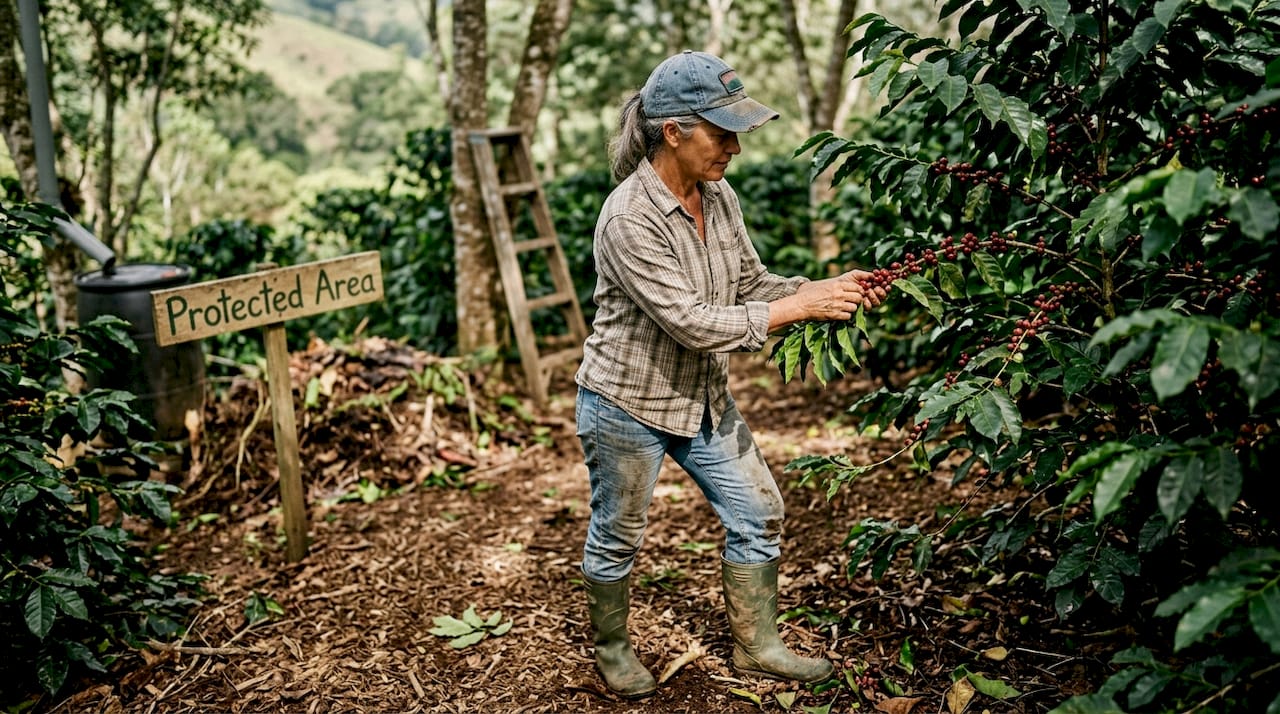
Deforestation represents one of coffee production’s most damaging environmental impacts, and fair trade standards explicitly prohibit clearing forests for coffee cultivation. Producers must demonstrate compliance through geolocation monitoring and satellite verification, ensuring that certified coffee doesn’t contribute to habitat destruction. This protection preserves critical ecosystems that support biodiversity and carbon sequestration.
The certification also restricts synthetic pesticides and chemical fertilizers that contaminate water sources and harm beneficial insects. By encouraging organic pest management and natural fertilization methods, fair trade standards reduce the chemical footprint of coffee production. Shade-grown coffee practices promoted under fair trade guidelines create habitat corridors for migratory birds and native wildlife while improving soil health through natural nutrient cycling.
Environmental protections include:
- Absolute bans on deforestation with satellite verification systems
- Restrictions on synthetic pesticides and harmful agrochemicals
- Requirements for soil conservation and water management practices
- Promotion of shade-grown coffee that supports biodiversity
- Waste management standards that minimize pollution
| Environmental Standard | Implementation Method | Measurable Impact |
|---|---|---|
| Deforestation Prevention | Geolocation monitoring | Zero forest clearing on certified farms |
| Chemical Reduction | Approved substance lists | 60-80% reduction in synthetic pesticide use |
| Biodiversity Support | Shade cover requirements | 40% increase in bird species diversity |
| Water Protection | Buffer zones and filtration | 70% reduction in waterway contamination |
Pro Tip: To maximize your environmental impact when you support eco-friendly coffee, choose fair trade certified options that also carry organic or Rainforest Alliance certifications for comprehensive ecological protection.
These environmental standards align perfectly with the values of eco-conscious consumers seeking coffee that tastes excellent while protecting the planet. The sustainable coffee environmental commitment embedded in fair trade certification creates verifiable ecological benefits that extend across entire growing regions.
3. Social benefits include child labor bans and community empowerment
Fair trade certification addresses social justice concerns through strict labor standards and community development initiatives. Fairtrade standards ban child labor and promote community projects funded by premiums that improve quality of life for farming families. These social safeguards distinguish fair trade from conventional coffee production where labor exploitation remains a persistent problem.
The prohibition on child labor includes both forced labor and exploitative work that interferes with education. Fair trade auditors verify that children in farming communities attend school rather than working in fields, breaking cycles of poverty that trap families across generations. When children receive education instead of premature employment, entire communities gain opportunities for long-term economic advancement.
Community premiums fund tangible social improvements that farmers identify as priorities. Cooperatives have invested premium funds in scholarship programs that enable high school attendance, healthcare clinics that serve remote farming regions, and clean water systems that reduce disease. These investments create ripple effects that improve community wellbeing far beyond the direct benefits of higher coffee prices.
The cooperative structure itself serves as a social benefit by strengthening farmer organization and collective decision making. Producers gain skills in democratic governance, financial management, and strategic planning that empower them to advocate for their interests. This organizational capacity building creates lasting social capital that benefits communities long after individual coffee harvests.
Social protections include:
- Absolute bans on child labor and forced labor with verification systems
- Premium-funded scholarships that improve educational access
- Healthcare initiatives serving farming families and communities
- Democratic cooperative structures that empower producer voices
- Gender equity programs promoting women’s participation in leadership
When you support sustainable coffee farms, you’re investing in social infrastructure that transforms entire communities. The social benefits of fair trade certification extend beyond individual transactions to create systemic improvements in farmer welfare and community resilience.
4. Understanding the nuanced economic impact of fair trade coffee
While fair trade certification delivers clear benefits, the economic impacts show more complexity than simple narratives suggest. Empirical studies show modest direct income gains and variable effects across countries depending on market conditions, cooperative efficiency, and regional factors. Understanding these nuances helps consumers set realistic expectations about fair trade’s economic influence.
Income increases from fair trade certification average around 5 cents per pound, with higher gains occurring when market prices fall below the fair trade minimum. During periods of high market prices, the fair trade premium provides less relative benefit since conventional prices may exceed fair trade minimums. This dynamic means fair trade functions most effectively as insurance against market crashes rather than a guaranteed income multiplier.
The benefits flow primarily to cooperatives rather than individual farmers, creating variation in how much reaches producer households. Well-managed cooperatives distribute benefits more effectively through both direct payments and community investments, while less efficient organizations may see premiums absorbed by administrative costs. The Harvard fair trade coffee impacts study found significant regional differences in effectiveness based on cooperative governance quality.
Direct trade models sometimes deliver higher prices to farmers by eliminating middlemen, but lack the social and environmental standards enforcement that fair trade certification provides. The comparison between organic coffee vs fair trade beans reveals different value propositions, with each certification addressing distinct priorities.
| Economic Factor | Fair Trade Impact | Regional Variation |
|---|---|---|
| Direct Income Gain | 5-10 cents per pound average | Higher in low-price markets |
| Community Premium | 20 cents per pound for projects | Depends on cooperative efficiency |
| Market Access | Improved for certified cooperatives | Stronger in specialty markets |
| Price Stability | Significant during market crashes | Less relevant in high-price periods |
These economic realities don’t diminish fair trade’s value but rather clarify where it delivers the strongest benefits. The certification works best as one component of ethical sourcing rather than a complete solution to coffee farmer poverty.
5. The certification process ensures traceability and ethical compliance
Fair trade certification maintains credibility through rigorous verification systems that distinguish it from self-proclaimed ethical claims. FLOCERT audits ensure compliance with labor, environmental, and trade standards through independent inspections that occur annually for producer organizations. This third-party oversight creates accountability that voluntary commitments cannot match.
The certification process follows a structured pathway:
- Initial application and documentation review of cooperative structure and practices
- Physical site inspection by trained auditors who verify compliance with standards
- Evaluation of financial records, labor practices, and environmental management systems
- Corrective action plans for any non-compliance issues identified during audits
- Annual re-certification audits to ensure ongoing adherence to evolving standards
- Random spot checks and complaint investigations that maintain continuous oversight
Traceability systems track certified coffee from farm to final sale through either physical segregation or mass balance methods. Physical segregation keeps certified coffee completely separate throughout processing and shipping, while mass balance allows mixing with verification that equivalent certified volumes enter and exit each stage. Geolocation monitoring uses satellite imagery to verify that certified farms don’t engage in deforestation or expand into protected areas.
The certification infrastructure includes both producer standards and trader standards, ensuring compliance throughout the supply chain. Roasters and retailers must also undergo audits demonstrating they purchase certified coffee at fair trade prices and accurately label products. This comprehensive verification system creates end-to-end accountability that consumers can trust when making purchasing decisions.
Pro Tip: Understanding the role of fair trade coffee in your purchasing decisions becomes easier when you recognize that certification logos represent verified compliance rather than marketing claims.
The certification process transforms abstract ethical commitments into concrete, verifiable practices that create real improvements in coffee production. This systematic approach to verification distinguishes fair trade from less rigorous sustainability claims.
Discover sustainable coffee that supports fair trade values
Now that you understand the compelling reasons behind fair trade coffee, you can put these values into practice with every cup. EcoVibe Roast offers convenient options that align with your commitment to ethical sourcing and environmental responsibility. Our 60 pack single serve coffee pods deliver premium taste while supporting sustainable farming practices and community development.

Explore our complete single serve collection featuring carefully sourced blends that meet rigorous sustainability standards. Every purchase contributes to our environmental initiatives, and you can track the tangible impact of your coffee choices on our environmental impact page. Experience how choosing ethically sourced coffee creates positive change without compromising the quality and convenience you expect from your daily brew.
Frequently asked questions about fair trade coffee
What makes fair trade different from direct trade coffee?
Fair trade involves third-party certification with standardized requirements for minimum prices, premiums, and social and environmental practices. Direct trade coffee describes relationships where roasters buy directly from farmers, often paying premium prices but without standardized verification or community development requirements. Fair trade provides systematic protections while direct trade offers flexibility and potentially higher individual farmer payments.
How do fair trade premiums actually get used in farming communities?
Cooperatives democratically decide how to allocate premium funds based on community priorities identified through member voting. Common investments include educational scholarships, healthcare facilities, clean water infrastructure, and agricultural equipment that benefits all members. Cooperatives must document premium spending and report allocation decisions to members annually, creating transparency in how these funds create community benefits.
Do ethical coffee certifications guarantee the best quality beans?
Certifications verify social and environmental practices rather than cup quality, though many certified coffees also achieve high quality scores. The financial stability from fair trade often enables farmers to invest in quality improvements like better processing equipment and selective harvesting. When you choose planet-friendly coffee beans, look for both ethical certifications and quality indicators like specialty grade ratings for the best combination.
Can I trust fair trade labels on coffee products?
Authentic fair trade labels come from recognized certifying bodies like Fairtrade International or Fair Trade USA, which maintain public databases of certified products. These organizations conduct regular audits and can revoke certification for non-compliance, creating accountability that generic ethical claims lack. Verify certification by checking product codes against official certifier databases if you want absolute certainty about label authenticity.
Why do some coffee experts criticize fair trade certification?
Critics point to modest direct income gains, administrative costs that reduce premiums reaching farmers, and potential market distortions from fixed pricing. Some argue direct trade relationships or other models deliver better farmer outcomes in specific contexts. These criticisms highlight that fair trade works best as one tool among many for improving coffee production rather than a perfect solution to all challenges facing coffee farmers.
Recommended
- Sustainability Trends in Coffee 2026: Impact on Ethical Choices – EcoVibe Roast
- Top 5 Organic Coffee vs Fair Trade Beans Choices in 2026 – EcoVibe Roast
- 7 Types of Coffee Certifications for Conscious Consumers – EcoVibe Roast
- 7 Essentials for a Sustainable Coffee Gift Checklist – EcoVibe Roast
- Sustainable Coffee Wholesale | Eco Friendly Supplier | Devon Somerse