

TL;DR:
- Micro-lot coffee offers high traceability and quality premiums that can incentivize ethical farming practices. However, its sustainability impact depends on transparent relationships, equitable premium distribution, and broader systemic support. Consumers should verify sourcing transparency and support brands committed to genuine, impactful ethical practices.
You’ve probably picked up a bag of micro-lot coffee at some point, seen the elegant label, the farm name, maybe even the GPS coordinates of the exact plot where the beans grew, and felt a genuine glow of doing something good. It’s a satisfying feeling. But here’s a question worth sitting with: does the label alone guarantee real sustainability, or is there more to the story? The truth is nuanced, and understanding it can actually make your choices far more powerful. Let’s walk through what micro-lot coffee really means for ethical sourcing, where it shines, and where it falls short.
Table of Contents
- What is micro-lot coffee? Context and definition
- Core ways micro-lot coffee supports sustainability
- Limitations and myths: Micro-lots are not a silver bullet
- Making a difference: How to buy micro-lot coffee responsibly
- The uncomfortable truth: Micro-lot impact depends on more than size
- Eco-friendly coffee, tea, and ethical choices with EcoVibe Roast
- Frequently asked questions
Key Takeaways
| Point | Details |
|---|---|
| Micro-lot defined | Micro-lot coffee is small-batch, high-traceability coffee often sold at a premium for quality and sustainable practices. |
| Sustainability mechanisms | Micro-lots can drive positive change when economic incentives and transparency support ethical trade and careful farming. |
| Limits and myths | Micro-lots are not always more sustainable; impact depends on transparent roasters and community resilience. |
| Buying responsibly | Eco-conscious buyers should prioritize direct trade, traceability, and transparent sourcing to ensure lasting sustainability. |
| Bigger picture | True sustainability comes from industry-wide transparency and support, not just micro-lot size. |
What is micro-lot coffee? Context and definition
Micro-lot coffee refers to small, traceable batches of beans harvested from a specific, clearly identified area of a farm, sometimes as small as a single hillside or a cluster of trees. These lots are separated from the broader farm harvest because they show distinctive flavor qualities, whether that’s a bright, floral Ethiopian natural process or a rich, chocolatey Guatemalan washed lot with notes that would get lost in a larger blend.
Specialty buyers and eco-conscious coffee consumers are drawn to micro-lots for a few good reasons. First, the traceability is remarkable. You know exactly where your coffee came from, which creates accountability all the way down the supply chain. Second, the flavor is often exceptional. Because farmers take extra care to hand-select and process micro-lot beans meticulously, the result tantalizes your taste buds in ways that a commodity blend rarely does. Understanding why coffee quality benefits go hand in hand with ethical production helps explain why micro-lots command a premium.
That premium is actually a key sustainability driver. When roasters pay more for traceable, high-quality lots, farmers have a financial incentive to invest in careful farming practices, reduce defect rates, and maintain the environmental conditions that produce great coffee. According to industry analysis, micro-lots support sustainability primarily through these economic incentives, fostering ethical direct trade relationships and encouraging careful, low-defect farming methods.
“Micro-lot coffee’s sustainability story is not written in the size of the batch alone. It is written in the relationships, the transparency, and the economic signals that flow between roasters and the people who grow the coffee.”
Here’s a useful bullet list of what makes micro-lot coffee distinct from standard commodity coffee:
- Precise traceability: Lot-level identification, often traceable to a specific field or processing method
- Quality premiums: Farmers receive above-market prices for exceptional, low-defect harvests
- Direct trade relationships: Shorter supply chains connecting roasters directly with growers
- Distinctive flavor profiles: Unique sensory attributes that reward careful, attentive farming
- Storytelling value: Rich narratives that connect consumers to the land and people behind the cup
Core ways micro-lot coffee supports sustainability
Now that we understand what micro-lot coffee is, let’s dig into how it actually supports sustainability in practice. The mechanisms are real, and they matter. But they only work well under certain conditions.
Here are the four core ways micro-lot coffee drives sustainable outcomes:
-
Higher and more stable farm income. When farmers know that a specific section of their land can command two or three times the commodity price, they are motivated to invest in that land. This means better soil care, more thoughtful pruning, and often a shift toward shade-grown cultivation that protects biodiversity. Stable income also means farmers can plan ahead rather than making desperate short-term decisions.
-
Reduced agricultural waste through defect reduction. Micro-lot processing demands precision. Farmers and processors sort beans more carefully, ferment them more attentively, and dry them with greater focus. This reduction in defects is not just a quality win but also an ecological one, as less waste ends up discarded from the processing chain.
-
Direct trade relationships that encourage eco-innovation. When a roaster visits a farm directly and builds a real relationship with a farmer, something meaningful happens. The farmer gains access to feedback, technical knowledge, and sometimes even investment in processing equipment. These relationships often spur on-farm experiments with regenerative agriculture, water conservation, and renewable energy. Check out the ethical sourcing benefits that flow from these kinds of genuine partnerships.
-
Consumer-driven accountability. When you buy a micro-lot coffee and can trace it to a named farmer on a specific hillside, you become a stakeholder in that farmer’s success. This accountability loop encourages roasters to maintain honest sourcing standards, because their customers are paying attention.
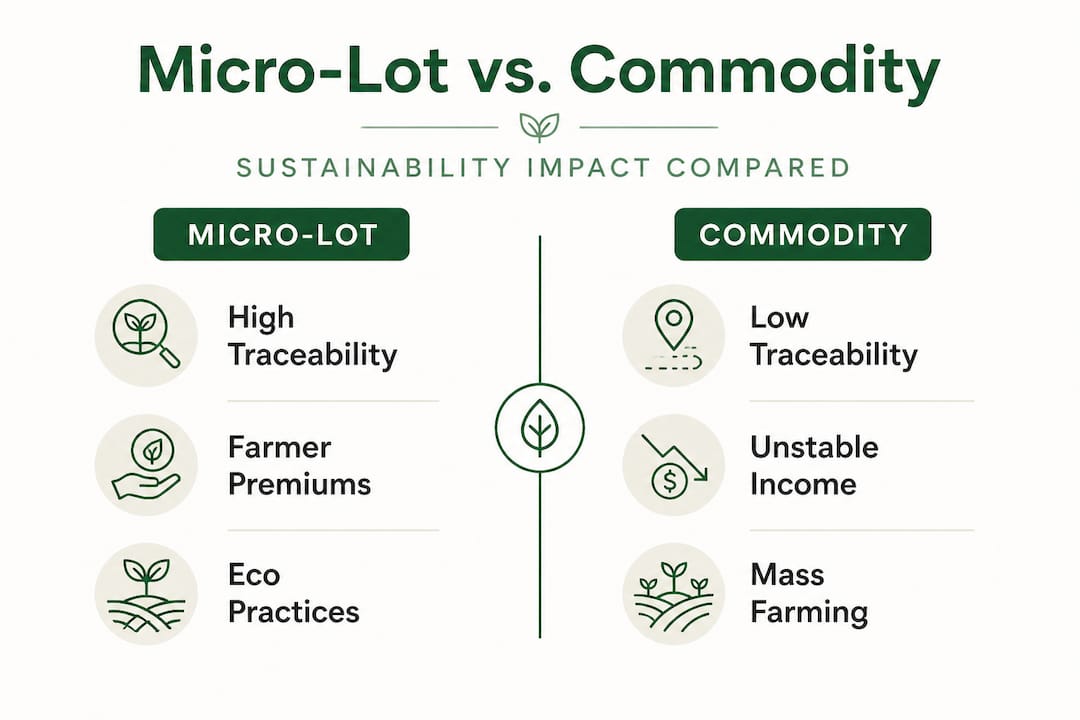
Here is a quick comparison to help you see how micro-lot and large-lot approaches stack up on key sustainability dimensions:
| Sustainability metric | Micro-lot approach | Large-lot/commodity approach |
|---|---|---|
| Farm income stability | Higher premiums, often more predictable | Volatile, commodity price dependent |
| Traceability | Lot-level, farm-specific | Limited, blended origins |
| Environmental incentives | Strong, tied to quality practices | Weaker, based on volume output |
| Farmer relationship depth | Direct trade, personal connections | Often multi-layer intermediary chain |
| Scalability for impact | Limited to small volumes | Broad reach but diluted accountability |
| Innovation support | Encourages farm-level experimentation | Standardization prioritized |

Pro Tip: When you are shopping for micro-lot coffee, look for roasters who publish sourcing reports or impact statements alongside their offerings. A roaster who names the farmer, describes the processing method, and shares how the premium was calculated is a roaster you can trust. Pair this habit with reading eco-friendly coffee drinking tips to sharpen your overall approach.
Limitations and myths: Micro-lots are not a silver bullet
Here is where things get honest, and honestly, a little uncomfortable. Micro-lot coffee has genuinely exciting potential, but the specialty coffee industry has sometimes let the marketing run ahead of the reality. Let’s separate the facts from the feel-good fiction.
Key limitations you should know about:
- Premiums do not always reach farmers. Supply chains, even in specialty coffee, have intermediaries. Exporters, importers, and regional brokers can each take a slice, meaning the premium you pay at the register does not automatically translate to meaningful extra income for the farmer who grew your beans.
- Market volatility still hits micro-lot farmers hard. Even farmers producing celebrated micro-lots are not immune to climate disruptions, currency fluctuations, or regional instability that can undercut a season’s work.
- Micro-lot size does not guarantee superior ethics. A small batch can still come from a farm with poor labor practices, water-intensive processing, or monoculture growing conditions. Small does not automatically mean sustainable.
- Co-operative large-lot coffees can be equally impactful. A well-run farmer co-op producing quality large lots with transparent profit-sharing can deliver broader, more resilient sustainability outcomes than a handful of premium micro-lots that only benefit a few individuals.
Concerned about your broader coffee drinking and ethics? You are not alone. Many thoughtful consumers are surprised to learn that co-op sourcing models can sometimes outperform micro-lots in difficult environments.
Research backs this up clearly. In high-risk, climate-vulnerable regions like parts of Ethiopia, micro-lots support innovation at a small experimental scale but require broader bulk diversification to genuinely protect farmer resilience. They are not inherently more sustainable than quality large lots sourced from transparent co-ops. Brands across the industry are grappling with this tension between differentiation and real-world impact, and sustainability for e-commerce brands is increasingly about substance over story.
| Scenario | Micro-lot outcome | Co-op large-lot outcome |
|---|---|---|
| Climate shock year | Single-farm vulnerability | Shared risk across many farmers |
| Premium distribution | Risk of intermediary capture | Transparent member profit-sharing |
| Community-wide benefit | Individual farm only | Village-level economic impact |
| Innovation capacity | Small-scale experimentation | Collective investment in shared infrastructure |
“The specialty coffee world has sometimes confused beautiful storytelling with meaningful impact. The most sustainable cup of coffee is not always the most photogenic one.”
Making a difference: How to buy micro-lot coffee responsibly
So, you want your coffee purchase to genuinely help people and the planet. That is absolutely possible, and here is your practical roadmap to making it happen with confidence.
Follow these steps when evaluating a micro-lot coffee for real sustainability impact:
-
Verify the traceability claim. A lot name and a farm photo are a start, but ask whether the roaster can tell you the farmer’s name, the region, and the specific lot. Vague regional claims like “Ethiopian highlands” are not the same as genuine micro-lot traceability.
-
Look for direct trade or relationship-based sourcing. Has the roaster visited the farm? Do they have a multi-year buying relationship? These signals suggest the premium is actually landing where it should. Resources on supporting local roasters can help you understand what genuine community commitment looks like.
-
Check for recognized certifications, but do not stop there. Fair Trade, Rainforest Alliance, and organic certifications all mean something. But they are a floor, not a ceiling. A certified coffee with genuine direct trade relationships is far more impactful than one that hides behind a logo.
-
Ask for impact statements. The best roasters publish documentation showing how premiums were distributed, what farm improvements were funded, and what the farmer’s quality score meant in dollar terms for their household.
-
Support brands that offer transparency in sourcing as a core value, not an afterthought. A brand that builds its identity around accountability is one that has skin in the game.
Pro Tip: Before committing to a new roaster, email them one simple question: “Can you tell me specifically how your micro-lot premiums benefit the farmers who grew this coffee?” The quality and honesty of the answer will tell you everything you need to know.
Here is a list of questions to vet whether a micro-lot offering is genuinely sustainable:
- Does the roaster publish a sourcing report or impact update?
- Is the farm name, farmer name, or cooperative clearly listed?
- Can the roaster explain the supply chain from farm to roaster in plain language?
- Are environmental practices like shade-growing, water use, or composting mentioned?
- Does the roaster maintain a multi-year buying commitment with this farm?
- Are labor conditions on the farm verified independently or through direct visits?
When you support eco-conscious brands that answer these questions openly, you are voting with your dollars for a coffee industry that actually works for farmers and the planet.
The uncomfortable truth: Micro-lot impact depends on more than size
We have spent years thinking about what genuinely drives sustainability in coffee sourcing, and here is the honest perspective we have earned: the size of the lot is almost beside the point. What actually matters is the quality of the relationship between the buyer and the farmer, the transparency of the money flow, and the resilience of the support system around the grower.
We have seen beautifully labeled micro-lots that delivered no meaningful extra income to the families who produced them. We have also seen co-operative bulk coffees from Rwanda and Peru that transformed entire village economies. The difference was never the bag size. It was the commitment of the people on both sides of the trade.
The lesson here is that your power as a consumer is real, but it needs to be pointed in the right direction. Industry data confirms that systemic issues like price volatility and uneven premium distribution consistently limit the broader impacts of micro-lot sourcing, especially when buyers do not pair their purchases with transparent roasting partners.
The most impactful thing you can do is hold brands accountable. Ask hard questions. Reward transparency. And do not assume that a higher price tag or a prettier label equals a better outcome for the people growing your coffee. You might also want to explore eco-friendly coffee alternatives that diversify your impact beyond micro-lots alone.
Systemic change in coffee sourcing happens one informed consumer at a time. That is not a small thing. That is actually the whole story.
Eco-friendly coffee, tea, and ethical choices with EcoVibe Roast
Ready to put all of this knowledge into action? At EcoVibe Roast, we source coffee and tea with exactly the kind of transparency and accountability you have been reading about. Every purchase plants mangrove trees and helps remove ocean-bound plastics, so your morning cup becomes a warm hug for both you and Mother Earth.

Whether you are drawn to traceable single-origin beans, convenient sustainable coffee pods, or aromatic herbal teas, you will find options that align with your values. Browse our full coffee and tea collection to discover offerings sourced with integrity and enjoyed with purpose. Your next cup can do more than taste good. It can make a real difference.
Frequently asked questions
Are micro-lot coffees always more sustainable than large-lot coffees?
No, micro-lots are not inherently more sustainable than quality large lots from co-ops, which can match or exceed their impact, especially in high-risk environments where shared resilience matters most.
How do I know if a micro-lot coffee is ethically sourced?
Look for transparency in sourcing, direct trade partnerships, and clear farmer impact statements, since transparent roasters are what truly make micro-lot purchases effective for eco-conscious buyers.
Do micro-lot premiums always reach farmers?
Not always. Price volatility and uneven distribution of premiums through multi-layer supply chains can significantly limit the economic benefit that actually reaches the farming household.
What should I ask my coffee roaster before buying micro-lot coffee?
Ask for specific details on traceability, the depth of the farmer relationship, and how premiums support sustainability, since transparent roasters will answer these questions clearly and willingly.
What’s the main advantage of micro-lot coffee for eco-conscious buyers?
The biggest advantage is meaningful traceability and direct farmer support, because premiums for quality and traceability foster ethical direct trade and incentivize careful, low-defect farming when backed by genuine transparency.
Recommended
- Sustainability Trends in Coffee 2026: Impact on Ethical Choices – EcoVibe Roast
- Top benefits of ethical sourcing for coffee & tea lovers – EcoVibe Roast
- Ethical sourcing in coffee and tea: real examples & how to choose – EcoVibe Roast
- How Community Support Transforms Sustainable Coffee Sourcing – EcoVibe Roast
- Why coffee quality matters: Elevate every cup you drink


