

TL;DR:
- Traceable blends document every ingredient’s origin, ensuring ethical sourcing and regulatory compliance. They provide more consistent flavor and supply stability than many single-origin products. Verifiable supply chains promote sustainability, fair wages, and consumer trust while meeting legal standards.
Traceable blends are defined as multi-origin coffee or tea products where every ingredient is individually documented, verified, and linked back to its farm of origin. The role of traceable blends goes far beyond a marketing label. It is the backbone of quality assurance, regulatory compliance, and ethical sourcing in the beverage industry. Regulations like the EU Deforestation Regulation now require plot-level geolocation for every blend ingredient, making traceability a legal necessity. Tools like TRST01Chain and audit standards like USDA Organic Handler certification are raising the bar for what “responsibly sourced” actually means. If you care about what’s in your cup and where it came from, understanding traceable blends is the place to start.
What is the role of traceable blends in coffee and tea supply chains?
Traceable blends give every ingredient a verifiable identity from the farm plot to your cup. The industry term for this practice is “supply chain traceability,” and it covers the full documentation trail that follows each component through processing, blending, and packaging. Without it, a brand’s sustainability claims are just words on a bag.
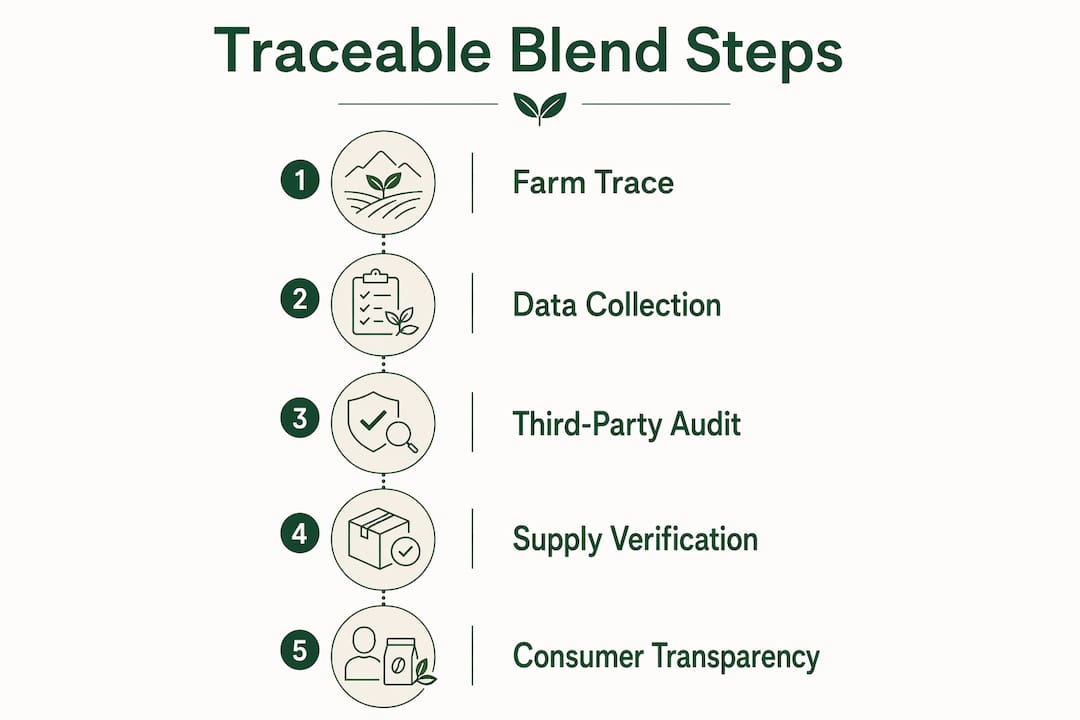
The coffee supply chain is long and complex. Beans may pass through farmers, cooperatives, exporters, importers, and roasters before reaching you. Each handoff is a point where origin data can be lost. Traceable systems lock that data in at every step, so the story of your coffee stays intact.
USDA Organic Handler certification now requires third-party audit verification of blending processes, replacing paper certificates with physical proof that travels with the product. That shift matters because paper is easy to fake. Physical audit trails are not.
How do traceable blends work technically and legally?
Traceability in blends operates on two levels: mass-balance and plot-level. Mass-balance accounting tracks volumes of certified ingredients across a supply chain without linking each unit to a specific farm. Plot-level traceability goes further, tying each batch to a specific GPS-verified farm location. Regulators increasingly demand the second approach.
Here is how a traceable blend moves through the supply chain:
- Farm registration. Each farm or plot is registered with geolocation data and assigned a unique identifier.
- Harvest documentation. Lot numbers are created at harvest and linked to the farm record.
- Processing records. Mills and processors log which lots they received and what they produced.
- Blending documentation. Roasters record the exact ratio of each lot used in a blend.
- Third-party verification. An auditor confirms the documentation chain is complete and consistent.
The biggest technical challenge sits at aggregation points like mills and processors. Farm-level identities are lost when multiple farmers deliver to the same mill. The solution is a layered evidence model that combines digital records with physical or forensic markers, such as chemical isotope testing, to confirm a product contains exactly what the label claims.
Pro Tip: When evaluating a brand’s traceability claims, ask specifically whether they use plot-level documentation or only mass-balance accounting. The difference tells you how seriously they take ingredient verification.
Technology platforms like TRST01Chain collect, store, and verify this data across the supply chain. They create an immutable record that regulators, auditors, and consumers can access. That kind of transparency in coffee supply is what separates a credible sustainability claim from a vague one.

Are traceable blends better than single-origin coffee and tea?
Single-origin coffee is not automatically superior to a well-documented blend. Quality depends on lot-level documentation and supply chain rigor, not the number of origins in the cup. A traceable multi-origin blend comprising two or three documented origins often outperforms single-origin products in flavor consistency because roasters can compensate for seasonal variation by adjusting ratios.
| Feature | Single-origin | Traceable blend |
|---|---|---|
| Flavor consistency | Varies by season and harvest | More consistent due to ratio adjustments |
| Supply stability | Vulnerable to single-region disruptions | More resilient with multiple documented sources |
| Regulatory compliance | Simpler documentation | Requires full multi-origin audit trail |
| Recall efficiency | Easier to isolate | Surgical recall possible with batch-linked data |
| Consumer transparency | One origin story | Multiple verified origin stories |
The benefits of traceable blends extend well beyond flavor. Consider what traceability does for safety and waste reduction:
- Surgical recalls. End-to-end traceability enables brands to isolate affected lots during a contamination event, protecting non-contaminated inventory from unnecessary disposal.
- Waste reduction. Broad market recalls in non-traceable supply chains pull entire product lines. Traceable systems limit the scope to the specific affected batch.
- Consumer confidence. Verified sourcing turns marketing language into defensible evidence that holds up under regulatory scrutiny.
- Compliance readiness. Traceable blends meet the documentation requirements of the EU Deforestation Regulation and similar frameworks without last-minute scrambling.
The insight that surprises most consumers is this: a blend with three documented origins and a complete audit trail is a stronger ethical purchase than a single-origin coffee with no verification behind it.
How do traceable blends support sustainability and ethical sourcing?
Traceability is core supply chain infrastructure for sustainability, not a marketing add-on. Brands lacking data connectivity struggle to meet modern sustainability targets because they cannot measure what they cannot track. Traceable blends create the data feedback loops that allow continuous improvement of sourcing ratios and environmental impact.
Here is what traceability makes possible in practice:
- Deforestation-free sourcing. Plot-level geolocation confirms that farms sit outside protected forest zones, supporting environmental goals with real evidence.
- Fair trade verification. Documented supply chains make it possible to confirm that farmers received fair wages at every stage, not just at the point of export.
- Certification support. Certifications like Fair Trade, Rainforest Alliance, and USDA Organic depend on audit trails. Traceable blends provide those trails automatically.
- ESG reporting. Verified traceability supports credible environmental, social, and governance reporting that regulators and investors increasingly require.
The data feedback loop is worth highlighting. When a roaster knows exactly which farms contributed to a blend, they can reward high-performing, sustainable farms with larger purchase commitments. That financial signal encourages better farming practices upstream. Traceability turns your purchase into a vote for the kind of agriculture you want to see more of.
Pro Tip: Look for brands that publish their sourcing data publicly, not just on request. Public data means the brand is confident enough in its supply chain to invite scrutiny.
Ethical sourcing in coffee and tea is only as strong as the documentation behind it. You can read more about real examples of ethical sourcing to see what genuine traceability looks like in practice.
What steps should you take when choosing traceable blends?
Choosing a traceable blend confidently takes a little know-how, but the process is straightforward once you know what to look for. Here are the steps to guide you:
- Read the origin information carefully. Look for specific farm names, regions, or cooperative names rather than just country of origin. “Colombia” is not traceability. “Huila region, La Esperanza cooperative, lot 2024-07” is.
- Check for third-party certifications. Labels like USDA Organic, Fair Trade Certified, or Rainforest Alliance indicate that an independent auditor has verified the supply chain. Learn more about how certifications drive sustainability in coffee and tea.
- Ask the brand directly. Contact the roaster and ask whether they use plot-level or mass-balance traceability. A brand committed to transparency will answer clearly and quickly.
- Understand the label language. Terms like “traceable multi-origin” signal that multiple sources are documented. “Blend” alone means nothing without supporting documentation.
- Use verification tools. Some brands provide QR codes or online portals where you can trace your specific batch. TRST01Chain is one platform that makes this kind of consumer-facing verification possible.
Choosing responsibly sourced beverages is a skill that gets easier with practice. The more you ask these questions, the more you train brands to provide better answers.
Key takeaways
Traceable blends are the most reliable way to verify that your coffee or tea is ethically sourced, environmentally responsible, and consistent in quality.
| Point | Details |
|---|---|
| Definition matters | A traceable blend documents every ingredient to its farm plot, not just its country of origin. |
| Blends beat single-origin | A well-documented multi-origin blend delivers better flavor consistency and supply stability than many single-origin products. |
| Regulations are driving change | The EU Deforestation Regulation requires plot-level geolocation, making traceability a legal requirement, not a choice. |
| Recalls become surgical | Batch-linked traceability isolates affected lots during contamination events, reducing waste and financial loss. |
| Your purchase sends a signal | Buying traceable blends rewards sustainable farms with larger commitments and drives better practices upstream. |
Why I think traceability is the most underrated story in your morning cup
Most coffee conversations focus on roast profiles, brewing methods, or origin stories. Traceability rarely comes up, and that gap frustrates me. The supply chain behind your cup is where the real ethical action happens, and most consumers never see it.
I have watched the conversation shift over the past few years. Regulations like the EU Deforestation Regulation are forcing brands to build real documentation systems instead of relying on feel-good marketing. That is genuinely good news. But the misconception I keep encountering is that single-origin automatically means more ethical or more transparent. It does not. A single-origin coffee with no audit trail is less verifiable than a traceable blend with full lot-level documentation.
The technology side of this story is also moving fast. Platforms that combine digital records with forensic verification like isotope testing are making it nearly impossible to fake origin claims. That shift from paper certificates to layered evidence models is the most important development in sustainable sourcing right now. It means the claims on your bag are becoming harder to fake and easier to verify.
My honest advice is to stop treating traceability as a bonus feature and start treating it as a baseline requirement. Ask your brand where your coffee came from. If they cannot tell you the farm, the lot, and the audit standard, keep looking. You deserve a cup that is as good for the planet as it tastes.
— LaSaundra
Ecoviberoast’s traceable single-serve pods worth trying
Ecoviberoast sources its coffee with full supply chain documentation, so you know exactly what you are drinking and where it came from. Every purchase also plants mangrove trees and removes ocean-bound plastics, making your morning ritual a warm hug for both you and Mother Earth.

The 60-pack single-serve coffee pods from Ecoviberoast deliver rich, aromatic flavor in a convenient format backed by traceable sourcing. Each pod is crafted from responsibly documented origins, so sustainability and great taste come together in every brew. If you want to start smaller, the 12-pack option lets you sample the same quality without committing to a full box.
FAQ
What are traceable blends in coffee and tea?
Traceable blends are multi-origin beverages where every ingredient is documented back to its specific farm or cooperative. Each component carries a verifiable record covering origin, processing, and blending ratios.
How do traceable blends support sustainability goals?
Traceable blends create data feedback loops that allow brands to confirm deforestation-free sourcing, verify fair wages, and meet certification audit requirements. Brands with full traceability can also produce credible ESG reports backed by real supply chain data.
Are traceable blends better than single-origin coffee?
A well-documented traceable blend often delivers more consistent flavor and greater supply stability than single-origin products. Quality depends on supply chain rigor and lot-level documentation, not the number of origins.
What regulations require traceable blends?
The EU Deforestation Regulation requires plot-level geolocation data for every blend ingredient sold in European markets. USDA Organic Handler certification also mandates third-party verification of audit trails in blending operations.
How can you verify a brand’s traceability claims?
Look for specific farm names, lot numbers, and third-party certifications like Fair Trade or USDA Organic on the packaging. Some brands also offer QR codes or online portals that let you trace your specific batch through the supply chain.


