

TL;DR:
- Choosing certified Bird Friendly coffee supports a diverse, multi-layer forest ecosystem that benefits birds and the environment.
- The certification ensures minimal habitat disruption, promotes native trees, and includes organic standards that protect insect populations vital for migratory birds.
You’ve probably noticed the words “shade-grown” on a coffee bag and felt good about your purchase. Here’s the thing, though: that label means almost nothing on its own. If you genuinely want your morning brew to protect migratory birds and tropical forests, you need to understand why choose bird-friendly beans certified by the Smithsonian’s Bird Friendly program specifically. The standards go far beyond a marketing claim, and once you see what’s actually required, you’ll never look at a coffee label the same way again.
Table of Contents
- Key takeaways
- Why choose bird-friendly beans: what the certification actually means
- The real ecological impact on birds and beyond
- How Bird Friendly compares to other certifications
- How to find and buy genuine Bird Friendly coffee
- My honest take on why this actually matters
- Taste the difference with Ecoviberoast
- FAQ
Key takeaways
| Point | Details |
|---|---|
| Bird Friendly beats “shade-grown” | Certified Bird Friendly coffee meets strict habitat, tree diversity, and organic standards that generic labels skip entirely. |
| Wildlife impact is measurable | Bird Friendly farms support 75% to 95% of bird species found in undisturbed tropical forests, compared to under 10% on sun farms. |
| Organic is part of the deal | The certification requires USDA Organic compliance, so insects that birds depend on for food are protected too. |
| Greenwashing is a real risk | Many bags claim “shade-grown” without meeting any verifiable ecological criteria, costing you a premium for no real benefit. |
| Finding real certification is easy | The Smithsonian National Zoo’s free retailer locator tool points you to verified Bird Friendly sellers near you. |
Why choose bird-friendly beans: what the certification actually means
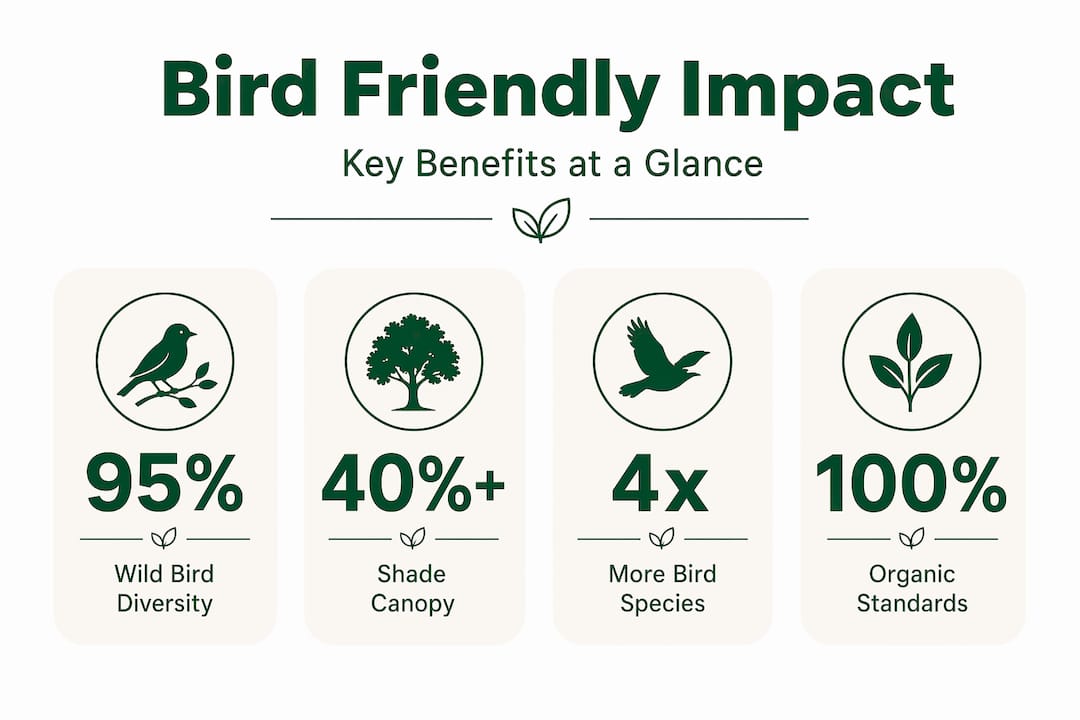
Not all shade is created equal. A coffee farm with a few scraggly trees overhead can technically call itself “shade-grown,” but that’s a far cry from a functioning forest ecosystem. The Bird Friendly certification requires a minimum of 40% shade cover, at least 10 tree species with 60% of those being native species, and a multi-layer canopy structure that mirrors how a natural tropical forest works. These aren’t arbitrary numbers. They were developed by Smithsonian ornithologists who spent years studying what birds actually need to survive.
That multi-layer canopy is worth pausing on. Think of it like an apartment building for wildlife: the upper story shelters raptors and large migrants, the middle story supports warblers and tanagers, and the understory provides cover for ground-feeding species. Each layer serves a different community of birds. A flat monoculture of sun-grown coffee, by contrast, is more like a parking lot. There is simply nowhere for birds to live.
The organic requirement is where things get even more interesting. Organic compliance protects insect populations that insectivorous migratory birds depend on for fuel during long flights. A farm could plant plenty of trees and still create what ecologists call an “ecological trap,” a place that looks like habitat but can’t support birds because the pesticides have wiped out their food supply. Bird Friendly certification closes that loophole entirely.
Pro Tip: When you’re shopping, look for the Bird Friendly seal showing the black and gold warbler silhouette. That specific logo signals Smithsonian certification. No logo means the “shade-grown” claim is unverified.
| Certification element | Bird Friendly requirement |
|---|---|
| Shade cover | Minimum 40% |
| Tree species count | At least 10 species |
| Native tree share | 60% or more native species |
| Canopy structure | Multi-layer (3+ strata) |
| Farming standard | USDA Organic certified |
The real ecological impact on birds and beyond
Here is a number worth sitting with: Bird Friendly farms support bird diversity at 75% to 95% of the levels found in undisturbed tropical forests. Sun-grown coffee farms? Under 10%. That’s not a modest difference. That’s the difference between a living forest and a biological desert that happens to grow coffee.
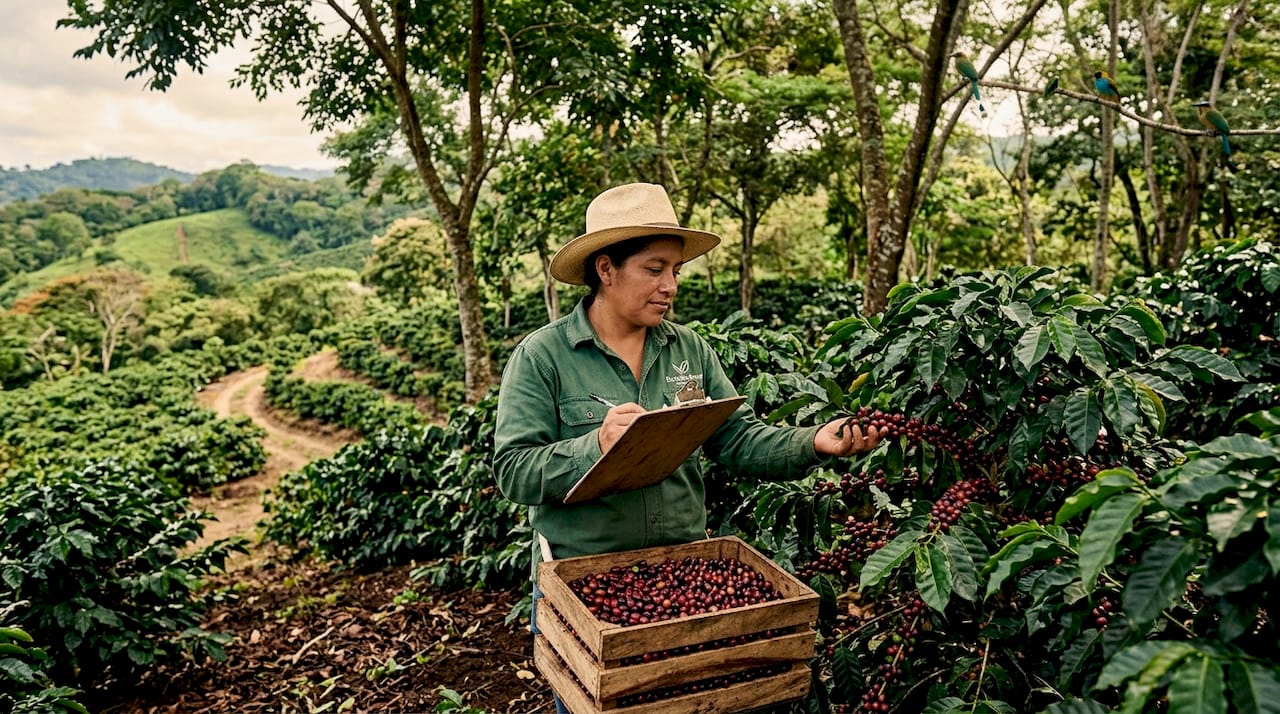
Why does it matter so much for bird conservation and coffee? Coffee-growing regions in Central America, Colombia, and Ethiopia sit directly along major migratory flyways. Hundreds of species of North American birds, including warblers, orioles, and thrushes, overwinter in these regions. If the farms they rely on for food and shelter convert to sun-grown monocultures, those birds have nowhere to go. Studies show that Bird Friendly farms can host up to four times as many bird species as conventional sun farms. Your cup of coffee is literally a vote on what that land looks like.
The benefits ripple well past birds, too. Here’s what the canopy supports across the whole ecosystem:
- Pest control: Insectivorous birds on shade farms reduce coffee berry borer infestations by around 50%, with pest control value estimated at $75 to $310 per hectare annually. That means farmers spend less on pesticides and still get better yields.
- Carbon sequestration: Bird Friendly farming sequesters 30 to 40 tons of carbon per hectare in above-ground tree biomass. Sun-grown monocultures store fewer than 5 tons per hectare by comparison.
- Soil health: Deep root systems from native shade trees reduce erosion, retain moisture, and feed the soil microbiome in ways bare-earth sun farms simply cannot.
- Mammal and reptile habitat: The multi-layer canopy creates microhabitats used by everything from small mammals to amphibians, supporting a genuinely functioning local ecosystem.
“The shade canopy of a Bird Friendly farm isn’t just a backdrop for coffee plants. It’s a working forest that feeds, shelters, and connects dozens of species across thousands of miles of migration routes.”
And there’s a bonus that tantalizes your taste buds, too. Shade-grown beans ripen more slowly in lower light, which builds higher sugar content. The result is a sweeter, more complex cup with balanced acidity and a smoother mouthfeel that coffee lovers consistently prefer over sun-grown alternatives.
How Bird Friendly compares to other certifications
This is where a lot of eco-conscious shoppers get tripped up. You see Rainforest Alliance, Fair Trade, Organic, and Bird Friendly all in the same specialty coffee aisle, and it’s easy to assume they’re roughly equivalent. They’re not.
To find the full picture on coffee certifications, it helps to understand what each label is actually measuring:
| Certification | Shade required | Organic required | Bird habitat rules | Native species requirement |
|---|---|---|---|---|
| Bird Friendly (Smithsonian) | Yes, 40% min | Yes, USDA Organic | Yes, specific canopy rules | Yes, 60% native |
| Rainforest Alliance | Partial | No | No specific rules | No |
| USDA Organic | No | Yes | No | No |
| Fair Trade | No | No | No | No |
| “Shade-grown” label | Unverified | No | No | No |
Fair Trade focuses on farmer wages and community equity, which matters enormously, but it says nothing about how the forest is managed. Rainforest Alliance addresses some environmental practices but lacks the specific shade and canopy criteria that make a farm genuinely usable by birds. USDA Organic protects against synthetic pesticides but doesn’t require a single shade tree. And the unregulated “shade-grown” claim on a bag? Many products claim shade-grown without meeting any Bird Friendly criteria at all.
Pro Tip: Don’t assume certifications stack to equal Bird Friendly. A bag can be Fair Trade and Organic without meeting a single bird habitat standard. Only the Smithsonian Bird Friendly seal guarantees the full ecological package.
Understanding these differences is what separates genuinely sustainable purchasing from well-intentioned greenwashing. If biodiversity and habitat conservation are your goals, the Bird Friendly seal is the only label that directly addresses them with measurable, verified standards. For a deeper look at shade-grown vs. sun-grown farming, the environmental and social contrasts are striking.
How to find and buy genuine Bird Friendly coffee
Knowing all of this is only useful if you can actually find the real thing. The good news is that the Smithsonian National Zoo makes it genuinely easy. Their official retailer locator lists over 800 retailers selling Bird Friendly certified coffee worldwide, and you can filter by location or shop online. Start there.
Beyond that, here are four practical steps to make sure you’re choosing sustainable beans for birds every time you buy:
- Look for the official seal. The Bird Friendly warbler logo on the bag is your clearest signal. No logo means the shade-grown or eco-friendly language on the packaging is not backed by Smithsonian verification.
- Check the farm details. The best Bird Friendly producers list their shade tree species and canopy percentages on their websites or packaging. Transparency like that signals genuine commitment.
- Expect a slight premium and understand why. Bird Friendly production is more labor-intensive due to complex canopy management and hand harvesting under shade. You are paying for real ecological rigor, not a marketing story.
- Use the Smithsonian locator as your filter. Before you pay a premium for any “shade-grown” coffee, take 30 seconds to check whether that brand appears in the verified database. It’s the fastest way to cut through greenwashing.
You can also find planet-friendly coffee options using practical tools that match your values and budget. The Bird Friendly supply chain is smaller than mainstream coffee, but the selection of genuinely great coffees within it is growing every year.
My honest take on why this actually matters
I’ve spent a lot of time reading certification standards, and here’s what strikes me most about the Bird Friendly program: it’s honest about what habitat actually requires. Most environmental certifications focus on what a farm avoids, fewer pesticides, less water use, reduced deforestation. Bird Friendly focuses on what a farm actively builds. That’s a fundamentally different and more demanding way of thinking about land stewardship.
What I’ve learned is that the mainstream coffee market struggles to adopt these standards widely because of the yield trade-off. A multi-layer shaded farm produces less coffee per hectare than a sun-grown monoculture. That’s just the reality. For large commodity buyers focused on volume and price, that’s a hard sell. But for you as a conscious consumer buying specialty coffee by the bag, that trade-off is almost invisible.
In my experience, the people who choose Bird Friendly beans and stick with them aren’t doing it out of guilt. They’re doing it because they understand the chain of cause and effect. Their purchase directly funds a farmer maintaining living forest in a country where deforestation pressure is intense. That forest shelters birds that will fly to North America in spring. The ecological system runs through your cup. That connection is genuinely rare in consumer goods, and I think it deserves to be taken seriously rather than lumped in with generic green marketing.
— LaSaundra
Taste the difference with Ecoviberoast

At Ecoviberoast, we believe your daily ritual should feel like a warm hug for both you and the planet. That’s why we curate eco-certified coffees and teas sourced with real transparency, not just good packaging copy. Every purchase plants mangrove trees and removes ocean-bound plastics, so you’re doing more than drinking well. Browse our full collection of sustainably sourced coffees, and if you’re looking to mix up your sustainable sip routine, our organic hibiscus tea and jasmine loose leaf tea bring the same commitment to ethical sourcing to your tea shelf. Because conscious consumption should feel this good.
FAQ
What makes Bird Friendly beans different from shade-grown?
Bird Friendly certification requires a minimum of 40% shade cover, at least 10 tree species with 60% native, a multi-layer canopy, and USDA Organic compliance. Generic “shade-grown” labels have no verified standards behind them.
Are bird-friendly beans worth the extra cost?
Yes. Bird Friendly farms support up to four times more bird species than sun farms, sequester 30 to 40 tons of carbon per hectare, and provide natural pest control valued at up to $310 per hectare annually. The premium reflects real ecological output, not marketing.
How can I verify a coffee is truly Bird Friendly certified?
Use the Smithsonian National Zoo’s free retailer locator at nationalzoo.si.edu to find verified sellers. You can also look for the official Bird Friendly warbler seal on the bag itself.
Does Bird Friendly coffee taste better?
Many coffee experts say yes. Beans grown under shade ripen more slowly, building higher sugar content and producing a sweeter, more complex flavor with balanced acidity and a smoother mouthfeel compared to sun-grown alternatives.
Can a coffee be organic but not Bird Friendly?
Absolutely. USDA Organic certification addresses farming inputs but requires no shade trees, no native species, and no canopy structure. Organic is a prerequisite for Bird Friendly, but being organic alone does not come close to meeting Bird Friendly habitat standards.


